
IRW-220 · Lesson 10 of 12 · 21 min
Grouting and protecting tendons
▶ Video coming soon A video version of this lesson is on the way.
On the last Saturday, November 14, Ruairi brought a piece of a tendon he had cut out of a twenty-year-old parking garage during a repair. The sheathing was split near the anchor, the grease had dried and gone, and two of the seven wires were rusted almost through. "This is what happens when water gets in," he said. "The deck looked fine from above. The tendon broke in the middle of a February night, and the slab sagged a hand's width before anyone noticed." He passed round a second piece from a newer garage, cut from the same kind of deck: a fully encapsulated tendon, with its plastic sleeve and cap still sealed, the grease soft and the strand bright.
A tendon is only as good as its protection. Unbonded tendons are protected by grease, sheathing and sealed anchors; bonded tendons by the grout that fills their ducts. This lesson covers how both kinds are protected, how stressing pockets are sealed, how ducts are grouted, and what the rod gang must do, and not do, to keep that protection intact.
Why tendons need protection
Prestressing strand is under very high stress for its whole life, and highly stressed steel is more sensitive to corrosion than ordinary bar. A small pit in a wire can grow until the wire breaks, and because an unbonded strand carries its force only at its anchors, one broken wire or a broken strand affects the whole tendon. Water, and especially salt water, is the enemy. In a parking structure, water carrying de-icing salts collects at slab edges, construction joints, cracks and drains, which are exactly where the anchors and pockets are.
Protecting unbonded tendons
An unbonded tendon has three layers of protection along its length: the grease coating, the plastic sheathing and the concrete cover. At its ends, the anchors are the weak point, because the strand passes through them and the wedges grip bare steel. Older systems left the anchors and the short lengths of strand near them unprotected except by the pocket grout, and those are the tendons that have failed in old parking structures.
Specifications classify environments by aggressiveness. Where tendons are exposed to chlorides, as in parking structures, bridges and marine work, ACI 423.7 and PTI's specifications for unbonded tendons require an encapsulated system, and the project specification sets the details.
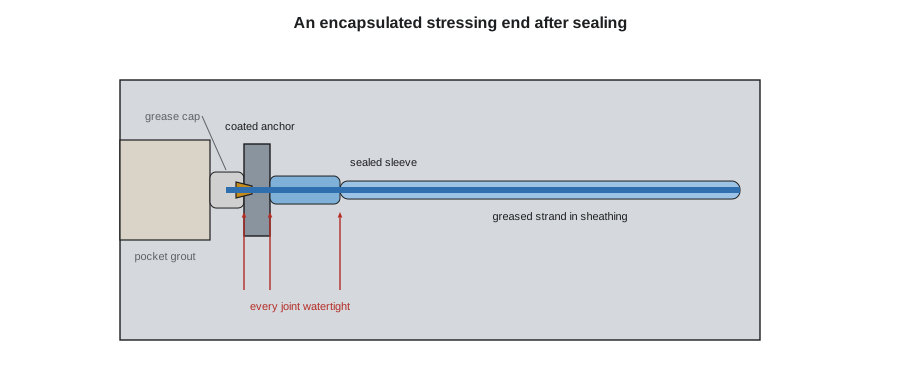
In an encapsulated system, every steel part of the tendon is enclosed in a watertight plastic envelope.
- The sheathing is continuous and undamaged from anchor to anchor.
- At each anchor, a sleeve connects the sheathing to the anchor body, sealed so that water cannot get in where the strand enters.
- The anchors themselves are coated or encased in plastic.
- The fixed-end anchor has its cap fitted in the plant.
- At the stressing end, after the tail is cut, a cap filled with grease is fitted over the wedges and the strand end, with a seal.
- At intermediate anchors and construction joints, the same watertight connections are made on both sides.
An encapsulated system works only if every one of these joints stays sealed. A sleeve pulled off its anchor while the gang works around it, a cap left off, or a tear in the sheathing near an anchor makes the whole tendon vulnerable. On the deck, the rod gang's part is to keep feet, bars and tools off the anchors and sleeves, and to report anything loose.
Sealing the stressing pockets
After stressing and tail cutting, the pocket in the slab edge in front of each stressing anchor must be sealed. The usual sequence is this, and the specification sets the details and the time limit.
- Cut the tail to the length the supplier specifies, without heating the wedges.
- Clean the pocket of dust, oil and loose material.
- Fit the grease-filled cap over the wedges and strand end, pressing it home so that its seal engages.
- Fill the pocket with a non-shrink, non-metallic grout or a patching material free of chlorides, as the specification allows, finished flush with the slab edge and cured.
The time between stressing and sealing matters. While the pockets are open, rain and slush can reach the anchors, so specifications require pockets to be capped and filled within a set number of days after stressing, and the general contractor schedules it like any other activity. At Quarry Point, Stratline will cap the pockets the day after stressing and the general contractor's finishers will grout them within the week.
Grouting bonded tendons
Bonded tendons are protected by the cement grout pumped into their ducts after stressing. The grout fills the space between the strands and the duct, bonds them together, and keeps the strand in an alkaline environment like ordinary concrete does for bars. A duct that is only partly filled is worse than useless: the voids collect water and air, and the strand inside corrodes where nobody can see it. The bridges and transfer girders where bonded tendons are used are exactly the places where such a failure would be most serious.
Grouting follows the project specification and, often by reference, PTI's grouting specification, which set the grout materials, mixing, fluidity tests, temperatures, pumping and venting procedures, and the records.
A typical grouting procedure, done by the post-tensioning supplier's specialist crew, follows these steps.
- Before grouting: check that every duct is sealed, every vent and drain is open, and the anchor caps are fitted. Blow the ducts out with oil-free compressed air to confirm they are clear.
- Mix the grout, usually a prepackaged material, in a colloidal mixer with the specified water, and test its fluidity, often with a flow cone, before pumping.
- Pump from the lowest inlet, usually at one anchor, steadily and without stopping.
- As the grout reaches each vent along the duct, let it run until it comes out with the same consistency as the grout going in, free of air and water, then close that vent and move on.
- When grout flows from the far end, close it and hold the specified pressure for the specified time to make sure the duct is full.
- Record each duct, the grout batch, the test results, the pressures and any problems.
Grouting is not done in freezing weather without precautions, because water in the grout or in the duct can freeze and crack the concrete. Specifications set the minimum temperatures for the concrete, the grout and the air, and how long they must be held. Grout and cement are corrosive to skin and eyes, and mixing powdered grout can release dust containing crystalline silica, so the crew wears eye protection, gloves and, where dust is generated, respiratory protection, as the product's safety data sheet says.
Worked problem
How much grout does a duct take
A bonded tendon has 12 strands of 0.6 in strand (0.217 in² each) in a round duct with an inside diameter of 2-3/4 in and a length of 130 ft. Ignoring the corrugations and the trumpets, how much grout does the duct take?
Show solution
- Duct area = π ÷ 4 × 2.75² = 5.94 in².
- Steel area = 12 × 0.217 = 2.60 in².
- Grout area = 5.94 − 2.60 = 3.34 in².
- Volume = 3.34 × 130 × 12 ÷ 1,728 = 3.01 ft³, about 22.5 gal.
Answer: About 3 ft³, or 22.5 gal, for the duct itself. The crew mixes more than this, because the corrugations, trumpets, hoses and the grout wasted at the vents all take extra, and running out halfway through a duct is not an option.
Protecting bonded ducts before the pour
The rod gang works around bonded ducts on bridges and girders more than around any other part of a bonded system, and most damage to ducts happens then. A dented or crushed duct can stop the strand being pulled through or the grout flowing; a hole lets concrete paste in, which can block the duct. The rules are like those for sheathing: do not walk on or drop bars on ducts, do not use them as supports, keep welding sparks away, and report any dent or hole. Ducts are supported at their profile like tendons, and their couplers and vents are sealed with tape or heat-shrink sleeves before the pour.
Protection over the life of the structure
Protection does not end when the pockets are grouted. In a parking structure, owners maintain the deck with sealers or membranes, keep the drains open and repair cracks and joints, because water reaching the tendons is what shortens their life. Many post-tensioned buildings have warning signs at the entrances or stamped on the slabs, and maintenance plans that require scanning before any drilling, as lesson 9 described. Ruairi's old tendon came from a garage that had none of this.
Protecting the tendons before stressing
Tendons are vulnerable between the pour and stressing too. In the days after a pour, the stressing tails stick out of the slab edges and the pocket recesses are open. Rain and slush can run down the tails into the anchors, and strand tails left in the open for weeks rust where the jack must grip them. Specifications usually limit how long tendons may stay unstressed after placing, and require the tails to be protected with plastic sleeves or tape until stressing. At Quarry Point, the schedule allows no more than a week between each pour and its final stressing, and less in wet weather.
Strand delivered to site must be protected as well. Coils of sheathed tendons are stored off the ground, covered and away from welding, and handled so that the sheathing is not torn on sharp edges or forklift tines. Bonded strand delivered bare for threading into ducts is kept dry and is never stored where it can get wet, because rust on the strand before it is grouted reduces its life.
Inspecting the sealed pockets
After the pockets are capped and grouted, the inspector checks a sample of them, or all of them on some jobs: that every pocket has its cap, that the grout is flush, sound and free of cracks and voids, and that the edge of the slab around the pocket is not cracked. A hollow sound when a pocket is tapped with a hammer means the grout has not bonded, and the pocket is redone. The pockets at the slab edges of a parking structure are where the weather hits first, so the specification may also require a sealer over them.
Bonded tendon records
For bonded tendons, the grouting record is as important as the stressing record. It shows, for each duct, the date, the grout material and batch, the fluidity test results, the air and grout temperatures, the pumping pressure, the vents and the order they were closed, the volume of grout used against the volume expected, and any problems, such as a blocked vent or an interrupted pump. A duct that took much less grout than its volume suggests has voids or a blockage, and the engineer may require it to be investigated, often by drilling small holes at the high points and filling any voids with grout under vacuum. A duct that took much more grout than expected may have leaked into the concrete through a damaged section.
Repairs to protection
Damage to the protection found before the pour is repaired as lesson 8 described: tears in sheathing with the supplier's repair tape, wrapped and overlapped as its procedure says, and loose sleeves reseated and sealed. In an encapsulated system, the supplier's procedure may require a damaged sleeve or cap to be replaced, not taped. After the pour, damage can only be reached by breaking out concrete, which is why prevention matters so much more than repair.
Damage found later in the life of a structure, during a condition survey or repair, is handled by specialist contractors with the engineer's design: exposing the tendon, replacing corroded strand with new strand pulled through the old sheath, or adding new external tendons. The cost of one such repair on an old parking deck is usually many times what full encapsulation would have cost when the deck was built.
Common mistakes
MistakeTreating sheathing tears near an anchor as cosmetic.
InsteadReport and repair every tear; anchors and their sleeves are the most vulnerable points.
MistakeLeaving stressing pockets open for weeks.
InsteadCap and fill pockets within the time the specification sets.
MistakeFilling pockets with ordinary mortar or a patch containing chlorides.
InsteadUse the specified non-shrink, chloride-free material.
MistakeClosing grout vents as soon as grout appears.
InsteadLet grout run until it matches the grout going in, then close the vent.
MistakeGrouting ducts in freezing weather without precautions.
InsteadFollow the specified minimum temperatures and protection.
Summary and key terms
- Highly stressed strand is sensitive to corrosion, and water with salt is the main threat.
- Unbonded tendons rely on grease, sheathing and cover, and their anchors are the weak point.
- Aggressive environments such as parking structures need encapsulated systems, under ACI 423.7, PTI and the specification.
- Stressing pockets are cleaned, capped with grease-filled caps and filled with non-shrink, chloride-free grout within the specified time.
- Bonded ducts are grouted from the low point, venting at each high point until clean grout flows, then held under pressure.
- Grouting has temperature limits and needs protection against cement and silica dust.
- Ducts and sheathing must be protected on the deck before the pour.
- Encapsulated system
- An unbonded tendon system in which every steel part is enclosed in a watertight plastic envelope.
- Sheathing
- The continuous plastic tube around a greased strand.
- Grease cap
- A cap filled with grease fitted over the wedges and strand end at an anchor.
- The recess in the slab edge in front of a stressing anchor.
- Grout
- A fluid cement mixture pumped into the ducts of bonded tendons.
- Vent
- A tube from a duct that lets air and water out during grouting and shows when grout has arrived.
- Flow cone
- A test device that measures the fluidity of grout by how long it takes to run out.
Practice problems
Work each problem on paper first, then reveal the answer to check.
A duct has an inside area of 4.5 in² and holds 1.8 in² of strand over 80 ft. How much grout?
Show answer
(4.5 − 1.8) × 960 ÷ 1,728 = 1.5 ft³.
Where is grout pumped into a duct?
Show answer
From the lowest inlet, usually at one anchor.
What is fitted over the wedges before a pocket is filled?
Show answer
A grease-filled cap.
Why are parking structures treated as aggressive environments?
Show answer
De-icing salts carried in by cars reach the slabs.
When is a vent closed during grouting?
Show answer
When the grout coming out matches the grout going in.
Lesson quiz · 5 questions
Score 60% or more to complete this lesson.
Create a free account to save your progress, take quizzes and earn a certificate.