
IRW-130 · Lesson 6 of 12 · 23 min
Tying methods and tie wire
▶ Video coming soon A video version of this lesson is on the way.
Renata Haugen, the journeyworker who runs most of the tying on Tobias's gang, came to rod school on Monday, November 9, with a reel of wire on her belt, a pair of pliers, a battery tier and a stopwatch. She built a small mat of bars on two sawhorses and had each apprentice tie twenty intersections with plain snap ties while she timed them. Shay took just under two minutes. She took thirty seconds. Then she stood on the mat and rocked it from side to side. Three of Shay's ties slid; none of hers moved. "Fast is nice," she said. "Tight is the job. Fast comes later, by itself."
This lesson covers the purpose of ties, tie wire, the hand tools and battery tiers used to tie, the common types of tie and where each is used, how many intersections are tied, and how to tie all day without wrecking your hands and back.
What ties do and do not do
Tie wire holds bars in position until the concrete has set around them. It keeps bars at the right spacing, holds them to their supports, fixes laps together and holds cages and mats together while they are lifted, walked on and buried in concrete. Once the concrete has hardened, the ties have no structural job at all; the concrete holds the bars. A tie is a construction aid, and a broken tie after the pour is harmless.
That does not make tying unimportant. A mat that comes apart under foot traffic, a cage that racks when it is lifted, or a top bar that slides along its chairs during the pour puts steel in the wrong place, and the wrong place stays forever. The quality of tying is judged by whether the steel is still exactly where it was placed when the concrete covers it.
Tie wire
The standard tie wire is soft black annealed wire, commonly 16 gauge, about 1/16 in thick, supplied on reels that clip onto the worker's belt or in bundles of pre-cut lengths. Annealing makes the wire soft enough to twist tightly without breaking. Heavier wire, 15 or 14 gauge, is used for heavy cages and for bars that will be lifted. Epoxy-coated and galvanized bars are tied with coated or galvanized wire, so that bare steel wire does not damage the coating or start corrosion, and stainless bars are tied with stainless wire. The wire is part of the steel inside the concrete, and its ends count when cover is checked.
Tie wire tails, the twisted ends, must be bent inward, away from the concrete surface. A tail pointing at the form becomes a rust stain on the finished face and a path for water into the slab. In a slab that will be exposed to weather or salt, a tail that reaches into the cover is treated as a defect.
Tools
- Lineman's style tying pliers, sometimes called nippers, with a long handle and a sharp cutter: the traditional tool. The ironworker wraps the wire, grips the two ends and twists by rolling the pliers in the hand, then cuts the wire from the reel in one motion.
- Wire twisters, a spinning hook pulled like a drill handle, used with pre-cut looped ties. They twist quickly with less wrist motion.
- Battery tiers, cordless tools that wrap and twist a tie in about a second when pushed against an intersection. Some are made with long extensions so that slab mats can be tied standing upright. They are expensive, need their own spools and must be used at the right setting so that ties are tight but not snapped.
Tools are chosen for the job. A battery tier on a long stand-up handle is the best friend of anyone tying a big slab mat. Pliers are still needed for heavy ties, awkward corners, cages and repairs.
Types of tie
Rodbusters use a handful of standard ties. Each holds the bars differently, and the right one depends on the load the intersection will see.
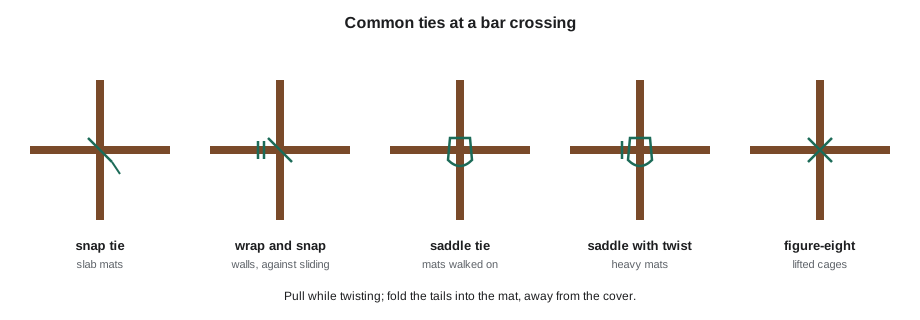
- Snap tie, also called a single tie or simple tie: one wrap diagonally around the crossing, twisted. The fastest tie, used for slab mats on chairs where the bars will not see much movement. It holds the bars together but lets them pivot.
- Wrap and snap tie: a snap tie with an extra full wrap around one of the bars. It stops the bars sliding and is used for wall mats and anywhere the bars must hold their spacing against a push.
- Saddle tie, also called a U-tie: the wire passes under one bar, up around the other and is twisted on top. It holds the bars tight to each other and to the support and is used where workers will walk on the mat and where bars must not lift off their chairs.
- Saddle tie with a twist: a saddle tie with the wire given an extra turn around one bar. It is used in heavy mats and cages that will be lifted or worked on.
- Figure-eight tie: the wire crosses the intersection in both directions. It is the strongest common tie and is used on cages and mats that are lifted by crane and on heavy bars.
Laps are tied with snap or wrap ties at each end of the lap and at intervals along it. Bars on supports are tied to the supports so that the supports cannot fall over or slide.
How many intersections to tie
Not every crossing in a mat needs a tie. Industry guidance and most specifications allow the field of a slab mat to be tied at every second or every third intersection, provided the perimeter is tied at every crossing and the mat holds its shape under traffic. Mats that will be walked on heavily, mats in walls, cages that will be lifted and bars around openings need more ties. Crossbeam's standard for slab mats is every crossing around the perimeter and every second crossing in the field, staggered like a checkerboard, unless the specification asks for more.
Worked problem
Ties in a slab mat
A layer of a slab mat covers a 30 ft by 30 ft bay with #5 bars at 12 in each way. Using Crossbeam's standard, how many ties are needed for one mat (two layers), and roughly how much wire if each tie uses 1 ft?
Show solution
- Bars each way = 360 ÷ 12 + 1 = 31.
- Crossings = 31 × 31 = 961.
- Perimeter crossings = 4 × 31 − 4 = 120, all tied.
- Field crossings = 961 − 120 = 841; every second one = 421 (rounded up).
- Ties = 120 + 421 = 541; wire ≈ 541 × 1 = 541 ft.
Answer: About 541 ties and about 541 ft of wire for the bay. With top and bottom mats, double it. At four seconds a tie by hand, 541 ties take about 36 minutes of steady tying; with a battery tier at about a second a tie, about 9 minutes, plus moving time.
Tying technique
Renata teaches the snap tie in five motions: pull a tail of wire from the reel with the pliers, pass it diagonally around the crossing, bring the end back to meet the wire from the reel, grip both with the pliers and twist two or three full turns while pulling slightly, then cut and fold the tail down. The pull while twisting is what makes the tie tight. A tie that is twisted without tension is loose before it is finished.
Over-twisting snaps the wire, which then has to be redone. Under-twisting leaves a tie that slides. The right tie is snug enough that the two bars cannot move against each other by hand, with two or three tight turns and no more. On a battery tier, the setting is chosen on a test crossing at the start of each shift, and the ties are checked by hand every so often.
Ties should all point the same way in a mat, tails folded down into the mat, so that the next layer sits flat and nobody's boots or knees catch the ends. In walls, the tails point into the wall, away from both faces.
Tying cages and mats that will be lifted
Column cages, beam cages, wall mats and footing mats are often tied flat on the ground or on horses and then lifted into place with the crane, as IRW-120 described. A lifted cage carries its own weight on its ties, and if the ties fail, the cage racks, collapses or drops bars. Cages for lifting get heavier ties, figure-eight or saddle ties with twists at the corners and at the pick points, temporary diagonal bracing bars, and pick points chosen by the foreperson or shown on a lift plan. Never lift a cage from a single bar or a single tie, and never pick a cage from its ties; the slings go around main bars at tied, braced points.
Ergonomics: tying all day
Tying is repetitive work, and the injuries that come from it are slow: sore wrists and elbows from twisting, back strain from bending over slab mats for hours, and knee damage from kneeling on bars. Rodbusters have among the highest rates of back and hand injuries in construction. The fixes are known.
- Use battery tiers with long stand-up handles on large slab mats so that tying is done upright.
- Rotate tasks through the day, so that no one ties bent over for a whole shift.
- Kneel on proper knee pads or a kneeling board, not on the bars.
- Keep the reel on the belt where it can be reached without twisting, and keep pliers sharp so that cutting does not take extra force.
- Report numbness, tingling or pain in the hands early; it is far easier to treat early.
Crossbeam bought stand-up battery tiers for the rod gang in 2025, and Tobias's crews now tie most large mats standing. Back complaints in the gang dropped noticeably the next season.
Tying in walls and columns
Wall mats stand vertically, so their bars carry their own weight on the ties. Horizontal bars are tied to the verticals with wrap and snap ties or saddle ties, so that they cannot slide down. The first horizontal at the bottom and every few rows up are tied at every crossing; in between, the specification or Crossbeam's standard allows every second or third crossing. Where a worker will climb a scaffold beside the mat and lean against it, more ties are added.
Column ties are tied to every vertical bar they pass, at every tie, because the ties hold the verticals in their pattern and a slipped tie leaves a vertical bar free to bow out. Tie hooks are turned into the core and tied down so that they cannot spring open when concrete is placed.
Tying laps, dowels and supports
At a lap, the two bars are tied together near each end of the lap and at intervals along it, so that the lap length cannot shrink if one bar is pushed. Dowels are tied to the mat they hook onto and to their template at the top. Bar supports are tied to the bars that sit on them, so that the support cannot fall over when someone steps on the mat. These ties are easy to forget, and an inspector looks for them.
Worked problem
Wire for a wall panel
A wall panel has two mats, each with 25 verticals and 11 horizontals. Every crossing around the edge of each mat is tied, and every second crossing inside. How many ties are needed, and how much wire at 1 ft a tie?
Show solution
- Crossings per mat = 25 × 11 = 275.
- Edge crossings = 2 × 25 + 2 × 11 − 4 = 68.
- Inside = 275 − 68 = 207; every second = 104 (rounded up).
- Ties per mat = 68 + 104 = 172; two mats = 344.
- Wire ≈ 344 × 1 = 344 ft.
Answer: About 344 ties and 344 ft of wire, before the ties for laps, spacers and the ties between the two mats.
Renata's practice drill ends every session the same way: twenty ties, timed, then the stand-on test. By the end of the fall, Shay's twenty ties took under a minute, and none of them slid.
Battery tiers need care too: the spool loaded the right way, the nose kept clean of concrete, batteries charged overnight and the tool checked on a test crossing each morning. A tier that ties loose ties all day is worse than no tier at all.
Common mistakes
MistakeTwisting a tie without pulling it tight.
InsteadPull while twisting; the tension makes the tie tight.
MistakeLeaving tie tails pointing at the form or the top surface.
InsteadFold tails inward, away from the cover.
MistakeTying only the field of a mat and skipping the edges.
InsteadTie every perimeter crossing and the field as specified.
MistakeLifting a cage by its ties or by one bar.
InsteadRig around main bars at braced, tied pick points with heavier ties.
MistakeTying bent over a mat all shift.
InsteadUse stand-up tiers, rotate tasks and use knee pads.
Summary and key terms
- Ties hold bars in place until the concrete sets; they have no structural job afterward.
- Standard wire is 16 gauge black annealed; coated or stainless bars need matching wire; tails fold away from the cover.
- Snap ties for slab mats, wrap and snap for walls, saddle ties where mats are walked on, figure-eight and twisted saddles for lifted cages.
- Tie every perimeter crossing and every second or third in the field, or as specified.
- Pull while twisting; two or three tight turns.
- Lifted cages need heavier ties, bracing and planned pick points.
- Stand-up tools, rotation and knee pads protect backs, hands and knees.
- Tie wire
- Soft annealed wire used to hold bars together at crossings.
- Snap tie
- A single diagonal wrap twisted at a crossing; the fastest tie.
- Wrap and snap tie
- A snap tie with an extra wrap around one bar to stop sliding.
- Saddle tie
- A tie passing under one bar and around the other, holding them tight together.
- Figure-eight tie
- A tie crossing the intersection in both directions; the strongest common tie.
- Battery tier
- A cordless tool that wraps and twists a tie automatically.
- Tail
- The twisted end of a tie.
Practice problems
Work each problem on paper first, then reveal the answer to check.
A bay has 21 bars each way. How many perimeter crossings are there?
Show answer
4 × 21 − 4 = 80.
Which tie is used for a cage that will be lifted?
Show answer
A figure-eight tie or a saddle tie with a twist.
What wire is used on epoxy-coated bars?
Show answer
Coated tie wire.
Which way do tie tails point in a wall?
Show answer
Into the wall, away from both faces.
Does tie wire carry load after the concrete sets?
Show answer
No; the concrete holds the bars.
Lesson quiz · 5 questions
Score 60% or more to complete this lesson.
Create a free account to save your progress, take quizzes and earn a certificate.