
IRW-130 · Lesson 11 of 12 · 25 min
Inspection before the pour
▶ Video coming soon A video version of this lesson is on the way.
At Harrow Square, on the morning of Thursday, June 11, 2026, the special inspector from the testing agency walked the level 1 ramp with Tobias, and Leona Fitzgerald from Fenwick Structural joined them, ninety minutes before the first concrete truck was due. Halfway down the ramp the inspector stopped, pushed a steel rule down beside a top bar, read it and pushed it down again a meter away. The top cover was 1-3/4 in where the drawings called for 2-1/2 in. The high chairs under the top mat had been set for the flat deck, and on the curved ramp they were one size too tall. The pour was held for three hours while the gang replaced 140 chairs. "Three hours of my crew," Tobias told the apprentices, "against thirty years of salt on that ramp. That is a cheap three hours."
This lesson covers the inspection of reinforcing before concrete is placed: who inspects, what they check, how the rod gang prepares, how tolerances are applied, and how exposed bars are protected so that the inspection itself is safe.
Who inspects
Several people look at the steel before a pour, and each has a different role.
- The rod gang's foreperson checks every area against the placing drawings first. This is the inspection that matters most, because it is done by the people who know the steel best and can fix it fastest.
- The general contractor's superintendent or field engineer checks that the steel, embeds, sleeves and forms are ready and coordinates the pour.
- A special inspector, employed by the owner through a testing agency, inspects reinforcing placement where the building code requires special inspection, which it does for most reinforced concrete buildings, and reports to the building official and the engineer of record.
- The municipal building inspector may inspect footings and other stages as the permit requires.
Each inspection needs notice. Tobias's gang calls for inspection only when an area is complete and has passed his own check, and the general contractor books it with enough time for corrections before the trucks are ordered.
What gets checked
Inspectors work from the reviewed placing drawings and the structural drawings, and they check the same things in every area. Crossbeam's pre-pour checklist follows the same order.
| Item | What is checked |
|---|---|
| Bar size and grade | Tags and mill marks match the drawings; no mixed grades. |
| Count and spacing | Number of bars and spacing within tolerance; end bars at the cover. |
| Position and layer | Top, bottom, each face and outer layer as shown in the sections. |
| Cover | Distance to every face, including to stirrups, ties and tie wire tails. |
| Laps and hooks | Lap lengths from the schedule, in the right places, tied; hooks facing the right way. |
| Supports and ties | Right type, class and height; spaced and tied; mats firm under foot. |
| Dowels and embeds | Dowels at the right projection and location; embeds, sleeves and blockouts as shown and clear of bars. |
| Openings and edges | Trim bars, corner bars, edge bars and steps as detailed. |
| Cleanliness | No mud, oil, form release, loose scale or debris on bars; forms clean. |
| Coated bars | Coating damage repaired; coated supports and wire used. |
| Safety | Caps or troughs on protruding bars; walk boards; guardrails and covers in place. |
Checking spacing and counts
Spacing is checked by measuring across a group of bars and dividing by the number of spaces, not by measuring one gap. One gap may be off by a bar diameter; the average over ten spaces shows whether the bars are right.
Worked problem
An average spacing check
An inspector counts 12 bars across a distance of 11 ft, measured from the first bar to the last. The drawings call for bars at 12 in. Is the spacing right?
Show solution
- Spaces = 12 − 1 = 11.
- Average spacing = 132 in ÷ 11 = 12 in.
Answer: Yes: 12 in on average. If the same 12 bars had covered 12 ft, the average would be about 13.1 in, and a bar would be missing.
Checking cover against the tolerance
Cover is measured with a steel rule pushed down beside the bar to the form, or across from the form face to the outermost bar, at many points. ACI 117 allows a tolerance of plus or minus 1/2 in in members deeper than 8 in, but the cover may not be reduced by more than one third of the specified cover; whichever limit is tighter governs. The specification may tighten it further.
Worked problem
Is the cover acceptable?
The specified top cover on a 10 in slab is 2-1/2 in. Readings along a ramp are 2-5/8, 2-3/8, 2 and 1-3/4 in. Which readings pass?
Show solution
- One third of 2-1/2 in is about 0.83 in, and the depth tolerance is 1/2 in; the tighter limit is 1/2 in.
- Minimum allowed cover = 2.5 − 0.5 = 2 in.
- 2-5/8, 2-3/8 and 2 in pass; 1-3/4 in fails.
Answer: Three pass and one fails. The low reading is not averaged away; that area is corrected until every reading meets the limit. On Harrow Square, the whole ramp was re-chaired.
Too much cover is also a defect. A top mat that sags on too few chairs, or bottom bars propped too high, puts the steel closer to the middle of the slab than the design assumed. Cover is checked in both directions.
Cleanliness and condition
Bars must be clean when the concrete covers them. Mud tracked onto bars from the excavation, oil from equipment, form release sprayed onto the steel, ice and snow, and loose flaking rust all reduce bond. Light, tight rust that does not come off with a rub of the hand is acceptable and even improves bond. Heavy scale that flakes off, or bars that have lost section from rust, are shown to the engineer. The gang cleans bars with a wire brush, water or air as needed, and form release is applied before the steel is placed, never after.
Coated bars are checked for coating damage from handling and walking. The specification usually allows small damaged areas to be repaired with the patching material the coater supplies, and limits how much damage is acceptable before a bar must be replaced. Coated bars are covered in IRW-220.
Holding the pour
Anyone who finds a problem in the steel can and should ask for the pour to be held. Holding a pour costs money: the concrete trucks, the pump, the finishing crew and the schedule. Pouring over a problem costs far more, because the cost of fixing buried steel, by coring, chipping out concrete or adding strengthening, runs into many times the cost of the delay, and some problems cannot be fixed at all. Crossbeam's rule is that nobody on the rod gang is ever criticized for raising a concern before a pour, even if it turns out to be nothing.
When a problem is found, it is fixed and re-checked, and the fix is recorded. For anything other than a simple correction back to the drawings, such as a missing bar that cannot be placed, a bar that will not fit or a different size used by mistake, the engineer decides what to do, and the decision is in writing before the pour goes ahead.
Records
Tobias photographs every area before inspection with the gridlines visible, notes the date and the drawing revision, and keeps the inspection reports and any engineer's instructions in the job file. On Harrow Square the photographs paid for themselves twice: once when the owner's consultant asked a year later what steel was in a beam that was being cored for a pipe, and once when a dispute about extra work was settled by a picture of the bars as they were placed.
Safe inspection: protecting exposed bars
Inspections bring people onto mats and around exposed bars who do not spend every day on steel. The protection that keeps rodbusters safe keeps inspectors safe too, and it must be in place before anyone is invited onto the work.
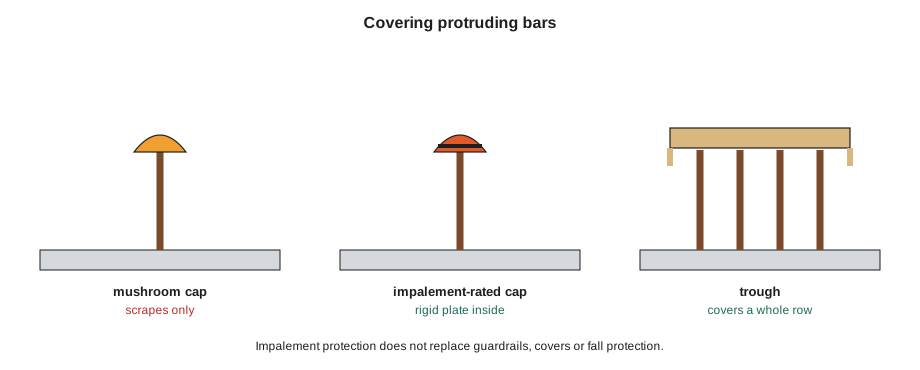
OSHA 1926.701(b) requires protruding reinforcing steel onto and into which employees could fall to be guarded to eliminate the hazard of impalement. OSHA has said that standard plastic mushroom caps do not provide impalement protection; they protect against scrapes and cuts, and in tests they did not stop a falling weight from being impaled. Where anyone could fall onto bars, Crossbeam uses caps with steel plates molded into them that are rated by their maker for impalement, or wooden troughs over whole rows of bars, and first of all prevents the fall with guardrails, covers and fall protection.
Preparing for the inspector
Inspections go faster and find fewer problems when the rod gang prepares for them. Before calling for inspection, Tobias's gang does five things. The foreperson walks the area with the placing drawings and the checklist and fixes anything found. The gang cleans the area of offcuts, tie wire scraps, loose chairs and debris, which otherwise end up in the concrete. Walk boards are laid on the main routes so the inspector does not have to walk on chairs. A set of the current reviewed drawings, the lap schedule and the bar lists for the area are ready at the work. And the protruding bars are capped and the edges protected, so that the inspection itself is safe.
An inspector should never be the one who finds that an area is not finished. Calling for inspection before the steel is complete wastes the inspector's time, and repeated early calls make every later inspection slower and stricter.
Reading the inspection report
After each inspection, the inspector issues a report: what was checked, what was found, what must be corrected and whether the pour may proceed. Items may be marked as corrected on site, to be corrected before the pour, or referred to the engineer. The foreperson reads every report, makes sure every item is closed, and keeps it in the job file. Repeated findings of the same kind, such as low cover on slab edges or missing ties at laps, are a sign that the gang's own method needs changing, not just the steel in that area.
Worked problem
Counting chairs to correct cover
A section of a parking deck 100 ft long and 8 ft wide has top mat high chairs at 4 ft each way, and all of them are found to be one size too tall. How many chairs must be replaced?
Show solution
- Along the length: 100 ÷ 4 = 25 spaces, so 26 rows.
- Across the width: 8 ÷ 4 = 2 spaces, so 3 lines.
- Chairs = 26 × 3 = 78.
Answer: 78 chairs. On a ramp of that size the gang would also re-tie the mat to the new chairs and re-check the cover at many points before calling the inspector back.
During the pour
Inspection does not end when the first truck arrives. During the pour, a rodbuster on the deck watches for bars pushed out of place by the pump hose, chairs knocked over, top mats walked down and dowels bumped out of line, and fixes them ahead of the concrete. The pour crew is told where the rodbuster is working, and the rodbuster stays out of the way of the hose and the screed. Anything that cannot be fixed ahead of the concrete is reported to the foreperson at once, so that the pour can be paused before the problem is buried.
When the pour is finished, the dowels and bars left projecting for the next pour are cleaned of concrete splatter before it hardens, checked for position and capped again.
When the inspector and the drawings disagree
Now and then an inspector asks for something that is not on the drawings, such as an extra bar, a different lap or a longer hook, or reads a detail differently from the way the gang placed it. The rod gang does not argue on the deck and does not quietly change the steel either. The foreperson shows the inspector the drawing and the detail the gang worked from, and if they still disagree, the question goes to the engineer, who designed the steel and decides. The answer is recorded in writing. Most of these questions turn out to be a revision one person had and the other did not, which is one more reason to check revisions every morning.
Inspectors are on the same side as the rod gang: both want the steel right. Tobias's advice to apprentices is to walk with the inspector when they can, ask what they are looking for and why, and learn from every finding. "Every inspector I have walked with taught me something," he said. "Some of them taught me twice."
Common mistakes
MistakeChecking spacing by measuring one gap.
InsteadMeasure across a group of bars and divide by the number of spaces.
MistakeAveraging a low cover reading with good ones.
InsteadEvery reading must meet the limit; correct the low area.
MistakeApplying form release after the steel is placed.
InsteadApply form release before the steel goes in, and keep bars clean.
MistakePouring over a problem to keep the schedule.
InsteadHold the pour, fix it and get the engineer's decision in writing if needed.
MistakeInviting inspectors onto mats with uncapped dowels around.
InsteadPut impalement protection, walk boards and guardrails in place first.
Summary and key terms
- The foreperson's own check comes first; the general contractor, the special inspector and the building inspector follow.
- Check size, grade, count, spacing, position, cover, laps, hooks, supports, ties, dowels, embeds, openings, cleanliness, coatings and safety.
- Check spacing over a group of bars; check cover at many points against the tolerance, in both directions.
- Light tight rust is fine; mud, oil, form release and flaking scale are not.
- Anyone may ask to hold a pour; buried mistakes cost far more than delays.
- Photograph and record each area; protect protruding bars against impalement and prevent falls.
- Special inspection
- Inspection required by the building code and carried out by a special inspector employed for the owner.
- Holding a pour
- Delaying concrete placement until a problem is corrected.
- Tolerance
- The allowed variation from the specified position or cover.
- Impalement-rated cap
- A bar cap with a rigid plate, rated by its maker to stop a falling worker from being impaled.
- Mushroom cap
- A plastic cap that protects against scrapes but not against impalement.
Practice problems
Work each problem on paper first, then reveal the answer to check.
Ten bars span 9 ft from first to last. What is the average spacing?
Show answer
108 ÷ 9 = 12 in.
Specified cover 2 in on a deep member. What is the minimum under ACI 117?
Show answer
One third of 2 in is about 0.67 in, the tolerance is 1/2 in; minimum 1-1/2 in.
Is light, tight rust on bars a problem?
Show answer
No; flaking scale and loss of section are.
When is form release applied?
Show answer
Before the steel is placed.
Do mushroom caps protect against impalement?
Show answer
No; use impalement-rated caps or troughs and prevent the fall.
Lesson quiz · 5 questions
Score 60% or more to complete this lesson.
Create a free account to save your progress, take quizzes and earn a certificate.