
INS-340 · Lesson 8 of 12 · 20 min
Cover materials and high-temperature fabrics
▶ Video coming soon A video version of this lesson is on the way.
When Tessa Moreau visited Pellam Thermal Covers with Tomasz Nowicki in June 2026, the first thing Ferris Quade showed her was not a sewing machine but a rack of rolls: gray, white, tan and dark blue fabrics, needled mats in several thicknesses, rolls of stainless steel wire mesh and boxes of thread and hardware. "Pick the wrong one of these and the cover falls apart in a year," he said. "Pick the right ones and it outlasts the valve." This lesson covers the layers of a removable cover, the fabrics, mats and barrier materials used in each, their typical temperature limits, and how to choose them for hot, outdoor, food plant, chemical and acoustic service.
The layers of a cover
A flexible removable cover is built like a quilt, usually with three layers:
- Inner jacket (hot face). The fabric against the hot surface. It must survive the full operating temperature, and the highest temperature the item can reach, without breaking down.
- Insulation mat. The filling that does the thermal work, sewn or pinned between the jackets so it cannot slide.
- Outer jacket (cold face). The fabric outside, which must resist the environment: weather, sunlight, water, oil, chemicals, washdown, abrasion and handling.
Acoustic covers add a barrier layer, and cold covers a vapor retarder, each placed where its own temperature limit and function require. Covers for very hot or abrasive service often add a stainless steel wire mesh liner on the hot face, which holds the mat in place and resists heat and wear.
Fabrics
Most cover fabrics are woven glass fiber, which does not burn and keeps its strength to high temperatures, with or without a coating. The coating sets how the fabric resists water, chemicals and wear, and usually limits the temperature of that face. Typical continuous limits, which vary by product, are:
| Fabric (typical) | Typical limit | Typical use |
|---|---|---|
| Silicone-coated glass fabric | 500 °F | Outer jacket for general industrial and outdoor use; flexible, water-resistant, takes stitching well |
| PTFE-coated glass fabric | 500 °F | Outer jacket where chemicals, oils, UV or washdown are present; slick surface sheds dirt |
| Uncoated or texturized glass cloth | 1,000 °F | Inner jacket on hot surfaces; not water-resistant |
| Vermiculite-coated glass fabric | about 1,500 °F | Inner jacket and heat shields at higher temperatures |
| High-silica cloth | about 1,800 °F | Inner jacket on very hot items such as turbine casings and exhaust |
| Stainless steel knitted wire mesh | above 1,000 °F (by alloy) | Hot-face liner to hold mat and resist abrasion |
| Vinyl-coated polyester or similar | about 210 °F | Indoor commercial covers on warm water and low-temperature lines only |
The outer fabric runs much cooler than the hot face, because the mat drops the temperature, so a silicone or PTFE outer jacket is fine on a cover for a steam valve at 366 °F, and often on much hotter items. The inner jacket faces the full temperature, so on Kellerton's steam the inner fabric is uncoated glass cloth, and the stainless mesh liner is added only on items that get handled roughly or exceed the cloth's limit.
Color matters too. Many fabricators offer several colors, and plants use them to tell services apart, or to make dirt and contamination visible in food areas. Kellerton specifies a light gray outer jacket in the boiler house and a white PTFE outer jacket in processing areas.
Insulation mats
| Mat (typical) | Typical limit | Notes |
|---|---|---|
| Glass fiber needled mat | 1,000 °F | The most common filling; no binder, so no smoke or odor at first heat-up |
| Mineral wool blanket | about 1,200 °F | Higher temperature than glass; some products have binders that burn off |
| High-silica needled mat | about 1,800 °F | For very hot service |
| Alkaline earth silicate (AES) or refractory ceramic fiber (RCF) blanket | 2,000 °F and higher | For extreme temperatures; RCF needs the controls INS-230 described, and many users prefer AES |
| Aerogel blanket | about 1,200 °F for high-temperature grades | Thin covers where space is tight; dusty to cut; check the maker's handling rules |
Mat thickness is set by the heat loss and surface temperature required, as INS-410 will calculate in detail; 1 to 2 in is common on steam fittings, often in two layers so that the seams do not line up. Needled mats are made by punching the fibers together with barbed needles, which holds them without binder, so they do not give off smoke when first heated. Mats with organic binders can smoke and smell at first start-up, which in a food plant can trigger a complaint or an alarm.
Barriers and vapor retarders in covers
Acoustic covers need a barrier layer, which is usually mass-loaded vinyl or a similar loaded sheet with a limited temperature range, or for hot service a high-temperature loaded fabric or a heavy mat. Because the barrier must stay within its limit, its position in the cover is a design decision, worked out from the temperature drop through the mat.
Worked problem
Where does the barrier go?
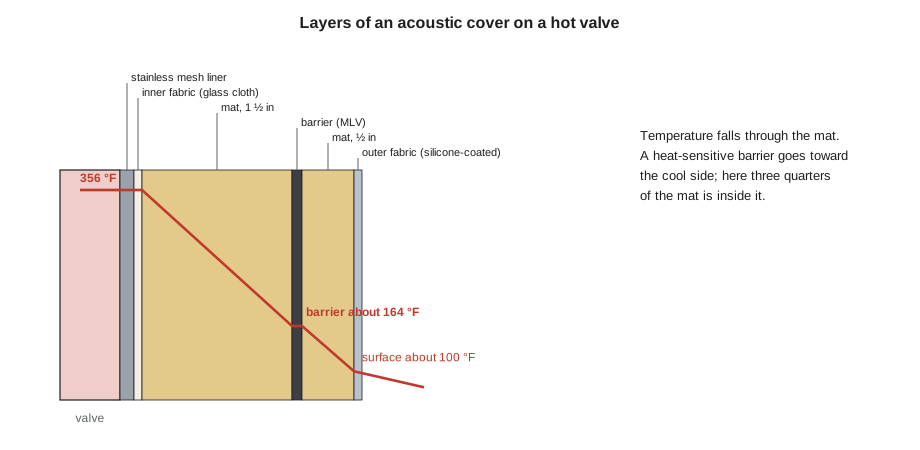
An acoustic cover for a valve at 356 °F has 2 in of mat in total, with a barrier layer whose limit is about 175 °F. Taking the mat's thermal conductivity as 0.31 Btu·in/(h·ft²·°F), the outside surface resistance as 0.57 h·ft²·°F/Btu and the room at 77 °F, estimate the barrier temperature if it sits halfway through the mat, and if it sits with three quarters of the mat inside it.
Show solution
- Halfway (1 in inside, 1 in outside): mat resistances = 1 ÷ 0.31 = 3.23 h·ft²·°F/Btu each; total = 3.23 + 3.23 + 0.57 = 7.03.
- Heat flow = (356 − 77) ÷ 7.03 = 39.7 Btu/(h·ft²).
- Barrier temperature = 356 − 39.7 × 3.23 = 227.8 °F: too hot.
- Three quarters inside (1 ½ in inside, ½ in outside): resistances 4.84 and 1.61; total = 4.84 + 1.61 + 0.57 = 7.02; heat flow = 279 ÷ 7.02 = 39.7 Btu/(h·ft²).
- Barrier temperature = 356 − 39.7 × 4.84 = 163.7 °F: within the limit.
Answer: With the barrier halfway, it would run at about 228 °F and soften; with three quarters of the mat inside it, about 164 °F. The outer surface is about 100 °F either way. This simple flat-layer estimate ignores the curvature of the item, which a full calculation would include.
On Compressor No. 5 the discharge valves and flanges ran at about 175 °F, so the barrier temperature was not a concern: Pellam built those covers with 1 in of glass fiber mat inside, then a layer of MLV, then a further ½ in of mat and the outer jacket, giving both decoupling and absorption on each side of the barrier.
Cold covers need a vapor retarder on the warm, outer side, with the overlaps and closures sealed. In practice this means closed-cell or sealed constructions, overlapping flaps with sealing strips, and careful fitting. Many designers avoid removable covers on lines colder than a few degrees below freezing, as lesson 6 noted.
Choosing materials for the service
ASTM C1695 groups hot-service blankets into three categories, which are a useful way to think about any cover:
- Industrial. Plant service, with weather resistance, chemical resistance or both, up to about 1,000 °F under the standard.
- Outdoor commercial. Outdoor service on commercial systems, needing weather resistance.
- Indoor commercial. Indoor heating and plumbing systems, such as steam and hot water in buildings, needing neither weather nor chemical resistance, limited to about 500 °F.
Beyond that, the conditions of each location point to particular choices:
| Condition | Typical choices |
|---|---|
| Outdoors | Silicone- or PTFE-coated outer jacket; seams and flaps arranged to shed water; drain grommets at low points; UV-resistant thread |
| Washdown and food areas | PTFE-coated outer jacket in a light color; sealed, smooth seams; no loose fibers; stainless hardware; no hook-and-loop where it traps dirt |
| Oil and chemical exposure | PTFE-coated outer jacket; closures that let leaks show and drain |
| Very hot surfaces | High-silica or vermiculite-coated inner jacket, stainless mesh liner, high-temperature mat |
| Rough handling or abrasion | Heavier outer fabric, stainless mesh liner, reinforcing patches at straps and lifting points |
| Acoustic service | Barrier layer placed within its temperature limit, decoupled by mat on the inside; sealed overlaps |
The specification usually names the categories and, sometimes, the exact fabrics. When it does not, the insulator gives the fabricator the conditions and lets the fabricator propose materials, then checks the proposal against the data sheets. For the PRV station covers, Pellam's proposal was silicone-coated glass outside in light gray, uncoated texturized glass cloth inside, 1 ½ in of needled glass fiber mat, glass fiber thread with a PTFE coating, and stainless steel hardware. Raj checked each data sheet against the 366 °F steam and approved it.
Materials to avoid
- Organic fabrics such as cotton canvas and nylon on hot surfaces; they char and can burn.
- Thread with a lower limit than the fabrics. A cover is only as hot-rated as its thread; lesson 9 covers thread.
- Mats with binders in areas sensitive to smoke or odor, unless they are heated out first.
- Galvanized or plated hardware on hot covers in some services, where the coating can flake or, on austenitic stainless steel at high temperature, cause problems; stainless hardware is the usual choice.
- Chloride-bearing materials against austenitic stainless steel at the temperatures where stress corrosion cracking can occur, as INS-220 explained; inner jackets and mats for stainless items should be suitable for stainless steel.
A worked material selection
When Wendell sent Pellam the information for the Compressor No. 5 covers, he listed the conditions, and Ferris proposed the materials. The reasoning shows how the choices follow from the service:
| Condition | Choice | Reason |
|---|---|---|
| Surface about 175 °F, ammonia engine room, indoors | Uncoated glass cloth inner jacket | Ample temperature margin; no coating needed against the surface |
| Acoustic covers on lagged line | MLV barrier between two layers of mat | Decouples the barrier from the valve and absorbs on both sides |
| Oil mist from the compressor package, washdown of the floor nearby | Silicone-coated glass outer jacket | Resists oil and water and wipes clean |
| Ammonia atmosphere | Stainless steel hardware, no copper or brass | Ammonia attacks copper alloys |
| Overlap onto lagging jacket | End skirts with drawstrings and a barrier strip | Seals the joint acoustically while staying removable |
The ammonia point is easily missed. Copper and its alloys, including brass and bronze, corrode in ammonia, so brass grommets, snaps or buckles, which some fabricators use on light covers, would have gone green and failed in the engine room. Ferris used stainless steel throughout, as he does for all industrial covers.
Fire, smoke and food safety
In buildings and some plants, the outer materials of a cover may need to meet surface burning limits for flame spread and smoke, like other insulation materials in plenums and exposed spaces. Glass fabrics and mats are noncombustible or have low ratings, but some coatings and barrier layers add to the smoke rating. The fabricator's data sheets show the tested values, and the specification or the building code sets the limits.
In food plants, the plant's sanitation rules may add more: no loose fibers that could reach the product, materials that do not shed, colors that show dirt, and covers that can be wiped down with the plant's cleaning chemicals without breaking down. Kellerton's sanitation lead approves the outer fabric for any cover in a processing area before it is ordered; she is the same person who inspected the blancher tank jacket in INS-310.
Common mistakes
MistakeChoosing the outer fabric for the full process temperature and the inner for the environment.
InsteadThe inner jacket faces the heat; the outer jacket faces the environment. Choose each for its own conditions.
MistakePutting a vinyl barrier against the hot face of an acoustic cover.
InsteadPlace the barrier where the temperature through the mat keeps it within its limit.
MistakeUsing hook-and-loop and rough seams in a washdown area.
InsteadUse smooth, sealed seams and cleanable, light-colored PTFE jackets with stainless hardware.
MistakeUsing a mat with binder on a cover for a food area.
InsteadUse needled mats without binder, or heat binder-bearing mats out before use.
MistakeApproving a fabricator's proposal without data sheets.
InsteadCheck each fabric, mat, thread and hardware item against its data sheet and the service conditions.
Summary and key terms
- A cover has an inner jacket for the heat, an insulation mat, and an outer jacket for the environment, with barriers, vapor retarders or mesh liners added as needed.
- Glass fabrics with silicone or PTFE coatings are common outer jackets; uncoated, vermiculite-coated and high-silica cloths and stainless mesh face higher temperatures.
- Needled glass fiber mat is the common filling; mineral wool, high-silica, AES and aerogel suit higher temperatures or thin covers.
- A heat-sensitive barrier must sit where the temperature drop through the mat keeps it within its limit.
- ASTM C1695 groups hot-service blankets into industrial, outdoor commercial and indoor commercial categories; local conditions decide the fabrics, seams and hardware.
- Inner jacket
- The fabric of a cover that faces the hot surface.
- Outer jacket
- The fabric of a cover that faces the surroundings.
- Insulation mat
- The filling of a cover that provides its thermal resistance.
- Needled mat
- A fiber mat held together by needle-punching, without binder.
- PTFE-coated glass fabric
- Woven glass fabric coated with polytetrafluoroethylene, resistant to chemicals and dirt.
- Silicone-coated glass fabric
- Woven glass fabric coated with silicone rubber, flexible and water-resistant.
- High-silica cloth
- A fabric of nearly pure silica fiber for very high temperatures.
- Wire mesh liner
- A knitted stainless steel layer on the hot face of a cover.
Practice problems
Work each problem on paper first, then reveal the answer to check.
Which layer of a cover must withstand the full surface temperature?
Show answer
The inner jacket (and any hot-face liner).
Why are PTFE-coated outer jackets preferred in washdown areas?
Show answer
They resist water, chemicals and dirt and are easy to clean.
What is an advantage of needled mat over mat with binder?
Show answer
It gives off no smoke or odor when first heated.
A barrier has a limit of 175 °F. The flat-layer estimate puts it at 228 °F halfway through the mat. What change helps?
Show answer
Move it further out, so more of the mat is inside it.
What is the ASTM C1695 temperature limit for indoor commercial blankets?
Show answer
About 500 °F.
Lesson quiz · 5 questions
Score 60% or more to complete this lesson.
Create a free account to save your progress, take quizzes and earn a certificate.