
INS-340 · Lesson 2 of 12 · 24 min
How insulation reduces noise
▶ Video coming soon A video version of this lesson is on the way.
Sunniva Hollowell's report on Compressor No. 5 arrived on Wednesday, July 22, 2026, and Raj Sandhu, Coldstream's project manager, read it with Wendell Ashby the next morning. Priya Lam sat in, because Wendell had asked for her on the job. The report recommended three things for Coldstream's scope: acoustic lagging on the discharge piping and the oil separator, a partial enclosure of acoustic curtain around the compressor skid, and removable acoustic covers on the valves and flanges of the discharge line. It also gave the performance each part had to reach, as insertion loss in octave bands.
"Before we price it," Wendell told Priya, "you need to know why each layer is there. Thermal insulation and acoustic insulation use some of the same materials, but they don't work the same way." This lesson covers the two basic ways materials reduce noise, absorption and blocking, and the ratings used for each: the absorption coefficient and NRC, transmission loss and STC, the mass law, and insertion loss. It ends with the details that make or break real treatments: leaks, flanking and decoupling.
Two different jobs: absorbing and blocking
When sound meets a material, some of it is reflected, some is absorbed inside the material and turned into a tiny amount of heat, and some passes through. Noise control materials are chosen to do one of two jobs, and it is important not to confuse them.
- Absorbers soak up sound that strikes them, reducing reflections. They are porous, open materials such as glass fiber, mineral wool and open-cell foam, in which the air can move. As the pressure wave pushes air in and out of the tiny passages, friction turns sound energy into heat. A good absorber reflects little sound, but sound also passes through it easily: a mineral wool blanket held up to your ear hardly blocks a radio.
- Barriers block sound from passing through. They are heavy, airtight materials such as sheet metal, gypsum board, concrete and mass-loaded vinyl. A barrier reflects most of the sound back toward the source and lets only a small part through. A barrier with no absorber on its source side, however, makes a room or enclosure louder inside, because the reflected sound builds up.
Almost every effective treatment combines the two. Acoustic pipe lagging has an absorbing layer next to the pipe and a barrier outside it; an acoustic enclosure has a heavy shell lined with an absorber. The absorber also acts as a soft spring that keeps the vibration of the pipe or machine from passing straight into the barrier, which lesson 3 covers in detail.
Absorption coefficient and NRC
The sound absorption coefficient (α, alpha) is the fraction of sound energy striking a surface that is not reflected, from 0 (a perfect reflector, like polished concrete) to 1 (a perfect absorber, like an open window). It varies with frequency. Thin absorbers work only at high frequencies; to absorb low frequencies, the material must be thick, about a quarter wavelength being the ideal, or be spaced away from the backing surface.
For quick comparison, absorbers are often rated by their Noise Reduction Coefficient (NRC), the average of the absorption coefficients at 250, 500, 1,000 and 2,000 Hz, rounded to the nearest 0.05. Laboratory testing follows standard methods in a reverberation room. An NRC tells you how well a material absorbs mid-frequency sound, but it says nothing about how well it blocks sound.
| Material (typical values) | NRC |
|---|---|
| Painted concrete block or bare steel | 0.05 or less |
| 1 in glass fiber board | about 0.70 |
| 2 in glass fiber or mineral wool board | about 0.90 to 1.00 |
| 1 in duct liner | about 0.70 |
| Perforated metal facing over 2 in mineral wool | about 0.85 to 0.95 |
Worked problem
Working out an NRC
A mineral wool board has tested absorption coefficients of 0.35 at 250 Hz, 0.75 at 500 Hz, 0.95 at 1,000 Hz and 0.90 at 2,000 Hz. What is its NRC?
Show solution
- Average = (0.35 + 0.75 + 0.95 + 0.90) ÷ 4 = 2.95 ÷ 4 = 0.7375.
- Round to the nearest 0.05: 0.75.
Answer: NRC 0.75. Note the low value at 250 Hz: this board would do little against the compressor's 237 Hz tone on its own.
Transmission loss and STC
A barrier is rated by its transmission loss (TL): how many decibels quieter the sound is on the far side than on the source side, in each frequency band, measured between two rooms in a laboratory. A sheet with a TL of 30 dB at 1,000 Hz lets one thousandth of the sound energy through at that frequency. The fraction that gets through is called the transmission coefficient (τ, tau):
The Sound Transmission Class (STC) is a single number rating that fits a standard curve to the TL values from 125 to 4,000 Hz. It was designed for speech through building walls and floors. It is useful for comparing walls and partitions, but it does not cover the low frequencies of most industrial noise, so engineers designing lagging and enclosures work with the octave band TL values instead. A related rating, the Outdoor-Indoor Transmission Class (OITC), puts more weight on low frequencies and suits traffic and aircraft noise.
The mass law
For a single, limp, airtight sheet, transmission loss depends mainly on its surface density, its mass per unit area, and on frequency. The approximate rule, called the mass law, is:
Two consequences follow, and both explain why noise control is a heavyweight business:
- Doubling the mass adds about 6 dB. Going from one layer of a barrier to two of the same kind gains about 6 dB, not double the decibels.
- Doubling the frequency adds about 6 dB. A barrier that gives 20 dB at 500 Hz gives only about 14 dB at 250 Hz. Low frequencies are always the hardest to block.
Worked problem
What does mass-loaded vinyl give by the mass law?
A common mass-loaded vinyl barrier has a surface density of 1 lb/ft². Estimate its transmission loss at 250, 500 and 1,000 Hz, and the effect of doubling it.
Show solution
- At 250 Hz: 20 log (1 × 250) − 33 = 48.0 − 33 = 15.0 dB, about 15 dB.
- At 500 Hz: 20 log 500 − 33 = 54.0 − 33 = 21.0 dB.
- At 1,000 Hz: 20 log 1,000 − 33 = 60.0 − 33 = 27.0 dB.
- Doubled to 2 lb/ft²: 20 log (2 × 250) − 33 = 21.0 dB at 250 Hz, 6 dB more.
Answer: About 15, 21 and 27 dB at 250, 500 and 1,000 Hz, rising 6 dB for each doubling of frequency or of mass. Real barriers fall short of the mass law at some frequencies, so tested data rules.
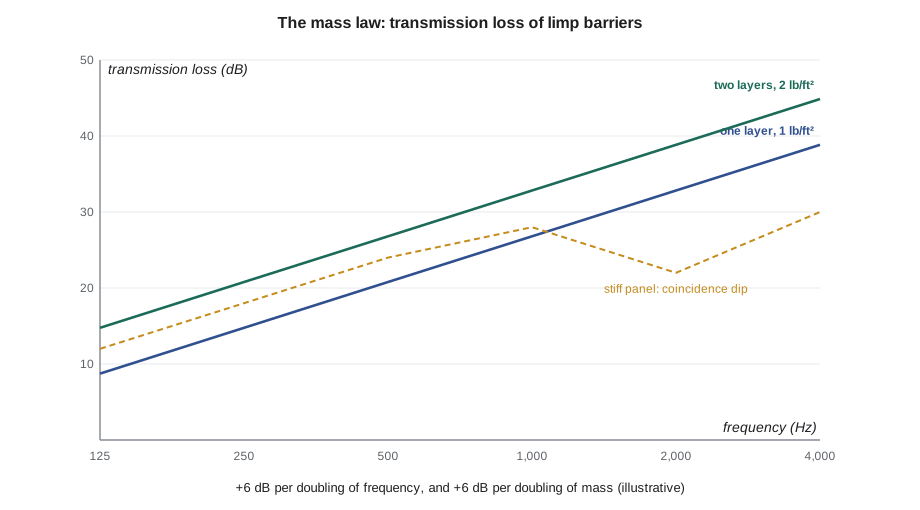
Stiff materials such as steel sheet and gypsum board do worse than the mass law near their coincidence frequency, where the bending waves in the panel match the sound waves in the air and the panel lets sound through easily. Mass-loaded vinyl is popular for lagging and curtains because it is limp: dense but floppy, so it follows the mass law closely over a wide range. That is also why it is not used as a jacket: it needs a protective cover over it.
Insertion loss
The most useful rating for insulators is insertion loss (IL): how many decibels the noise drops at a given point when the treatment is installed, compared with the same point without it. For pipe lagging, insertion loss is measured on a test rig with the same pipe bare and then lagged, in each octave or one-third-octave band. Insertion loss is not the same as transmission loss: it includes the effect of the absorber, the barrier, the gap between them, the way the system is supported and how well it is sealed.
Sunniva's specification for Compressor No. 5 set minimum insertion loss values for the discharge pipe lagging in each octave band from 125 to 8,000 Hz. Her sample values, which Coldstream had to meet with a tested system, were 2 dB at 125 Hz, 7 at 250, 15 at 500, 22 at 1,000, 27 at 2,000, 30 at 4,000 and 32 at 8,000 Hz. Like all lagging, the system gives little at low frequencies and a great deal at high ones.
Leaks: why a small gap matters so much
A barrier is only as good as its weakest part. Sound pours through gaps, cracks and unsealed joints, because an opening has a transmission loss of zero. The average transmission of a wall or jacket with a gap is the area-weighted average of the transmission coefficients, and the gap dominates.
Worked problem
A barrier with a 1 in 100 gap
A barrier of 100 ft² has a transmission loss of 30 dB. A gap in one seam adds up to 1 in 100 of the area, 1 ft². What is the transmission loss of the whole barrier?
Show solution
- Transmission coefficient of the barrier: τ = 10^(−30 ÷ 10) = 0.001. The gap: τ = 1.
- Average τ = (99 × 0.001 + 1 × 1) ÷ 100 = (0.099 + 1) ÷ 100 = 0.01099.
- TL = 10 log (1 ÷ 0.01099) = 19.6 dB.
Answer: About 19.6 dB: an opening of only 1 in 100 of the area throws away more than 10 dB of the barrier's 30 dB. Sealing every seam matters more than adding mass.
This is why Wendell's first rule for the crew on the compressor job was "every lap overlaps, every seam is taped, every penetration is sealed". A lagging system with a 1 in open strip along a seam performs like a much lighter one.
Flanking and structure-borne paths
Flanking is sound getting around a treatment by another path: through a pipe support, along the pipe itself beyond the end of the lagging, through a floor slab, or through a duct. A perfectly lagged section of pipe does little if the pipe's vibration passes through a rigid hanger into a steel beam that radiates into the next room. The usual remedies are to lag the whole radiating length, to isolate supports with resilient pads or spring hangers, and to treat valves and flanges so there are no bare spots.
Decoupling means separating the vibrating surface from the barrier with a soft, springy layer so that vibration does not pass directly into the barrier. In pipe lagging, the absorbing layer of mineral wool or foam does this. If the jacket or barrier touches the pipe anywhere, at a support, a spacer or a crushed spot, it becomes a sound bridge and radiates almost as if it were part of the pipe. Lesson 3 shows the details used to avoid bridges at supports and ends.
Thermal and acoustic insulation compared
| Question | Thermal insulation | Acoustic insulation |
|---|---|---|
| Main purpose | Slow heat flow | Absorb or block sound and stop vibration reaching the cover |
| Key material property | Low thermal conductivity | Porosity and flow resistance (absorber); mass and limpness (barrier) |
| Effect of the jacket | Weather, damage and vapor protection | Often the barrier itself, or protection for a barrier layer |
| Effect of a small gap | Small local heat loss | Large loss of performance |
| Contact between jacket and pipe | Small thermal bridge | Sound bridge that can ruin the system |
| Rating | Thermal conductivity, R or RSI value | Absorption coefficient, NRC, TL, STC, insertion loss |
Many acoustic systems also do a thermal job, and the two must be designed together. On the hot discharge line of Compressor No. 5, the mineral wool layer of the lagging also kept the jacket safe to touch; on cold lines, acoustic lagging must also carry a continuous vapor retarder, as INS-320 explained, or the absorber becomes wet and stops working on both counts.
Common mistakes
MistakeExpecting an absorber alone to block noise.
InsteadUse an absorber to cut reflections and decouple, and a heavy, airtight barrier to block transmission.
MistakeAssuming twice the barrier gives twice the decibels.
InsteadDoubling mass gives about 6 dB; check the tested data.
MistakeLeaving a seam or penetration open in an acoustic jacket.
InsteadOverlap and seal every lap, seam and penetration; a small gap can cost 10 dB or more.
MistakeLetting the barrier or jacket touch the pipe.
InsteadKeep the absorbing layer continuous so the barrier is decoupled; avoid sound bridges at supports and ends.
MistakeJudging a material by its NRC for a blocking job.
InsteadNRC rates absorption; use TL or insertion loss for blocking.
Summary and key terms
- Absorbers are porous materials that soak up sound and reduce reflections; barriers are heavy, airtight materials that block transmission.
- The absorption coefficient runs from 0 to 1; NRC averages it at 250 to 2,000 Hz.
- Transmission loss is the decibel drop through a barrier; STC is a single-number rating for walls, weak at low frequencies.
- By the mass law, doubling surface density or frequency adds about 6 dB of transmission loss.
- Insertion loss is the drop at a point when a treatment is installed, and is the rating used for pipe lagging.
- Small gaps destroy barrier performance; flanking paths and sound bridges must be avoided by sealing, isolating and decoupling.
- Absorber
- A porous material that absorbs sound energy, reducing reflection.
- Barrier
- A heavy, airtight material that blocks sound transmission.
- Absorption coefficient
- The fraction of incident sound energy that a surface does not reflect.
- Noise Reduction Coefficient (NRC)
- The average absorption coefficient at 250, 500, 1,000 and 2,000 Hz, rounded to 0.05.
- Transmission loss (TL)
- The reduction in sound level through a barrier, in decibels.
- Sound Transmission Class (STC)
- A single-number rating of a barrier's transmission loss over speech frequencies.
- Mass law
- The rule that transmission loss rises about 6 dB per doubling of surface density or frequency.
- Insertion loss (IL)
- The reduction in sound level at a point when a treatment is installed.
- Flanking
- Sound bypassing a treatment by another path.
- Decoupling
- Separating a vibrating surface from a barrier with a soft layer so that vibration does not pass directly.
Practice problems
Work each problem on paper first, then reveal the answer to check.
What NRC has a board with coefficients 0.20, 0.55, 0.80 and 0.85?
Show answer
Average 0.60; NRC 0.60.
A barrier gives 24 dB at 1,000 Hz. About what does the mass law predict at 500 Hz?
Show answer
About 18 dB, 6 dB less for half the frequency.
What fraction of energy passes a barrier with TL 20 dB?
Show answer
One hundredth: τ = 10^(−2) = 0.01.
Why is mass-loaded vinyl described as limp?
Show answer
It is dense but flexible, so it follows the mass law without a strong coincidence dip.
Which rating is used to specify pipe lagging performance?
Show answer
Insertion loss, in octave or one-third-octave bands.
Lesson quiz · 5 questions
Score 60% or more to complete this lesson.
Create a free account to save your progress, take quizzes and earn a certificate.