
INS-340 · Lesson 11 of 12 · 22 min
Personnel protection and touch temperatures
▶ Video coming soon A video version of this lesson is on the way.
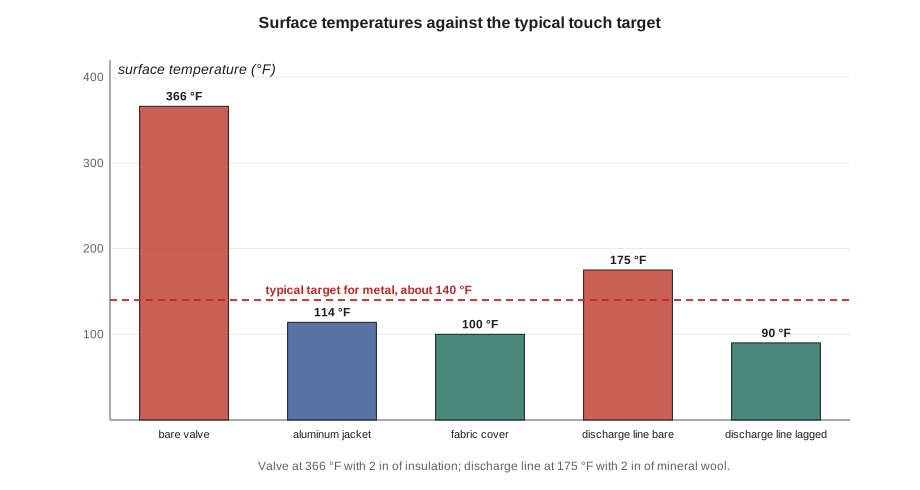
Before the noise job, the discharge line of Compressor No. 5 ran bare across the engine room at about 175 °F, at hip height beside the walkway to the oil separator. In June 2026, an operator steadied himself on it while stepping over a hose and burned the palm of his hand through his glove. The burn was minor, but Lou Brisebois added a line to Sunniva's scope: whatever went on the pipe for noise had to make it safe to touch, too. The lagging did both: after the work, the jacket beside the walkway read about 90 °F.
Personnel protection is insulation or guarding installed to keep people from being burned by hot surfaces, or injured by very cold ones. It is one of the oldest jobs of the insulation trade and one of the most important. This lesson covers how contact burns happen, the industry guidance on safe surface temperatures, how insulation and covers bring surface temperatures down, guards as an alternative, where protection is needed, and the cold side of the problem.
How contact burns happen
Skin is burned when its temperature rises high enough, for long enough, to damage the tissue. Two things decide how fast that happens on contact with a hot surface:
- The surface temperature. The hotter the surface, the faster the skin heats. Skin held at about 111 °F for many hours can be damaged; at higher temperatures the time falls very quickly, to seconds and then fractions of a second.
- The material of the surface. Metals conduct heat into the skin very quickly, so a metal surface at a given temperature burns much faster than a plastic, fabric or painted surface at the same temperature. Everyone knows this from a sauna, where the air and wooden benches are comfortable at temperatures that would burn instantly on metal.
Contact time matters too. A person who touches a hot surface by accident usually pulls away within a second or two; one who grips it, falls against it or is trapped against it can be burned badly by a surface that would be harmless for a brief touch.
Safe-to-touch guidance: ASTM C1055 and C1057
The industry guidance in North America is ASTM C1055, the standard guide for heated system surface conditions that produce contact burn injuries. It brings together research on how long skin can touch surfaces of different temperatures and materials before a burn. As INS-110 and INS-120 explained, most specifications take from it a target surface temperature of about 140 °F for metal surfaces that people can touch, a temperature at which an adult has about five seconds of contact before a lasting burn, enough time to pull away.
A companion practice, ASTM C1057, describes how to work out the skin contact temperature for a particular surface, by calculation or by measuring with an instrument that mimics the thermal properties of skin. It explains why a fabric cover at a given temperature is safer than a metal jacket at the same temperature, and allows a higher surface temperature where the outer material is a poor conductor.
Neither standard is a law in itself, but specifications, owners' standards and courts treat them as the accepted measure of a reasonable surface temperature. A few points to remember:
- About 140 °F is a target for short accidental contact with metal, not a comfortable temperature; it will still hurt.
- Children, older people and people with reduced sensation are injured more easily, and some specifications for public buildings use lower targets.
- Long or forced contact, such as leaning on a surface or being trapped against it, needs lower temperatures still.
How insulation lowers the surface temperature
Heat flows from the hot surface through the insulation and then from the outer surface to the surrounding air. The outer surface settles at a temperature where the heat arriving through the insulation equals the heat leaving by convection and radiation. More insulation, or a better insulator, lowers the heat flow and so the surface temperature. The way the outer surface gives off heat also matters:
- Emittance. Dull, dark and fabric surfaces radiate heat well (high emittance). Shiny metal jackets, especially new aluminum and stainless steel, radiate poorly (low emittance), so they run hotter for the same heat flow. INS-120 and INS-310 noted this when checking jacket temperatures.
- Air movement. Wind or forced air carries heat away and cools the surface; still air in a closed room does not.
- Surroundings. A surface in a hot room, or next to other hot equipment, runs hotter.
Worked problem
Fabric cover compared with aluminum jacket
A steam valve at 366 °F in a room at 77 °F is covered with 2 in of insulation of thermal conductivity 0.31 Btu·in/(h·ft²·°F). Using a flat-layer estimate, find the outer surface temperature with a fabric outer jacket (surface coefficient about 1.76 Btu/(h·ft²·°F)) and with a shiny aluminum jacket (about 1.06 Btu/(h·ft²·°F)).
Show solution
- Insulation resistance = 2 ÷ 0.31 = 6.45 h·ft²·°F/Btu.
- Fabric: surface resistance = 1 ÷ 1.76 = 0.568; heat flow = (366 − 77) ÷ (6.45 + 0.568) = 289 ÷ 7.02 = 41.2 Btu/(h·ft²); surface = 77 + 41.2 × 0.568 = 100.4 °F.
- Aluminum: surface resistance = 1 ÷ 1.06 = 0.943; heat flow = 289 ÷ (6.45 + 0.943) = 39.1 Btu/(h·ft²); surface = 77 + 39.1 × 0.943 = 113.9 °F.
Answer: About 100 °F with the fabric cover and 114 °F with the aluminum jacket, both well below the target. The shiny jacket loses slightly less heat but runs about 13 °F hotter. A full calculation by ASTM C680 methods would include the curvature of the item and radiation separately, as INS-410 will show.
Worked problem
The Compressor No. 5 discharge line
The discharge line runs at about 175 °F. With 2 in of mineral wool and an aluminum jacket, using the same values, what is the jacket temperature?
Show solution
- Heat flow = (175 − 77) ÷ (6.45 + 0.943) = 98 ÷ 7.39 = 13.3 Btu/(h·ft²).
- Surface = 77 + 13.3 × 0.943 = 89.5 °F.
Answer: About 90 °F, which matches what Wendell read with a surface thermometer after the job. The bare pipe at 175 °F was well above the target; the lagged pipe is comfortably below it.
Where personnel protection is needed
Most specifications do not require every hot surface to be insulated for protection, only those people can reach in normal work. Typical rules, which vary by owner and specification, protect hot surfaces:
- Within about 7 ft above a floor, platform or walkway, and within about 24 to 36 in horizontally of a walkway, ladder or work area.
- Around valves, instruments and equipment that people operate or read.
- Above about 140 °F, or the owner's chosen limit.
Pipes that are deliberately left bare to give off heat, such as some steam tracer lines, condensate drain legs and the cooling legs of steam traps that INS-210 described, still need protection where people can touch them. Guards are often the better choice there, because insulation would defeat the reason the pipe is bare.
| Method | Advantages | Limits |
|---|---|---|
| Insulation | Saves energy as well as protecting; neat; protects the whole surface | Not suitable where the pipe must give off heat; must be maintained |
| Removable covers | Protect valves and fittings that must be opened | Must be put back after maintenance |
| Guards (expanded metal, perforated sheet or wire mesh cages, held clear of the surface) | Let heat escape; quick to fit; no insulation to maintain | Guard itself can get warm; gaps must be small enough to keep fingers out |
| Warning signs and barriers | Simple; useful as a temporary measure | Rely on people noticing and obeying; not a substitute for protection where contact is likely |
Guards are usually standoff cages of expanded metal or perforated sheet, held 1 to 3 in from the surface on spacers, so that air flows behind them and the guard stays cool. The openings must be small enough that a finger cannot reach the hot surface. Insulators fit them on traps, tracer lines and exhausts as part of a personnel protection job.
The rules
OSHA's general duty clause requires employers to keep the workplace free of recognized hazards likely to cause serious harm, which includes contact with hot surfaces, and OSHA has cited employers for unprotected hot surfaces under it. Building codes add requirements in particular places, such as protection of hot pipes in public spaces. Owners' specifications usually set the details: which surfaces, what temperature, and what method.
For the insulator, the practical question on every job is the same: where can people touch, and what will the surface temperature be? When the specification is silent on personnel protection, the insulator raises it in writing, as with removable covers.
Cold surfaces
Very cold surfaces injure skin too. Bare skin can freeze to metal below about 14 °F, and cryogenic surfaces, such as liquid nitrogen lines and their valves, can cause cold burns in seconds. Most cold lines are insulated anyway to stop condensation and heat gain, as INS-320 covered, but cold valves left bare for operation, frosted vent lines and vacuum-jacketed piping with failed vacuum all need guarding or covers where people can touch them. Insulated gloves are standard for anyone operating cryogenic valves.
Checking surface temperatures
After installing personnel protection, the crew checks the result. Contact surface thermometers and infrared thermometers both work, with care:
- Infrared thermometers read shiny metal jackets too low, because of their low emittance. Reading through a strip of black electrical tape or a spot of flat black paint on the jacket, or setting the instrument's emittance, gives a better value.
- Contact thermometers read true but must be held until the reading settles.
- Check at the hottest likely conditions, with the line at full temperature and the room at its warmest, and at the most likely contact points, such as the parts of valves people grip.
Wendell checked the Compressor No. 5 line at six points beside the walkway with a contact thermometer after the job. The highest reading, 93 °F, was at the bend where the mineral wool sections met, which he checked for a gap; there was none, and the reading was simply where the jacket was closest to a warm air outlet.
Personnel protection on a removable cover job
Removable covers often double as personnel protection, and the two purposes can pull in different directions. A cover thick enough for energy savings is usually thick enough for touch safety too, but the parts left bare for operation, such as stems, handwheels and gauges, may still be hot. Handwheels on steam valves are usually far enough from the body to stay cool, but short stems, small valves and actuator yokes can run near the line temperature. The measurer notes them, and the owner decides whether they need guards, insulated handwheels or warning labels.
Covers that are taken off for maintenance leave the item bare and hot while the work is done. Maintenance crews need to know that the valve body under the cover is at full line temperature, and they need gloves and sleeves rated for it. Kellerton's work orders for covered items on steam now include the line temperature and a reminder to let the item cool where the job allows.
Hot surfaces during installation
Insulators are exposed to hot surfaces more than almost any other trade. On live lines, Coldstream's crews wear heat-resistant gloves rated for the surface temperature, long sleeves and eye protection, and they plan each task so that no one has to reach over or lean on a hot item. Bare skin never touches a hot surface to "check" it; a contact thermometer does that job. On the Compressor No. 5 line, Priya wore leather gloves with heat-resistant liners for the first lengths of mineral wool, when the pipe was bare at 175 °F, and lighter gloves once the line was covered.
Common mistakes
MistakeAssuming a surface is safe because it is only warm to the touch for a moment.
InsteadUse the target from the specification or ASTM C1055, about 140 °F for metal, and remember that long contact needs lower temperatures.
MistakeReading a shiny jacket with an infrared thermometer set for a dull surface.
InsteadUse tape or flat paint on the jacket, set the emittance, or use a contact thermometer.
MistakeInsulating a pipe that must give off heat to protect people.
InsteadUse a standoff guard where the pipe must stay bare, such as trap cooling legs and some tracers.
MistakeIgnoring valves and fittings in a personnel protection job.
InsteadCover the parts people touch, often with removable covers so maintenance can reach them.
MistakeForgetting cold surfaces.
InsteadGuard or cover very cold and cryogenic surfaces where people can touch them.
Summary and key terms
- Contact burns depend on surface temperature, the surface material and contact time; metal burns much faster than fabric or plastic at the same temperature.
- ASTM C1055 is the guide most specifications use; it supports a target of about 140 °F for metal surfaces people can touch; ASTM C1057 works out skin contact temperatures for particular surfaces.
- Insulation lowers surface temperature; shiny, low-emittance jackets run hotter than fabric or painted surfaces for the same insulation.
- Protection is usually required on surfaces within reach of floors, platforms and walkways, by insulation, removable covers or standoff guards.
- Very cold surfaces also need protection; check surface temperatures after the work with suitable instruments.
- Personnel protection
- Insulation or guarding installed to prevent burns or cold injury from contact with surfaces.
- Contact burn
- A skin injury from touching a hot surface.
- ASTM C1055
- The standard guide for heated system surface conditions that produce contact burn injuries.
- ASTM C1057
- The practice for determining skin contact temperature from heated surfaces.
- Emittance
- The ability of a surface to give off heat by radiation, from 0 to 1.
- Standoff guard
- A cage of expanded metal or mesh held clear of a hot surface to keep people from touching it.
Practice problems
Work each problem on paper first, then reveal the answer to check.
Why does a fabric cover feel cooler than a metal jacket at the same temperature?
Show answer
Fabric conducts heat into the skin much more slowly than metal.
What target surface temperature do most specifications use for touchable metal surfaces?
Show answer
About 140 °F, from ASTM C1055.
Why does a shiny aluminum jacket run hotter than a fabric cover over the same insulation?
Show answer
It has a lower emittance, so it gives off heat less readily.
Where is a standoff guard better than insulation?
Show answer
On surfaces that must stay bare to give off heat, such as trap cooling legs.
How can an infrared thermometer be used accurately on a shiny jacket?
Show answer
Read through black tape or flat black paint, or set the correct emittance.
Lesson quiz · 5 questions
Score 60% or more to complete this lesson.
Create a free account to save your progress, take quizzes and earn a certificate.