
INS-340 · Lesson 4 of 12 · 23 min
Noise control on ducts and equipment
▶ Video coming soon A video version of this lesson is on the way.
Sunniva's survey had turned up a second, smaller problem at Kellerton. The packaging office, a room of eight desks on the mezzanine beside the engine room, had a steady rumble that the staff blamed on Compressor No. 5. Her measurements showed that most of it came from a different source: the engine room exhaust duct, a 24 × 16 in galvanized steel duct that ran 26 ft across the office's ceiling space from the engine room fan to a roof outlet. The fan noise inside the duct was making the duct walls vibrate, and the walls were radiating into the office. On Friday, August 14, 2026, after the main work on the compressor, Wendell and Priya lagged that duct.
Ducts, fans, pumps and other equipment make a large share of the noise in buildings and plants. This lesson covers how noise travels in and out of ducts, the difference between lining a duct and lagging it, how duct lagging is installed, what insulators do on fans, pumps and other equipment, and what they must leave alone.
How noise travels through a duct system
A fan is a powerful noise source, and a duct is a very good path for its noise. Noise from a duct system reaches people in three main ways:
- Along the inside of the duct. Fan noise travels down the duct with the air and comes out of the grilles and diffusers in occupied rooms, or out of the roof outlet toward the neighbors.
- Breakout. Sound inside the duct makes the thin duct walls vibrate, and the walls radiate it into the spaces the duct passes through. Rectangular ducts, with large flat walls, break out much more than round ducts, which are stiffer.
- Break-in and cross-talk. Noise from a loud space gets into a duct and travels to a quiet one, such as speech from one office to the next through a shared duct, or engine room noise along a duct into an office.
Air moving fast through dampers, elbows and grilles also makes its own noise, called regenerated noise, which no treatment downstream of the noisy fitting can stop. That is a duct designer's problem, but it is one reason ducts near quiet rooms are sized for low velocity.
Lining compared with lagging
INS-310 covered duct liner, the absorbing material installed inside a duct. Liner and lagging do different jobs, and it is worth being clear about which one a specification calls for:
| Duct liner (inside) | Duct lagging (outside) | |
|---|---|---|
| Main job | Absorb noise traveling along the duct | Stop noise breaking out through the duct walls |
| Typical build-up | Faced glass fiber or mineral wool on the inner surface | Porous blanket plus barrier, sometimes plus jacket, on the outside |
| Typical result | A few decibels of attenuation per foot at mid and high frequencies | Several to 20 dB or more of breakout reduction, depending on the build-up |
| Effect on airflow | Reduces the inside area; adds friction | None |
| Concerns | Erosion at high velocity, cleaning, health-care restrictions | Weight on hangers, access doors, fire dampers |
A third device, the silencer or sound attenuator, is a short section of duct packed with absorbing baffles behind perforated metal. Silencers give large attenuation along the duct in a short length, at the cost of some pressure drop. Sheet metal contractors install them; insulators sometimes insulate the casings. At Kellerton, the HVAC contractor fitted a silencer behind the engine room's intake louver the following week, on Sunniva's recommendation, to keep compressor noise from escaping through the wall opening.
Duct lagging
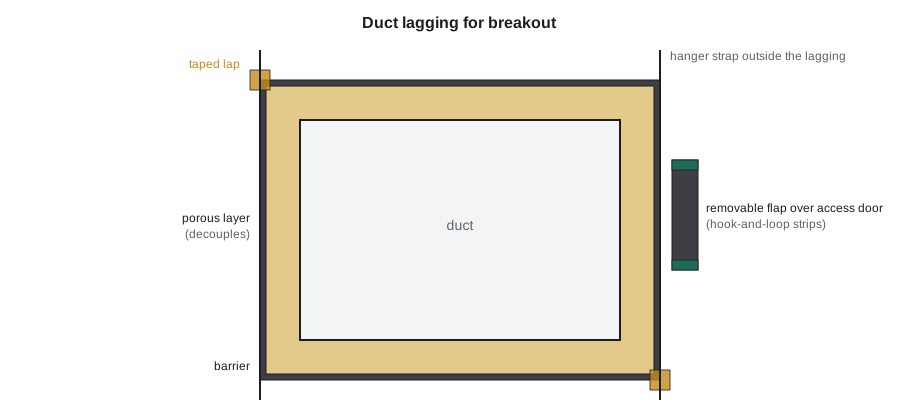
Duct lagging follows the same principle as pipe lagging: a porous layer next to the duct to absorb and decouple, then a barrier, sealed at every joint. Common build-ups are:
- Composite blanket. A factory-made product of mass-loaded vinyl bonded to a glass fiber or foam decoupling layer, installed in one step with the decoupling side against the duct. It is the most common choice for duct breakout in buildings.
- Separate layers. Duct wrap or board, then mass-loaded vinyl wrapped over it, with taped seams, and, where it will be exposed to damage, a jacket.
- Gypsum board or sheet metal enclosure. For severe cases, the duct is boxed in with a separate, airtight enclosure built around it, filled with absorbing material, by the drywall or sheet metal trade.
Installation points that matter:
- Fasten without bridging. On the sides and bottom of a large duct, the composite is held with weld pins and washers or with bands, as for duct wrap. Pins carry a little vibration through, so they are kept to the spacing the maker gives, and washers do not crush the decoupling layer.
- Seal every seam. All butt joints and laps in the barrier are overlapped and taped with the maker's tape, and the seam at a hanger or support is carried around it.
- Keep access. Fire damper access doors, duct access doors, test ports and control dampers must stay accessible. The lagging is cut around them and finished with a removable flap or panel of the same build-up, sealed with tape or hook-and-loop strips, so it can be opened and closed again.
- Check the hangers. A composite barrier adds several pounds per square foot; on long runs the duct hangers must carry it. Where the duct hangs from the structure above a quiet room, resilient hangers stop vibration reaching the slab.
Worked problem
How much composite for the office duct?
The exhaust duct is 24 × 16 in and 26 ft long over the office. The composite is 1 in thick, and its laps overlap 2 in. How much composite is needed, before waste?
Show solution
- Outside size over the composite = (24 + 2 × 1) × (16 + 2 × 1) = 26 × 18 in.
- Perimeter = 2 × (26 + 18) = 88 in; with the 2 in lap, cut width = 90 in, or 7.5 ft.
- Area = 7.5 × 26 = 195 ft².
Answer: 195 ft² before waste; Wendell ordered two rolls, which also covered the patches around the two access doors.
Measured as the outside perimeter of the finished lagging, rather than the bare duct, the stretch-out allows for the thickness at each corner, as with duct wrap in INS-310. On the Kellerton duct, the two access doors for the backdraft damper were finished with removable flaps of composite held by hook-and-loop strips, and a 4 in test port was boxed with a small, taped cap.
Worked problem
What should the office hear afterwards?
Before the work, the office measured 51 dBA from the duct breakout and 42 dBA from the office's own ventilation and other sources. The composite lagging is expected to reduce the breakout by about 10 dBA. What will the office level be?
Show solution
- Before: 10 log (10^5.1 + 10^4.2) = 51.5 dBA.
- Breakout after lagging: 51 − 10 = 41 dBA.
- After: 10 log (10^4.1 + 10^4.2) = 44.5 dBA.
Answer: About 44.5 dBA, a drop of 7 dB. The office cannot get much quieter than its own 42 dBA background, so more lagging on the duct would gain almost nothing.
When Sunniva checked the office in her follow-up survey on Wednesday, August 26, it measured 44 dBA, and the rumble the staff had complained of was gone. The packaging supervisor asked whether the compressor had been turned off.
Fans, pumps and other equipment
On equipment, insulators work alongside the trades that install and isolate the machines. The insulator's part is usually lagging casings and connected piping and ducts, and making removable covers. Typical items:
- Fan housings. Scroll housings of centrifugal fans radiate strongly. They can be lagged with a porous layer and barrier, fixed with pins or bands, leaving inspection doors, drains and bearings clear.
- Pump casings and volutes. Lagged with removable acoustic covers so the pump can be serviced; the cover must not touch the shaft, coupling guard or seal.
- Compressor packages. Usually treated with enclosures (lesson 5) rather than lagging, because they need cooling air and frequent access. The connected piping and its valves and flanges are lagged.
- Steam turbines, blowers and gas turbines. Often have factory enclosures; insulators lag connected ducts and piping and make high-temperature removable covers for casings.
- Valves with high pressure drops. Control valves and pressure-reducing valves are lagged with removable acoustic covers, and the lagging is carried a good distance downstream, where the noise travels.
What insulators must not do is defeat the vibration isolation that keeps noise out of the structure. The trades that install equipment use:
- Isolators. Springs, rubber mounts or inertia bases under machines, and spring hangers for pipes and ducts near them.
- Flexible connectors. Rubber or braided metal pipe connectors and fabric duct connectors that break the solid path between a machine and its piping or ductwork.
Lagging or jacketing that bridges across a flexible connector, or packs a spring isolator solid, carries vibration straight past it. The rule is to stop the lagging on each side of a flexible connector and close the gap with a soft, flexible wrap of the barrier, or a removable cover, that does not tie the two sides together. At Kellerton, Priya stopped the lagging on each side of the braided connector on the compressor discharge and covered the connector with a loose sleeve of barrier lapped over both ends and taped to one side only.
Coordinating with the other trades
Noise control jobs often involve several contractors, and the insulator's work is only part of the treatment. On the Compressor No. 5 job, Sunniva's report divided the work:
| Item | Who did it |
|---|---|
| Spring hangers and pads on the discharge line | Refrigeration contractor |
| Lagging of discharge line and oil separator | Coldstream |
| Removable acoustic covers on valves and flanges | Coldstream, fabricated by Pellam Thermal Covers |
| Acoustic curtain enclosure around the compressor skid | Coldstream, curtain panels from an acoustic supplier |
| Exhaust duct lagging over the packaging office | Coldstream |
| Intake louver silencer | HVAC contractor |
The order of work matters. The hangers had to be changed before lagging covered them; the silencer was installed after Coldstream's crew had finished in the engine room so the two crews did not share the lift; and Sunniva's after measurement had to wait until everything was done, or it would not show what the whole package achieved.
Lagging round ducts, plenums and casings
Round ducts break out less than rectangular ones, but large round ducts from fans and blowers can still radiate strongly. The composite is wrapped like pipe lagging, with the longitudinal lap at the side and every circumferential joint overlapped and taped. Spiral ducts have a raised seam that the decoupling layer must bridge without gaps; the composite is wrapped over it, not cut around it.
Fan plenums and air handler casings are large flat panels, and they behave like rectangular ducts: they radiate easily at low and middle frequencies. Insulators can lag the outside of a casing with composite held by pins, but access doors, filter doors, drain pans, coil connections and motor access must stay usable. Each door gets its own removable panel of composite, fastened with hook-and-loop strips or latches and sealed at the edges with a lapped flap. A casing lagged so that the filters cannot be changed will be stripped by the first maintenance crew to service it.
What lagging cannot fix
Lagging and lining treat noise in the duct and through its walls, but they do not fix the source. A fan running far from its best operating point, an unbalanced impeller, a slipping belt or a damper that whistles will keep making noise. When Sunniva walked the Kellerton duct, she also checked that the engine room exhaust fan was running near its design point and that its belt guard was not rattling, because there is no point lagging a duct to hide a fault that maintenance can fix in an hour. An insulator who notices a loose guard, a rubbing belt or a rattling damper while working should report it, not wrap it.
Finally, any lagging added near a duct's fire damper, smoke damper or fire-rated assembly must not interfere with it. Dampers need clear access for testing, and a duct passing through a fire separation is part of a tested assembly whose details the lagging must not change; INS-330 explained the rules for firestops around ducts.
Common mistakes
MistakeLining a duct when the problem is breakout into a room.
InsteadUse duct lagging (porous layer plus barrier) for breakout; liner treats noise traveling along the duct.
MistakeCovering a fire damper access door with lagging.
InsteadCut the lagging around access doors and test ports and finish them with removable, sealed flaps.
MistakeJacketing solidly across a flexible connector.
InsteadStop the lagging at each side and use a loose, flexible cover that does not tie the two sides together.
MistakeAdding heavy lagging without checking the hangers.
InsteadCheck that hangers can carry the extra weight; use resilient hangers near quiet rooms.
MistakeTreating a minor source while a louder one remains.
InsteadMeasure first; the room cannot get quieter than its strongest remaining source or its own background.
Summary and key terms
- Duct noise reaches people along the inside of the duct, by breakout through the walls, and by break-in and cross-talk between spaces.
- Duct liner absorbs noise traveling along the duct; duct lagging stops breakout; silencers give large attenuation in a short length.
- Duct lagging uses a porous decoupling layer and a sealed barrier, installed without crushing and with removable flaps at access doors and test ports.
- On equipment, insulators lag casings and connected piping and make removable covers, without bridging vibration isolators or flexible connectors.
- Noise control jobs need coordination: supports and isolation first, treatment next, measurement last.
- Breakout
- Noise inside a duct or pipe radiated through its walls into the surrounding space.
- Break-in
- Noise from a space entering a duct and traveling elsewhere.
- Cross-talk
- Sound passing from one room to another through a shared duct.
- Regenerated noise
- Noise made by air flowing through dampers, elbows and grilles.
- Silencer
- A duct section with absorbing baffles that attenuates noise traveling along the duct.
- Composite barrier
- A factory product combining a barrier layer with a decoupling layer.
- Flexible connector
- A rubber, braided or fabric connection that breaks the solid path between a machine and its piping or ducts.
- Isolator
- A spring or resilient mount that stops vibration passing from a machine to the structure.
Practice problems
Work each problem on paper first, then reveal the answer to check.
Which travels better through duct walls: noise in a rectangular duct or a round one?
Show answer
A rectangular duct, because its flat walls are less stiff and break out more.
What is the stretch-out of composite for a 20 × 12 in duct with 1 in composite and a 2 in lap?
Show answer
2 × (22 + 14) + 2 = 74 in.
Why can lagging not be carried straight across a fabric duct connector?
Show answer
It would tie the duct to the fan and carry vibration past the connector.
A room has 40 dBA background and a duct source of 40 dBA. What is the total, and what would it be with the duct source removed?
Show answer
43 dBA; 40 dBA with the duct source removed.
What must be done where lagging meets a fire damper access door?
Show answer
Cut the lagging around the door and finish it with a removable, sealed flap so the door can be opened.
Lesson quiz · 5 questions
Score 60% or more to complete this lesson.
Create a free account to save your progress, take quizzes and earn a certificate.