
HSE-402 · Lesson 6 of 12 · 20 min
OSHA inspections
At 6:10 a.m., two hours after the spiral conveyor injury, Elena reported the worker's hospitalization to OSHA by phone, within the 24 hours the recordkeeping rule allows. Nine days later, at 8:30 a.m., a compliance safety and health officer arrived at the front desk of the Gainesville plant, showed her credentials and asked to see the plant manager. Marcus called Elena, who called Dev, who had worked the night shift and was about to go home. 'Stay,' she said. 'This is your area, and you need to see how an inspection works.' This lesson follows that inspection from the front desk to the closing conference.
Inspections are how OSHA checks compliance and gathers evidence for citations. Most employers will be inspected at some point, and many supervisors meet a compliance officer only after a serious injury, when emotions are high and mistakes are easy to make. Knowing how an inspection works, and what the supervisor's role is, protects both the workers and the company.
Why OSHA inspects
OSHA cannot inspect every workplace, so it sets priorities. Its Field Operations Manual lists them roughly in order: imminent danger situations; fatalities and catastrophes; reports of severe injuries such as amputations, in-patient hospitalizations and losses of an eye; complaints and referrals from workers, other agencies and the media; programmed inspections targeted at high-hazard industries and emphasis programs; and follow-up inspections to check that earlier violations were corrected. Food manufacturing plants are often covered by OSHA's national emphasis program on amputations, which targets industries where machines regularly cause amputations, so they can be inspected even without an incident.
After a severe injury report, OSHA either opens an on-site inspection or sends the employer a rapid response investigation letter asking it to investigate and report back what it found and fixed. For the spiral conveyor, the combination of a hospitalization, a caught-in hazard and an industry under the amputations emphasis program made an on-site inspection likely. Elena expected it and had prepared.
Arrival and credentials
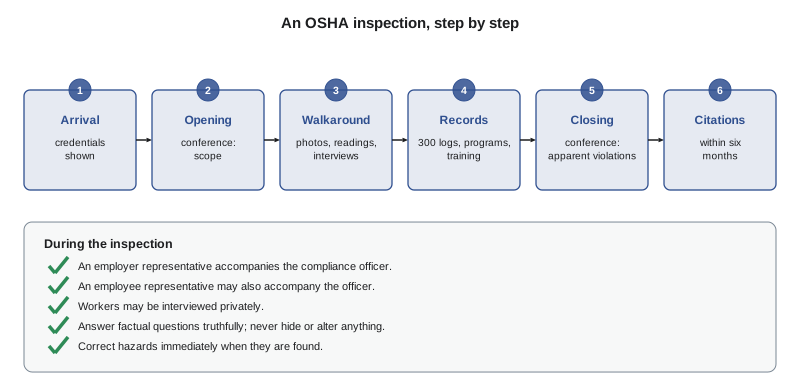
A compliance officer will present official credentials, which include a photograph and a serial number, and will ask to speak to the person in charge. Front desk staff should have a short instruction: politely ask the officer to wait in a suitable place, call the plant manager and the safety manager, and do not keep the officer waiting longer than necessary. Long delays can look like an attempt to hide or fix things before the officer sees them.
The Fourth Amendment protects employers from unreasonable searches, and in Marshall v. Barlow's, Inc. (1978) the Supreme Court held that OSHA generally needs either the employer's consent or a warrant to inspect. In practice, most employers consent, because OSHA can usually obtain a warrant quickly, and refusing tends to sour the relationship. Many companies, including Harrowgate Foods Inc., have a policy of consenting while agreeing the scope of the inspection at the opening conference. Employers have the right to have a representative accompany the officer throughout.
The opening conference
At the opening conference, the officer explains why the plant was selected, the scope of the inspection, the employer's rights and the employee representative's right to take part. For a severe injury report, the scope is usually the injury and the hazards connected to it, but officers can expand the scope if they see other hazards in plain view during the walkaround. Elena, Marcus and Dev attended, with Sam Pellerin, the worker co-chair of the safety committee at the distribution center, who had agreed to act as the employee representative because the main plant's co-chair was away.
The officer asked for several documents: the OSHA 300 logs and 300A summaries for the past five years, the written energy control program and machine-specific procedures, lockout training records for the sanitation crew, the most recent periodic inspection of the energy control procedure required by 1910.147(c)(6), and the company's investigation of the injury. Elena had a folder ready. She kept a copy of everything she handed over and a list of what was provided and when, which is good practice.
The walkaround
During the walkaround, the officer looks at the conditions related to the inspection, takes photographs and video, may take measurements or samples, and interviews employees. The employer representative should accompany the officer, take duplicate photographs of everything the officer photographs, and take notes of what is observed and said. If the officer points out a hazard that can be fixed immediately, it should be fixed, because quick correction is a sign of good faith, although it does not prevent a citation.
The officer spent most of the walkaround at the spiral conveyor. She photographed the far disconnect, the new floor-level disconnect that had been installed after the injury, the posted procedure and the interlocked gate. She asked Dev to walk her through the lockout steps, which he did accurately. She also noticed, on the way back, an unguarded belt on a packaging conveyor, which was within plain view and became part of the inspection.
Employee interviews
Compliance officers interview employees, usually privately, and the employer has no right to be present for non-management interviews. Employees can choose whether to be interviewed and what to say. Managers and supervisors are generally treated as speaking for the company, and the company may have counsel or a representative present for their interviews. Supervisors should answer truthfully, stick to facts they know, avoid guessing or speculating, and never coach workers on what to say or discourage them from talking. Retaliating against a worker for what they told an officer would violate section 11(c).
Several sanitation workers told the officer that lockout on the spiral had been skipped most nights under the previous supervisor. The previous supervisor, interviewed as a management representative, admitted he knew. Those interviews became the key evidence that Harrowgate Foods Inc. knew about the violation, because a supervisor's knowledge is imputed to the employer.
The closing conference
At the end of the inspection, the officer holds a closing conference, either on site or later by phone, to discuss the apparent violations found, possible citations and the employer's rights. The officer does not usually announce penalty amounts at the closing conference. The employer can provide information about corrective actions taken and the timeframe for others. OSHA must issue any citation within six months of the date the violation occurred, under section 9(c) of the Act. Lesson 7 covers citations, penalties and the choices an employer has once they arrive.
At Harrowgate Foods Inc.'s closing conference, the officer said she was considering citations under the lockout standard for failing to use energy control procedures during the spiral clean, inadequate training and the periodic inspection, and under the machine guarding standard for the packaging belt. Elena described the corrective actions already completed and provided photos of the guarded belt, fixed the same afternoon.
Measuring readiness
After the inspection, Elena scored each high-risk task on three questions that an inspection effectively asks: was the hazard identified (foresight), were the controls effective (efficiency), and were the rules supervised and enforced (authority)? She asked for evidence for every point awarded.
# Evidence check for high-risk tasks at the main plant (0 = none, 3 = strong and documented).
tasks = {
    #                foresight efficiency authority
    "spiral clean":     (1, 1, 0),
    "mixer tank clean": (2, 2, 2),
    "slicer change":    (2, 3, 1),
    "oven maintenance": (3, 2, 2),
    "forklift loading": (2, 2, 1),
}
names = ("foresight", "efficiency", "authority")
for task, s in tasks.items():
    weakest = names[s.index(min(s))]
    print(f"{task:<17} {'/'.join(map(str, s))}  total {sum(s)}/9  weakest: {weakest}")
avg = [sum(s[i] for s in tasks.values()) / len(tasks) for i in range(3)]
print("average by duty:", dict(zip(names, [round(a, 1) for a in avg])))spiral clean 1/1/0 total 2/9 weakest: authority
mixer tank clean 2/2/2 total 6/9 weakest: foresight
slicer change 2/3/1 total 6/9 weakest: authority
oven maintenance 3/2/2 total 7/9 weakest: efficiency
forklift loading 2/2/1 total 5/9 weakest: authority
average by duty: {'foresight': 2.0, 'efficiency': 2.0, 'authority': 1.2}Elena used the same scores for both purposes. A task where supervision and enforcement scored low was a task where OSHA would likely find a violation that supervisors knew about, and where the company's defenses would be weak. That pattern set up the work in lesson 8.
Worked problem
Handling an officer's request on the walkaround
Show solution
- On the walkaround, the officer asks to photograph a mixer control panel and to interview two operators privately.
- Dev takes the same photograph from the same position and notes the time and what the officer looked at.
- He confirms the operators are free to choose whether to talk, does not ask what they will say, and does not attend their interviews.
- When the officer points out a missing cover on an electrical box, Dev calls maintenance, who fix it within the hour; he records the fix.
- At the end of the day he gives Elena his notes and photos so the company's record matches the officer's.
Answer: Accompany, document, correct and never interfere with employee interviews.
Preparing for an inspection before it happens
The best time to prepare for an OSHA inspection is long before the officer arrives. Elena built an inspection plan for each site that named who would greet the officer, who would accompany them, and who would collect documents. It listed the documents an officer usually asks for and where each was kept. It reminded managers of the employer's rights: to know the reason for the inspection, to agree the scope, to accompany the officer, to have a representative present at management interviews, to protect trade secrets, and to receive copies of any samples or results. And it reminded everyone of the employees' rights, which must never be interfered with.
Dev added one thing to the plan for night shift. Officers usually arrive during the day, but if a fatality or serious injury happens at night, the scene, the witnesses and the first decisions all belong to the night supervisor. His checklist covered getting help, securing the scene, preserving evidence such as lockout devices and the machine's position, recording witness names, and making the required report through Elena within the time limits. Those first hours often shape what an officer finds days later.
After the inspection
Once the officer has left, there is still work to do. The company should debrief: compare its notes and photos with what the officer observed, list every apparent violation discussed, and start correcting each one, recording dates and evidence. It should check whether the same hazards exist at other sites, because OSHA can treat a later violation of the same standard anywhere in the company as a repeat. Elena sent photos of the spiral fixes and the packaging belt guard to the distribution center and the sauces plant the next day, and asked each site to check its own conveyors for the same problems.
She also met with the night crew. The inspection had been stressful for the workers who were interviewed, some of whom worried they had said the wrong thing. Elena and Dev told them plainly that they had done nothing wrong by telling the truth, that the company would never penalize anyone for talking to OSHA, and that the hazards they had described were now fixed. That conversation mattered as much as any document, because it showed the crew that honesty with the regulator was safe.
Trade secrets, recordings and samples
A few practical points often come up during inspections. If the officer wants to photograph or record something the company considers a trade secret, such as a proprietary recipe or a custom machine design, the employer can ask for it to be marked confidential, and section 15 of the OSH Act requires OSHA to protect trade secret information. If the officer takes air, noise or surface samples, the employer can ask for the results and can take its own side-by-side samples. And if the officer records interviews or the walkaround, the company should make its own notes of what was said and seen. None of these steps is about obstructing the inspection. They make sure the company's record of the day is as complete as OSHA's.
Common mistakes
MistakeKeeping the officer waiting while hazards are hurriedly fixed.
InsteadGreet the officer promptly, call the right people and begin the inspection.
MistakeCoaching workers on what to tell the officer.
InsteadWorkers may speak freely and privately; interfering can be retaliation.
MistakeLetting the officer walk around alone.
InsteadAccompany the officer, take duplicate photos and notes.
MistakeGuessing or speculating in a management interview.
InsteadAnswer truthfully with facts you know; say when you do not know.
MistakeLeaving an obvious hazard in place until citations arrive.
InsteadCorrect hazards as soon as possible and record the correction.
Summary and key terms
- OSHA prioritizes imminent danger, fatalities, severe injury reports, complaints and referrals, programmed and emphasis inspections, and follow-ups.
- Officers present credentials; OSHA generally needs consent or a warrant, and most employers consent and agree the scope.
- The inspection has an opening conference, walkaround, interviews, document review and closing conference.
- Employee interviews are private; supervisors speak for the company and must answer truthfully.
- A supervisor's knowledge of a violation is generally imputed to the employer.
- Citations must be issued within six months of the violation.
- Compliance safety and health officer
- An OSHA inspector, often called a CSHO.
- National emphasis program
- An OSHA program targeting specific hazards or industries for inspection.
- Rapid response investigation
- An OSHA process asking an employer to investigate a severe injury and report back, instead of an on-site inspection.
- Opening conference
- The meeting at the start of an inspection to explain its scope and the parties' rights.
- Walkaround
- The physical inspection of the workplace by the officer.
- Closing conference
- The meeting at the end of an inspection to discuss apparent violations.
Practice problems
Work each problem on paper first, then reveal the answer to check.
List OSHA's main inspection priorities.
Show answer
Imminent danger, fatalities and catastrophes, severe injury reports, complaints and referrals, programmed and emphasis inspections, follow-ups.
What did Marshall v. Barlow's decide?
Show answer
OSHA generally needs the employer's consent or a warrant to inspect.
What should the employer representative do during the walkaround?
Show answer
Accompany the officer, take duplicate photos and notes, and fix hazards promptly.
Why were the workers' interviews so important?
Show answer
They showed the supervisor knew lockout was skipped, which is imputed to the employer.
Within what time must OSHA issue a citation?
Show answer
Within six months of the violation.
Lesson quiz · 5 questions
Score 60% or more to complete this lesson.
Create a free account to save your progress, take quizzes and earn a certificate.