
HSE-402 · Lesson 6 of 12 · 20 min
Due diligence: the legal standard
Three months after the spiral conveyor injury, Harrowgate Foods Ltd. received a letter from the Department of Labour, Skills and Immigration: the company was being charged under the Occupational Health and Safety Act with failing to ensure that machinery was locked out before cleaning. Rachel called a meeting with Elena, Marcus and the company's lawyer, Aisha Grant. The first question Rachel asked was whether the company could defend the charge. Aisha's answer introduced the most important legal idea in Canadian safety law. 'The Crown will probably be able to prove the lockout wasn't done,' she said. 'The question is whether we can prove we took every reasonable precaution to prevent it. That's due diligence, and the burden is on us.'
This lesson explains what due diligence means in law, where it comes from, and the three practical duties that make it up. Lesson 7 covers how the Department enforces the law, and lesson 8 shows how an employer and a supervisor build the evidence of due diligence before anything goes wrong.
Strict liability offences
Most offences under provincial safety laws are what courts call strict liability offences. The idea comes from the Supreme Court of Canada's 1978 decision in R. v. Sault Ste. Marie, a case about pollution, which divided regulatory offences into three types. Offences requiring proof of intent, called mens rea offences, are mostly found in the Criminal Code. Absolute liability offences allow no defence at all once the act is proven. Strict liability offences sit in the middle: the prosecution must prove beyond a reasonable doubt that the prohibited act happened, but the accused can then avoid conviction by proving, on a balance of probabilities, that it took all reasonable care to prevent it, or that it reasonably believed in a mistaken set of facts which, if true, would have made the act innocent.
The court reasoned that regulatory laws protect the public, so the prosecution should not have to prove what was in a company's mind, but that it would be unfair to convict someone who had done everything reasonable. The burden of proving reasonable care therefore falls on the accused, because the accused knows what it did to prevent the harm. Canadian courts have applied this framework to occupational health and safety offences ever since, and the defence of reasonable care is what safety professionals call due diligence.
In practice, that means a safety prosecution usually turns on two questions. First, did the prohibited thing happen: was the machine not locked out, was the guard missing, was the worker untrained? That is often easy to prove after an injury. Second, can the employer prove that it took every reasonable precaution in the circumstances to prevent it? That second question is where most cases are won or lost.
What 'reasonable care' means
Due diligence does not require perfection. Courts have said repeatedly that employers are not insurers of worker safety, and that the standard is reasonable care, not every conceivable precaution. But the standard rises with the danger. Where the potential harm is death or serious injury, the care expected is high, and courts expect employers to anticipate foreseeable human error, including workers taking shortcuts under pressure. A defence that says 'our procedure prohibited it and the worker broke the rule' rarely succeeds unless the employer can show it did everything reasonable to make the rule work and to enforce it.
Courts weigh several factors in deciding whether care was reasonable. How serious and how likely was the harm? What did the industry know about the hazard, and what were others doing? What alternatives were available, and at what cost? How much control did the accused have over the situation? What knowledge and skill did the accused and its supervisors have? Was the event foreseeable? These questions are asked about the situation as it was before the incident, not with hindsight, but the incident itself often reveals what was foreseeable.
The three duties of due diligence
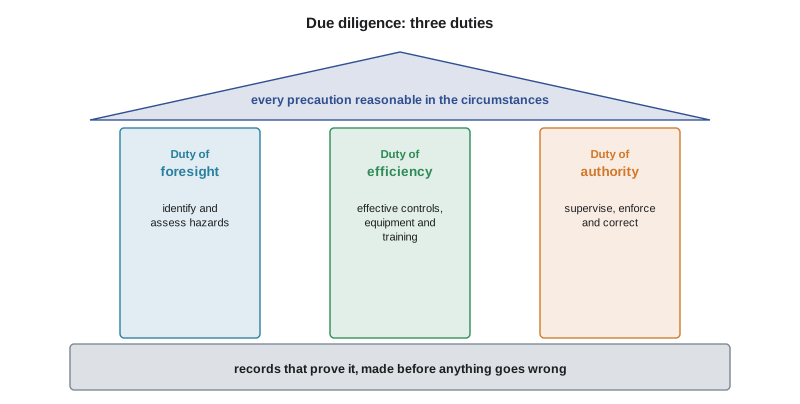
Lawyers and safety professionals often break due diligence into three duties. The framing is a teaching tool rather than a legal test written in any statute, but it maps well onto what courts look for, and it gives supervisors a practical way to check their own work.
The duty of foresight. The employer must look ahead and identify the hazards workers face, including foreseeable misuse and shortcuts. This is the hazard assessment duty from lesson 3. A court will ask whether the hazard that caused the incident was identified, whether the assessment reflected how the work was really done, and whether it was updated when things changed. For the spiral conveyor, the hazard had been identified, but the assessment did not reflect the shortened cleaning window or the far disconnect. That is a weakness.
The duty of efficiency. The employer must put effective controls in place to deal with the hazards it has identified: engineering controls, safe equipment, written procedures, training and protective equipment, following the hierarchy of controls. Effective means the controls actually work in practice, not only on paper. For the spiral, the lockout procedure existed and the training had been delivered, but the training was generic and the disconnect placement made the procedure hard to follow within the schedule. Another weakness.
The duty of authority. The employer must supervise the work, enforce its rules, correct unsafe behaviour and conditions when they are found, and discipline repeated or deliberate breaches fairly. This is where the spiral defence was weakest. The previous night supervisor knew lockout was being skipped and did nothing. Workers said it happened most nights. A rule that is broken routinely with a supervisor's knowledge is evidence that the employer did not exercise its authority.
Aisha summarized the position for the leadership team. The company had a procedure, locks and training, which would help. But the evidence of tolerated non-compliance, the generic training, the old hazard assessment and the time pressure from the schedule would all be used by the Crown to show that the company had not taken every reasonable precaution. The prospects of a full due diligence defence were poor.
Due diligence after the event
Due diligence is judged on what was done before the incident. What a company does afterwards cannot create a defence that did not exist. But post-incident actions still matter. They show whether the company takes the problem seriously, they can reduce the risk of a repeat, and they are relevant at sentencing if there is a conviction. Courts often take into account an employer's prompt and thorough response, its cooperation with the investigation and its willingness to accept responsibility when deciding the size of a fine.
Harrowgate Foods Ltd.'s response after the injury was strong: the floor-level disconnect and interlocked gate, the extended sanitation window, the rewritten procedure, machine-specific training and a supervisor verification step. Aisha advised that these would not defend the charge, but would weigh heavily in any sentencing and, more importantly, would protect the next worker.
Measuring readiness
After the meeting with Aisha, Elena built a simple scorecard to test due diligence in each high-risk task, scoring each of the three duties from 0 to 3 and asking for evidence for every point awarded.
# Evidence check for high-risk tasks at the main plant (0 = none, 3 = strong and documented).
tasks = {
    #                foresight efficiency authority
    "spiral clean":     (1, 1, 0),
    "mixer tank clean": (2, 2, 2),
    "slicer change":    (2, 3, 1),
    "oven maintenance": (3, 2, 2),
    "forklift loading": (2, 2, 1),
}
names = ("foresight", "efficiency", "authority")
for task, s in tasks.items():
    weakest = names[s.index(min(s))]
    print(f"{task:<17} {'/'.join(map(str, s))}  total {sum(s)}/9  weakest: {weakest}")
avg = [sum(s[i] for s in tasks.values()) / len(tasks) for i in range(3)]
print("average by duty:", dict(zip(names, [round(a, 1) for a in avg])))spiral clean 1/1/0 total 2/9 weakest: authority
mixer tank clean 2/2/2 total 6/9 weakest: foresight
slicer change 2/3/1 total 6/9 weakest: authority
oven maintenance 3/2/2 total 7/9 weakest: efficiency
forklift loading 2/2/1 total 5/9 weakest: authority
average by duty: {'foresight': 2.0, 'efficiency': 2.0, 'authority': 1.2}The scorecard showed the same pattern across most tasks: authority, meaning supervision and enforcement, was weakest. That told Elena where to focus supervisors' time, and it set up the work in lesson 8 on building and recording due diligence.
Worked problem
Would due diligence succeed?
Show solution
- A worker's hand is cut by an unguarded blade on a packaging line. The guard had been removed for maintenance the day before and not replaced.
- Foresight: the hazard was identified, and the procedure required the guard to be replaced and checked before restart.
- Efficiency: the guard is interlocked so the line will not start without it, but the interlock had been bypassed with a wedge by the maintenance contractor.
- Authority: the company had audited interlocks monthly, found and disciplined a previous bypass, and the maintenance contract banned bypassing; the supervisor checked the line at start-up but the wedge was hidden.
- Assessment: a due diligence defence has a real chance, because the company identified the hazard, used an engineering control, audited it and enforced the rule.
Answer: A strong engineering control, audited and enforced, can support due diligence even when an unexpected bypass defeats it.
Due diligence for supervisors personally
Due diligence is not only a defence for employers. Supervisors and workers charged personally can raise it too, and the same three questions apply on a smaller scale. Did the supervisor know the hazards of the work they directed? Did they make sure the workers were trained and had the right equipment and procedures? Did they check, correct and enforce? A supervisor who can answer yes to each, with records to show it, is in a strong position even if a worker on their crew is hurt. A supervisor who knew about a serious breach and did nothing is in a very weak one.
This is why Elena told Dev that his supervisor log was the single most important document he would keep. When he verified lockout on the spiral, he wrote the time and his initials. When he corrected a worker who started cleaning before verification, he noted it and the follow-up. When he found a hazard, he recorded what he did and whom he told. None of this took more than a few minutes a shift. Over months, it built exactly the evidence a court would look for to judge whether he had exercised his authority.
Mistake of fact
Sault Ste. Marie also allows a second branch of the defence: that the accused reasonably believed in a mistaken set of facts which, if true, would have made the act innocent. In safety cases this branch is narrower and less often used. An example would be a supervisor who checked that a machine had been locked out, saw a lock and tag on the disconnect and reasonably believed the machine was isolated, when in fact a contractor had wired a second, undocumented power feed. The belief must be honest and reasonable, and the accused must have taken reasonable steps to check. Wishful thinking or failing to look is not a reasonable mistake.
How the courts see due diligence today
Decades of decisions have settled into a fairly consistent picture. Courts reward employers that identify hazards realistically, choose strong controls, train for the actual job, supervise actively, enforce consistently and keep records of all of it. They are sceptical of programs that look impressive on paper but are not followed on the floor, and of defences that blame the injured worker for a shortcut that supervisors had tolerated. The most persuasive evidence is usually ordinary and routine: inspection records, completed checklists, coaching notes, discipline for repeated breaches and responses to committee recommendations, created long before anyone imagined a prosecution.
Common mistakes
MistakeThinking a written procedure alone proves due diligence.
InsteadCourts look for effective controls, training that matches the job and consistent enforcement.
MistakeAssuming the Crown must prove the company was careless.
InsteadFor strict liability offences, the accused must prove reasonable care on a balance of probabilities.
MistakeBlaming the worker who broke the rule.
InsteadCourts expect employers to anticipate foreseeable shortcuts and to supervise and enforce.
MistakeBelieving post-incident fixes create a defence.
InsteadDue diligence is judged before the incident; later actions matter mainly for sentencing and prevention.
MistakeTolerating a known breach to keep production going.
InsteadTolerated breaches are the strongest evidence against the duty of authority.
Summary and key terms
- Most provincial safety offences are strict liability offences under the 1978 Sault Ste. Marie framework.
- The Crown proves the act beyond a reasonable doubt; the accused can then prove reasonable care on a balance of probabilities.
- Due diligence means every precaution reasonable in the circumstances, judged before the incident, with a higher standard for more serious hazards.
- It is often described as three duties: foresight, efficiency and authority.
- Tolerated breaches, generic training and outdated assessments weaken a defence; post-incident actions matter at sentencing.
- Supervisors carry much of the duty of authority, which is often the weakest part of a defence.
- Strict liability offence
- An offence where the prohibited act is proven and the accused can then avoid conviction by proving reasonable care.
- Due diligence
- Taking every precaution reasonable in the circumstances to prevent the offence.
- R. v. Sault Ste. Marie
- The 1978 Supreme Court of Canada decision that set out the three categories of regulatory offences.
- Balance of probabilities
- The civil standard of proof: more likely than not.
- Duty of foresight
- Identifying and assessing hazards, including foreseeable shortcuts.
- Duty of authority
- Supervising, enforcing rules and correcting unsafe acts and conditions.
Practice problems
Work each problem on paper first, then reveal the answer to check.
What are the three categories of offences in Sault Ste. Marie?
Show answer
Mens rea offences, strict liability offences and absolute liability offences.
Who must prove due diligence, and to what standard?
Show answer
The accused, on a balance of probabilities.
Name the three duties of due diligence.
Show answer
Foresight, efficiency and authority.
Why was the spiral conveyor defence weak on the duty of authority?
Show answer
The supervisor knew lockout was skipped most nights and did nothing.
How do post-incident actions matter?
Show answer
They do not create a defence, but they matter at sentencing and for preventing a repeat.
Lesson quiz · 5 questions
Score 60% or more to complete this lesson.
Create a free account to save your progress, take quizzes and earn a certificate.