
HSE-402 · Lesson 10 of 12 · 19 min
Injury and illness recordkeeping under 29 CFR 1904
On a Thursday night in Dev's third month, a sanitation worker slipped on a wet ramp, fell against a handrail and cracked a rib. She finished the shift, saw a doctor the next morning and was told to stay off work for a week. Dev knew she needed help and made sure she got a ride to the clinic. What he was less sure about was whether the injury was recordable, who had to be told and by when. 'There are two separate questions,' Elena told him the next morning. 'What we must report to OSHA right away, and what we must record on our log. Let's go through both.'
This lesson covers OSHA's injury and illness recordkeeping rule in 29 CFR part 1904: which injuries must be reported to OSHA within hours, how to decide whether a case is recordable, the forms, posting and retention rules, electronic submission, and the rules that protect workers who report injuries.
Reporting severe injuries to OSHA
Under 29 CFR 1904.39, employers must report to OSHA any work-related fatality within 8 hours of learning about it, and any work-related in-patient hospitalization of one or more employees, amputation, or loss of an eye within 24 hours. Reports can be made by phone to the nearest area office, to OSHA's national number, or online. The clock starts when the employer, through any manager or supervisor, learns of the event. A fatality must be reported if it happens within 30 days of the incident, and a hospitalization, amputation or loss of an eye if it happens within 24 hours of the incident. In-patient hospitalization means formal admission, not treatment in an emergency department and release.
The rib injury did not need to be reported to OSHA, because the worker was treated at a clinic and sent home, not admitted. The spiral conveyor injury, by contrast, involved an in-patient hospitalization and was reported within hours. Elena reminded Dev that supervisors are often the first to know about a severe injury, and that the company's reporting clock starts when they know. At Harrowgate Foods Inc., the procedure was that the supervisor called Elena or the on-call manager immediately for any serious injury, and she made the report.
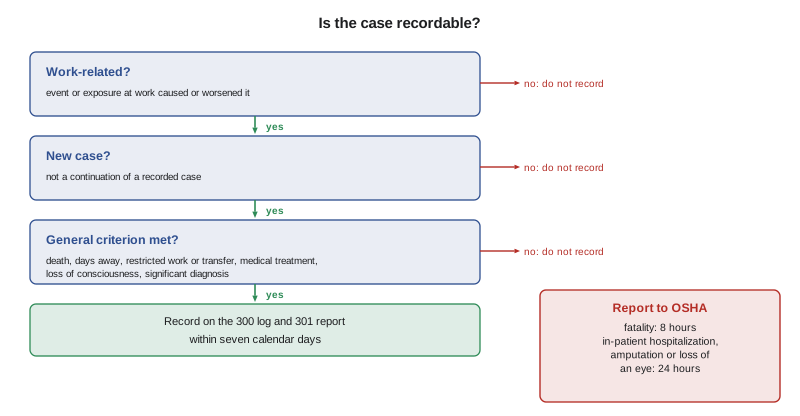
Is it recordable?
Recording and reporting are different. Most recordable cases never need to be reported to OSHA by phone, but they must be entered on the employer's records. Under 1904.4 to 1904.7, a case is recordable if it is work-related, a new case, and meets one or more general recording criteria: death, days away from work, restricted work or transfer to another job, medical treatment beyond first aid, loss of consciousness, or a significant injury or illness diagnosed by a physician or other licensed health care professional, such as a fracture or a punctured eardrum. Some conditions have special criteria, such as needlesticks, hearing loss and tuberculosis.
Work-relatedness is presumed if an event or exposure in the work environment caused or contributed to the condition or significantly aggravated a pre-existing one, unless one of the listed exceptions applies, such as eating and drinking for personal consumption or voluntary participation in a wellness program. First aid has a specific, complete list in 1904.7(b)(5)(ii), including non-prescription medication at non-prescription strength, cleaning and covering wounds, hot or cold therapy, non-rigid supports, eye flushing and removing splinters by simple means. Anything beyond the list, such as prescription medication, stitches or rigid splints, is medical treatment.
The rib injury was work-related, a new case, and involved days away from work, so it was recordable. A cracked rib is also a significant diagnosed injury. Elena entered it on the 300 log within seven calendar days, as 1904.29 requires, and completed the 301 incident report. She counted the days away as calendar days, not workdays, starting the day after the injury, as the rule requires, with a cap of 180 days for any one case.
The forms, posting and retention
Employers covered by the rule keep three forms, or equivalent forms with the same information. Form 300, the Log of Work-Related Injuries and Illnesses, lists each recordable case with the employee's name, job title, date, location, a short description and the outcome. Form 301, the Injury and Illness Incident Report, gives more detail for each case and must be completed within seven calendar days. Form 300A, the annual summary, totals the year's cases, hours worked and average employees; a company executive must certify it, and it must be posted in a conspicuous place from February 1 to April 30 of the following year. Records must be kept for five years after the end of the year they cover, and the 300 log must be updated during that time if a case's outcome changes.
Employers with ten or fewer employees at all times in the previous year, and employers in certain low-hazard industries, are partially exempt from keeping the forms, although they must still report severe injuries. Food manufacturing and warehousing are not exempt. Privacy cases, such as sexual assaults, mental illnesses and certain infectious diseases, are entered without the employee's name. Employees, former employees and their representatives have the right to see the 300 log, and the employer must provide a copy by the end of the next business day after a request.
Electronic submission
Under 1904.41, certain establishments must submit their data electronically to OSHA through its Injury Tracking Application each year, by March 2. Establishments with 250 or more employees in industries covered by the recordkeeping rule must submit the 300A summary. Establishments with 20 to 249 employees in industries listed in Appendix A must also submit the 300A. And since 2024, establishments with 100 or more employees in the higher-hazard industries listed in Appendix B, which include many manufacturing and warehousing industries, must also submit information from their 300 logs and 301 reports. Harrowgate Foods Inc.'s main plant and distribution center had to submit all three; the sauces plant, with about 60 employees, submitted the 300A. OSHA publishes much of the submitted data, so a company's injury records are increasingly visible to the public.
Never discourage reporting
Accurate records depend on workers being willing to report. Under 1904.35, employers must establish a reasonable procedure for employees to report work-related injuries and illnesses promptly and accurately; a procedure that would deter or discourage a reasonable employee from reporting is not reasonable. Employers must tell employees about the procedure and their right to report, and must not discharge or discriminate against them for reporting. OSHA can cite employers under 1904.35(b)(1)(iv) for retaliation even without a complaint from the worker. Practices such as disciplining workers simply for being injured, requiring immediate reporting so strict that workers who report late are punished, or incentive programs that reward crews for having no reported injuries can all discourage reporting. OSHA's 2018 memorandum explained that incentive programs are permitted only if they are not used to deter reporting.
HSE-401 described how Harrowgate Foods Inc.'s distribution center had a quarterly no-injury bonus that hid injuries. It was replaced with recognition for reporting hazards and near misses. In the year after the change, recorded minor injuries rose and serious injuries fell, which is exactly the pattern a healthy reporting culture produces: problems are seen while they are small.
Measuring with the records
Elena used the 300 logs and hours worked to calculate the standard OSHA rates for each site: the total recordable case rate (TRC) and the days away, restricted or transferred rate (DART), both per 200,000 hours worked, which represents 100 full-time employees working a year.
# OSHA incidence rates: cases x 200,000 / hours worked (invented data).
sites = {
    # site: (hours worked, recordable cases, days-away/restricted/transfer cases)
    "main plant": (861_000, 14, 9),
    "distribution center": (229_000, 7, 5),
    "sauces plant": (121_000, 2, 1),
}
for site, (hours, trc, dart) in sites.items():
    print(f"{site:<20} TRC {trc * 200_000 / hours:4.2f}   DART {dart * 200_000 / hours:4.2f}")
total_h = sum(v[0] for v in sites.values())
print(f"company TRC {sum(v[1] for v in sites.values()) * 200_000 / total_h:4.2f}")main plant TRC 3.25 DART 2.09 distribution center TRC 6.11 DART 4.37 sauces plant TRC 3.31 DART 1.65 company TRC 3.80
The distribution center had the highest rates, which matched what supervisors already suspected about forklift traffic and manual handling. Elena reminded the leadership team that rates are lagging indicators, and that a low rate can hide under-reporting, as the old bonus had shown.
Worked problem
Recordable or not?
Show solution
- A worker at the distribution center cuts a hand on a pallet strap. The wound is cleaned and covered with a bandage, and she returns to work.
- Cleaning and covering a wound is first aid, so the case is not recordable.
- Two days later the cut becomes infected and a doctor prescribes antibiotics: prescription medication is medical treatment, so the case becomes recordable.
- Elena enters it on the 300 log within seven calendar days of learning about the prescription and completes the 301.
- No OSHA phone report is needed, because there was no hospitalization, amputation, loss of an eye or death.
Answer: A case can become recordable later; recording and severe injury reporting are separate duties.
The supervisor's part in recordkeeping
Recordkeeping is the employer's duty, but supervisors make it work. The supervisor is usually the first manager to learn of an injury, and under 1904.39 the reporting clock starts when any manager or supervisor knows. Dev's internal incident report for the rib injury took fifteen minutes and recorded the time, place, task, what the worker said happened, the names of nearby workers, photographs of the wet ramp and the leaking hose above it, and the first aid given. He did not try to decide fault. That report gave Elena what she needed for the 301 and for the investigation, which found that the hose had been leaking for two weeks because a verbal maintenance request was never logged.
Dev also told his crew at the start of every shift that he wanted to hear about every injury and near miss, however small. When a worker reported a strained wrist from a hose reel, he thanked her in front of the crew and had maintenance replace the reel's spring that week. Small acts like that show a crew whether reporting is welcome, and they are exactly what 1904.35 is meant to protect.
Updating and reviewing the log
The 300 log is a living record. When the worker with the cracked rib returned after a week on restricted duties, Elena updated the entry: the case now showed both days away and days of restricted work, and the outcome column reflected the most serious result, days away from work. If a case later turns out not to be work-related, or a diagnosis changes, the entry must be corrected. Each quarter, Elena compared the 300 log with the internal incident reports, first aid records and workers' compensation claims, looking for cases that had been treated somewhere but never assessed for recordability. The first comparison found two: a prescription for a strained back and a rigid splint for a finger, both missed because the clinic visit happened days after the incident. Both were added. The review took an hour and made the log something the company could stand behind if an inspector compared it with the clinic's records.
Common mistakes
MistakeAssuming an emergency room visit must be reported to OSHA.
InsteadOnly in-patient admission, amputation, loss of an eye or death must be reported.
MistakeCounting days away as workdays.
InsteadCount calendar days, starting the day after, capped at 180.
MistakeCalling prescription-strength medication first aid.
InsteadFirst aid is a closed list; prescription medication is medical treatment.
MistakeForgetting to post the 300A from February 1 to April 30.
InsteadPost the certified summary every year, even with zero cases.
MistakeRewarding crews for having no reported injuries.
InsteadIncentives must not deter reporting; reward hazard and near-miss reports.
Summary and key terms
- Report fatalities within 8 hours and in-patient hospitalizations, amputations and losses of an eye within 24 hours.
- A case is recordable if work-related, new and meeting a general criterion such as days away or medical treatment beyond first aid.
- Record cases on the 300 log and 301 report within seven calendar days; post the certified 300A from February 1 to April 30.
- Keep records for five years; employees can see the 300 log by the end of the next business day.
- Electronic submission is due by March 2; large and high-hazard establishments submit 300 and 301 data too.
- Employers must have a reasonable reporting procedure and must never discourage or retaliate against reporting.
- Recordable case
- A work-related, new injury or illness meeting OSHA's recording criteria.
- First aid
- The treatments on OSHA's closed list in 1904.7(b)(5)(ii), which do not make a case recordable.
- Form 300A
- The annual summary of recordable cases, certified by an executive and posted February 1 to April 30.
- In-patient hospitalization
- Formal admission to a hospital for care or treatment.
- DART rate
- Cases with days away, restricted work or transfer per 200,000 hours worked.
Practice problems
Work each problem on paper first, then reveal the answer to check.
Which events must be reported to OSHA within 24 hours?
Show answer
In-patient hospitalization, amputation and loss of an eye.
Is a cracked rib with a week off recordable?
Show answer
Yes: work-related, new and with days away, and also a significant diagnosed injury.
When must the 300A be posted?
Show answer
From February 1 to April 30, certified by a company executive.
How long must records be kept?
Show answer
Five years after the end of the year they cover.
What does 1904.35 require about reporting procedures?
Show answer
A reasonable procedure that does not deter reporting, workers informed of it, and no retaliation.
Lesson quiz · 5 questions
Score 60% or more to complete this lesson.
Create a free account to save your progress, take quizzes and earn a certificate.