
HSE-402 · Lesson 1 of 12 · 22 min
How OSHA law works in the United States
Five weeks after the spiral conveyor injury described in HSE-401, Dev Sandhu started as the new night sanitation supervisor at Harrowgate Foods Inc.'s main plant in Gainesville. On his first night, the plant manager, Marcus Bell, handed him a binder, a radio and a short list: the crew roster, the sanitation schedule, the lockout procedure and the letter from OSHA about the injury. Dev had worked in food plants for twelve years, the last four as a lead hand. He knew how to clean a spiral freezer. He did not know, in any detail, what the law expected of him now that he was in charge of other people.
That gap is common. Most supervisors are promoted because they are good at the work, not because they know the law. Yet the moment someone directs the work of others, the law gives them duties, and in serious cases it can hold them personally responsible. This course is about those duties: what the law requires of employers and supervisors, how regulators enforce it, what happens after something goes wrong, and how supervisors can protect workers and themselves by doing the job well and keeping the right records.
Elena Novak, the health and safety manager, agreed to meet Dev every week for his first three months. Her first lesson was a map of where the rules come from. 'Before you can follow the law,' she said, 'you need to know whose law it is and who enforces it here in Georgia.'
Why the law exists
Workplace safety law grew out of disaster. In the nineteenth century, factory and mining laws were passed one industry at a time, usually after a fire, explosion or collapse killed many workers. Modern general laws, which cover almost every workplace with the same basic duties, came much later. They share a simple idea: the people who control the work and profit from it must take reasonable steps to protect the people who do it.
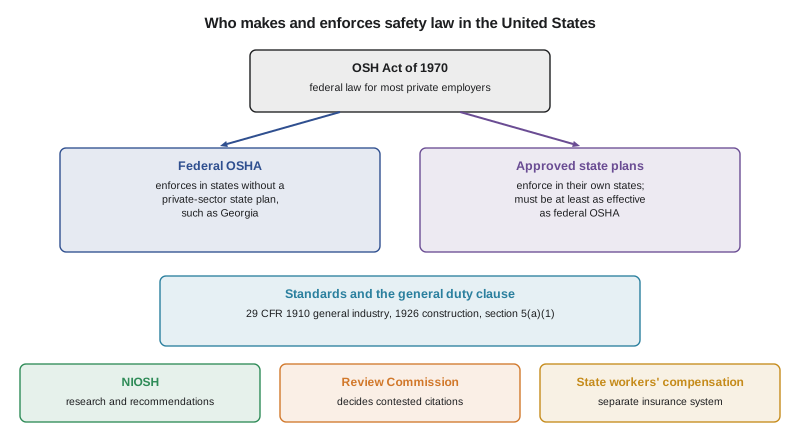
In the United States the modern era began with the Occupational Safety and Health Act of 1970, signed by President Nixon after years of rising injury rates. The OSH Act created the Occupational Safety and Health Administration (OSHA) in the Department of Labor to set and enforce standards, the National Institute for Occupational Safety and Health (NIOSH) to research hazards and recommend limits, and an independent Occupational Safety and Health Review Commission (OSHRC) to hear disputes over citations. Its stated purpose is to assure, so far as possible, safe and healthful working conditions for every working man and woman in the nation.
Who makes the rules
Under the OSH Act, OSHA covers most private-sector employers in all fifty states, the District of Columbia and the US territories. The Act allows a state to run its own program, called a state plan, if OSHA approves it as being at least as effective as the federal program. Today there are about two dozen state plans. Some cover both private employers and state and local government workers; a handful cover only public employees. In states without a plan for private employers, federal OSHA enforces the law directly.
Georgia does not have a state plan for private employers, so federal OSHA enforces the OSH Act at Harrowgate Foods Inc.'s plants in Gainesville and Athens and at the distribution center in McDonough. Georgia's public employers are covered by a separate state arrangement, which does not affect Harrowgate Foods Inc.. Workers' compensation is a separate state system under Georgia law, run through insurers and the State Board of Workers' Compensation. If Harrowgate Foods Inc. ran its own interstate trucks, some driver safety rules would come from the Federal Motor Carrier Safety Administration rather than OSHA. Supervisors do not need to master every law, but they need to know which one governs their workplace.
The layers of law
Safety law comes in layers, and supervisors meet all of them. Understanding the layers helps you know where to look and how much weight each document carries.
- The OSH Act sets out the general duties of employers and employees, the powers of OSHA, the rights of workers, and the penalties.
- Standards are regulations that OSHA adopts through rulemaking and publishes in Title 29 of the Code of Federal Regulations: part 1910 for general industry, which covers food plants and warehouses, part 1926 for construction, and others for maritime and agriculture. They include the lockout/tagout standard (1910.147), machine guarding (1910.212), powered industrial trucks (1910.178), hazard communication (1910.1200), recordkeeping (part 1904) and many more.
- Consensus standards from organizations such as ANSI and NFPA are sometimes incorporated by reference, and are often used to show what is feasible and recognized in an industry.
- OSHA directives and letters of interpretation explain how OSHA reads its standards and conducts enforcement, including the Field Operations Manual.
- Decisions of the Review Commission and the federal courts interpret the Act and standards, and set out the defenses that employers can raise.
When a specific standard covers a hazard, OSHA cites the standard. When no standard applies, OSHA can still cite the employer under the general duty clause in section 5(a)(1) of the Act, which requires every employer to furnish a workplace free from recognized hazards that are causing or likely to cause death or serious physical harm. Lesson 2 looks at the general duty clause in detail. The important point for supervisors is that a hazard does not become legal just because no standard names it.
Who enforces the law
OSHA enforces the Act through compliance safety and health officers (CSHOs) working from area offices; Georgia has several. CSHOs inspect workplaces in response to fatalities and severe injuries, complaints and referrals, and under programmed inspection plans that target high-hazard industries and emphasis programs. They can enter, inspect, take samples and photographs, and interview employees privately. After an inspection, OSHA issues citations with proposed penalties and abatement dates, which the employer can accept, settle or contest. Lessons 6 to 8 cover inspections, citations, penalties and defenses in detail.
Other regulators touch the same workplace. The company's workers' compensation insurer and Georgia's State Board of Workers' Compensation handle claims. Food safety inspectors from the US Department of Agriculture or the Food and Drug Administration check sanitation and food safety, sometimes with requirements that pull in a different direction from worker safety, such as wash-down chemicals and hygiene rules. Fire officials enforce the fire code, and the Environmental Protection Agency regulates chemicals such as ammonia used in refrigeration. A good supervisor knows which visitor is which, and what each one can require.
| Body | Main role | What a supervisor might see |
|---|---|---|
| OSHA area office | Enforces the OSH Act and standards | Inspections, citations, informal conferences |
| Workers' compensation insurer and State Board | Compensation claims | Claim forms, return-to-work contacts |
| USDA or FDA | Food safety and sanitation | Inspections of sanitation and hygiene |
| Fire officials and EPA | Fire code, chemical rules | Fire inspections, ammonia program reviews |
| Review Commission and courts | Disputes and appeals | Contested citations, testimony |
How the duties fit together
The OSH Act puts the main legal duty on the employer. Section 5(a) requires each employer to comply with OSHA standards and to keep the workplace free of recognized serious hazards. Section 5(b) requires each employee to comply with the standards and rules that apply to their own conduct, but OSHA does not cite or fine employees; the employer is responsible for making sure the work is done safely. Supervisors are the employer's agents, so what a supervisor knows and does is generally treated as what the employer knows and does. Lesson 2 looks at how this shared responsibility works in practice, including on sites with several employers.
This has practical consequences. When OSHA investigated the spiral conveyor injury, the compliance officer asked not only 'Did Harrowgate Foods Inc. have a lockout procedure?' but also 'Did the night supervisor know the procedure was being skipped?' Because a supervisor's knowledge is generally imputed to the employer, the previous supervisor's tolerance of skipped lockout became evidence that Harrowgate Foods Inc. knew of the violation. A supervisor who looks the other way does not protect the company; he puts it, and his workers, at risk.
How enforcement data shapes priorities
Elena showed Dev how the regulator decides where to look. Enforcement is targeted: regulators concentrate inspections on industries and hazards with the highest rates of serious injury, and they always respond to serious incidents and complaints. Food manufacturing has injury rates above the average for all industries, with amputations, lacerations, musculoskeletal injuries and slips among the most common, so plants like Harrowgate Foods Inc.'s get regular attention. She ran a short script on the company's own injury data to show Dev which hazards drove the most serious cases.
# Serious injuries at the main plant over five years, by hazard (invented company data).
cases = {
    "caught in machinery": 9, "manual handling strain": 31, "slip or trip": 22,
    "knife cut": 18, "struck by forklift or pallet jack": 4, "burn from oven or fryer": 7,
    "chemical splash": 5,
}
# Weight by typical severity: lost days per case (illustrative averages).
days = {"caught in machinery": 95, "manual handling strain": 28, "slip or trip": 21,
        "knife cut": 9, "struck by forklift or pallet jack": 60, "burn from oven or fryer": 18,
        "chemical splash": 12}
rows = sorted(((n * days[h], h, n) for h, n in cases.items()), reverse=True)
total = sum(r[0] for r in rows)
for lost, h, n in rows:
print(f"{h:<34} cases {n:>3} lost days {lost:>5} share {lost / total:5.1%}")manual handling strain cases 31 lost days 868 share 31.3% caught in machinery cases 9 lost days 855 share 30.8% slip or trip cases 22 lost days 462 share 16.7% struck by forklift or pallet jack cases 4 lost days 240 share 8.7% knife cut cases 18 lost days 162 share 5.8% burn from oven or fryer cases 7 lost days 126 share 4.5% chemical splash cases 5 lost days 60 share 2.2%
The output surprised Dev. Machinery injuries were few in number but ranked near the top for lost days, because they were so severe. Manual handling strains topped the list by volume. The lesson Elena drew was that supervisors should know the law that applies to their highest-severity hazards in the most detail: for the night sanitation crew, that meant lockout, machine guarding, chemical handling and confined spaces in tanks and mixers.
Worked problem
Which law applies?
Show solution
- A Harrowgate Foods Inc. maintenance contractor is hurt while repairing a mixer at the Gainesville plant.
- Georgia has no state plan for private employers, so federal OSHA has jurisdiction.
- Both the contractor and Harrowgate Foods Inc. may have duties: the contractor as the exposing employer, Harrowgate Foods Inc. as the host and controlling employer (see lesson 2).
- If the injury causes an in-patient hospitalization, Harrowgate Foods Inc. must report it to OSHA within 24 hours if it is Harrowgate Foods Inc.'s own employee; the contractor reports for its own worker. The claim goes to the contractor's workers' compensation insurer.
- The supervisor's role: secure the scene, get help, report, and cooperate with the investigation.
Answer: Federal OSHA governs; both employers may have duties; each reports for its own employees.
Reading the law for yourself
Elena gave Dev a simple habit: when someone says 'the law says', ask to see the words. Statutes and regulations are free to read online, and most of what a supervisor needs is in a handful of sections. Reading the actual text has three benefits. You find out whether a rule really exists or is only workplace folklore. You see exactly who the duty falls on and what triggers it. And you learn the vocabulary the regulator will use if it ever investigates your area.
Dev started with four things: the general duty clause in section 5, the lockout/tagout standard in 29 CFR 1910.147, the machine guarding rules in subpart O of part 1910, and the hazard communication standard for the sanitation chemicals. Then he looked up the permit-required confined space standard in 1910.146 for the mixer tanks and OSHA's anti-retaliation rules. He kept a one-page list of citations taped inside his binder, so he could find the words quickly when a question came up on night shift.
Reading the law does not make a supervisor a lawyer, and nobody expects it to. When the answer is unclear or the stakes are high, the right move is to ask the safety manager, who can ask legal counsel or the regulator. But a supervisor who knows the basic duties and where to find them asks better questions, spots problems earlier and is far harder to talk into a shortcut by someone who claims 'the rule doesn't really apply here'.
Why supervisors are the law's front line
The regulator's officers might visit a plant once or twice a year. Supervisors are there every shift. In practice, almost all of the protection the law promises is delivered, or not delivered, by supervisors deciding how work will be done: whether a machine is locked out before cleaning, whether a new worker is shown the hazards before starting, whether a concern raised at 3 a.m. is fixed or brushed aside. That is why the law gives supervisors duties, and why the rest of this course concentrates on what those duties mean in everyday work.
Common mistakes
MistakeAssuming a hazard is legal because no specific rule mentions it.
InsteadThe general duty clause covers recognized serious hazards no standard names.
MistakeThinking safety law is only the safety department's job.
InsteadSupervisors carry many legal duties on the floor because they direct the work.
MistakeConfusing the safety regulator with food safety or compensation bodies.
InsteadKnow which body enforces which law and what each can require.
MistakeApplying a state plan's rules in Georgia, or federal rules in a state-plan state.
InsteadCheck which jurisdiction governs your workplace before relying on a rule.
MistakeTreating the regulation binder as the whole law.
InsteadThe law also includes the Act, adopted standards and court decisions that interpret them.
Summary and key terms
- Federal OSHA covers private employers in states without a state plan, such as Georgia; about two dozen states run approved state plans.
- The OSH Act sets general duties; standards in 29 CFR set specific rules; the general duty clause covers recognized hazards without a standard.
- OSHA compliance officers inspect, and OSHA issues citations and penalties that employers can contest before the Review Commission.
- Workers' compensation, food safety and fire codes are separate systems with their own regulators.
- The employer carries the legal duty; a supervisor's knowledge and actions are generally treated as the employer's.
- Enforcement targets high-severity hazards, so supervisors should know the rules for their own highest-severity hazards in detail.
- OSH Act
- The Occupational Safety and Health Act of 1970, the main federal workplace safety law.
- OSHA
- The Occupational Safety and Health Administration, which sets and enforces standards.
- State plan
- A state workplace safety program approved by OSHA as at least as effective as the federal program.
- Standard
- A rule adopted by OSHA and published in Title 29 of the Code of Federal Regulations.
- General duty clause
- Section 5(a)(1) of the OSH Act, requiring a workplace free of recognized serious hazards.
- Review Commission
- The independent body that hears contested OSHA citations.
Practice problems
Work each problem on paper first, then reveal the answer to check.
Who enforces workplace safety law at Harrowgate Foods Inc.'s Georgia plants?
Show answer
Federal OSHA, because Georgia has no state plan for private employers.
What is a state plan?
Show answer
A state program approved by OSHA as at least as effective as the federal program.
What can OSHA use when no standard covers a recognized serious hazard?
Show answer
The general duty clause, section 5(a)(1).
Where are general industry standards published?
Show answer
29 CFR part 1910.
Why did machinery injuries rank high in the data despite few cases?
Show answer
They were severe, with many lost days per case.
Lesson quiz · 5 questions
Score 60% or more to complete this lesson.
Create a free account to save your progress, take quizzes and earn a certificate.