
HSE-402 · Lesson 4 of 12 · 21 min
Duties of supervisors and the competent supervisor
Dev's predecessor on night sanitation had been a capable, well-liked lead hand who was promoted when the old supervisor retired. He was never trained as a supervisor. He knew lockout was required, and he knew the crew skipped it on the spiral when they were behind. He told the investigators he had raised the time pressure with day-shift management twice, verbally, and been told to 'make it work'. He had not written it down. He had not stopped the work. After the injury he was moved off nights, and for weeks he worried that he might be charged personally.
His story is the reason this lesson exists. Supervisors sit at the point where the employer's promises meet the real work. The law expects a great deal of them, often without saying so in plain words, and most are never told what it is. This lesson sets out what the law expects of supervisors, what makes a supervisor competent, and the practical habits that let a supervisor meet those expectations.
Who is a supervisor?
OSHA does not cite individual supervisors, and the OSH Act does not list supervisor duties separately. But the law treats a supervisor as the employer's agent: what a supervisor knows, the employer is generally deemed to know, and what a supervisor allows, the employer is deemed to allow. Many OSHA standards also assign specific tasks to people the employer designates as a competent person or qualified person, and those people are often supervisors. In law a supervisor is defined by what they do, not by their title: if you direct others' work, decide how a job will be done or can stop work, you act for the employer whether your title is supervisor, lead, foreman or coordinator.
The practical test is authority. Dev could assign his crew to tasks, decide the order of cleaning, approve or refuse overtime, and stop a machine. Those powers carried the duty to use them for safety. His predecessor had the same powers. He used them to keep the schedule. OSHA treated his knowledge of the skipped lockout as Harrowgate Foods Inc.'s knowledge, which turned a lockout violation into one the company had known about for months.
What the law expects of supervisors
Taken together, the duties that apply to supervisors in Canadian and US law can be summarized in six practical expectations. They are not a legal checklist, but a supervisor who meets all six is doing what regulators and courts look for.
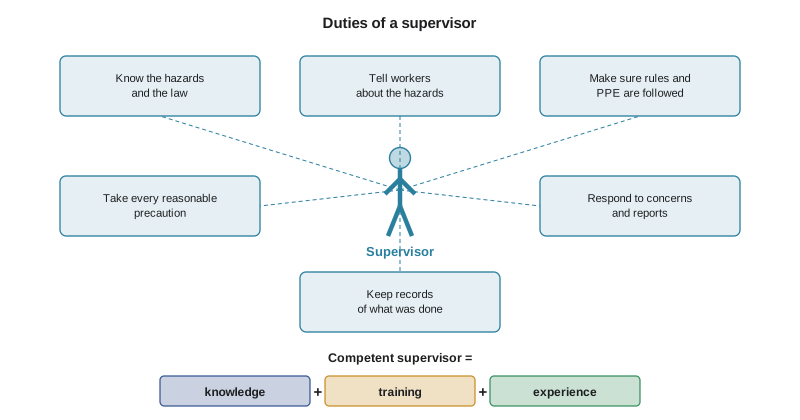
1. Know the hazards and the law that applies. A supervisor must know the hazards of the work they direct, the controls that are supposed to be in place, and the legal requirements that apply. Ignorance is not a defense: a supervisor who did not know that lockout was required on a machine he oversaw is in a worse position, not a better one, than one who knew and tried to enforce it.
2. Tell workers about the hazards. Supervisors must make sure each worker knows the hazards of their job and how to work safely, especially new and young workers, workers new to a task, and temporary or agency workers. This is more than handing out a procedure. It means showing, watching the worker do it, and checking again later.
3. Make sure workers follow the rules and use the controls. Supervisors must see that procedures are followed and that required protective equipment and devices are used. This means being present, checking, correcting on the spot and following up. A supervisor who knows a rule is routinely broken and does nothing is, in law, allowing the breach.
4. Take every reasonable precaution. Beyond specific rules, supervisors must use judgment to protect workers: noticing new hazards, stopping work that cannot be done safely, and not directing anyone to work in a way that endangers them. If the schedule cannot be met safely, the supervisor's duty is to the worker, not the schedule.
5. Respond to concerns, reports and refusals. When a worker raises a concern, reports a hazard or refuses unsafe work, the supervisor must respond promptly and properly: investigate, fix what can be fixed, escalate what cannot, and never retaliate. Lesson 5 covers refusals in detail.
6. Keep records. Supervisors should record what they do: inspections, training and coaching, corrections, hazards reported and how they were resolved. Records are how a supervisor shows, later, that the other five duties were met. Lesson 11 covers documentation.
The competent supervisor
Many OSHA standards use the term competent person, meaning someone capable of identifying existing and predictable hazards in the surroundings or working conditions and who has authorization to take prompt corrective measures to eliminate them. Others use qualified person, meaning someone who, by degree, certificate or professional standing, or by extensive knowledge, training and experience, has shown the ability to solve problems related to the subject matter. Both ideas share the same ingredients, and a good supervisor needs all of them, even where no standard requires a designation.
- Knowledge: of the work, the hazards, the controls and the law that applies.
- Training: in supervision itself, not only in the trade, including how to assess hazards, coach, investigate and respond to refusals.
- Experience: enough time doing and watching the work to recognize when something is wrong.
Dev's predecessor had plenty of experience and knowledge of the work, but no training in supervision or in the law. He did not know that his knowledge of skipped lockout made the company responsible, or that he had the authority, and the duty, to stop the work. He thought raising it verbally with management was all he could do. Competence is not only about knowing the job; it is about knowing what the role requires.
Authority to act
Competence also needs authority. The OSHA definition of a competent person explicitly includes authorization to take prompt corrective measures. A supervisor cannot be expected to control hazards they have no power to fix. For employers, that means giving supervisors real authority to stop work, a small budget for immediate fixes, and a clear and fast path to escalate. For supervisors, it means using that authority, and putting it in writing when the authority is not enough.
After the injury, Rachel gave every supervisor at Harrowgate Foods Inc. a written statement of their authority: to stop any work they believed was unsafe, without needing approval and without penalty for lost production; to spend up to a set amount on immediate safety fixes; and to escalate directly to the plant manager or Elena at any hour. Dev kept the card in his pocket. He used the stop-work authority twice in his first month, both times on the spiral when the incoming crew had started cleaning before lockout was verified.
Supervisors and personal liability
OSHA does not cite individual supervisors, and the Act's criminal provision in section 17(e) applies to employers. But supervisors can face consequences: internal discipline, loss of their position, and in rare and serious cases prosecution under other criminal laws where a death results from conduct that a prosecutor treats as reckless. Lesson 9 covers criminal liability. In practice, a supervisor's bigger risk is that their action or inaction becomes the evidence on which the company is cited, and that someone on their crew is hurt. The best protection is the habits in this lesson: know, tell, check, act, respond and record.
A supervisor's first 30 days
Elena gave Dev a list of things to do in his first month, and tracked them with him every week. The script below shows the plan and how far he had got by the end of week three.
# Dev's first-30-days plan and status at the end of week 3.
plan = [
    ("Read the Act's duties, refusal and reprisal sections", 1, True),
    ("Walk every task with the crew and note hazards", 1, True),
    ("Review lockout procedure for each machine with the crew", 2, True),
    ("Check each worker's training against the machines they clean", 2, True),
    ("Verify lockout personally on every spiral clean", 1, True),
    ("Agree authority card with the plant manager", 1, True),
    ("Attend a committee meeting", 3, True),
    ("Start a supervisor log for inspections and coaching", 1, True),
    ("Complete a supervisor investigation course", 4, False),
    ("Hold first crew safety talk on refusals and reporting", 3, False),
]
done = [p for p in plan if p[2]]
late = [p for p in plan if not p[2] and p[1] <= 3]
print(f"done {len(done)} of {len(plan)}")
for task, week, ok in plan:
    print(f"week {week}  {'done' if ok else 'open':<5} {task}")
print("overdue:", [t for t, w, ok in late])done 8 of 10 week 1 done Read the Act's duties, refusal and reprisal sections week 1 done Walk every task with the crew and note hazards week 2 done Review lockout procedure for each machine with the crew week 2 done Check each worker's training against the machines they clean week 1 done Verify lockout personally on every spiral clean week 1 done Agree authority card with the plant manager week 3 done Attend a committee meeting week 1 done Start a supervisor log for inspections and coaching week 4 open Complete a supervisor investigation course week 3 open Hold first crew safety talk on refusals and reporting overdue: ['Hold first crew safety talk on refusals and reporting']
The overdue item was the crew talk on refusals, which Dev had put off because he was unsure how to explain the process. Elena helped him plan it for the following week, using the material in lesson 5. The supervisor course was scheduled for week four, so it was not yet late.
Worked problem
What should Dev do when the day lead says 'just make it work'?
Show solution
- At 11 p.m., the day lead tells Dev the spiral must be back in service by 4:30 a.m., not 5:00, for a rush order.
- Dev knows the spiral clean with full lockout takes the full window. Cutting 30 minutes would force the crew to skip steps.
- He tells the day lead he will not shorten the clean, explains why, and offers to clean the spiral first so it is ready as early as is safe.
- He emails the plant manager with the request, his response and the reason, so the decision is on record.
- In the morning he raises the planning gap at the production meeting so rush orders account for the sanitation time.
Answer: Dev uses his authority to protect the crew, offers a safe alternative and puts the decision in writing.
New, young and temporary workers
Supervisors' duties are heaviest for workers who are new to the job, new to the task, young or temporary. Injury data consistently show that workers in their first months on a job are far more likely to be hurt than experienced workers, whatever their age. Federal child labor rules under the Fair Labor Standards Act bar workers under 18 from many hazardous jobs, including operating forklifts and most power-driven meat and bakery machines, and OSHA's temporary worker guidance stresses that host employers must train temporary staff as they would their own. At Harrowgate Foods Inc., seasonal and agency workers arrived at the distribution center every autumn for the holiday rush, and many had never driven a pallet jack or worked in a freezer.
Dev applied the same thinking on nights. Before any new or agency worker cleaned a machine, he paired them with an experienced crew member for at least three shifts, walked them through the lockout points himself, watched them perform a full lockout and verification, and signed off only when they could explain each step back to him. It took more of his time in the first week. It was also the clearest evidence he could have that he had told them about the hazards and made sure they could work safely.
Supervising across shifts
Night and weekend supervisors face a particular challenge: the people who can approve money, change schedules and fix equipment are usually at home. That makes the supervisor's own judgment and authority more important, not less. It also makes the handover between shifts a critical safety moment. Dev started a written shift handover with the day supervisor: open hazards, equipment out of service, refusals or concerns raised, and anything that needed a decision. Problems that had been passed on verbally, and forgotten, now arrived in writing and were followed up.
Common mistakes
MistakeThinking only people with 'supervisor' in their title have supervisor duties.
InsteadAnyone who directs others' work or can stop work is treated as a supervisor.
MistakeRaising a serious hazard verbally once and leaving it there.
InsteadMake the area safe, report in writing, escalate and follow up.
MistakeAssuming trade experience makes someone a competent supervisor.
InsteadCompetence needs knowledge, training in supervision and the law, and experience.
MistakeKeeping a rule on paper while knowing the crew breaks it.
InsteadA supervisor who knows and does nothing is allowing the breach.
MistakeLetting the schedule decide whether a safety step happens.
InsteadThe supervisor's duty is to the worker; offer a safe alternative and escalate the conflict.
Summary and key terms
- A supervisor is anyone who directs others' work or can stop work, whatever the title.
- Supervisors act as the employer's agents; their knowledge and conduct are generally attributed to the employer.
- Six expectations: know the hazards and law, tell workers, make sure rules are followed, take every reasonable precaution, respond to concerns, and keep records.
- Competence combines knowledge, training and experience, plus the authority to act.
- Employers should give supervisors written authority to stop work, a budget for fixes and a fast escalation path.
- The best protection for a supervisor is doing the job well and recording it.
- Supervisor
- A person who directs the work of others or has authority over how work is done.
- Competent person
- In OSHA standards, a person able to identify hazards and authorized to take prompt corrective measures.
- Qualified person
- In OSHA standards, a person with a recognized credential or extensive knowledge, training and experience in the subject.
- Imputed knowledge
- The legal rule that a supervisor's knowledge is generally treated as the employer's knowledge.
- Stop-work authority
- The authority, and duty, to stop work that cannot be done safely.
Practice problems
Work each problem on paper first, then reveal the answer to check.
What makes someone a supervisor in law?
Show answer
Directing the work of others, deciding how work is done, or having authority to stop work.
List the six expectations of a supervisor.
Show answer
Know the hazards and law, tell workers, make sure rules are followed, take every reasonable precaution, respond to concerns, keep records.
What were the three ingredients of competence, and which did Dev's predecessor lack?
Show answer
Knowledge, training and experience; he lacked training in supervision and the law.
Why is authority part of competence?
Show answer
A supervisor cannot control hazards without the power to fix them or stop the work.
What should a supervisor do when told to cut a safety step to meet a deadline?
Show answer
Refuse to cut it, offer a safe alternative, put the decision in writing and raise the planning problem.
Lesson quiz · 5 questions
Score 60% or more to complete this lesson.
Create a free account to save your progress, take quizzes and earn a certificate.