
HSE-402 · Lesson 3 of 12 · 20 min
Duties of employers
Rachel Okoye, the vice-president of operations, asked Elena for a plain-language list of what the law expects of Harrowgate Foods Inc. as an employer. 'Not the whole binder,' she said. 'One page I can put in front of the leadership team, so every manager and supervisor knows what we are promising.' Elena's page became the basis for this lesson. It is organized around a simple question that regulators and courts keep asking after something goes wrong: what did the employer do, before the incident, to make the work safe?
The general duty
At the top of every employer's list are the two duties in section 5(a) of the OSH Act: comply with the standards, and keep the workplace free of recognized hazards likely to cause death or serious physical harm. These duties are not guarantees that nobody will ever be hurt. But they require the employer to identify hazards covered by standards, to comply with those standards, and to address other serious recognized hazards with feasible controls. In practice, OSHA judges an employer by what it knew or should have known, what the standards and its industry required, and what it actually did.
The general duty then breaks down into more specific duties. They overlap, and a good safety program addresses all of them together.
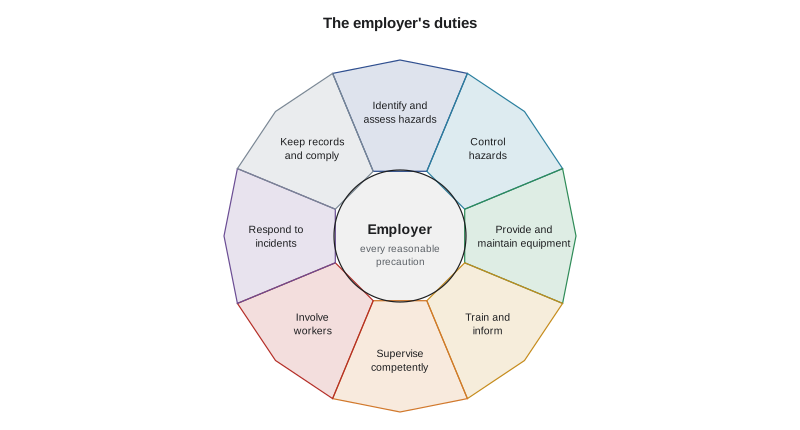
1. Identify and assess hazards
An employer cannot control a hazard it has not found. Several OSHA standards require specific hazard assessments: for example, the personal protective equipment standard in 1910.132(d) requires a written certification that the workplace has been assessed for hazards requiring PPE, and the lockout standard requires machine-specific energy control procedures. More broadly, OSHA's recommended practices for safety and health programs make hazard identification a core element. In practice that means walking the workplace, looking at each task, talking to the people who do it, reviewing incident and near-miss reports, reading safety data sheets and manuals, and repeating the exercise when things change.
At Harrowgate Foods Inc., the hazard assessment for night sanitation had been done three years earlier by the day-shift safety coordinator, using the written procedure rather than observing the actual work. It listed lockout as the control for the spiral conveyor but did not notice that the disconnect was on a far mezzanine, or that the cleaning window had been cut from four hours to two and a half. A hazard assessment that describes work as imagined, rather than work as done, gives a false sense of security.
2. Control hazards using the hierarchy of controls
Once hazards are found, the employer must control them. The accepted order of preference is the hierarchy of controls: eliminate the hazard if possible; substitute something less hazardous; use engineering controls such as guards, interlocks and ventilation; use administrative controls such as procedures, training, signs and scheduling; and, as the last line of defense, provide personal protective equipment. Regulators and courts expect employers to work down this list and to explain why a higher-level control was not practicable before relying on procedures and PPE.
For the spiral conveyor, Harrowgate Foods Inc.'s response after the injury followed the hierarchy. Engineering: a lockable disconnect was installed at floor level beside the spiral, and an interlocked access gate was added so that opening it stopped the drive. Administrative: the sanitation schedule was extended back to four hours, the lockout procedure was rewritten with the crew and posted at the machine, and supervisors were required to verify lockout on every spiral clean. PPE: cut-resistant sleeves were issued for jam clearing. The engineering changes did most of the work; the procedure and PPE backed them up.
3. Provide and maintain equipment, materials and protective devices
The employer must provide and maintain equipment, machines and protective devices in safe condition, and must pay for most required PPE. OSHA's 2007 rule on employer payment for PPE requires employers to pay for protective equipment used to comply with OSHA standards, with limited exceptions such as ordinary safety-toe footwear and prescription safety eyewear worn off the job. Maintenance is part of the duty: a guard that was safe when installed but has since been damaged is no longer compliant, and OSHA cites the condition, not the date it was bought.
4. Inform, instruct and train
Many OSHA standards require training: lockout (1910.147(c)(7)), hazard communication (1910.1200(h)), powered industrial trucks (1910.178(l)), bloodborne pathogens, permit-required confined spaces and others. OSHA expects training to be presented in a manner and language employees understand, to be specific to their jobs and equipment, and to be refreshed when processes change or when there is reason to believe a worker lacks the needed knowledge. A sign-in sheet proves attendance; it does not prove understanding.
The spiral conveyor investigation found that the injured worker had attended annual lockout training. But the training was a classroom video covering lockout in general, not the specific disconnects, procedures and verification steps for the machines his crew actually cleaned. He knew the rule; he had never been shown how to follow it in the two and a half hours the schedule allowed. Training that does not match the job does not meet the duty.
5. Supervise competently
OSHA standards often require that certain tasks be done or overseen by a competent person or qualified person, and the employer is responsible for designating them. More broadly, effective supervision is how an employer shows that its rules are actually enforced, which is central to the unpreventable employee misconduct defense discussed in lesson 8. Lesson 4 looks at what this means for supervisors. For employers, the duty is to choose supervisors carefully, train them, give them time and authority, and check that they are doing it.
6. Involve workers
Federal OSHA does not require safety committees, although some state plans do. But worker involvement is a core element of OSHA's recommended practices, and the Act protects workers who raise safety concerns, request inspections and take part in them. At Harrowgate Foods Inc., the safety committees at each site were voluntary but treated as central: Rachel had committed to respond in writing to every committee recommendation within 21 days, matching the practice in many Canadian provinces.
7. Respond to incidents and emergencies
Employers must report fatalities to OSHA within 8 hours and in-patient hospitalizations, amputations and losses of an eye within 24 hours, keep injury and illness records under part 1904, provide medical and first aid services under 1910.151, and maintain emergency action plans where standards require them. Lesson 10 covers recordkeeping and reporting in detail. Investigating incidents is not itself a general OSHA requirement for every case, but it is expected practice, and OSHA will ask what the employer learned and changed after earlier incidents.
8. Comply, and make sure others comply
Finally, the employer must comply with the law and make sure its supervisors and workers comply. That means having rules, communicating them, checking that they are followed, and responding consistently when they are not. A rule that is routinely broken with supervisors' knowledge is, in practice, not a rule at all, and courts and regulators treat it that way.
Turning duties into a checklist
Elena turned the eight duties into a simple self-assessment for each department. Supervisors scored each duty from 0 (not in place) to 3 (in place, documented and verified), and the scores were reviewed with the plant manager. The point was not the score but the conversation about the gaps.
# Self-assessment of employer duties for night sanitation, before and after changes (0 to 3).
duties = ["identify hazards", "control hazards", "equipment", "train and inform",
          "supervise", "involve workers", "respond to incidents", "comply and enforce"]
before = [1, 1, 2, 1, 0, 1, 2, 0]
after  = [3, 3, 2, 3, 2, 2, 3, 2]
print(f"{'duty':<22}{'before':>7}{'after':>7}")
for d, b, a in zip(duties, before, after):
    flag = "  <- still a gap" if a < 3 else ""
    print(f"{d:<22}{b:>7}{a:>7}{flag}")
print(f"{'total (max 24)':<22}{sum(before):>7}{sum(after):>7}")duty before after identify hazards 1 3 control hazards 1 3 equipment 2 2 <- still a gap train and inform 1 3 supervise 0 2 <- still a gap involve workers 1 2 <- still a gap respond to incidents 2 3 comply and enforce 0 2 <- still a gap total (max 24) 8 20
The before scores showed where the system had failed: supervision and enforcement scored zero because the previous supervisor had tolerated skipped lockout, and training and hazard assessment scored one because they described work as imagined. The after scores showed progress but also honest gaps. Equipment stayed at two because older machines still had disconnects in awkward places, and worker involvement at two because the night crew had only just started sending a member to the committee.
Worked problem
Applying the hierarchy to a chemical splash risk
Show solution
- Hazard: sanitation workers mix concentrated caustic cleaner by hand in buckets, with occasional splashes to the face.
- Elimination or substitution: can a less corrosive cleaner do the job? The sanitation chemical supplier offers a milder product for most surfaces.
- Engineering: install a wall-mounted dilution system so workers never handle concentrate directly.
- Administrative: written mixing procedure, labeled secondary containers, eyewash checks every shift.
- PPE: face shield and chemical gloves for the remaining tasks that use concentrate.
Answer: Working down the hierarchy removed most of the exposure before relying on procedures and PPE.
Duties to people who are not employees
OSHA's duties run mainly to the employer's own employees, but the multi-employer policy means Harrowgate Foods Inc. can be cited for hazards it creates or controls that expose other employers' workers, such as contractors and agency staff. Other duties come from different laws: premises liability under Georgia law for visitors and the public, and food safety rules for auditors and inspectors. For Harrowgate Foods Inc., these overlapping duties showed up at the loading docks, where truck drivers waited in the yard while forklifts moved, and in the plants, where equipment technicians and cleaning contractors worked alongside employees. The practical response is the same: identify the hazards they face, control them, and give them the information they need.
Duties that cannot be delegated
Employers often hire consultants, contractors and staffing agencies to help with safety. That is sensible, and the law expects employers to use expertise they do not have in-house. But the core duty cannot be handed off. If a consultant writes the lockout program and it is wrong, the employer still answers for it. If a contractor performs maintenance unsafely in the employer's plant, the employer may still be responsible for failing to coordinate and check. Elena's rule for Harrowgate Foods Inc. was that every contractor and consultant could advise and help, but a named Harrowgate Foods Inc. manager always owned each hazard and each control.
Resources and time are part of the duty
One finding from the spiral conveyor investigation changed how Rachel talked to the leadership team. The night crew had the training, the procedure and the locks. What they did not have was time. When a company sets a schedule that cannot be met without skipping a safety step, it has created the hazard as surely as if it had removed the guard. Courts and regulators look at whether the employer gave people the resources, staffing and time needed to work safely, not only at whether the rules existed on paper. Rachel added a line to the one-page list: 'If we set the target, we own the trade-offs it forces.'
Dev took that line seriously. When the bakery planned to add a fourth bread variety to the morning run, he asked how the extra changeover would affect the sanitation window before the change was approved, and the schedule was adjusted in advance instead of after a near miss. Asking that question early is part of what competent supervision looks like, and it is the subject of the next lesson.
Common mistakes
MistakeTreating training as the main control for a serious hazard.
InsteadUse elimination, substitution and engineering first; training and PPE back them up.
MistakeWriting hazard assessments from procedures instead of watching the work.
InsteadAssess work as done, with the people who do it, and update when things change.
MistakeCounting a training sign-in sheet as proof of competence.
InsteadCheck understanding and on-the-job performance, and match training to the specific equipment.
MistakeKeeping rules that are routinely broken with supervisors' knowledge.
InsteadEither make the rule workable and enforce it consistently, or change it.
MistakeFixing the immediate cause of an incident and stopping there.
InsteadCorrect the system causes, such as schedules, equipment layout and supervision.
Summary and key terms
- Employers must comply with standards and keep the workplace free of recognized serious hazards.
- Employers must find and assess hazards, ideally with the people who do the work, and write the assessment down.
- Controls should follow the hierarchy: elimination, substitution, engineering, administrative, then PPE.
- Employers must provide safe equipment, pay for most required PPE, and train in a language and manner workers understand.
- Worker involvement is a core recommended practice, and the Act protects workers who raise concerns.
- Rules must be communicated, checked and enforced consistently, or they are not really rules.
- Hierarchy of controls
- The preferred order of controls: elimination, substitution, engineering, administrative, PPE.
- Hazard assessment
- A systematic, written review of the hazards of tasks and the controls needed.
- Engineering control
- A physical change, such as a guard or interlock, that reduces exposure without relying on people.
- Administrative control
- A procedure, schedule, sign or training that changes how people work.
- Work as done
- How a task is really performed, as opposed to how procedures describe it.
- Personal protective equipment
- Equipment worn by a worker, such as gloves or face shields, as the last line of defense.
Practice problems
Work each problem on paper first, then reveal the answer to check.
What are the two employer duties in section 5(a)?
Show answer
Comply with OSHA standards and keep the workplace free of recognized serious hazards.
Why was the old night sanitation hazard assessment inadequate?
Show answer
It described the procedure rather than the real work, missing the far disconnect and the shortened cleaning window.
List the hierarchy of controls from most to least effective.
Show answer
Elimination, substitution, engineering, administrative, personal protective equipment.
What did the injured worker's training lack?
Show answer
It was generic and did not cover the specific disconnects, procedures and verification for his machines.
Why did supervision score zero in the self-assessment?
Show answer
The previous supervisor had tolerated skipped lockout, so the rule was not enforced.
Lesson quiz · 5 questions
Score 60% or more to complete this lesson.
Create a free account to save your progress, take quizzes and earn a certificate.