
HSE-395 · Lesson 9 of 12 · 22 min
Outbreaks and surge planning
▶ Video coming soon A video version of this lesson is on the way.
Most emergencies in a hospital are over in hours. An infectious disease outbreak can last weeks, and a pandemic can last years. Outbreaks are also unusual in that the hazard spreads through the people who are supposed to respond: staff become ill, staff stay home with sick children, staff are frightened of taking the illness home. The COVID-19 pandemic showed hospitals and care homes across North America how much an outbreak can strain space, staff, supplies and people's endurance. This lesson covers how facilities detect and manage outbreaks, how they plan for a surge of patients that lasts weeks, and how they protect the staff who carry the load.
What an outbreak is
An outbreak is an increase in cases of an infection above what is normally expected in a particular place and time, or a cluster of cases linked to each other. In a hospital or long-term care home, a handful of linked cases can be an outbreak, because patients and residents are vulnerable, live close together and share staff. Common outbreaks in healthcare include:
- Respiratory infections, such as influenza, COVID-19 and respiratory syncytial virus, especially in winter.
- Gastrointestinal infections, such as norovirus, which spreads quickly through vomiting and diarrhea and through contaminated surfaces.
- Antibiotic-resistant organisms, such as carbapenemase-producing organisms, spreading between patients on a unit.
- Clostridioides difficile infection, linked to antibiotic use and spread by spores on surfaces.
- Less often, infections such as scabies, measles or tuberculosis, and rare high-consequence infections such as viral hemorrhagic fevers.
In Minnesota, hospitals and nursing homes report outbreaks and certain diseases to the Minnesota Department of Health, which advises on control measures and tracks outbreaks across the state, using guidance from the CDC. Nursing homes also report certain infections to CMS through national systems, and infection prevention and control is part of CMS conditions of participation.
Detecting an outbreak early
The sooner an outbreak is recognized, the fewer people get sick. Detection depends on staff noticing and reporting patterns: three residents vomiting on the same home area in a day, several patients on a unit with new fevers and coughs, or a lab result that matches another from last week. The infection prevention and control team reviews lab results, symptom reports and admissions every day, a process called surveillance, and looks for clusters.
Every worker has a part to play. Staff report new symptoms in patients promptly, follow the screening and testing procedures on admission, and report their own symptoms and stay home when they are ill. Presenteeism, working while sick, is a common way outbreaks spread among staff and to patients, and it happens most when staff feel they cannot afford to stay home or their unit is short.
Managing an outbreak
When an outbreak is suspected, an outbreak management team meets right away. At Northbridge it includes infection prevention and control, the unit managers involved, the medical lead, Employee Health and Safety, environmental services, communications, and, for confirmed outbreaks, the public health unit. The team decides on the control measures, which usually include:
- Case finding: identifying everyone with symptoms, testing as advised, and keeping a line list of cases with dates of onset.
- Isolation and cohorting: placing ill patients in single rooms or grouping them together, with dedicated staff where possible.
- Restricting admissions and transfers to and from the affected area, and closing it to new admissions if needed.
- Enhanced cleaning, with the right disinfectant for the organism and more frequent cleaning of frequently touched surfaces.
- Additional precautions and PPE matched to how the infection spreads.
- Hand hygiene audits and reminders.
- Visitor guidance and, when needed, limits on visiting, balanced against the harm that isolation does to patients and residents.
- Staff measures: excluding ill staff for a set time, limiting staff movement between affected and unaffected areas, and offering vaccines or treatment where available.
- Communication with staff, patients, families and the public.
The team meets regularly until public health or the infection control team declares the outbreak over, usually after a set time has passed with no new cases.
In February, the Cedar home area at Maple Court had a norovirus outbreak. Infection control kept a line list and plotted the cases by day of onset. The curve, built from the list, helped the team judge whether the controls were working.
# Cedar norovirus outbreak: new cases by day of onset
residents = [3, 5, 4, 2, 1, 0, 1, 0, 0]   # days 1 to 9
staff     = [1, 2, 3, 1, 0, 0, 0, 0, 0]
CEDAR_RESIDENTS = 24
CEDAR_STAFF = 31

for day, (r, s) in enumerate(zip(residents, staff), start=1):
    print(f"day {day}: " + "R" * r + "S" * s)

print()
r, s = sum(residents), sum(staff)
print(f"residents ill: {r} of {CEDAR_RESIDENTS} "
      f"(about {round(100 * r / CEDAR_RESIDENTS)} in 100)")
print(f"staff ill:     {s} of {CEDAR_STAFF} "
      f"(about {round(100 * s / CEDAR_STAFF)} in 100)")
last = max(d for d, n in enumerate(zip(residents, staff), 1) if sum(n))
print(f"last case on day {last}")day 1: RRRS day 2: RRRRRSS day 3: RRRRSSS day 4: RRS day 5: R day 6: day 7: R day 8: day 9: residents ill: 16 of 24 (about 67 in 100) staff ill: 7 of 31 (about 23 in 100) last case on day 7
The curve peaked on day 2 and fell after the team cohorted ill residents, stopped communal dining in Cedar, switched to a disinfectant that works against norovirus, and excluded ill staff until 48 hours after their symptoms ended. Seven staff were ill, most in the first four days, which left the home area short at the worst moment; the hospital sent two float staff who had not worked in Cedar that week. The single late case on day 7 was a resident who had been exposed before the cohorting started. With no new cases in the time set by public health after day 7, the outbreak was declared over.
Outbreaks in long-term care
Long-term care homes carry a heavy share of the harm from outbreaks. Residents are old and frail, many have dementia and cannot follow precautions or stay in their rooms, they share dining rooms and lounges, and staff move between them all day. During the first waves of COVID-19, homes in Ontario, Minnesota and across North America had far higher death rates than the community around them, and reviews afterwards pointed to the same problems: crowded rooms with three or four residents, staff working in several homes, too few staff, shortages of PPE, and weak infection control programs.
Maple Court's plan now builds on those lessons. Every home area has an infection prevention lead among its staff, rooms have no more than two residents, staff who work in more than one setting are tracked so that exposures can be traced, and the home keeps its own stock of PPE. The plan also recognizes the harm of isolation. Residents confined to their rooms for weeks during outbreaks lost weight, mobility and the will to eat, and families were kept from people who were dying. During outbreaks, Maple Court now keeps designated essential caregivers able to visit with PPE and training, and staff plan activity and contact for residents in isolation, instead of closing the doors and waiting.
Surge planning: conventional, contingency and crisis
A large outbreak or a pandemic produces a surge that lasts weeks or months, not hours. Planners describe the response as a continuum with three levels of care.
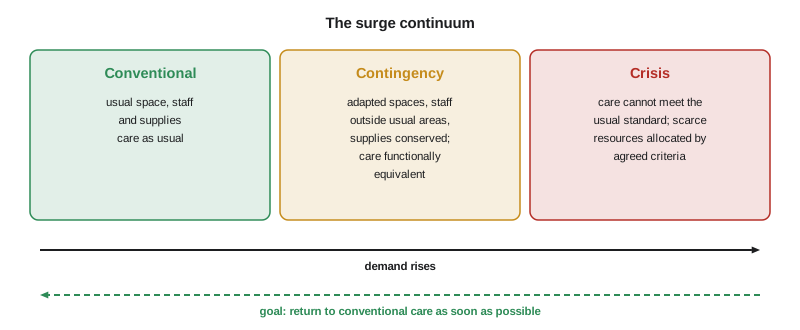
- Conventional care uses the usual spaces, staff and supplies, perhaps with more of them, and care is delivered as usual.
- Contingency care adapts: recovery rooms become ICU beds, staff work in unfamiliar areas with support and supervision, supplies are conserved, substituted or reused where safe. Care is functionally equivalent to usual care, even if it looks different.
- Crisis care happens when demand overwhelms what can be adapted, and care cannot be given to the usual standard. Scarce resources, such as ICU beds or ventilators, may have to be allocated using agreed criteria, with the goal of the best outcomes for the population rather than each individual. These decisions are guided by provincial or state crisis standards of care, made by trained teams rather than individual clinicians at the bedside, and reviewed as conditions change.
The aim is always to delay crisis care as long as possible and return to conventional care as soon as possible. Most of the planning work is about building contingency capacity in advance so that crisis care is never needed.
Staff: the hardest resource to replace
Beds can be borrowed and ventilators shipped in, but trained staff cannot be created quickly. Surge plans therefore spend a lot of attention on staff:
- Redeployment: staff from paused services, such as day surgery and clinics, work on inpatient units, often in team-based models in which an experienced nurse leads a team that includes redeployed staff.
- Cross-training before a surge, so that staff have some familiarity with other areas.
- Extending scope where rules allow, such as students, retired staff and other health professionals.
- Protecting staff health: vaccines, PPE and fit testing, testing and clear rules for when ill or exposed staff stay home and return.
- Practical support: childcare, parking, food, rest areas, accommodation for staff who do not want to go home and risk exposing family.
- Mental health support: the long surges of COVID-19 led to burnout and moral distress, especially when staff could not give the care they believed patients needed. Plans now include peer support, access to counseling, reasonable hours and honest communication from leaders.
PPE and supplies
Early in the COVID-19 pandemic, hospitals and care homes ran short of N95 respirators, gowns, gloves and disinfectant, because supply chains depended on a few overseas manufacturers and demand rose everywhere at once. Since then, facilities and governments have built stockpiles and changed purchasing. At Northbridge, the logistics team now:
- Keeps a rolling stock of key PPE and supplies, used and replaced in rotation so that it does not expire.
- Tracks daily use of critical items during an outbreak, so it can see how many days of supply are left.
- Fit tests staff on more than one model of respirator, so a change in supplier does not leave staff without a tested model.
- Has written plans for extended use or reuse of some PPE in contingency and crisis conditions, based on public health guidance, so that decisions are not improvised.
- Takes part in regional purchasing and sharing agreements.
High-consequence infectious diseases
Some infections are rare but so serious that one case needs a special response, such as Ebola and other viral hemorrhagic fevers, or a new strain of avian influenza spreading between people. Every hospital must be able to identify a possible case, isolate the person right away and inform infection control and public health, a sequence often summarized as identify, isolate, inform. Emergency departments screen patients for symptoms and travel or exposure history, and have a room and PPE ready for the first hour. Most such patients are then transferred to designated treatment centers with specially trained teams.
Worked problem
A respiratory outbreak on 4 West
In January, three patients on 4 West develop fever and cough within 36 hours, and two test positive for influenza A. One nurse calls in sick with similar symptoms. What should happen?
Show solution
- The charge nurse reports the cases to infection control, who confirm the cluster and call an outbreak management team meeting that day, and notify public health as required.
- Ill patients are placed on droplet and contact precautions in single rooms or cohorted, and the unit stops new admissions and transfers until the team decides otherwise.
- Infection control finds other cases, starts a line list, and arranges antiviral treatment or prevention as advised; staff are reminded of vaccination, and ill staff stay home until they meet the return-to-work criteria.
- Environmental services increases cleaning of frequently touched surfaces, visitors are told about the outbreak and asked to stay away if ill, and the team meets daily until the outbreak is declared over.
Answer: Report early, convene the outbreak team, isolate and cohort, restrict admissions, find cases, protect and support staff, clean more, communicate, and continue until the outbreak is declared over.
Common mistakes
MistakeComing to work with vomiting or a fever because the unit is short.
InsteadStay home, report your symptoms and follow the return-to-work criteria.
MistakeWaiting for lab confirmation before isolating patients with symptoms.
InsteadStart precautions as soon as symptoms suggest an infection.
MistakeUsing a disinfectant that does not work on the organism.
InsteadChoose the product recommended for the organism, such as one effective against norovirus or spores.
MistakeFit testing staff on only one respirator model.
InsteadFit test on more than one model so supply changes do not leave staff unprotected.
MistakeLeaving crisis care decisions to individual clinicians in the moment.
InsteadUse agreed crisis standards of care and trained triage teams.
Summary and key terms
- An outbreak is more cases than expected, or linked cases, and can be just a few cases in a healthcare facility.
- Minnesota facilities report outbreaks to the Minnesota Department of Health, using CDC guidance.
- Early detection depends on surveillance and on staff reporting symptoms and staying home when ill.
- Outbreak control includes case finding, isolation and cohorting, admission limits, cleaning, PPE, visitor guidance and staff measures.
- Surge care moves from conventional to contingency to crisis; planning aims to avoid crisis care.
- Staff are the hardest resource to replace; plans cover redeployment, protection, practical support and mental health.
- PPE stockpiles, tracking, fit testing on several models and regional agreements guard against shortages.
- Outbreak
- An increase in cases above what is expected, or a cluster of linked cases.
- Surveillance
- The ongoing review of data to detect infections and clusters early.
- Cohorting
- Grouping patients with the same infection together, with dedicated staff.
- Line list
- A table of cases in an outbreak with key details such as date of onset.
- Attack rate
- The share of a group at risk who become ill during an outbreak.
- Crisis standards of care
- Agreed rules for allocating scarce resources when care cannot meet usual standards.
Practice problems
Work each problem on paper first, then reveal the answer to check.
Why can a few linked cases count as an outbreak in a care home?
Show answer
Residents are vulnerable, live close together and share staff, so infections spread easily.
What is presenteeism, and why does it matter in outbreaks?
Show answer
Working while sick; it spreads infections to patients and colleagues.
Name four outbreak control measures.
Show answer
Any four of case finding, isolation and cohorting, restricting admissions, enhanced cleaning, PPE, hand hygiene, visitor guidance and staff exclusion.
What were the resident and staff attack rates in the Cedar outbreak?
Show answer
About 67 in 100 residents (16 of 24) and about 23 in 100 staff (7 of 31).
What is the difference between contingency and crisis care?
Show answer
Contingency care adapts but stays functionally equivalent to usual care; crisis care cannot meet the usual standard and allocates scarce resources by agreed criteria.
What three steps should every hospital take for a possible high-consequence infection?
Show answer
Identify, isolate and inform.
Lesson quiz · 5 questions
Score 60% or more to complete this lesson.
Create a free account to save your progress, take quizzes and earn a certificate.