
HSE-395 · Lesson 7 of 12 · 22 min
Hazardous spills and decontamination
▶ Video coming soon A video version of this lesson is on the way.
Hazardous materials reach a hospital in two ways. Most spills start inside: a jug of formalin dropped in the lab, a leaking bag of a cancer drug, a broken thermometer in an old storage room, a cleaning product mixed too strong. Far less often, the hazard arrives from outside, on people: workers splashed in an industrial accident, farm families exposed to a pesticide, or dozens of people coated with a chemical after a train derailment or a deliberate release. Inside spills are a test of everyday preparation; outside contamination is a test of the whole emergency plan. This lesson covers both, from the spill kit on a unit to a decontamination area at the emergency department doors.
Spills inside the building
A facility alert for a hazardous material spill at Northbridge is called for a spill inside the facility that needs more than routine cleanup: a spill of a hazardous chemical, a hazardous drug spill larger than the unit can handle, a release of a gas, or any spill where staff are unsure of the hazard.
Not every spill needs a code. Northbridge sorts spills into two kinds:
- Minor spills: a small amount of a known product, which trained staff on the unit can clean up safely with the spill kit and the PPE listed on the safety data sheet. Examples include a small amount of disinfectant, a broken specimen container of formalin in a ventilated area, or a small hazardous drug spill handled under the hazardous drug procedure.
- Major spills: a large amount, an unknown product, a highly toxic or flammable product, a gas, a spill in a public area or near patients who cannot be moved, or any spill that has injured someone or that staff are not trained or equipped to handle. These call for the code and the spill response team.
The steps for any spill follow the same order:
- Protect people: warn others, move patients, visitors and staff away, and help anyone who has been splashed to an eyewash or safety shower.
- Isolate the area: close doors, block off the area with signs or barriers, and keep people out.
- Identify the product: check the label and safety data sheet, which tell you the hazards, the PPE needed and how to clean up.
- Call: for a major spill, call the code with the product, amount and location. For any spill, report it.
- Control and clean: only trained people with the right PPE contain and clean up the spill, working from the outside in, and put waste in the right containers.
- Ventilate and recover: let the area air out as directed, check that it is safe before reopening, restock the spill kit and complete the incident report.
Some products need special care. Flammable liquids such as xylene or alcohols need ignition sources removed. Spilled formalin releases formaldehyde vapor that irritates the eyes and airways, so large spills need respiratory protection. Mercury from older thermometers and blood pressure devices must never be vacuumed or swept, because that spreads the vapor; mercury spill kits use special sponges and powders. Mixing bleach with ammonia or acids releases toxic gases, which is why spills of cleaning products should not be wiped up with another cleaning product.
Joanne Pelletier keeps a log of spill reports at Northbridge. Last year there were 34, of which 29 were minor spills handled on the unit and 5 were codes. Three of the five codes were formalin spills in the lab and pathology, one was a refrigerant leak in a mechanical room and one was a chlorine gas release in a janitor's closet when two products were mixed. The response team arrived within 6 minutes on average.
The spill response team
Northbridge's spill response team is drawn from maintenance, security, environmental services, the laboratory and Employee Health and Safety, with at least two trained members on every shift. Team members are trained to a level that matches their role, with fit-tested respirators, chemical-resistant suits, gloves and boots, monitoring equipment for some gases, and larger spill kits. For spills beyond what the team can safely handle, such as a large release of a toxic gas, the team isolates the area and calls the fire department's hazardous materials team.
In the United States, OSHA's HAZWOPER standard (29 CFR 1910.120) covers workers who respond to releases of hazardous substances, with training levels that depend on the role. Workers who clean up minor spills of products they use every day are covered by HazCom training instead. The fire department's hazardous materials team responds to larger releases.
When contaminated patients arrive
A chemical, biological or radiological release in the community can send many contaminated people to the hospital at once. The biggest danger for the hospital is that contaminated people walk in before anyone knows there has been a release. In past events around the world, most people affected did not wait for ambulances: they drove, walked or were brought by friends to the nearest hospital, often still wearing contaminated clothing. In the 1995 sarin attack on the Tokyo subway, the hospital that received the most casualties saw many patients arrive on foot or by taxi, and many of its staff became ill from the vapor coming off patients' clothing in poorly ventilated areas.
That history shapes the response. Staff must recognize a possible contamination event early, stop contaminated people from entering the emergency department, and decontaminate them outside before treatment, while protecting themselves. Signs that suggest a chemical release include several people arriving at once with similar symptoms, such as burning eyes, coughing, trouble breathing, twitching or seizures; an unusual smell on clothing; or reports of a spill, fire or explosion nearby.
At Northbridge, staff who suspect that arriving patients are contaminated keep them outside, call the switchboard for a facility alert for contaminated patients, and lock down the emergency department entrance, directing people to the decontamination area at the side of the ambulance bay.
Decontamination zones
Decontamination is set up in zones, so that contamination moves in only one direction: from dirty to clean.
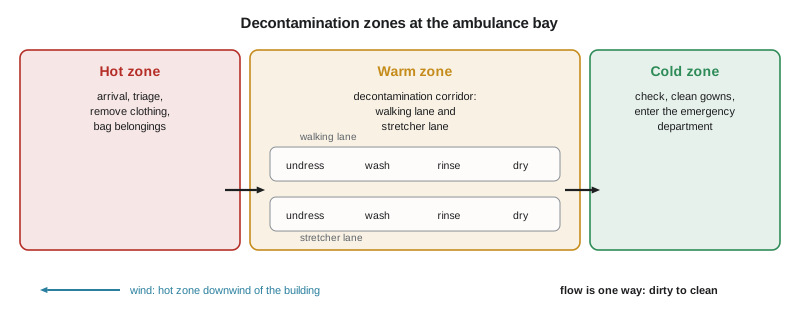
- The hot zone is the arrival point, where contaminated people are met, triaged and directed. It is outside, downwind and downhill of the building where possible.
- The warm zone is the decontamination corridor itself, with separate lanes for people who can walk and people who must lie down. Staff here wear protective equipment.
- The cold zone is the clean area, where decontaminated people are checked, given clean gowns or clothing and taken into the hospital for treatment.
Patients who need life-saving treatment, such as opening an airway, stopping heavy bleeding or giving an antidote for nerve agent poisoning, may get it in the hot or warm zone from staff in protective equipment before decontamination is complete. Treatment and decontamination go on side by side.
Removing contamination
The single most important step in decontamination is taking off contaminated clothing. Removing clothing, including shoes and jewelry, removes most of the contamination for most chemicals, so it should happen as early as possible, even before washing. Clothing is placed in labeled bags, which are sealed and kept for police or for testing, with personal items such as phones and wallets bagged separately and tagged with the person's name.
After clothing comes off, staff choose between dry and wet decontamination:
- Dry decontamination: blotting and wiping exposed skin with absorbent material, such as dry towels or wipes. It is the starting point for most chemical exposures, unless the person has symptoms of a liquid chemical on the skin or the substance is caustic.
- Wet decontamination: washing with lukewarm water at low pressure, usually with mild soap, from head to toe, followed by rinsing and drying. It is used for caustic chemicals, for people who have symptoms from a chemical on their skin, and when dry decontamination is not enough. Water that is too hot opens skin pores, and water that is too cold can cause hypothermia, especially in children and older adults.
Children, older people, people with disabilities and people who cannot follow instructions need help, privacy and reassurance. Families should be kept together where possible. Privacy screens, gender-separated lanes where feasible, and clear, repeated instructions in plain language, with pictures for people who do not speak the local language, all help people cooperate.
Protecting staff
Staff who work in the hot and warm zones wear protective equipment chosen for the likely hazards. OSHA's guidance for hospital first receivers recommends, as a minimum for most situations, a powered air-purifying respirator with a hood, a chemical-resistant suit, double chemical-resistant gloves and boots. This level of protection is suited to contaminated people who have already left the release site, not to the release site itself, where fire department hazardous materials teams use self-contained breathing apparatus. Team members must be trained to the right HAZWOPER level, fit and practiced: working in a suit and hood is hot and tiring, and staff are limited to short shifts with rest, fluids and monitoring of their vital signs.
How many people can we decontaminate?
Grant Ellison uses the throughput of each lane to plan how many people the decontamination area can handle and how many staff it needs. People who can walk are much faster to decontaminate than those on stretchers.
# Decontamination throughput at the Northbridge ambulance bay
walk_lane_per_hour = 30       # people who can walk, with 4 staff
stretcher_lane_per_hour = 6   # people on stretchers, with 6 staff

def hours_needed(walking, stretcher, walk_lanes=1, stretcher_lanes=1):
    w = walking / (walk_lane_per_hour * walk_lanes)
    s = stretcher / (stretcher_lane_per_hour * stretcher_lanes)
    return max(w, s)

scenarios = [("bus of farm workers", 38, 4), ("rail car leak, town", 120, 15)]
for name, walking, stretcher in scenarios:
    for lanes in (1, 2):
        h = hours_needed(walking, stretcher, lanes, lanes)
print(f"{name:22} lanes x{lanes}: about {h * 60:4.0f} minutes")bus of farm workers lanes x1: about 76 minutes bus of farm workers lanes x2: about 38 minutes rail car leak, town lanes x1: about 240 minutes rail car leak, town lanes x2: about 120 minutes
The numbers show where the bottleneck is. For a bus of 38 farm workers exposed to a pesticide, one walking lane would take a little over an hour, and doubling the lanes would cut that in half, because most of them can walk. For a larger release in town, 120 people who can walk would take four hours through one lane, and the 15 people on stretchers would take two and a half hours through theirs. Two lanes of each bring the total down to about two hours, which is still a long wait for people with burning skin, so the plan adds the second lanes, staffed by the hospital's trained team, and asks the fire department to decontaminate as many people as possible at the scene.
Biological and radiological events
Not every release needs washing. For most biological agents, such as a powder in an envelope, people who were near it need to remove their clothing and wash with soap and water, but the main concern is identifying who was exposed and giving treatment or protection where needed. Infectious diseases, covered in the lesson on outbreaks, need isolation rather than decontamination.
For radiological contamination, such as from a damaged industrial source or a dirty bomb, the same principles apply: life-saving treatment first, because radioactive contamination is rarely an immediate danger to staff wearing basic protective equipment; then removing clothing, which removes most of the contamination; then washing. The hospital's radiation safety officer, Dr. Helen Ward, uses survey meters to check people and areas, and staff wear personal dosimeters. Contaminated water and clothing are collected for disposal as directed.
Worked problem
The chlorine gas in the janitor's closet
Marta Kowalski opens a janitor's closet on 3 East and finds a strong smell of chlorine and a colleague coughing and wiping her eyes. Two cleaning products have spilled from a shelf and mixed in the floor drain. What should Marta do?
Show solution
- Marta gets her colleague out of the closet and away from the area, closes the closet door, and warns staff nearby.
- She calls 5555 for a hazardous material spill: a chlorine smell from mixed cleaning products, janitor's closet on 3 East, one worker exposed.
- Her colleague is taken to the emergency department for assessment, and staff close patient room doors near the closet while the spill team arrives with respirators.
- The spill team ventilates the closet, neutralizes and cleans up the products, and the review leads to storing acidic and chlorine-based products on separate shelves with spill trays.
Answer: Get people out, close the door, call the spill code, get the exposed worker care, and let the trained team deal with the spill.
Common mistakes
MistakeCleaning up a spill of an unknown product with paper towels.
InsteadIsolate the area, check the label and safety data sheet, and call the code if unsure.
MistakeVacuuming or sweeping spilled mercury.
InsteadUse a mercury spill kit, which avoids spreading the vapor.
MistakeLetting contaminated people walk into the emergency department waiting room.
InsteadKeep them outside and decontaminate them before they enter.
MistakeWashing people before removing their clothing.
InsteadRemove clothing first; it removes most of the contamination.
MistakeUsing hot water at high pressure for decontamination.
InsteadUse lukewarm water at low pressure.
Summary and key terms
- Minor spills of known products are cleaned up by trained unit staff; major spills call the code and the spill team.
- For every spill: protect people, isolate, identify the product, call, control and clean, then ventilate and recover.
- Contaminated people often arrive on their own, before the hospital knows about a release.
- Decontamination uses hot, warm and cold zones so contamination moves one way.
- Removing clothing removes most contamination; dry decontamination comes first for most chemicals, with wet decontamination for caustics and symptoms.
- Staff in the hot and warm zones wear powered respirators, chemical-resistant suits, gloves and boots, and work short shifts.
- Throughput planning shows how many lanes and trained staff a large event needs.
- Spill kit
- Supplies for containing and cleaning up a spill, with PPE and waste bags.
- Decontamination
- Removing or neutralizing hazardous material on people, equipment or areas.
- Hot zone
- The contaminated area where people arrive and are triaged.
- Warm zone
- The decontamination corridor between the contaminated and clean areas.
- Cold zone
- The clean area where decontaminated people are checked and treated.
- Dry decontamination
- Removing contamination by blotting and wiping, without water.
Practice problems
Work each problem on paper first, then reveal the answer to check.
Give two examples of a spill that needs the code rather than unit cleanup.
Show answer
Any two of a large spill, an unknown product, a highly toxic or flammable product, a gas, a spill near immobile patients, or a spill that has injured someone.
List the six steps for responding to a spill.
Show answer
Protect people, isolate the area, identify the product, call, control and clean, ventilate and recover.
Why is it important to keep contaminated people outside the emergency department?
Show answer
They can contaminate the department and make staff ill, as happened after the Tokyo sarin attack.
What is the most important first step in decontaminating a person?
Show answer
Removing their contaminated clothing.
When is wet decontamination needed?
Show answer
For caustic chemicals, for people with symptoms from a chemical on their skin, and when dry decontamination is not enough.
In the throughput model, how long would one walking lane take for 120 people who can walk?
Show answer
About four hours; two lanes would take about two.
Lesson quiz · 5 questions
Score 60% or more to complete this lesson.
Create a free account to save your progress, take quizzes and earn a certificate.