
HSE-395 · Lesson 8 of 12 · 22 min
Mass casualty incidents and incident command
▶ Video coming soon A video version of this lesson is on the way.
A mass casualty incident is any event that produces more patients than a hospital can care for with its normal resources and routines. For a large urban trauma center it might take a hundred casualties; for Northbridge, with a 26-stretcher emergency department and six operating rooms, a bus crash with twenty injured people would qualify. In a mass casualty incident the goal changes from doing everything possible for each patient to doing the most good for the most people. This lesson explains how a hospital prepares for and responds to a sudden surge of casualties, how patients are sorted by need, and how the incident management system lets a hospital organize hundreds of people around one plan.
When the call comes
Most mass casualty incidents begin with a call from paramedic dispatch or the scene: a collision on the highway with many injured, a fire in an apartment building, a roof collapse at an arena. The first report is usually incomplete and often wrong about numbers. The hospital has to decide quickly whether to activate its plan, at what level, and what to do while it waits for better information.
At Northbridge, the emergency department charge nurse and physician in charge receive the call and decide, with the administrator on call, whether to call a mass casualty facility alert. The plan has two stages: an alert, which warns key departments to prepare, and full activation, which puts the plan into effect, calls in staff and opens the hospital's emergency operations center.
It is better to activate early and stand down than to activate late. Getting ready takes time: clearing the emergency department, calling in staff, opening operating rooms and setting up triage. The first casualties often arrive within 15 to 30 minutes of the event, and some walk in on their own before the first ambulance.
Making room: surge capacity
The first job is to create space, staff and supplies for the incoming patients. Planners think about surge capacity in three parts, sometimes called the three S's: space, staff and stuff (supplies and equipment). A fourth, systems, covers the processes that hold the response together. Northbridge's plan lists actions for each area when the plan is activated:
- Emergency department: move admitted patients to inpatient beds right away, discharge or redirect patients who can safely go elsewhere, and open extra treatment spaces in the fast-track area and hallways.
- Inpatient units: identify patients who can safely be discharged early or moved to a lower level of care, a process called reverse triage, and have their discharge ready within an hour.
- Surgery: hold or cancel elective procedures, keep open operating rooms ready, and call in surgical teams.
- Critical care: prepare beds and ventilators, and move stable ICU patients to step-down care.
- Diagnostic imaging, laboratory and blood bank: prepare for many urgent X-rays, CT scans and blood tests, and check blood supplies.
- Support services: extra stretchers, linen, supplies and portering staff, and security to control access and traffic.
Sarah MacLeod and the bed manager use a simple tally at the start of every Code Orange drill to estimate how many beds the hospital can free up in the first hour.
# Beds Northbridge can make available in the first hour of a surge
open_beds = {"medical": 3, "surgical": 2, "ICU": 1, "step-down": 1}
early_discharges = {"medical": 6, "surgical": 4, "ICU": 0, "step-down": 2}
icu_to_stepdown = 2          # stable ICU patients moved out
surge_spaces = {"ED hallway": 6, "day surgery": 8, "endoscopy": 4}

inpatient = sum(open_beds.values()) + sum(early_discharges.values())
icu = open_beds["ICU"] + icu_to_stepdown
temporary = sum(surge_spaces.values())
print(f"inpatient beds freed:   {inpatient}")
print(f"ICU beds available:     {icu}")
print(f"temporary care spaces:  {temporary}")
print(f"total for new patients: {inpatient + temporary}")inpatient beds freed: 19 ICU beds available: 3 temporary care spaces: 18 total for new patients: 37
The total looks large, but beds are not the hard part. The hospital can find close to 40 spaces in the first hour, but only three ICU beds, and two operating rooms can be staffed at night without calling people in. For a highway crash with five critically injured people, the ICU and the operating rooms would run out first, which is why the plan includes early calls to the regional trauma center to transfer patients who need care Northbridge cannot provide.
Triage: sorting patients by need
In normal practice, emergency departments sort patients with tools such as the Canadian Triage and Acuity Scale or the Emergency Severity Index. In a mass casualty incident, a faster method is needed, one that a nurse or paramedic can apply in under a minute per patient. Many systems in North America use START (Simple Triage and Rapid Treatment) for adults and JumpSTART for children, sorting patients into four color-coded categories.
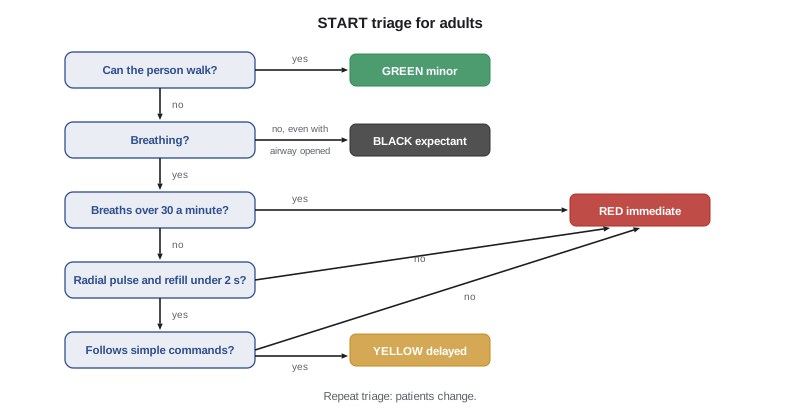
- Green (minor): the walking wounded, who can wait for care. In START, everyone who can walk is first directed to a green area, which quickly clears the scene and leaves the more seriously injured.
- Yellow (delayed): seriously injured but stable for now, able to wait a short time for treatment.
- Red (immediate): life-threatening injuries that can be treated, needing care first.
- Black (expectant or deceased): not breathing after the airway is opened, or injuries so severe that survival is very unlikely with the resources available.
Triage is repeated, because patients change. A yellow patient can become red, and a patient placed in black early in an incident may receive care once the immediate patients are treated. At the hospital, a triage officer, usually an experienced emergency physician or nurse, meets every arriving patient at the door, confirms or changes their category and sends them to the right treatment area. Patients are tracked with triage tags or wristbands that carry a number linked to the hospital's records.
Children and other groups with special needs
Mass casualty incidents often involve children, such as a school bus crash, and most community hospitals see few seriously injured children in a normal year. Children need different triage criteria (JumpSTART adjusts START for children's breathing rates and for infants who cannot walk), equipment and drug doses sized by weight, and staff who are comfortable caring for them. Northbridge keeps a pediatric surge cart with length-based dosing tapes and child-sized airway equipment, and the plan calls for an early conversation with the regional children's hospital. Unaccompanied children also need a safe, supervised area and a careful process for reuniting them with their families, with identity checked before any child is released. Older adults, people with disabilities, people who do not speak English and people with chronic conditions who lose their usual care also need attention, and the plan names who will look after each group.
The incident management system
A mass casualty response involves hundreds of people across the whole hospital, many doing jobs they do not do every day. Without a clear structure, people duplicate work, important tasks are missed, and decisions are made by whoever is loudest. Hospitals use an incident management system to organize the response.
In the United States, hospitals use the Hospital Incident Command System (HICS), a version of the national Incident Command System built for hospitals and last revised in 2014. Using HICS means hospital roles and terms line up with those of fire, police and emergency management under the National Incident Management System.
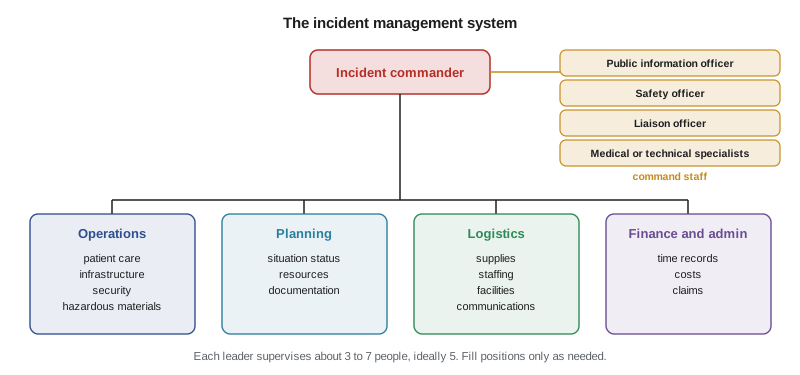
The structure has a few key features:
- An incident commander leads the response and is responsible for everything until they hand parts of the job to others. At night this is usually the administrator on call, until a more senior leader arrives and takes over through a formal handover.
- Command staff support the commander: a public information officer handles the media and public messages; a safety officer watches for hazards to responders and can stop unsafe activities; a liaison officer works with outside agencies such as paramedics, police, public health and other hospitals; and medical or technical specialists advise on topics such as infection control or radiation.
- Four sections do the work. Operations carries out the response, including patient care. Planning tracks the situation and resources and writes the incident action plan. Logistics gets the staff, supplies, equipment, food and facilities needed. Finance and administration tracks time, costs and claims.
- Positions are filled only as needed. A small incident may have only an incident commander and an operations leader; a large one fills every box.
Several principles make the system work. Each person reports to one supervisor (unity of command). Each supervisor has between three and seven people reporting to them, ideally five (span of control). Everyone uses common terms rather than local jargon. Each role has a job action sheet, a one-page card that tells the person taking the role what to do in the first hour and beyond, so that anyone with the right background can step into it. And the response follows an incident action plan, set for an operational period, often 8 or 12 hours, then reviewed and reset.
The command team works from the hospital's emergency operations center, a room set up with phones, computers, wall displays, maps, plans and job action sheets. Northbridge's is in a large meeting room on the main floor, with a backup in the Maple Court boardroom in case the main building is affected.
Staff call-in and the people who self-dispatch
During a large event, the hospital calls in extra staff through its mass notification system and unit call-in lists. Staff should come in only when called, and report to the staffing pool or their unit as instructed. Staff who come in on their own, however well meant, can overwhelm the entrance, take parking from responders, and leave the hospital short of rested staff for the next shift. Every response also needs people for the next 12, 24 and 48 hours, not only the first hour.
Families, the public and the media
In any mass casualty incident, people will arrive looking for family members, and the phones will ring nonstop. Northbridge opens a family information center away from the emergency department, staffed by social work, spiritual care and volunteers, linked to the patient tracking system so that staff can tell families where their relatives are. Identifying patients who arrive unconscious and without identification is part of this work, using descriptions, photos and belongings. The public information officer prepares regular updates for the media and the hospital's channels, so that staff do not have to answer questions and rumors are corrected quickly.
Standing down and recovery
When the last patient has been triaged and the situation is under control, the incident commander decides to stand down, often in stages. Departments return to normal, rescheduled surgery is planned, and supplies are restocked. A debrief soon afterwards, sometimes called a hot wash, captures what went well and what did not while memories are fresh, followed by a formal after-action report and improvement plan. Staff who cared for seriously injured or dying patients, especially children, may need support for weeks afterwards.
Worked problem
The highway collision
At 1740 on a Friday, dispatch reports a collision between a bus and a truck on the highway 12 km (7 miles) from Northbridge, with an estimated 25 injured. What should the emergency department and the hospital do in the first 30 minutes?
Show solution
- The charge nurse and physician call a mass casualty facility alert with the administrator on call, who becomes incident commander and opens the emergency operations center.
- The emergency department moves admitted patients to the units, discharges or redirects those who can go, opens hallway spaces and sets up triage at the ambulance entrance with tags and a tracking board.
- Units identify early discharges, surgery holds its elective cases and calls in two teams, the ICU prepares two beds and the lab checks the blood supply. The liaison officer calls the regional trauma center.
- The incident commander fills key roles with job action sheets, staffing calls in extra nurses through mass notification, and a family information center opens in the cafeteria annex.
Answer: Activate early, take command with clear roles, create space, staff and supplies, set up triage and tracking, and coordinate with paramedics and the trauma center.
Common mistakes
MistakeWaiting for confirmed numbers before activating the plan.
InsteadActivate early at the alert level and stand down if not needed.
MistakeDoing full emergency assessments on every patient at the door.
InsteadUse a rapid triage method such as START, and repeat triage as patients change.
MistakeComing in to help without being called.
InsteadCome in only when called, so rested staff are available for later shifts.
MistakeHaving too many people report to one supervisor.
InsteadKeep span of control between three and seven, ideally five.
MistakeLetting every worker answer media questions.
InsteadSend all media and public questions to the public information officer.
Summary and key terms
- A mass casualty incident produces more patients than normal resources can handle, so the goal becomes the most good for the most people.
- Activate early; casualties can arrive within 15 to 30 minutes, some on their own.
- Surge capacity covers space, staff, supplies and systems; reverse triage frees inpatient beds.
- START triage sorts patients into green, yellow, red and black in under a minute each.
- US hospitals use the Hospital Incident Command System (HICS).
- The incident commander leads, supported by command staff and four sections: operations, planning, logistics, and finance and administration.
- Families, the media, staff call-in and recovery are all part of the plan.
- Mass casualty incident
- An event that produces more patients than normal resources can handle.
- Surge capacity
- The ability to expand space, staff, supplies and systems to care for more patients.
- Reverse triage
- Identifying inpatients who can safely be discharged or moved to free beds.
- START triage
- Simple Triage and Rapid Treatment, a method of sorting casualties by need.
- Incident commander
- The person in overall charge of the response.
- Job action sheet
- A card that describes the duties of a role in the incident management system.
- Span of control
- The number of people a supervisor directs, ideally about five.
Practice problems
Work each problem on paper first, then reveal the answer to check.
Why should a hospital activate its plan early when the first report is unclear?
Show answer
Getting ready takes time, and casualties may arrive within 15 to 30 minutes, some on their own.
What are the parts of surge capacity?
Show answer
Space, staff and supplies (the three S's), plus systems.
In START, what happens to everyone who can walk?
Show answer
They are directed to the green (minor) area.
Name the four sections of the incident management system.
Show answer
Operations, planning, logistics, and finance and administration.
What does the safety officer do in an incident?
Show answer
Watches for hazards to responders and can stop unsafe activities.
From the Northbridge tally, what would run out first after a crash with several critically injured people?
Show answer
ICU beds and staffed operating rooms, not general beds.
Lesson quiz · 5 questions
Score 60% or more to complete this lesson.
Create a free account to save your progress, take quizzes and earn a certificate.