
HSE-395 · Lesson 6 of 12 · 22 min
Medical emergencies and missing patients
▶ Video coming soon A video version of this lesson is on the way.
It may seem odd to plan for medical emergencies in a hospital, where medical help is everywhere. But a cardiac arrest in the parking garage, the cafeteria or the finance office is a long way from the crash cart, and the people nearby may be cashiers, clerks or visitors rather than nurses. Hospitals also have to plan for people going missing: a patient with dementia who walks out of the building in January, a patient at risk of suicide who leaves the emergency department, or the worst nightmare of a birthing unit, a baby taken by a stranger. This lesson covers how Northbridge responds to medical emergencies outside clinical areas, how it finds missing patients and residents, and how it prevents and responds to infant and child abduction.
Medical emergency codes
At Northbridge, a medical alert for cardiac arrest, still called Code Blue by staff, is called for an adult in cardiac arrest or with a life-threatening medical emergency, and a pediatric medical alert for an infant or child. Each brings a team: a physician, a critical care or emergency nurse, a respiratory therapist, and for a child, a nurse from the birthing unit or pediatrics, with a crash cart that includes a defibrillator, airway equipment and emergency drugs.
Most hospitals also have a rapid response team (sometimes called a medical emergency team or critical care outreach) that staff can call for a patient who is getting worse but has not yet arrested: falling blood pressure, fast breathing, a sudden change in consciousness, or simply a nurse who is worried. Calling early is the point. Studies of patients who arrest on wards show that most had warning signs in the hours before, and rapid response teams exist to act on those signs.
Medical emergencies in non-clinical areas
A medical emergency in the lobby, cafeteria, offices, parking areas or grounds is harder to manage than one on a unit. The nearest people may have no medical training, the team takes longer to arrive, and equipment must be brought. Northbridge's plan for these areas covers everyone who works there.
- Any worker who finds someone collapsed checks for danger, checks if the person responds and is breathing normally, and calls 5555 with the code and the exact location.
- If the person is not breathing normally, a trained bystander starts chest compressions and sends someone for the nearest automated external defibrillator (AED). Every Northbridge employee is offered CPR and AED training, and it is required for many roles.
- Someone meets the team at the entrance or elevator and guides them to the person, because public areas are confusing and the team may not know the way.
- Others keep the area clear, give the person privacy and look after anyone with them.
The chain of survival, used by heart and stroke organizations across North America, shows why the first minutes matter. Each link improves the chance of survival: early recognition and calling for help, early CPR, early defibrillation, advanced care by the team, and care after the heart restarts. For each minute without CPR and defibrillation, a person's chance of surviving a cardiac arrest falls sharply.
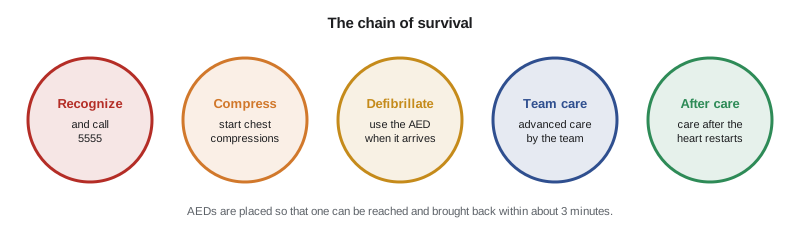
AEDs are placed in public areas where they can be reached quickly: the main lobby, cafeteria, emergency waiting room, outpatient clinics, the parking garage and Maple Court's main hall. A common planning goal is that an AED can be reached and brought back within about three minutes. AEDs need regular checks of batteries and pads, and their locations must be marked and known.
Responsibility for emergencies on the grounds and in the parking areas must be clear. At Northbridge, the Code Blue team responds anywhere inside the main building and Maple Court. For the parking areas and grounds, security and an emergency department team respond together, and the switchboard also calls 911 so an ambulance can transport if needed. For someone who collapses on the public sidewalk beyond the property line, staff call 911 and help as trained bystanders, as anyone would.
Code status and the decision to resuscitate
Not every patient or resident wants resuscitation. Many residents of Maple Court, and some hospital patients, have made decisions with their families and physicians about the care they want if their heart stops, recorded as their code status or level of care. Staff must know where to find this information quickly, on the unit census, in the chart and on the resident's care plan, because in an emergency there is no time to search for it. A decision not to resuscitate does not mean no care: staff still call for help, keep the person comfortable, call the physician and the family, and support the people with them. When staff are unsure of a person's wishes and cannot find them in time, they start resuscitation and call the code.
Staff who become ill at work
Staff collapse at work too, and the response is the same as for any medical emergency. Workers with known conditions, such as epilepsy, diabetes or severe allergies, may choose to tell their manager or a trusted colleague what to do in an emergency. Workers who are injured or become ill in non-emergency situations go to the emergency department or Employee Health and Safety, depending on the time of day and the seriousness.
Missing patients and residents
A patient or resident who leaves the unit or building without staff knowing, when they are not safe to be alone, is in danger. People with dementia may wander outside in winter clothing or slippers, become lost, fall or walk into traffic. A patient at risk of suicide may harm themselves. A patient being held involuntarily for a mental health assessment may leave before being assessed. Speed matters: the longer a person is missing, the wider the area to search.
Prevention starts with knowing who is at risk. At Northbridge, every patient and resident is screened for risk of wandering or leaving at admission and when their condition changes. Those at high risk get a care plan that may include:
- Regular, documented checks at set times.
- A recent photo and description on file, updated when clothing or appearance changes.
- Electronic wander alert bracelets that sound an alarm or lock doors when the wearer approaches an exit.
- Secured units, such as the mental health unit and Birch, with door codes or delayed exits that comply with the fire code.
- Meaningful activity, toileting, food and company, since many people with dementia wander because they are bored, uncomfortable or looking for someone.
When a patient or resident is missing, staff call a missing patient alert early, after a quick check of the unit. Northbridge's procedure sets out a search in widening circles:
- The unit: every room, bathroom, closet, shower, storage room and stairwell door on the unit, searched immediately by unit staff.
- The building: each department searches its own assigned area, including stairwells, elevators, roof access, basement and service corridors, and reports back to the switchboard within a set time.
- The grounds: security searches the parking areas, gardens, bus stops and nearby roads, and checks camera recordings.
- The community: police are called, and the family is told. For high-risk patients, such as those with dementia, at risk of suicide or held involuntarily, police are called at once, without waiting for the building search to finish.
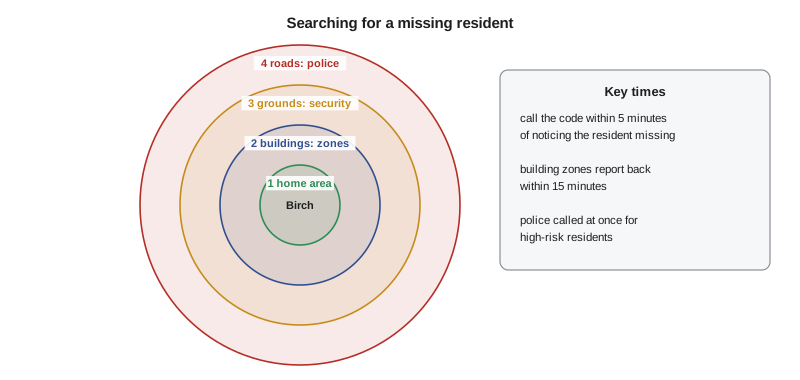
Each department has an assigned zone, so the search covers everything without duplication. Grant Ellison checks the zone list after every drill, using the time each zone took to report back.
# Code drill: minutes for each search zone to report back
zones = {
    "Z1 Maple Court Birch":      4,
    "Z2 Maple Court other":      9,
    "Z3 Main floor and lobby":  12,
    "Z4 Basement and tunnels":  21,
    "Z5 Floors 2 to 4":         14,
    "Z6 Stairwells and roof":   18,
    "Z7 Parking and grounds":   16,
}
TARGET = 15
late = {z: m for z, m in zones.items() if m > TARGET}
print(f"zones searched: {len(zones)}, last report at {max(zones.values())} min")
for z, m in sorted(late.items(), key=lambda kv: -kv[1]):
print(f"late: {z:26}{m:3} min")zones searched: 7, last report at 21 min late: Z4 Basement and tunnels 21 min late: Z6 Stairwells and roof 18 min late: Z7 Parking and grounds 16 min
The basement and tunnels were the slowest zone, for a simple reason: the zone belonged to the laundry and stores departments, which had only two people on duty that evening, and the area has many rooms. The fix was to split the zone and give half of it to maintenance. The stairwell and roof zone was also late, because the searcher had to fetch keys for the roof doors; security now carries a set in the search kit. The parking and grounds zone was one minute late because one security officer covered it alone; the plan now sends a second officer from the main entrance once the entrance is locked.
When the person is found, the switchboard announces the all clear. The person is assessed for injury, the family and physician are told, the care plan is reviewed, and the event is reported and reviewed like any other incident.
Infant and child abduction
A security alert for an infant or child abduction is called when an infant or child is missing and may have been abducted. Infant abductions from hospitals are rare, and much less common now than in the 1980s and 1990s, mainly because of better security, but the response must be immediate.
Prevention on Northbridge's birthing unit uses several layers:
- Electronic infant security tags that sound an alarm and lock doors if the baby is taken near an exit or the tag is cut.
- Matching identification bands for the baby and parents, checked whenever the baby is returned to a parent.
- Staff photo identification with a special design worn only by birthing unit staff, and parents taught never to hand their baby to anyone without that badge.
- Babies moved only in their cribs, never carried in arms in corridors.
- Controlled access to the unit, with visitors identified at the entrance.
- Teaching parents about the risks, including that abductors often pose as staff or befriend parents over several days.
If a baby or child is missing, staff call the code at once with a description. Staff in every department go to the nearest exit and stairwell and watch it, stopping anyone carrying a baby or a bag or bundle large enough to hide one, and politely asking to check. The building is locked down, police are called immediately, and all cameras are reviewed. Staff do not physically struggle with someone who refuses; they note the description and direction and report it.
Worked problem
The missing patient from the emergency department
A 19-year-old patient who was brought to the emergency department after an overdose, and who is waiting for a mental health assessment, is not in his room when the nurse checks at 2210. He was last seen 15 minutes earlier. The physician had assessed him as at high risk of suicide. What should happen?
Show solution
- The nurse and security check the department quickly, including bathrooms and the ambulance bay, while the charge nurse calls 5555 for a missing patient with a full description and the time last seen.
- Because he is at high risk, police are called at once, without waiting for the building search, and given his description, his risk and the time he left.
- Departments search their zones and security checks the grounds, bus stop and cameras, while the family is contacted.
- When police find him walking toward downtown and bring him back, he is assessed; the department reviews how he left and adds a sitter and a location closer to the nursing station for high-risk patients waiting for assessment.
Answer: Call the code early, call police at once for a high-risk patient, search by zones, and review the event to prevent it from happening again.
Common mistakes
MistakeWaiting to see if a cardiac arrest in the cafeteria is serious before calling.
InsteadCall the code at once and start CPR if the person is not breathing normally.
MistakeNot sending anyone to meet the team in a public area.
InsteadSend someone to the entrance or elevator to guide the team.
MistakeSearching for a missing resident alone for half an hour before calling.
InsteadDo a quick unit check, then call the code early.
MistakeWaiting for the building search before calling police for a high-risk patient.
InsteadCall police at once for patients at high risk.
MistakeHanding a baby to someone in scrubs without checking their badge.
InsteadCheck for the birthing unit badge every time, and teach parents to do the same.
Summary and key terms
- Medical alerts for cardiac arrest and for children bring a team with a crash cart; rapid response teams treat patients who are getting worse.
- In non-clinical areas, call the code, start CPR, get the AED and send someone to guide the team.
- The chain of survival shows that early recognition, CPR and defibrillation save lives.
- Patients and residents at risk of wandering or leaving are identified at admission and protected with care plans, checks and wander alerts.
- A missing person search spreads outward through assigned zones, and police are called at once for high-risk patients.
- Infant abduction is prevented with security tags, matching bands, staff badges and parent teaching, and answered with an immediate lockdown and exit watch.
- Rapid response team
- A team that assesses and treats patients who are getting worse before they arrest.
- AED
- An automated external defibrillator, a device that analyzes the heart rhythm and delivers a shock if needed.
- Chain of survival
- The linked actions that give the best chance of surviving a cardiac arrest.
- Wander alert
- An electronic system that alarms or locks doors when a person at risk nears an exit.
- Search zone
- An area of the building assigned in advance to a department during a missing person search.
- Infant security tag
- An electronic tag on a baby that alarms if the baby is taken near an exit.
Practice problems
Work each problem on paper first, then reveal the answer to check.
What should a worker do first on finding someone collapsed in the cafeteria?
Show answer
Check for danger, check if the person responds and is breathing, and call the code with the exact location.
Why should someone meet the Code Blue team at the entrance?
Show answer
Public areas are confusing, and guiding the team saves time.
What is a common planning goal for AED placement?
Show answer
That an AED can be reached and brought back within about three minutes.
Name three ways to reduce the risk of a resident with dementia leaving unnoticed.
Show answer
Any three of regular checks, current photo and description, wander alert bracelets, secured units, and meaningful activity and comfort.
For which patients should police be called at once?
Show answer
High-risk patients, such as those with dementia, at risk of suicide or held involuntarily.
What should staff at an exit do during an infant abduction code?
Show answer
Watch the exit and politely stop anyone carrying a baby or a bag large enough to hide one; do not struggle, but note and report details.
Lesson quiz · 5 questions
Score 60% or more to complete this lesson.
Create a free account to save your progress, take quizzes and earn a certificate.