
HSE-395 · Lesson 12 of 12 · 23 min
Capstone: running a unit emergency drill
▶ Video coming soon A video version of this lesson is on the way.
Plans that have never been tested are hopes, not plans. Every lesson in this course has shown the same pattern: problems that nobody noticed on paper became obvious the first time a unit practiced. Stored sleds that no one could unroll, corridors full of equipment, doors that could not be locked quickly, downtime kits with old forms. Drills and exercises are how a facility finds these problems before a real emergency does. In this capstone, you will follow Sarah MacLeod and the 4 West team as they plan, run and learn from a night-shift drill, using the methods that emergency managers use for exercises of every size.
Types of exercises
Exercises range from a conversation around a table to a full-scale test involving the whole hospital, outside agencies and actors playing casualties. In the United States, the Homeland Security Exercise and Evaluation Program (HSEEP) sets out a common approach that many hospitals use, and Canadian emergency managers use very similar methods. Exercises fall into two families:
- Discussion-based exercises talk through a plan without moving people or equipment. A seminar or workshop introduces or develops a plan. A tabletop exercise presents a scenario to a group of leaders and staff, who talk through what they would do, step by step, as the facilitator adds new information. Tabletops are cheap, safe and good at finding gaps in plans, roles and decisions.
- Operations-based exercises test the plan in action. A drill tests one function or skill, such as a fire response on one unit, a decontamination set-up or a call-in of staff. A functional exercise tests coordination and command, such as running the emergency operations center during a simulated mass casualty incident, without moving real patients. A full-scale exercise involves multiple agencies and real people moving through a realistic scenario, such as a simulated bus crash with actors arriving at the emergency department.
The CMS Emergency Preparedness Rule requires hospitals to carry out two exercises each year, at least one of them a full-scale or functional exercise, and NFPA 101 requires fire drills every quarter on every shift. But the best programs choose exercises based on the hazard analysis and on what the facility most needs to learn, not only on what is required.
The exercise cycle
Every exercise, from a ten-minute unit drill to a full-scale event, follows the same cycle.
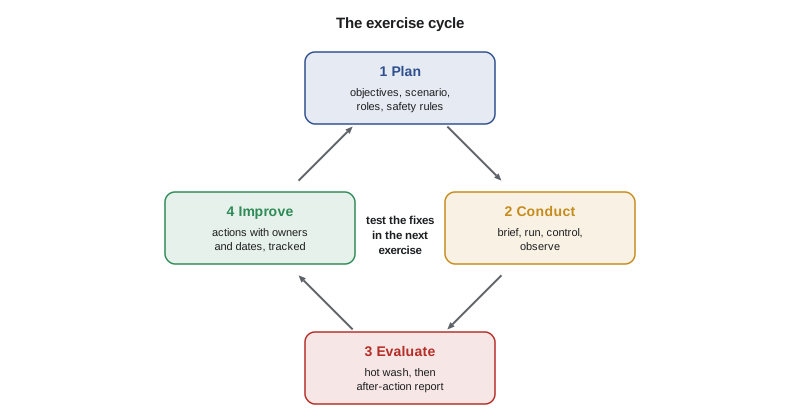
- Plan: decide what the exercise is for, write objectives, design the scenario, choose participants and roles, and set safety rules.
- Conduct: brief everyone, run the scenario, and observe what happens.
- Evaluate: collect observations, hold a hot wash, and write an after-action report.
- Improve: turn findings into an improvement plan with owners and dates, and follow up until the actions are done. Then test the fixes in a later exercise.
Step 1: planning the 4 West drill
Sarah chose a night-shift drill because the fire drill results and the evacuation model in earlier lessons both pointed to nights as the weak point. She worked with Grant Ellison, Tom Bergstrom for maintenance, the security supervisor and Amira Haddad, who would lead the drill on the unit as the safety committee member, to plan it.
The first step was writing objectives. Good objectives are specific and measurable, so that evaluators can say whether they were met. Vague objectives such as test the fire plan cannot be evaluated. The team wrote five:
- Within 60 seconds of discovering the fire, staff raise the alarm, call 5555 with the correct location, and close the door of the fire room.
- Within 3 minutes, all patient room doors and the smoke barrier doors are closed and the corridor is clear of equipment.
- Within 3 minutes, the charge nurse confirms the oxygen status of every patient on oxygen before any decision to close a zone valve.
- The fire response team arrives on 4 West within 4 minutes.
- Staff move four simulated bed-bound patients to the next compartment within 10 minutes, using beds and evacuation sleds, with every move recorded on the tracking sheet.
Next came the scenario, which needs to be realistic and to test the objectives without putting anyone at risk. The scenario was a fire in the clean linen room at 0300, discovered by a staff member responding to a call bell nearby. The team used a smoke machine with harmless theatrical smoke in the linen room and a light to simulate fire, with the agreement of the fire department and maintenance, and switched the area's smoke detectors to drill mode to avoid sending a real alarm to the fire department.
Then the roles. Every exercise has players, who respond as they would in a real event; controllers, who run the scenario and add information (injects); evaluators, who observe and record against the objectives; simulators or actors, who play patients or other people; and a safety officer, who watches for real hazards and can stop the exercise. For the 4 West drill, the players were the night staff and the fire response team; Grant was the controller; two evaluators from another unit used a checklist and a stopwatch; four volunteers from the education department played bed-bound patients; and Tom was the safety officer.
Safety rules were set in advance. No real patient would be moved; patients on the unit would stay in their rooms with doors closed and a staff member assigned to them, and would be told about the drill the evening before. Any real emergency, or a phrase agreed in advance, would stop the drill at once. All radio and phone messages would begin and end with the words this is a drill. Night staff on the unit were told that a drill would happen sometime that week, but not when, so that the drill would show how they would actually respond.
Step 2: running the drill
At 0300, Grant started the smoke machine and gave the first inject to the nurse responding to the call bell: you see smoke coming from under the door of the clean linen room and smell burning. From then on, the evaluators recorded times and observations. Grant added two more injects during the drill: at 2 minutes, a simulated patient in room 414 asks to go to the washroom and is confused; at 5 minutes, the fire response team is told the elevator they would normally use is out of service. Injects test the parts of the plan that a simple scenario might not, such as decisions under pressure and backup routes.
When the last simulated patient was moved and checked in, Grant ended the drill with the agreed announcement, and the unit returned to normal care. The whole drill took 14 minutes.
Step 3: evaluating
Right after the drill, Sarah held a hot wash: a short, informal debrief with everyone who took part, while memories were fresh. She asked three questions: what went well, what did not go as planned, and what would you change? The tone was learning, not blame. Then the evaluators compared their records with the objectives, using a short script to score the drill.
# 4 West night fire drill: results against objectives
objectives = [
    # objective, target seconds, actual seconds (None if not observed)
    ("alarm raised, 5555 called, fire door closed",  60,  48),
    ("all doors closed and corridor clear",         180, 205),
    ("oxygen status confirmed for all patients",    180, 170),
    ("fire response team on unit",                  240, 290),
    ("four bed patients moved and tracked",         600, 540),
]
met = 0
for name, target, actual in objectives:
    ok = actual is not None and actual <= target
    met += ok
    status = "met" if ok else f"missed by {actual - target} s"
    print(f"{name:45}{actual:4} s  {status}")
print(f"objectives met: {met} of {len(objectives)}")alarm raised, 5555 called, fire door closed 48 s met all doors closed and corridor clear 205 s missed by 25 s oxygen status confirmed for all patients 170 s met fire response team on unit 290 s missed by 50 s four bed patients moved and tracked 540 s met objectives met: 3 of 5
Three of the five objectives were met, and the observations explained the two that were missed:
- The corridor took 205 seconds to clear because a vital signs machine and a lift had been left outside rooms 409 and 410, and the staff member assigned to clear the corridor was also helping the confused patient in room 414.
- The fire response team arrived 50 seconds late, because two of its members were on another floor and their usual elevator was out of service, as in the inject; they did not know the alternate route through the east stairwell.
- On the positive side, the alarm and first call were fast and accurate, the oxygen check was done before anyone touched the zone valve, and the sled moves were smooth, because the unit had practiced them at the skills day.
- The tracking sheet was used for all four moves, but the time of each move was missing on two lines.
The evaluators also noted things the objectives did not cover: the overhead announcement could not be heard in two rooms at the end of the corridor, and one staff member did not know where the second evacuation sled was stored.
Step 4: improving
Within two weeks, Grant and Sarah wrote a short after-action report: the objectives, what happened, what went well, what needs to improve and why. It ended with an improvement plan, the part that matters most, because findings that are not acted on will appear again in the next drill or a real emergency.
| Finding | Action | Owner | Due |
|---|---|---|---|
| Corridor clutter slowed door closing | Assign storage for the vital signs machine and lifts; add a corridor check to each shift huddle | Sarah MacLeod | 2 weeks |
| One person had two jobs (corridor and confused patient) | Revise night roles on the flip chart so the corridor job is not combined with patient care | Amira Haddad | 1 month |
| Response team did not know the alternate route | Add alternate routes to the response team card; walk the routes at the next team meeting | Security supervisor | 1 month |
| Announcements not heard in two rooms | Inspect and repair speakers at the end of the corridor | Tom Bergstrom | 3 weeks |
| Tracking sheet times missing | Add a time column reminder to the sheet; review at the skills day | Unit educator | next skills day |
| Second sled location unknown | Label sled locations on the unit floor plan | Amira Haddad | 1 week |
The improvement plan went to the emergency management committee and the safety committee, which tracked each action until it was finished. Three months later, the unit ran a shorter night drill to test the fixes: the corridor cleared in 150 seconds and the response team arrived in 3 minutes 40 seconds, using the east stairwell. That repeat test closed the loop.
Lessons for any drill
Running a good drill on any unit does not need a big budget. It needs a few habits:
- Start from your own hazards and weak points, and write objectives you can measure.
- Keep it safe: never move real patients for a drill, use volunteers or mannequins, plan for real emergencies during the drill, and say this is a drill on every message.
- Test the shifts and situations that matter most, including nights and weekends, not only weekday days.
- Use evaluators who are not taking part, and give them a checklist and a stopwatch.
- Hold a hot wash right away, and keep it about learning, not blame.
- Turn every finding into an action with an owner and a date, and test the fix.
- Start small. A ten-minute tabletop discussion at a staff meeting, asking what would we do if the power failed now, is an exercise too, and often finds real gaps.
Over this course, you have seen how emergencies in healthcare are planned for, called, answered and learned from. The common thread is that preparation happens before the emergency, and that every worker, not only managers and specialists, is part of it. Knowing the codes, keeping corridors clear, charging equipment, knowing where the sleds are, reporting near misses and taking drills seriously are the everyday actions that decide how a facility performs on its worst night.
Worked problem
Planning a tabletop on Birch
Lina Santos and the Birch nurse in charge want to run a 20-minute tabletop exercise for the evening staff at Maple Court on a utility failure: a power failure at 2100 in January that lasts several hours. How should they plan it?
Show solution
- Set two or three measurable objectives, for example: staff can name every resident who depends on powered equipment and the backup for each; staff can locate flashlights, the emergency phone and the downtime kit; staff know how residents will be kept warm.
- Write a short scenario with injects: the power fails at 2100; at 10 minutes, a resident's air mattress deflates; at 15 minutes, the heating has not come back and the temperature is falling.
- Run it at a staff meeting with a facilitator, letting staff talk through what they would do at each step, and have someone note gaps and questions.
- Hold a quick hot wash, list actions with owners and dates, such as checking flashlight batteries and adding warm blankets to the emergency box, and share them with the manager and the committee.
Answer: Choose measurable objectives, write a simple scenario with injects, facilitate the discussion, capture gaps and turn them into actions with owners and dates.
Common mistakes
MistakeWriting objectives such as test the evacuation plan.
InsteadWrite measurable objectives with times or clear standards.
MistakeMoving real patients to make a drill realistic.
InsteadUse volunteers or mannequins and keep real patients safe in their rooms.
MistakeOnly running drills on weekday day shifts.
InsteadTest nights and weekends, when staffing is thinnest.
MistakeUsing the hot wash to blame people for mistakes.
InsteadKeep the debrief focused on learning and on fixing systems.
MistakeWriting an after-action report and filing it.
InsteadTurn findings into an improvement plan with owners and dates, and test the fixes.
Summary and key terms
- Exercises find problems in plans before a real emergency does.
- Discussion-based exercises include seminars, workshops and tabletops; operations-based exercises include drills, functional and full-scale exercises.
- Every exercise follows the cycle of plan, conduct, evaluate and improve.
- Good objectives are specific and measurable; good scenarios are realistic, safe and use injects to test decisions.
- Exercises need players, controllers, evaluators, simulators and a safety officer.
- The hot wash, after-action report and improvement plan turn findings into fixes, which are tested in the next exercise.
- Every worker is part of emergency preparedness through everyday actions.
- Tabletop exercise
- A discussion of a scenario by a group, led by a facilitator, without moving people or equipment.
- Drill
- An exercise that tests one function or skill.
- Full-scale exercise
- An exercise with multiple agencies and real people moving through a realistic scenario.
- Inject
- New information added by a controller during an exercise.
- Hot wash
- A short debrief right after an exercise.
- After-action report
- A written evaluation of an exercise or event against its objectives.
- Improvement plan
- A list of actions from an exercise or event, with owners and due dates.
Practice problems
Work each problem on paper first, then reveal the answer to check.
What is the difference between a tabletop exercise and a drill?
Show answer
A tabletop talks through a scenario without moving people or equipment; a drill tests one function in action.
Name the four steps of the exercise cycle.
Show answer
Plan, conduct, evaluate and improve.
Rewrite the objective test the fire plan so that it can be measured.
Show answer
For example: within 3 minutes, all patient room doors and smoke barrier doors are closed and the corridor is clear.
What does a safety officer do during an exercise?
Show answer
Watches for real hazards and can stop the exercise.
Which two objectives did 4 West miss, and why?
Show answer
Clearing the corridor, because of stored equipment and one person with two jobs; and the response team arrival, because members did not know the alternate route.
Why did 4 West run a second, shorter drill three months later?
Show answer
To test whether the fixes in the improvement plan had worked.
Lesson quiz · 5 questions
Score 60% or more to complete this lesson.
Create a free account to save your progress, take quizzes and earn a certificate.