
HSE-383 · Lesson 9 of 12 · 16 min
Delivery driving and parking-lot safety
▶ Video coming soon A video version of this lesson is on the way.
Juniper Street started its own delivery service in 2025, after years of relying only on third-party apps. Two drivers, Marcus Bell and Jenna Ruiz, take orders in their own cars to homes and offices within 4 mi (about 6 km) of the restaurant, from 5 p.m. until the kitchen closes. Delivery brought the restaurant new customers and new revenue, and it also moved some of its workers onto the road, which is statistically the most dangerous place most people ever work. This lesson covers the hazards of delivery driving, Juniper's delivery rules, and the parking lot, where drivers, closing staff and guests all walk in the dark.
Why driving matters
Transportation incidents are the most frequent cause of fatal work injuries in the United States, according to the Bureau of Labor Statistics. OSHA has no general standard for driving on public roads, but employers are responsible under the General Duty Clause for recognized hazards, and the risks of delivery driving are well recognized. That includes workers who drive their own vehicles for the job. Delivery drivers face more risk than most drivers because of time pressure, frequent stops, unfamiliar addresses, night driving and the temptation to use a phone for navigation.
The hazards of delivery driving
Marcus and Jenna listed the hazards they meet on a typical night, and the list matched what the research says:
- Time pressure: hot food, hungry customers and a promised delivery time push drivers to speed, run yellow lights and park badly.
- Distraction: checking the next address, the navigation app or a message from the restaurant while moving.
- Night driving and fatigue: most deliveries are in the evening, often after a full day.
- Weather: rain, fog, ice and snow in winter, or heat, sudden thunderstorms and flooded streets.
- Unfamiliar destinations: dark driveways, steep steps, icy paths, apartment buildings with confusing entrances, unlit addresses, loose dogs.
- People at the door: a customer who is intoxicated, aggressive or disputes the order, or a person who has placed an order to lure a driver.
- Cash: drivers who carry cash are targets for robbery.
Juniper's delivery rules
Juniper's delivery rules were written with Marcus and Jenna and are reviewed each year.
- Realistic times. The ordering system quotes delivery times based on actual driving times plus a buffer. No driver is ever criticized or penalized for a late delivery caused by traffic, weather or safe driving, and there is no bonus for speed.
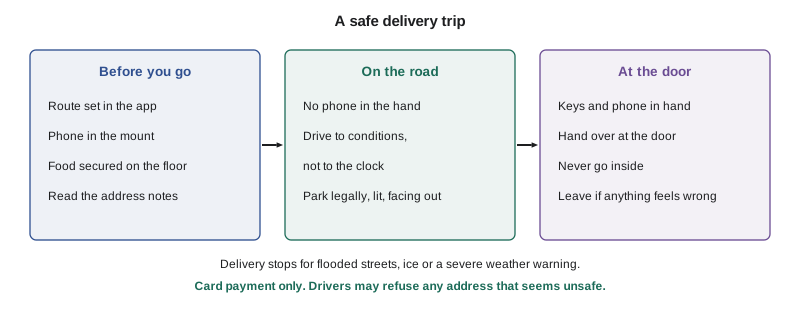
- No phone in the hand. Phones go in a dashboard mount, the route is set before the car moves, and calls and messages wait until the car is parked.
- Card only. Delivery orders are paid online when they are placed; drivers carry no cash and say so on the order confirmation.
- Right to refuse. A driver can refuse a delivery to an address that seems unsafe, or leave without completing a delivery if anything at the door feels wrong, and tell the manager. The restaurant refunds the order without question.
- Check-ins. Each trip starts and ends in the delivery app, so the manager can see where drivers are and notice if a trip runs much longer than expected.
- Weather limits. The manager suspends delivery when roads are dangerous, such as heavy snow or ice, freezing rain, or a severe weather warning.
- No alcohol on deliveries. Juniper's delivery menu has no alcohol, which avoids the extra legal duties and ID checks at the door.
If Juniper did deliver alcohol with meals, it would need the right state and local permits, and drivers would have to check ID at the door and refuse delivery to anyone under 21 or noticeably intoxicated. The restaurant decided the extra risk was not worth the small amount of extra revenue.
The driver and the vehicle
Drivers must be at least 21, hold a valid license with no recent serious violations, and show Olivia proof each year that their auto insurance covers delivery use. Many personal auto policies exclude driving for business deliveries, which can leave a driver uninsured after a crash, so drivers may need a delivery endorsement or a business-use policy. Juniper pays a mileage allowance that covers fuel, wear and insurance. Georgia's Hands-Free Georgia Act prohibits holding or supporting a phone while driving, and police enforce it actively.
Each month, drivers do a quick vehicle check with Olivia: tires, lights, wipers and washer fluid, brakes, and in winter on the Canadian site the right tires for the season. A delivery bag strapped down or placed on the floor keeps hot food from sliding or spilling, and nothing is balanced on the passenger seat.
At the door
Most deliveries are uneventful: a quick handover and a thank-you. Drivers still follow a few habits that keep the uneventful ones that way.
- Park in a legal, lit spot, close to the door, facing out so you can leave easily. Do not block driveways or park where you must back out blindly.
- Take only the food, your phone and your keys. Leave nothing valuable visible in the car, and lock it.
- Use the walkway, not shortcuts across lawns or through dark side yards. Watch for ice, steps, hoses and toys, and use a flashlight on dark paths.
- Hand the order over at the door. Never go inside a home or a private office, even if invited.
- Watch for dogs. If a dog is loose, stay in the car and phone the customer.
- If the customer is intoxicated, aggressive or anything feels wrong, leave the food if it is safe to do so, or simply leave, get back in the car and tell the manager. A refund is cheaper than an injury.
Parking-lot safety
Juniper has a small lot behind the building with a dozen spaces, plus the back lane where deliveries come in. It is used by guests, staff arriving and leaving, the delivery drivers picking up orders, and the closing crew at midnight. The front-of-house walk in Lesson 1 rated the unlit corner by the back door as a score of 12, and the fixes went beyond a single light.
- Lighting. A motion-sensor light now covers the corner by the back door, and a second fixture lights the row where staff park. Burned-out bulbs are reported the same night and replaced within a week.
- Visibility. Overgrown bushes along the lot edge were cut back so nobody can stand hidden near the cars, and a camera covers the lot and the back door.
- Staff parking. Staff park in the lit row closest to the building, and the drivers' pickup spot is right by the kitchen window, inside the lit area.
- Habits. Keys in hand before going outside, phone away, a look around before walking to the car, and a look into the back seat before getting in. Doors locked as soon as you are inside.
- Company. Closing staff walk out together and wait for each other's cars to start. Anyone who feels uneasy can ask a colleague or the manager to walk with them at any time.
If anyone sees a person loitering near the cars, someone sleeping in the lot, or anything that seems wrong, they go back inside, lock the door and tell the manager. Staff do not approach strangers in the lot. The manager decides whether to call the police non-emergency line or 911.
Guests in the lot
The parking lot is also where an intoxicated guest may try to drive away, as Lesson 6 described, and where a guest who has been asked to leave may wait for a staff member. If a guest who was refused service or banned is seen in the lot at closing, staff stay inside and the manager calls the police. Nobody walks out alone past someone who has threatened them.
Tracking delivery trips
The delivery app keeps a log of every trip. Each week Olivia runs a short check that flags trips with an average speed that looks too high for city streets, trips that ran far longer than expected, and trips after 10 p.m., which get an extra check-in. The program below is a simplified version.
# Weekly check of delivery trips: average speed, long trips and late trips.
trips = [  # (driver, start time, miles one way, minutes door to door)
    ("Marcus", "18:10", 2.0, 9), ("Jenna", "18:25", 3.2, 11), ("Marcus", "19:05", 3.1, 7),
    ("Jenna", "19:40", 1.5, 25), ("Marcus", "21:15", 3.6, 13), ("Jenna", "22:20", 2.4, 10),
]
CITY_LIMIT = 30          # mph, typical city limit

for driver, start, mi, minutes in trips:
    speed = mi / (minutes / 60)
    flags = []
    if speed > CITY_LIMIT * 0.8:
        flags.append(f"average {speed:.0f} mph, check driving")
    if minutes > 20:
        flags.append("long trip, ask why")
    if start >= "22:00":
        flags.append("late trip, extra check-in")
print(f"{start} {driver:6s} {mi:4.1f} mi {minutes:3d} min " + ("; ".join(flags) or "OK"))18:10 Marcus 2.0 mi 9 min OK 18:25 Jenna 3.2 mi 11 min OK 19:05 Marcus 3.1 mi 7 min average 27 mph, check driving 19:40 Jenna 1.5 mi 25 min long trip, ask why 21:15 Marcus 3.6 mi 13 min OK 22:20 Jenna 2.4 mi 10 min late trip, extra check-in
Two trips stood out. A door-to-door average that high on city streets, with stops and lights, suggests speeding, and Olivia talked with Marcus about it; he admitted he had been rushing to get back for a large order, and they agreed the kitchen would hold that order rather than push him. Jenna's long trip turned out to be an apartment building with a locked lobby and no answer; she waited, called the customer, and was right not to go in with a stranger who held the door. The late trip got its extra check-in as planned.
Summary and key terms
- Driving is one of the most dangerous parts of work, and the employer's safety duties apply to delivery drivers, including those using their own cars.
- Time pressure, distraction, night, weather, unfamiliar addresses, people at the door and cash are the main delivery hazards.
- Juniper quotes realistic times, never rewards speed, bans hand-held phones, takes card payment only, lets drivers refuse unsafe deliveries and suspends delivery in dangerous weather.
- Drivers must have the right license and insurance for delivery use, and vehicles are checked monthly.
- The parking lot is made safer with lighting, visibility, cameras, staff parking close to the door, good habits and walking out together.
- Delivery radius
- The maximum distance from the restaurant that orders are delivered.
- Business-use coverage
- Vehicle insurance that covers using a personal vehicle for work such as deliveries.
- Hands-free
- Using a phone only through a mount or voice controls, never held while driving.
- Right to refuse
- The driver's right to decline or abandon a delivery that seems unsafe, without penalty.
- Loitering
- Someone hanging around an area without an obvious reason, such as near staff cars at closing.
Fatigue and the last trips
Delivery drivers often work after a day job or classes, and the last trips of the night are the most dangerous: darker, emptier roads, more impaired drivers on the road, and a tired driver. Juniper limits delivery shifts to six hours, ends delivery when the kitchen closes, and lets a driver stop early if they are too tired to drive safely, without penalty. Drivers are encouraged to take a short break between busy periods rather than pushing straight through.
Third-party delivery couriers
Juniper still uses third-party delivery apps for some orders. The couriers who pick up those orders are not Juniper's employees, but they come into the restaurant, wait at the pickup counter and use the parking lot. The pickup counter is placed where couriers do not walk through the kitchen or the dining room, orders are labeled and sealed so couriers do not wait long, and staff treat couriers with the same courtesy as guests. If a courier is aggressive or unsafe, the manager reports it to the app company.
After a crash or incident
If a driver is in a crash on a delivery, the first priority is safety: stop, check for injuries, call 911 if anyone is hurt, and move to a safe place. Then the driver calls the manager. Drivers keep a copy of their insurance details in the car and use the phone to photograph the scene once it is safe. Any crash, near miss, threat or injury on a delivery is written up the same way as an incident in the restaurant, and is reported as a work injury where applicable.
Weather on the road
Summer evenings in Savannah bring sudden downpours that flood low streets in minutes, and drivers never drive through standing water: a small depth of moving water can carry a car away. Drivers allow more time, slow down, turn on headlights in rain and wait out the worst storms in a safe place. During tropical storm warnings, Juniper suspends delivery altogether.
Common mistakes
MistakeFast deliveries deserve a bonus.
InsteadRewarding speed encourages unsafe driving; quote realistic times and never penalize safe, late deliveries.
MistakeChecking the next address on the phone at a red light is fine.
InsteadSet the route before moving and keep the phone in the mount; hand-held use is illegal and dangerous.
MistakeA friendly customer who invites the driver in is safe.
InsteadHand over the order at the door and never go inside a home or private office.
Practice problems
Work each problem on paper first, then reveal the answer to check.
Name four rules in Juniper's delivery policy that reduce driving risk.
Show answer
Realistic quoted times with no speed bonus, phone in a mount only, card payment only, right to refuse unsafe deliveries, check-ins in the app, and suspending delivery in dangerous weather.
Why must drivers show proof of insurance that covers delivery use?
Show answer
Personal insurance may not cover business deliveries, which could leave the driver and others without coverage after a crash.
At closing, Nadia sees a man standing by the staff cars in the dark. What should she do?
Show answer
Go back inside, lock the door and tell the manager; do not approach him; the manager decides whether to call police, and staff leave together when it is safe.
Lesson quiz · 5 questions
Score 60% or more to complete this lesson.
Create a free account to save your progress, take quizzes and earn a certificate.