
HSE-383 · Lesson 6 of 12 · 16 min
Refusing service and preventing over-service
▶ Video coming soon A video version of this lesson is on the way.
In December, a company booked Juniper Street's back section for a holiday party of 12. The host had paid for an open bar for two hours. By the second hour, one guest had had six or seven drinks, most of them doubles, and was getting louder, knocking into chairs and repeating himself. When he came to the bar for another, Nadia told him quietly that she could not serve him any more alcohol tonight and offered him a soda and a plate of food. He laughed, then got angry, then told her he was the boss's best friend and she would lose her job. Nadia did not argue. She used the code word, Olivia came over, and together they held the line, offered food and water, and asked one of his colleagues to sit with him. When he said he would drive himself home, Olivia called a taxi, and his colleague rode with him. The next morning, the party's host phoned to thank them.
That evening could have gone very differently. This lesson covers the legal duty not to serve intoxicated guests, the consequences of over-service, how to refuse service safely and respectfully, and what to do when an intoxicated guest wants to drive.
The legal duty
Georgia law forbids selling, giving or furnishing any alcoholic beverage to any person who is in a state of noticeable intoxication. The City of Savannah's alcohol ordinance adds its own rules and penalties, and a violation can lead to fines and to the suspension or loss of the restaurant's alcohol license, which for many restaurants would be the end of the business. The rule applies to every member of staff who serves alcohol, not just the manager or the owner.
The law sets the minimum. Juniper's house policy is stricter: staff stop serving at the first clear signs of intoxication, rather than waiting until a guest is obviously drunk, and they never serve a guest who arrives already intoxicated.
When over-service causes harm
Over-service can also lead to civil liability. Georgia's dram shop law makes a person or business that serves alcohol liable for injuries caused by a guest if they knowingly served a noticeably intoxicated person, or a person under 21, knowing that the person would soon be driving a motor vehicle. Georgia courts have read "knowingly" to include what the server should have known with reasonable care, so the law does not reward looking the other way, although the courts have also held that servers have no general duty to ask every guest how they are getting home. Punitive damages may be available. The lesson for staff is that the guest's behavior, the number of drinks and any sign that he is about to drive all matter.
Beyond the law, over-service hurts people. Intoxicated guests fall down stairs, start fights, harass staff and drive. Every one of Juniper's physical incidents with customers in the injury year involved a guest who had been drinking heavily.
Spotting it before it becomes a refusal
The best refusal is the one that never has to happen. The pacing habits from Lesson 5 do most of the work: water, food, one drink at a time and a slower pace for fast drinkers. Bartenders and servers also share information. When a server notices that a guest has had several drinks, she tells the bartender before ordering another, and the bartender passes the word at shift change. At Juniper's bar, Nadia keeps a simple count for anyone she is watching, and the short program below shows the rule of thumb she uses for flagging guests: more than one standard drink an hour, sustained over the evening, is a reason to slow down and watch closely.
# Flag bar guests whose pace of drinking is high, using standard drinks per hour.
from datetime import datetime

tabs = {   # guest: list of (time served, standard drinks)
    "seat 3": [("18:30", 1), ("19:30", 1), ("20:25", 1)],
    "seat 7": [("19:10", 2), ("19:35", 2), ("20:00", 1.5), ("20:20", 2)],
    "seat 11": [("18:20", 1), ("20:10", 1)],
}
now = datetime.strptime("20:30", "%H:%M")

for guest, rounds in tabs.items():
    first = datetime.strptime(rounds[0][0], "%H:%M")
    hours = max((now - first).seconds / 3600, 1.0)
    total = sum(d for _, d in rounds)
    rate = total / hours
    if rate > 1.5:
        action = "STOP and involve the manager"
    elif rate > 1.0:
        action = "slow down: food, water, check in"
    else:
        action = "fine"
print(f"{guest}: {total} drinks in {hours:.1f} h = {rate:.1f}/h -> {action}")seat 3: 3 drinks in 2.0 h = 1.5/h -> slow down: food, water, check in seat 7: 7.5 drinks in 1.3 h = 5.6/h -> STOP and involve the manager seat 11: 2 drinks in 2.2 h = 0.9/h -> fine
The numbers never replace judgment. A guest can be intoxicated after fewer drinks than the count suggests, especially if he arrived after drinking elsewhere, has not eaten, or is taking medication. The count is a prompt to look harder, and the behavioral signs from Lesson 5 decide.
How to refuse service
Refusing service is one of the most common triggers for an argument, so it is done in a planned way, the same way every time.
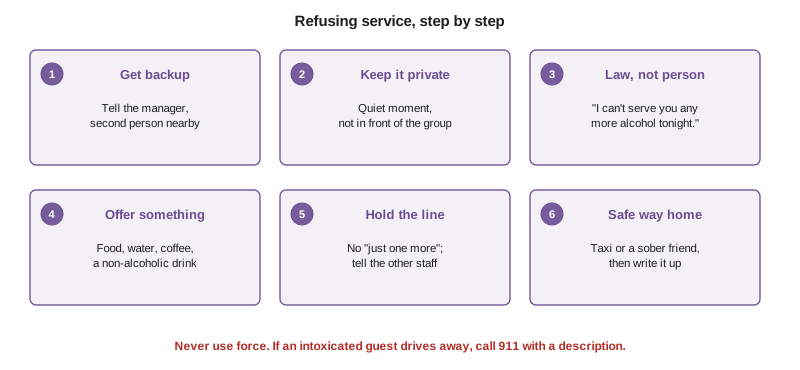
- Involve the manager first. Before saying anything, tell the manager and make sure a second staff member is nearby. Refusals are never done alone if it can be avoided.
- Keep it private. Speak to the guest quietly, away from his friends if possible. Being refused in front of a group is humiliating, and humiliation drives aggression.
- Focus on the law and the policy, not the person. Say "I can't serve you any more alcohol tonight" rather than "You're drunk." Avoid judging words such as drunk, wasted or cut off.
- Offer an alternative. Food, water, coffee or a non-alcoholic drink lets the guest stay without losing face.
- Be firm and consistent. Do not negotiate ("just one more"), and do not let a friend order on his behalf. Tell the other servers and the bartender so the refusal holds across the room.
- Use de-escalation. Everything in Lesson 4 applies: space, calm voice, acknowledge the feeling, give choices.
- Record it. Write the refusal up in the incident log that night, with the time, what the guest had been served, the signs of intoxication, what was said and what happened next. That record protects the staff and the restaurant if there is any complaint or claim later.
Friends, groups and hosts
Groups make refusals harder. Friends may buy drinks for a guest who has been refused, or a group may rush to order a big round at last call. Servers watch where drinks go after they leave the bar and stop serving a group that is passing drinks to someone who has been refused. At private events with an open bar, the person paying does not decide who gets served; the staff do. Olivia explains this to event hosts when they book, and asks them to name someone in their group who can help if a guest drinks too much. Juniper also limits open bars to set times and always offers food.
When an intoxicated guest wants to drive
The most serious risk of over-service is a guest who drives. Juniper's policy is clear, and every server knows it:
- Discourage driving. Speak to the guest and, often more effectively, to his friends. Offer to call a taxi or a rideshare, or ask a sober friend to drive. Juniper pays for the taxi if needed, and Olivia keeps a taxi company's number at the host stand.
- Delay. Offering food, coffee and a seat while the taxi comes gives time and often changes the guest's mind.
- Do not use force. Staff do not physically take keys, block cars or restrain anyone. If a guest hands over his keys voluntarily, the manager holds them and returns them the next day.
- Call the police if he drives. If an intoxicated guest gets into a car and drives away, the manager calls 911 with a description of the person and the vehicle, the license plate if it can be seen safely, and the direction of travel. That call may save a life.
- Do not put an intoxicated guest out alone. If a guest must leave, make sure he leaves with a friend, in a taxi or in the care of someone responsible, especially late at night or in bad weather.
Supporting staff who refuse
None of this works unless staff know that management will back them. Juniper's house policy says plainly that no server or bartender will ever be disciplined for refusing service in good faith, and that the manager on duty takes over any argument about a refusal. Olivia never overrides a refusal at the table to keep a guest happy, even a regular. Staff are also never paid or rewarded in a way that pushes them to sell more drinks to guests who have had enough: there are no sales contests on shots or doubles.
Summary and key terms
- Georgia law forbids serving anyone who is noticeably intoxicated, and Savannah's ordinance can suspend or revoke the alcohol license.
- Georgia's dram shop law can make the server and the business liable for harm caused by a noticeably intoxicated guest they knew would soon drive.
- Pacing and information sharing prevent most refusals; a count of standard drinks per hour prompts a closer look but never replaces judgment.
- Refuse with the manager present, privately, politely and firmly, focusing on the law, offering an alternative and recording it.
- Discourage an intoxicated guest from driving, arrange a ride, never use force, and call 911 with a description if he drives away.
- Over-service
- Serving alcohol to a guest who is intoxicated, or serving so much that the guest becomes intoxicated.
- Refusal of service
- Declining to serve any more alcohol to a guest, usually for intoxication or lack of ID.
- Commercial host liability
- The legal responsibility of a business that serves alcohol for harm caused by intoxicated guests.
- Dram shop law
- A law that makes alcohol sellers liable in some circumstances for harm caused by intoxicated customers.
- Incident log
- The written record of refusals, customer incidents and other events, kept by the manager.
Guests who arrive intoxicated
Some guests have been drinking before they arrive, at another bar, a sports event or a party. The rule is the same as for guests who become intoxicated at Juniper: no alcohol. The host or server who notices the signs tells the manager, who decides whether the guest can stay for food and non-alcoholic drinks or should be asked to leave. Asking someone to leave follows the same steps as a refusal, with extra attention to how the guest is getting home. A guest who arrives intoxicated and alone, late at night, is not simply sent back out into the street.
Documenting a refusal well
A useful incident record answers the questions a liquor inspector, an insurer or a lawyer would ask months later. Juniper's form asks for the time the guest arrived and left; what and how much the guest was served, and when; the signs of intoxication staff saw; when service stopped and who decided; what was said, as close to the actual words as possible; what was offered instead; how the guest got home or what happened if he drove; the names of staff and any witnesses; and whether police were called. Nadia and Olivia fill it in together before leaving that night, while the details are fresh. Over the past year, three refusal records have been requested by guests or their families; in each case the record showed exactly what staff did and why.
Last call
The last half hour before the bar closes is when many guests try to order a final round, often bigger than usual. Juniper announces last call once, 30 minutes before close, and does not serve doubles or shots for groups after that. Lesson 12 makes this part of the closing-shift plan.
Supporting the bartender at the bar
Most refusals at Juniper happen at the bar, and the bartender is often the first to see the problem. From 10 p.m. on Friday and Saturday a second bartender works with Nadia, which means one can step away to speak with a guest privately or fetch the manager while the other keeps the bar running. The manager also does a walk past the bar every half hour on busy nights, so there is a natural moment for the bartender to mention a guest she is watching.
Common mistakes
MistakeTell the guest loudly that he is drunk so his friends will back you up.
InsteadSpeak privately and talk about the law and the policy, not about the person; public refusals provoke anger.
MistakeIf the host paid for an open bar, every guest can be served.
InsteadStaff decide who is served; nobody who is intoxicated is served, whoever is paying.
MistakeGrab the keys of an intoxicated guest who wants to drive.
InsteadNever use force; discourage, delay, arrange a ride, and call 911 with a description if he drives away.
Practice problems
Work each problem on paper first, then reveal the answer to check.
Write the first sentence you would say to refuse service to an intoxicated guest at the bar.
Show answer
For example: "I'm sorry, I can't serve you any more alcohol tonight, but I'd be happy to get you some food and a soda."
A refused guest's friend orders two beers and slides one across to him. What should the bartender do?
Show answer
Stop serving the friend as well, explain politely that the refused guest cannot be given alcohol, tell the manager and the other staff, and record it.
An intoxicated guest leaves, gets into his car and drives off before anyone can stop him. What does the manager do?
Show answer
Call 911 with a description of the person and car, the plate if seen safely and the direction of travel, then write up the incident.
Lesson quiz · 5 questions
Score 60% or more to complete this lesson.
Create a free account to save your progress, take quizzes and earn a certificate.