
HSE-383 · Lesson 7 of 12 · 16 min
Harassment from customers
▶ Video coming soon A video version of this lesson is on the way.
For most of a year, a regular who came in on Thursday nights made comments to Chloe Martin about her looks and her body, asked whether she had a boyfriend, and twice touched her lower back as she leaned over to clear plates. He tipped well and was friendly with the bartenders, and Chloe told herself it was part of the job. She did not report it until a new server, on her second shift, came into the kitchen in tears after the same man asked her what time she finished work and whether she needed a ride. That night Olivia spoke to both servers, then to the guest, and he has not been back. Afterward Olivia asked the rest of the front-of-house team, and found that almost everyone had a story, about him and about others, that they had never written down.
Harassment from customers is one of the most common problems front-of-house workers face, and one of the least reported. This lesson covers what it is, why it is so common in restaurants and bars, what the law expects of the employer, and how Juniper's policy helps staff deal with it.
What harassment is
Harassment is unwelcome conduct or comments that a reasonable person would know could humiliate, intimidate or offend someone. In a restaurant it most often looks like:
- Sexual comments, jokes or questions about a worker's body, appearance or private life.
- Unwanted touching, including hands on the back, waist or arm, or brushing past deliberately.
- Requests for dates, phone numbers or meetings after work, especially repeated ones, or offers of money or big tips in exchange for attention.
- Comments about race, religion, accent, gender identity, sexual orientation, disability or age.
- Staring, following a worker, waiting outside after closing, or contacting a worker online after finding them through the restaurant.
Some of these are also crimes. Touching someone sexually without consent is assault, and following or repeatedly contacting someone in a way that makes them fear for their safety can be criminal harassment or stalking. Staff are always free to report those to the police.
Why it is so common in restaurants
Several features of restaurant work make harassment from customers more likely and less likely to be reported.
- Tips. When a large part of a server's income comes from tips, refusing a guest's attention can feel like refusing money. Customers who harass often use tips as leverage, and workers tolerate behavior they would never accept elsewhere.
- "The customer is always right." A service culture that puts guests' satisfaction first can leave workers believing they are expected to smile through anything.
- Alcohol. Intoxicated guests are less inhibited and more likely to harass.
- Young workers. Many servers, hosts and bartenders are in their teens and twenties, often in their first jobs, and less sure of their right to object.
- Short interactions with many people. Each incident feels small and the guest will soon be gone, so it seems easier to ignore than to report.
None of those reasons makes harassment acceptable, and every one of them can be addressed by the employer.
What the law expects
In the United States, Title VII of the Civil Rights Act prohibits harassment based on sex, race, color, religion and national origin, and other federal laws cover age and disability. It applies to employers with 15 or more employees, which includes Juniper. EEOC regulations say an employer may be responsible for sexual harassment of its employees by non-employees, including customers, where the employer knew or should have known about it and failed to take immediate and appropriate corrective action. Courts have applied the same reasoning to harassment by customers on other protected grounds. Georgia has no separate state harassment law for private employers, so the federal rules are the main ones. Federal law also forbids retaliating against an employee who reports harassment.
The common thread is that an employer cannot treat customer harassment as something staff must put up with. Once management knows, or should know, it must act.
Juniper's policy
After the Thursday regular, Juniper's safety committee rewrote the harassment section of the front-of-house policy. It is short enough to fit on one page, and every new worker reads it with Olivia on their first day. Its key points are:
- You do not have to put up with harassment from anyone, guests included. It is not part of the job.
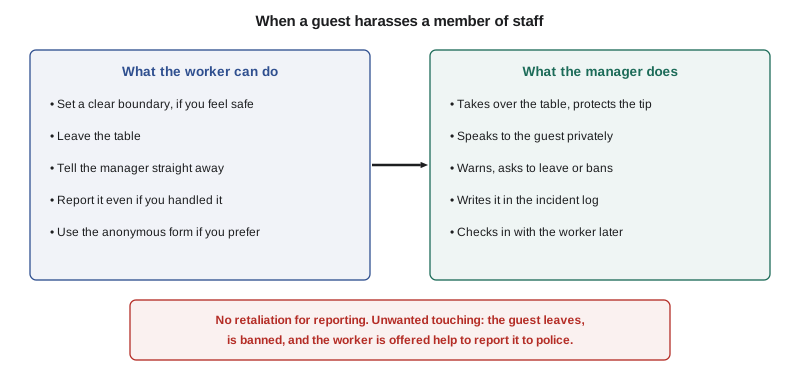
- You can deal with it however you feel safest: set a boundary yourself, walk away from the table, or go straight to the manager.
- Report every incident to the manager on duty, even if you handled it yourself. If the manager is the problem, report to the general manager or the owner.
- The manager will take over the table if you ask, and your tip for that table will not suffer: the manager adds the table to your sales or covers the tip from the house.
- Nobody will be disciplined, have shifts cut or be treated worse for reporting.
- The manager decides what happens to the guest, from a warning to being asked to leave and placed on the ban list.
Setting a boundary
Some workers prefer to respond directly, and a short, clear statement often works. The aim is to name the behavior and say it is not acceptable, without debate:
- "Please don't touch me."
- "That's not an appropriate comment. Can I get you anything else?"
- "I don't give out my number. I'll be back with your bill."
A worker should never feel obliged to do this. Walking away and telling the manager is always an equally good response, and is the right one whenever the guest is intoxicated, angry, in a group, or has touched the worker.
What the manager does
The manager's response is what makes the policy real. When a worker reports harassment, Olivia or the manager on duty:
- Takes over the table or reassigns it, so the worker does not have to go back.
- Speaks to the guest privately and calmly, using the same de-escalation principles as any other incident: "The comments you made to our server aren't acceptable here. If it happens again, I'll have to ask you to leave."
- Asks the guest to leave if the behavior was serious, such as touching, or if it continues after a warning. Physical contact of a sexual nature means the guest leaves and is banned, and the worker is offered help to report it to the police.
- Writes it up in the incident log the same night, including what the worker said and what was done.
- Checks in with the worker later in the shift and again the next day, and offers the employee assistance plan.
- Adds the guest to the ban list where appropriate, with a description, so that hosts and managers on other shifts recognize him.
Reporting and follow-up
Underreporting was Juniper's biggest problem. To make reporting easier, the safety committee added a short anonymous form that staff can fill in on their phones, for incidents they do not want to raise face to face, and Nadia, as the front-of-house member of the committee, collects concerns as well. The anonymous reports are not used to discipline anyone; they show the managers where the problems are. Olivia summarizes them each quarter with a short program like the one below.
# Summarize anonymous harassment reports by type and how quickly a manager responded.
from collections import Counter

reports = [  # (type, reported to manager?, minutes until manager responded or None)
    ("comments about body or looks", True, 5), ("unwanted touching", True, 2),
    ("repeated requests for a date", False, None), ("comments about body or looks", True, 12),
    ("waiting outside after close", True, 1), ("comments about accent", False, None),
    ("unwanted touching", True, 3), ("comments about body or looks", False, None),
    ("repeated requests for a date", True, 8),
]

print("By type:")
for kind, n in Counter(r[0] for r in reports).most_common():
    print(f"  {n}  {kind}")
told = [r for r in reports if r[1]]
print(f"Raised with a manager at the time: {len(told)} of {len(reports)}")
times = [r[2] for r in told]
print(f"Manager response: average {sum(times) / len(times):.0f} min, slowest {max(times)} min")By type: 3 comments about body or looks 2 unwanted touching 2 repeated requests for a date 1 waiting outside after close 1 comments about accent Raised with a manager at the time: 6 of 9 Manager response: average 5 min, slowest 12 min
The summary showed two things: comments about appearance were the most common problem, and a third of incidents were still not being raised at the time. The committee responded by repeating the policy at pre-shift meetings, posting it in the staff area, and asking managers to check in with servers at busy tables rather than waiting to be told.
Harassment between staff
This lesson is about customers, but the same policy covers harassment by co-workers and managers, and the same rules apply: report it, it will be dealt with, and nobody will suffer for reporting. Kitchens and bars have a long tradition of rough humor, and the line between banter and harassment is crossed when comments are unwelcome, about someone's body or identity, or repeated after a person has made it clear they do not like them.
Summary and key terms
- Harassment from customers includes sexual comments, unwanted touching, repeated advances and comments about race, religion or other personal characteristics.
- Tips, a customer-first culture, alcohol and young workers make it common and underreported in restaurants.
- Federal law makes an employer responsible for customer harassment it knew or should have known about and failed to correct, and forbids retaliation for reporting.
- Workers can set a boundary, walk away or go straight to the manager; the manager takes over the table, protects the tip, deals with the guest and records it.
- Every report is taken seriously, nobody is punished for reporting, and anonymous reports show where problems are.
- Harassment
- Unwelcome conduct or comments that a reasonable person would know could humiliate, intimidate or offend someone.
- Sexual harassment
- Unwelcome conduct of a sexual nature, including comments, advances and touching.
- Retaliation
- Treating a worker worse, such as cutting shifts or disciplining them, because they reported harassment.
- Boundary statement
- A short, clear statement naming a behavior and saying it is not acceptable.
- Corrective action
- The steps an employer takes to stop harassment once it knows about it.
Online harassment
Harassment does not always stay in the restaurant. Guests sometimes find servers on social media from a name tag or a receipt, send messages, or post comments and photos. Juniper's name tags show first names only, receipts show a server number rather than a name, and staff are never required to give out personal contact details or connect with guests online. If a guest contacts a worker online after a visit, the worker can tell the manager, who can ban the guest, and the worker is supported in reporting threats or stalking to the police. Staff are also asked not to post photos of guests or colleagues from work without permission.
Uniforms and dress
Uniform choices can make harassment more or less likely. Juniper's front-of-house uniform is the same for everyone regardless of gender: dark shirt or top, dark trousers or a skirt of the worker's choice, an apron and safe shoes. No server is ever asked to dress in a way that is more revealing, to wear makeup or to change their appearance to attract tips. Olivia also makes sure that workers who are uncomfortable with a particular table, for any reason, can swap sections with a colleague without having to explain.
When the harasser is a valued customer
The hardest cases are regulars, large spenders and guests connected to the business, like the Thursday regular. The policy applies to them in exactly the same way. Olivia's view, which the owner backs, is that losing one customer who harasses staff costs far less than losing servers, damaging the restaurant's reputation among workers, or facing a complaint for failing to act.
Training managers
A policy is only as good as the managers who carry it out. Every Juniper manager has had training on how to receive a harassment report: listen, believe the worker, do not minimize what happened, act the same shift, record it, and follow up. Managers are also trained not to ask the worker to confront the guest, not to suggest that the worker caused the behavior by being friendly, and not to treat a report as a scheduling problem.
Common mistakes
MistakeComments from a good tipper are just part of the job.
InsteadNobody has to put up with harassment; report it, and the manager will protect the tip.
MistakeIf the server handled it herself, there is nothing to report.
InsteadReport every incident so the manager can act and patterns can be seen.
MistakeThe guest should get a second chance after touching a server.
InsteadUnwanted touching means the guest leaves and is banned, and the worker is offered help to report it to police.
Practice problems
Work each problem on paper first, then reveal the answer to check.
Give two reasons servers often do not report harassment from guests.
Show answer
Fear of losing tips, believing the customer is always right, not wanting to make a fuss, thinking it is part of the job, or not being sure the manager will act.
A guest asks Maya, the 16-year-old host, for her phone number and says he will wait for her after her shift. What should happen?
Show answer
Maya walks away and tells the manager; the manager speaks to the guest, likely asks him to leave and bans him, makes sure Maya is not alone at the end of her shift and gets home safely, and records it.
Why does Juniper protect the tip when a manager takes over a table?
Show answer
So that reporting harassment does not cost the worker money, which removes one of the main reasons workers put up with it.
Lesson quiz · 5 questions
Score 60% or more to complete this lesson.
Create a free account to save your progress, take quizzes and earn a certificate.