
HSE-383 · Lesson 11 of 12 · 17 min
Emergencies in a full restaurant
▶ Video coming soon A video version of this lesson is on the way.
At 8:40 p.m. on a Friday in February, the charbroiler fire described in HSE-382 set off Juniper Street's kitchen suppression system and the building fire alarm. There were 140 guests and 22 staff in the building. Within about three minutes, everyone was outside at the assembly point in the parking lot across the back lane, Daniel Okafor had done a head count with the reservation list and the staff schedule, and he was talking to the fire captain. Nobody was hurt. That result was not luck. It came from a fire safety plan, assigned roles, practice drills and a front-of-house team who knew what to do. This lesson is about the front-of-house side of emergencies: moving a full room of guests, medical emergencies at the table, and the other events a restaurant must be ready for.
Why a full restaurant is different
In most workplaces, the people in the building know it and have practiced leaving it. In a restaurant, most of the people present are guests who have never thought about the exits. Many have been drinking. Some are elderly, use wheelchairs or walkers, or have young children with them. They are seated in booths and behind tables, their coats and bags are on their chairs, and the instinct of most people in an emergency is to leave the way they came in, through the front door, even when other exits are closer. The staff are the only people in the room who know the building, and guests will follow them if they act with confidence.
Roles during an evacuation
Juniper's fire safety plan gives every front-of-house role a job when the alarm sounds. The roles are posted in the staff area and reviewed at the start of every patio season.
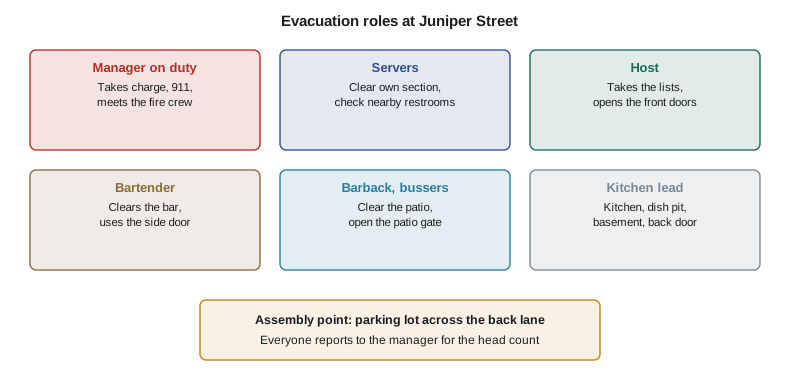
- The manager on duty takes charge, confirms that the alarm or the emergency is real, makes sure 911 has been called, and meets the fire department or paramedics on arrival.
- Each server clears their own section, telling guests calmly and clearly to leave now by the nearest exit, and pointing the way. They check the restrooms closest to their section on the way out.
- The host takes the reservation list and the staff schedule from the host stand, props the front doors fully open, and directs guests out from the front.
- The bartender clears the bar and directs guests toward the side door, which is closer to the bar than the front entrance.
- The barback and bussers clear the patio and open the patio gate to the sidewalk.
- The kitchen lead clears the kitchen, the dish pit and the basement and leaves by the back door.
- Everyone goes to the assembly point and reports to the manager, who does the head count.
What to say
Clear, short instructions work best. "Please leave the building now. Follow me to the side door." Staff speak loudly enough to be heard over the alarm, use gestures, and keep moving. They do not stop to explain what is happening, collect bills or wait for guests to finish. Guests who want to collect coats or bags are told to leave them. Staff never go back into the building once they are out, for any reason.
During the February evacuation, Olivia noticed that almost all of the guests in the back section went out the front door, past the bar, even though the side door was closer. The spring drill found the same thing. The fix was to give the servers whose sections are nearest the side door the specific job of standing by it and calling guests toward it. In the autumn drill, the side door took about a third of the guests, and the room emptied faster.
Guests who need help
Some guests cannot leave quickly on their own: people using wheelchairs or walkers, people with limited vision or hearing, young children, and guests who are very intoxicated. The server for that section helps them or makes sure someone does, and tells the manager at the assembly point. Juniper's ground floor has step-free exits at the front and the side, so guests using wheelchairs can leave without stairs. A guest who cannot be moved safely is helped to the safest place available, such as just outside the side door, and the manager tells the firefighters exactly where they are.
The head count
The head count is how the manager knows whether anyone is still inside. Daniel uses the staff schedule and sign-in sheet for staff, and the reservation list plus each server's knowledge of their tables for guests. Guests often leave the assembly point and go home, which is fine, but the servers need to tell the manager which tables were occupied and whether the guests were seen leaving. The program below is the simple check Daniel's tablet does for staff, comparing who signed in with who reported at the assembly point.
# Head count at the assembly point: who signed in for the shift and who has reported.
signed_in = ["Olivia", "Chloe", "Sam", "Nadia", "Rafael", "Maya", "Marcus", "Jenna",
             "Tomas", "Aisha", "Hana", "Ben", "Kofi", "Luis", "Noah", "Daniel"]
on_delivery = {"Jenna"}
reported = {"Olivia", "Chloe", "Sam", "Nadia", "Maya", "Marcus", "Tomas", "Aisha",
            "Hana", "Ben", "Kofi", "Luis", "Noah", "Daniel"}

missing = [name for name in signed_in if name not in reported and name not in on_delivery]
print(f"Signed in: {len(signed_in)}  Reported: {len(reported)}  Out on delivery: {len(on_delivery)}")
if missing:
    print("NOT ACCOUNTED FOR:", ", ".join(missing))
    print("Tell the fire captain now: last known location and which exit they would use.")
else:
    print("All staff accounted for.")
for name in sorted(on_delivery):
print(f"Phone {name}: tell them not to return to the building.")Signed in: 16 Reported: 14 Out on delivery: 1 NOT ACCOUNTED FOR: Rafael Tell the fire captain now: last known location and which exit they would use. Phone Jenna: tell them not to return to the building.
In this drill example, Rafael was missing from the count. He had gone out the patio gate with the patio guests and walked around to the front of the building instead of the assembly point. The manager phoned him, and he came over. In a real fire, the fire captain would have been told immediately that one staff member was unaccounted for, along with where he was last seen. That is the whole reason for the count: firefighters should never enter a burning building to search for someone who is safe on the sidewalk.
Choking
A guest choking on food is the medical emergency restaurants see most often. In July, a guest at one of Sam Patel's tables stood up suddenly, clutching his throat and unable to speak or cough. Sam, who holds a first aid certificate, asked him "Are you choking?" and got a nod. He told another server to call 911 and gave back blows and abdominal thrusts as his first aid course had taught him, until the food came out. The guest was checked by paramedics and went home.
- If a guest can cough forcefully or speak, encourage them to keep coughing and stay with them.
- If they cannot breathe, speak or cough, call 911 and start first aid immediately, using the technique taught in your first aid course. Canadian and American first aid programs teach back blows and abdominal thrusts, with variations for pregnant or very large people and for children.
- If the person becomes unresponsive, lower them to the floor, make sure 911 has been called, and start CPR.
- Anyone who received abdominal thrusts should be checked by paramedics or a doctor, even if they feel fine.
Allergic reactions
HSE-381 covered allergen control in the kitchen. Front-of-house staff are often first to see a reaction. Mild symptoms such as an itchy mouth or a few hives can progress quickly to anaphylaxis, a severe reaction that can kill within minutes. The signs include swelling of the lips, tongue or throat, trouble breathing or swallowing, wheezing, hives spreading over the body, vomiting, dizziness or collapse.
- Call 911 immediately if there are signs of anaphylaxis.
- Help the guest use their own epinephrine auto-injector, injected into the outer thigh, or use it for them if they cannot.
- Have the guest lie down with legs raised, or sit up if they are having trouble breathing. Do not have them stand or walk.
- A second dose may be given after about five minutes if symptoms do not improve and a second injector is available.
- Tell the manager, keep the dish and the ticket, and record exactly what was eaten.
Cardiac arrest and other medical emergencies
When a person collapses and is not breathing normally, every minute without CPR and defibrillation lowers the chance of survival. In 2026, Juniper installed an automated external defibrillator (AED) in a cabinet beside the host stand, and every manager and the staff with first aid certificates were trained to use it. The steps are the same for any collapse:
- Check whether the person responds. If not, shout for help and call 911, putting the phone on speaker.
- Send someone for the AED and someone to the front door to meet the paramedics.
- If the person is not breathing normally, start chest compressions: hard and fast in the center of the chest.
- Turn on the AED as soon as it arrives and follow its spoken instructions.
- Keep going until paramedics take over.
For other medical emergencies, such as a fall, a seizure, a diabetic emergency or a guest who suddenly feels very unwell, the approach is the same: call 911 when in doubt, send someone to meet the paramedics, give first aid within your training, clear space around the person and protect their privacy. The manager keeps the rest of the room calm and moves nearby guests if needed.
Other emergencies
Juniper's emergency plan also covers events that affect the whole building.
- Power outage: emergency lights come on along the exit routes. Cooking stops, gas appliances are turned off if they do not shut off on their own, and the manager decides whether to close. Staff guide guests and do not light candles indoors.
- Severe weather: Savannah faces hurricanes from June to November and occasional tornadoes. For hurricanes, the restaurant follows Chatham County's warnings and evacuation orders and closes early, bringing in patio furniture and heaters. For a tornado warning, staff move guests away from windows to the lowest, most interior space, the basement storage area and the restrooms, and stay there until the warning ends.
- Threats: a bomb threat by phone is kept on the line as long as possible while another person calls 911; the details are written down and the police decide on evacuation. If a violent person is in or near the building, staff and guests get out if they can, hide and lock doors if they cannot, and call 911 when it is safe.
Drills
Juniper runs two full evacuation drills a year with staff only, before opening, and talks through one emergency scenario at a pre-shift meeting each month: a choking guest, an allergic reaction, a power cut on a Saturday night. Each drill is timed and written up, and every finding goes onto the list for the next safety walk. The drills are why the February fire went the way it did.
Summary and key terms
- In an emergency, guests do not know the building, many have been drinking and most head for the front door; staff must lead with confidence.
- Every front-of-house role has an evacuation job: manager in charge, servers clear sections, host takes the lists and opens the front, bartender uses the side door, barback and bussers clear the patio.
- The head count, using the staff sign-in and the reservation list, tells firefighters whether anyone is still inside.
- For choking, allergic reactions and cardiac arrest: call 911, give first aid within your training, use the guest's epinephrine and the AED, and send someone to meet paramedics.
- The plan also covers power outages, hurricanes and tornadoes, and threats, and is practiced in drills.
- Assembly point
- The agreed place outside where everyone gathers after an evacuation for the head count.
- Head count
- Checking that every staff member and guest is accounted for after an evacuation.
- Anaphylaxis
- A severe, rapid allergic reaction that can block breathing and cause collapse.
- Epinephrine auto-injector
- A pen-like device that injects a dose of epinephrine into the thigh to treat anaphylaxis.
- AED
- An automated external defibrillator, which analyzes the heart rhythm and delivers a shock if needed.
Communication with the kitchen
Front-of-house staff and the kitchen must know about each other's emergencies. When the alarm sounds, the kitchen lead shuts off what can be shut off quickly on the way out, but nobody stays behind to do it. When a guest has an allergic reaction, the server tells the kitchen immediately so the dish and its ingredients can be checked and kept for the paramedics and any follow-up. When a guest collapses, the kitchen sends someone to help clear space and fetch the first-aid kit.
Common mistakes
MistakeLet guests finish paying before they leave in an alarm.
InsteadEveryone leaves immediately; bills and belongings are left behind.
MistakeIf a staff member is missing at the assembly point, go back in to look.
InsteadNever re-enter; tell the fire captain who is missing and where they were last seen.
MistakeA guest who can still cough needs abdominal thrusts.
InsteadEncourage forceful coughing and stay with them; start first aid if they cannot breathe, speak or cough.
Practice problems
Work each problem on paper first, then reveal the answer to check.
The alarm sounds on a busy Saturday. You are a server with a section near the side door. What do you do?
Show answer
Tell your guests calmly to leave now, direct them and others to the side door, help anyone who needs it, check the nearby restroom, leave, go to the assembly point and report to the manager.
A guest's lips swell and he says his throat feels tight after a dessert. What happens next?
Show answer
Call 911, help him use his epinephrine auto-injector, have him sit or lie as is comfortable for breathing, tell the manager, keep the dish and ticket, and be ready to give a second dose after about five minutes if needed.
Why does the head count matter so much to firefighters?
Show answer
It tells them whether they need to search inside a burning building, and where; an unaccounted-for person who is actually safe outside puts firefighters at risk for nothing.
Lesson quiz · 5 questions
Score 60% or more to complete this lesson.
Create a free account to save your progress, take quizzes and earn a certificate.