
HSE-383 · Lesson 4 of 12 · 16 min
De-escalation for servers and bartenders
▶ Video coming soon A video version of this lesson is on the way.
On a Saturday in March, a party of six at Chloe Martin's table waited 50 minutes for their mains because a ticket had been lost in the kitchen. By the time the food came, one guest, a large man who had finished three beers while he waited, was standing up, pointing at Chloe and telling the whole room what he thought of the restaurant. Chloe did not argue, did not apologize over and over, and did not walk away. She lowered her voice, kept a table's width between them, agreed that 50 minutes was far too long, told him exactly what she was going to do, and used the code word to bring Olivia over. Within three minutes he was sitting down, the mains were comped and the table left a reasonable tip. The rest of the room went back to their dinners.
That is de-escalation: using words, tone, body language and choices to calm a person who is upset, so that the situation does not turn into a fight. It is a skill, and like any skill it can be learned and practiced. This lesson covers the techniques that work for servers and bartenders, how to keep yourself safe while you use them, how to bring in help, and when to stop trying and get out.
The goal is safety, not winning
De-escalation starts with a change of goal. In the moment, it is natural to want to prove the guest wrong, defend the kitchen, or make him apologize. None of those keeps anyone safe. The goal is to bring the temperature down so that everyone, including the guest, gets through the next few minutes without harm. Whether the guest was right about the wait, the bill or the steak can be sorted out later, by the manager, once everyone is calm.
Look after your own safety first
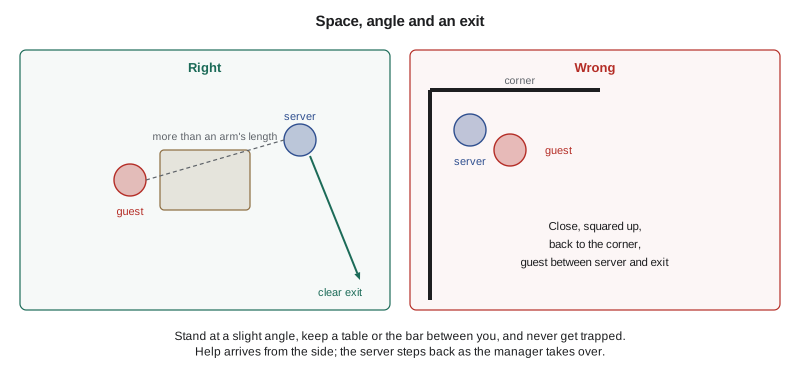
Before saying a word, a server or bartender should check three things: space, exits and help.
- Space: stay at least a long arm's length away, 3 to 5 ft (about 1 to 1.5 m), and further if the person is very agitated. A table, the bar or a chair between you is useful. Stand at a slight angle rather than square on, which looks less confrontational and makes it easier to step away.
- Exits: make sure you can leave, and that the guest can too. Never get trapped in a booth, a corner or behind the bar with the guest blocking the gap. A person who feels cornered is more likely to lash out.
- Help: know where the manager is, use the code word early, and make sure someone else can see you. The bar's panic button exists for the moments when words are not enough.
What to say and how to say it
The words matter less than the way they are said. Research on communication in tense situations consistently finds that tone of voice and body language carry more weight than the words themselves. A calm, low, slow voice, relaxed open hands, and an unhurried manner signal that you are not a threat and that the situation is under control.
- Listen first. Let the person say what is wrong without interrupting. Nod, keep reasonable eye contact, and wait for a pause.
- Acknowledge the feeling, even if you do not agree with the complaint. "Fifty minutes is a long time to wait. I'd be frustrated too." This is not admitting fault; it is showing that you heard.
- Keep it short and simple. Angry people do not process long explanations. One or two sentences at a time.
- Say what you will do, not what you cannot do. "I'm going to check with the kitchen right now and come straight back" works better than "There's nothing I can do."
- Offer choices. "I can bring the mains as they're ready, or have them all come out together in five minutes. Which would you prefer?" Choices give back a sense of control.
- Use the person's name if you know it, and avoid jargon and house rules that sound like excuses.
- Avoid trigger phrases: "calm down", "you need to", "that's our policy", "there's nothing I can do", and sarcasm. They tend to escalate.
What not to do
Some responses feel natural but make things worse:
- Raising your voice to match his, or talking over him.
- Touching the person, even a friendly hand on the arm. Touch can be read as a threat.
- Pointing, crossing your arms, hands on hips or standing over someone seated.
- Laughing, smirking or rolling your eyes, even at a colleague behind the guest.
- Making promises you cannot keep, such as a free meal that the manager has not agreed to.
- Arguing about the facts in front of the table or the room.
- Taking the bait when the guest insults you personally. Stay focused on the problem.
Bartenders have a particular job
Bartenders de-escalate in a different setting from servers. The bar is a physical barrier, which helps, but the guests are often more intoxicated, the room is louder and the bartender is frequently the person who has to refuse a drink, which is one of the most common triggers. Nadia's approach at Juniper's bar has three parts.
- Watch the room. She keeps track of who is drinking what and how fast, notices who is getting louder, and steps in early with water, food and a slower pace before anyone needs to be cut off.
- Use the bar. She stays behind it, steps back out of reach if a guest leans in or reaches across, and never comes around the bar to confront someone.
- Use the team. She tells the manager about a guest she is worried about before it becomes a problem, and she and the servers use the code word to bring help.
Lesson 6 covers refusing service in detail, because it combines de-escalation with legal duties.
The code word and the panic button
Juniper's code word is a question asked out loud, across the room or into the kitchen, that sounds ordinary to guests: "Can someone check table 40?" There is no table 40 at Juniper. Any staff member who hears it moves to where the speaker is and stays visible nearby; the manager on duty comes over to take charge. Having a second person present often calms a situation by itself, and it means there is a witness.
The panic buttons behind the bar and under the host stand alert the manager's phone and, after hours, the monitoring company. They are for situations that are past words: a guest threatening someone, a fight starting, a weapon shown. Pressing the button is never wrong if someone feels unsafe.
Olivia runs a short drill every month at a pre-shift meeting: someone says the code word at a random time during the shift, and she records how long it takes for a second person and the manager to arrive. The target is a second person within 30 seconds and the manager within 60.
# Code word drill: time from the call to the first helper and to the manager (seconds).
drills = [
    ("Jan", 18, 41), ("Feb", 25, 55), ("Mar", 22, 48), ("Apr", 35, 80),
    ("May", 20, 44), ("Jun", 16, 39), ("Jul", 28, 66), ("Aug", 19, 47),
]

helper_target, manager_target = 30, 60
missed = []
for month, helper, manager in drills:
    ok = helper <= helper_target and manager <= manager_target
    if not ok:
        missed.append(month)
    print(f"{month}: helper {helper:3d} s, manager {manager:3d} s  {'OK' if ok else 'MISSED'}")

avg_helper = sum(d[1] for d in drills) / len(drills)
avg_manager = sum(d[2] for d in drills) / len(drills)
print(f"Average: helper {avg_helper:.0f} s, manager {avg_manager:.0f} s")
print("Months to review:", ", ".join(missed))Jan: helper 18 s, manager 41 s OK Feb: helper 25 s, manager 55 s OK Mar: helper 22 s, manager 48 s OK Apr: helper 35 s, manager 80 s MISSED May: helper 20 s, manager 44 s OK Jun: helper 16 s, manager 39 s OK Jul: helper 28 s, manager 66 s MISSED Aug: helper 19 s, manager 47 s OK Average: helper 23 s, manager 52 s Months to review: Apr, Jul
April and July missed the target. In April the manager was in the basement office; in July the patio was full and the manager was outside. Both led to changes: the manager on duty now carries the phone that receives panic alerts at all times, and on busy patio nights a second supervisor covers the patio.
When to stop and get out
De-escalation does not always work, and it is not the server's job to keep trying when the risk is rising. Stop talking, step away and get help immediately if the person:
- threatens to hurt anyone or shows a weapon;
- moves toward you after you have stepped back;
- picks up something that could be thrown or used as a weapon, such as a bottle, glass or knife;
- starts damaging property or pushing other guests;
- is so intoxicated or distressed that he cannot follow what you are saying.
In those cases, move away to a place where there are other people, press the panic button or tell the manager, and call 911 if anyone is in danger. Warn guests nearby to move away if you can do it safely. Do not try to take a weapon from anyone or physically restrain anyone. Give the police a clear description and stay available to tell them what happened.
After an incident
When it is over, the manager makes sure the worker is not hurt and is not left to finish the shift alone at that table or section. The incident is written up the same night, and any injury is recorded and reported under the workers' compensation rules. The worker is encouraged to see a doctor for any injury or for symptoms such as trouble sleeping, anxiety or intrusive memories, which are real effects of a frightening event. A short debrief, either that night or at the next pre-shift meeting, looks at what happened and what could change, without blame. Juniper also offers counseling through its employee assistance plan after any serious incident.
Chloe's table in March went well, but she was shaken afterward, and Olivia sat with her for a few minutes in the office before she went back to the floor. That kind of support matters as much as the technique.
Summary and key terms
- The goal of de-escalation is safety, not winning the argument.
- Check space, exits and help before engaging: keep more than an arm's length away, stand at an angle and never get cornered.
- Listen, acknowledge the feeling, keep it short, say what you will do and offer choices; avoid trigger phrases and touch.
- Use the code word early and the panic button whenever someone feels unsafe; practice both.
- Stop and get help if there is a threat, a weapon or movement toward you; afterward, record the incident, support the worker and debrief without blame.
- De-escalation
- Using words, tone, body language and choices to calm an upset person and prevent harm.
- Reactionary gap
- The space kept between a worker and an agitated person, usually more than an arm's length.
- Trigger phrase
- A phrase such as "calm down" or "that's our policy" that tends to make an upset person angrier.
- Debrief
- A short, blame-free discussion after an incident about what happened and what could change.
- Employee assistance plan
- A confidential counseling and support service paid for by the employer.
Practicing the words
De-escalation is easier to learn by practice than by reading. At pre-shift meetings, Olivia sometimes runs a two-minute role play: one server plays a guest whose order is wrong, another responds, and the group talks about what worked. The point is to have the first few sentences ready, so that in a real situation nobody has to think of them from scratch. Servers who have said "I'm sorry about the wait, here's what I'm going to do" a few times in practice say it naturally when it counts.
De-escalating with a group
Groups add complications. One member may be angry while the others are embarrassed, or the group may egg each other on. Usually the best approach is to find the calmest person in the group and work with them: "Could you help me out here? I want to sort this out for your table." Speaking to the angry guest on his own, a few steps away from the table, removes his audience. A server never tries to calm a whole group alone; that is a job for the manager, with the server alongside.
Language barriers and hearing
Not every guest who seems angry is angry. A guest who does not speak English well, who is hard of hearing, or who has a condition that affects how they communicate may raise their voice or seem abrupt simply because they are struggling to be understood. Slowing down, using simple words, pointing to the menu, writing things down and checking that you have understood all help. Treating a misunderstanding as aggression is one of the quickest ways to create real aggression.
Looking after yourself
Handling an angry guest is stressful even when it goes well. Servers are encouraged to take a short break in the staff area after a difficult table, to tell the manager how they are feeling, and to hand the table over if they need to. Nobody is expected to absorb abuse and carry on smiling for the rest of the shift.
Common mistakes
MistakeTelling an angry guest to calm down shows you are in control.
InsteadIt usually makes people angrier; acknowledge the feeling and say what you will do instead.
MistakeA reassuring hand on the guest's arm helps calm things.
InsteadTouch can be read as a threat; keep your distance.
MistakeThe bartender should come around the bar to deal with a guest face to face.
InsteadStay behind the bar, step back out of reach and bring in the manager.
Practice problems
Work each problem on paper first, then reveal the answer to check.
Rewrite this sentence to de-escalate: "That's our policy, there's nothing I can do."
Show answer
For example: "I understand why that's frustrating. Let me get the manager over right now so we can sort it out for you."
Name three things a server checks before speaking to an upset guest.
Show answer
Space (more than an arm's length, a table between), an exit for both people, and where help is (manager, code word, someone watching).
A guest picks up a beer bottle by the neck while shouting at Nadia. What should she do?
Show answer
Stop talking, step back out of reach, press the panic button or alert the manager, move other people away if safe, and call 911; do not try to take the bottle.
Lesson quiz · 5 questions
Score 60% or more to complete this lesson.
Create a free account to save your progress, take quizzes and earn a certificate.