
HSE-383 · Lesson 3 of 12 · 16 min
Difficult and aggressive customers
▶ Video coming soon A video version of this lesson is on the way.
Almost every guest who walks into Juniper Street wants a good meal and a pleasant evening, and almost every complaint is about food, service, waiting or the bill. A small number of interactions go further. A guest raises his voice, swears at a server, refuses to leave, threatens someone, grabs an arm or throws a glass. Front-of-house workers in restaurants and bars meet this more often than most workers, because they serve the public, they serve alcohol, they work late, they handle money and they are often young. This lesson is about recognizing those situations early, understanding why they escalate, and putting controls in place before anything happens. The next lesson covers what servers and bartenders actually say and do when a situation starts to go wrong.
What counts as violence at work
There is no single legal definition of workplace violence in federal OSHA rules, but OSHA and NIOSH describe it as any act or threat of physical violence, harassment, intimidation or other threatening disruptive behavior that occurs at the work site. That includes a guest who says "I'll be waiting for you in the parking lot", even if he never touches anyone. Swearing and rudeness that do not threaten anyone are not violence, but they are still worth recording, because they are often the first stage of something worse.
Juniper's incident log uses four categories: verbal abuse (shouting, swearing, insults aimed at a worker), threats (statements or gestures that suggest harm), physical contact (grabbing, pushing, throwing things, blocking someone's way) and assault causing injury. In the injury year there were 9, 3, 2 and 0 incidents in those categories.
Why it happens in restaurants and bars
Research on violence in the hospitality industry points to the same risk factors over and over. Juniper has most of them:
- Alcohol, which lowers inhibitions and judgment and makes some people more irritable and more willing to fight.
- Late hours, when the guests are more intoxicated, the street outside is quieter and there are fewer staff on.
- Waiting, crowding and frustration: a long wait for a table, a wrong order, a bill that is higher than expected.
- Refusing something: refusing service, refusing entry, asking someone to leave or checking ID.
- Money: cash in the till, tips on the table and disputes over the bill.
- Working alone or with few staff, especially at opening and closing.
- Young and inexperienced workers who have not yet learned to read a room.
Most of Juniper's 14 incidents happened between 9 p.m. and midnight, and most involved alcohol. Two happened at the host stand when the wait for a table was long, and three happened when a server or Nadia refused to serve another drink.
Early signs of trouble
Very few incidents come out of nowhere. Most build through stages, and each stage has signs that an alert server can notice. The signs are not a checklist that proves anything, but noticing two or three together is a signal to involve the manager early.
- Body language: clenched fists or jaw, pacing, invading personal space, staring, pointing, standing up suddenly, hitting the table.
- Voice: getting louder or much quieter, faster speech, swearing, repeating the same demand, refusing to answer questions.
- Intoxication: slurring, loud and boisterous behavior, stumbling, spilling drinks, buying rounds for strangers.
- Group dynamics: a group egging one person on, or one person trying to impress others.
- Context: a history with this guest, a recent refusal, a long wait or a dispute about the bill.
How incidents escalate
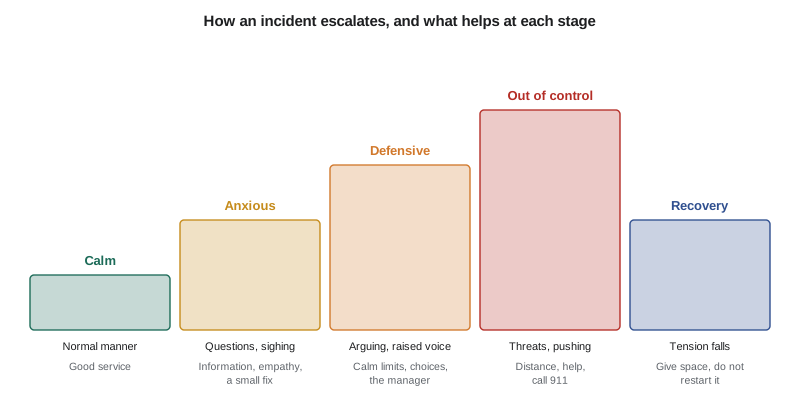
Safety trainers often describe escalation as a set of stages. A guest starts out calm, becomes anxious or frustrated, then defensive and argumentative, then may lose control and become aggressive, and finally calms down again over a period of tension and recovery. The useful point is that the right response depends on the stage. At the anxious stage, a server can almost always calm things with information, empathy and a small fix. At the defensive stage, the server needs to set clear, respectful limits and bring in the manager. Once a person loses control, the only goal is safety: get space, get help and let the police handle it.
Juniper's risk assessment
Federal OSHA has no workplace violence standard, but its guidance for late-night retail and other high-risk businesses recommends a written program: management commitment and worker involvement, a worksite analysis of past incidents and risk factors, controls, training, and recordkeeping and evaluation. OSHA can cite an employer under the General Duty Clause where violence is a recognized hazard and feasible controls were not used. Juniper's voluntary safety committee did a risk assessment in 2026 using the incident log, guidance from OSHA, NIOSH and the National Restaurant Association, and a walk of the front of house.
The assessment looked at each place and time where staff meet guests, rated the risk, and listed controls. The highest-rated situations were: refusing service at the bar on Friday and Saturday nights; asking an intoxicated guest to leave; the host stand during long waits; the last hour of the night, when two or three staff close; and the parking lot after closing. Lessons 6, 8 and 9 cover refusing service, closing and the parking lot in detail.
Controls that work
Like every hazard, violence is controlled best by changing the situation rather than relying on each worker's skill in the moment. Juniper's controls fall into four groups.
- The physical environment: good lighting at the entrance, bar and parking lot; a clear view from the bar and host stand across the dining room; the bar laid out so the bartender can step back out of reach; a panic button behind the bar and under the host stand that alerts the manager's phone; security cameras covering the entrance, bar, till and back door, with signs saying so.
- Staffing and scheduling: never fewer than two staff at closing; a manager on duty on every shift who is trained to handle incidents; extra staff on nights with large reservations or events; no young workers on the late shift.
- Policies: a clear house policy on intoxication and refusal of service; a written procedure for asking a guest to leave; a code word that tells other staff to come over and help; a ban list for guests who have been violent or abusive; cash kept to a minimum on the floor.
- People: training for every front-of-house worker in this lesson and the next; practice of the code word and the panic button; and a manager who backs staff up when they set a limit.
Some things are deliberately missing from the list. Juniper does not ask servers or bartenders to physically remove anyone, to block an exit, or to chase a guest who leaves without paying. Those actions cause far more injuries to staff than they prevent losses. The house rule is: if a guest walks out on the bill, let them go, note the description, and tell the manager. The money is not worth a broken wrist or a knife wound.
Recording and reviewing incidents
Every incident, from verbal abuse to an assault, is written up the same night on a one-page form: date, time, location, what happened, who was involved, what staff did, whether police were called and whether anyone was hurt. The manager on duty signs it, and the safety committee reviews the log each month. The review looks for patterns rather than blame: a particular time, a particular situation, a repeat guest. The log is also how Juniper decides to ban a guest, and it is evidence if a guest later makes a complaint.
The short program below is the one Aisha uses to summarize the log for the committee each quarter.
# Summarize the customer incident log by type, hour and alcohol involvement.
from collections import Counter

log = [  # (hour, type, alcohol involved)
    (18, "verbal", False), (19, "verbal", True), (20, "verbal", True), (20, "threat", False),
    (21, "verbal", True), (21, "verbal", True), (21, "physical", True), (22, "verbal", True),
    (22, "threat", True), (22, "verbal", False), (22, "physical", True), (23, "verbal", True),
    (23, "threat", True), (23, "verbal", True),
]

by_type = Counter(t for _, t, _ in log)
late = sum(1 for h, _, _ in log if h >= 21)
alcohol = sum(1 for _, _, a in log if a)
print("By type:", dict(sorted(by_type.items())))
print(f"After 9 p.m.: {late} of {len(log)}")
print(f"Alcohol involved: {alcohol} of {len(log)}")
busiest = Counter(h for h, _, _ in log).most_common(1)[0]
print(f"Busiest hour: {busiest[0]}:00 with {busiest[1]} incidents")By type: {'physical': 2, 'threat': 3, 'verbal': 9}
After 9 p.m.: 10 of 14
Alcohol involved: 11 of 14
Busiest hour: 22:00 with 4 incidentsThe numbers confirmed what staff already felt: the late hours and alcohol drove almost everything. The committee's main decisions for the year followed from that: a second staff member at the bar from 10 p.m. on Friday and Saturday, a firmer house policy on the last hour of service, and the panic buttons.
When a guest is in crisis
Occasionally a person comes in from the street who is not a customer at all and who is clearly unwell: confused, talking to people who are not there, very distressed, or under the influence of drugs. Most people in a mental health crisis are not violent, and many are frightened. The same principles apply: stay calm, keep a safe distance, speak simply and kindly, do not argue, and involve the manager. If the person seems at risk of harming themselves or others, call 911 and describe what you see. Juniper keeps the number of the local crisis line at the host stand.
Summary and key terms
- Violence at work includes threats and threatening behavior, not only physical force.
- Alcohol, late hours, waiting, refusals, money, few staff and young workers raise the risk in restaurants and bars.
- Incidents usually escalate through stages, and early signs in body language, voice and context give time to act.
- A risk assessment of each situation where staff meet guests leads to controls in the environment, staffing, policies and training.
- Staff are never expected to physically remove guests or chase walkouts; every incident is recorded and reviewed for patterns.
- Workplace violence
- Physical force, or a threat or threatening behavior, by someone other than a worker that could cause injury.
- Escalation
- The way an interaction moves from calm through frustration and defensiveness toward loss of control.
- Panic button
- A hidden alarm button that alerts the manager or a monitoring service that a worker needs help.
- Code word
- An agreed phrase that tells other staff to come and support a colleague without alarming guests.
- Ban list
- A record of guests who are no longer welcome because of violence, threats or harassment.
The host stand
The host is often the first person a frustrated or intoxicated guest meets, and the host stand is where some of Juniper's incidents began: long waits on Saturday nights, guests who had been drinking elsewhere, and walk-ins who did not accept that the restaurant was full. Hosts are often among the youngest staff, as Maya is. Juniper's controls at the host stand include honest wait times with a text when the table is ready, so guests do not hover at the door; a manager who comes to the front as soon as a guest starts to argue; a clear policy that the host never refuses entry to an intoxicated guest alone, but calls the manager to do it; and the panic button under the stand. The host stand was also moved slightly so that the host is not standing directly in the path of people coming in from the street.
Guests who have been banned
A ban only works if staff recognize the guest. Juniper's ban list is kept in the manager's binder and on the host stand tablet, with a short description and, where there is one from the cameras, a photo. Bans are recorded with the reason and the date and reviewed after a year. If a banned guest arrives, the host does not confront him but calls the manager, who tells him calmly that he cannot be served and asks him to leave. If he refuses, the manager calls the police rather than trying to remove him.
Training new staff
Every new front-of-house worker at Juniper goes through this lesson and the next during their first week, before they work a late shift, and they shadow an experienced server on at least two busy nights. New staff are told plainly that they will never be expected to handle a threatening guest alone, and they practice the code word and find the panic buttons on their first shift.
Common mistakes
MistakeIt was only a threat, so there is nothing to report.
InsteadA threat that gives a worker reason to fear injury is workplace violence and must be recorded and reviewed.
MistakeServers should stop guests who walk out without paying.
InsteadLet them go, note the description and tell the manager; chasing or blocking causes injuries.
MistakeViolence is unpredictable, so planning does not help.
InsteadMost incidents follow predictable patterns of time, place and situation, which a risk assessment can target.
Practice problems
Work each problem on paper first, then reveal the answer to check.
List four risk factors for violence that are present at a busy restaurant bar on a Saturday at 11 p.m.
Show answer
Alcohol, late hours, crowding and waiting, refusals of service, cash, fewer staff toward closing, and guests in groups.
A guest at the host stand has been told the wait is 40 minutes. He is pacing, sighing and asking repeatedly. Which stage is he at, and what helps?
Show answer
Anxious or frustrated; give honest information, empathy, a small fix such as a seat at the bar or a call when the table is ready, and keep checking in.
Why does Juniper record verbal abuse that did not threaten anyone?
Show answer
It is often the early stage of escalation, patterns in it guide controls, it may be harassment, and records support bans and later complaints.
Lesson quiz · 5 questions
Score 60% or more to complete this lesson.
Create a free account to save your progress, take quizzes and earn a certificate.