
HSE-361 · Lesson 9 of 12 · 21 min
Art rooms: kilns, clay, glazes, solvents and printmaking
Art rooms rarely appear on lists of hazardous school spaces, yet many contain the same kinds of hazards as labs and shops: a kiln reaching higher temperatures than anything in the science wing, silica dust from clay, glazes containing metal compounds, solvents for oil painting and printmaking, spray fixatives, and sharp cutting tools. Art teachers often work alone, without a lab assistant or a department of colleagues trained in safety, and many art supplies are brought in from home or donated. Lucia Ferraro teaches visual arts at Pinecrest High School, and Willow Park's art room is run by a generalist teacher with a second-hand kiln. This lesson follows both.
Kilns
Ceramic kilns fire clay and glazes at temperatures that commonly range from about 1,000 °C to over 1,250 °C (1,800 °F to over 2,300 °F). They bring three main hazards: heat and fire, fumes, and electrical hazards.
- Heat and fire. The outside of a kiln gets hot enough to burn skin and ignite nearby combustibles. Kilns need clearance from walls and anything flammable as specified by the manufacturer, a non-combustible floor, and a room that is not used for storing paper, cardboard, clay bags or other materials.
- Fumes. As clay and glazes fire, they release carbon monoxide, sulfur oxides, fluorine compounds, and metal fumes from some glazes. These must be vented outdoors, usually with a hood over the kiln or a vent system that draws air through the kiln and exhausts it outside. A kiln in an unvented classroom or storage room exposes everyone in the area.
- Infrared radiation. Looking into the spy holes of a hot kiln exposes the eyes to infrared light, which over time can damage the eyes. Infrared-protective glasses or welding-type shade lenses rated for kiln viewing should be used.
- Electrical. Electric kilns draw large currents and must be on a dedicated circuit installed by an electrician, with the correct plug and receptacle, never on an extension cord.
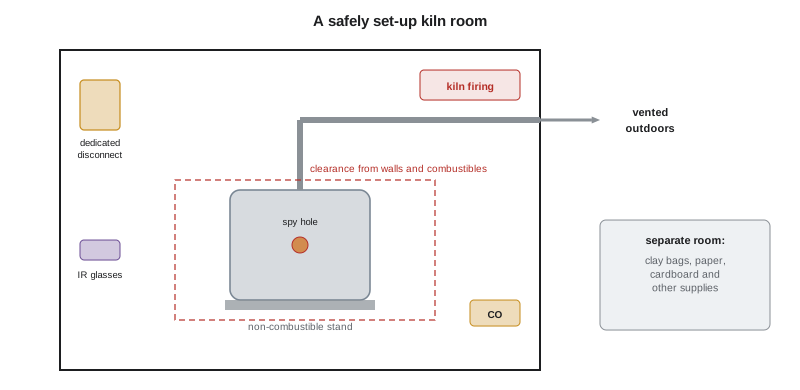
Modern electric kilns have automatic controllers that shut off at the end of a firing, but they can fail, and a kiln that overfires can melt its contents and damage its elements. The district's procedure requires that firings be planned so the kiln reaches its peak while staff are in the building, that someone checks the kiln at the expected end of the firing, and that the kiln room is locked and signed while firing. Students should not be in the kiln room during a firing and should never open or unload a kiln until it has cooled below the temperature specified by the manufacturer.
When Daniel visited Willow Park, he found the second-hand kiln in a storage closet beside the art room, with no vent, paper supplies stacked against it, and a plug adapter on the cord. The kiln was taken out of service until it could be moved to a proper location with a vent and a dedicated circuit, and the district added kilns to its list of equipment that cannot be accepted as donations without an inspection.
Clay and silica dust
Clay contains crystalline silica, and dry clay dust can be breathed deep into the lungs. Long-term exposure to respirable crystalline silica causes silicosis, a scarring of the lungs that does not heal, and is linked to lung cancer. In a ceramics studio, the main sources are dry clay trimmings, sanding dried pieces, mixing dry clay or glaze powders, and sweeping dust that has built up on floors and tables.
Controls focus on keeping clay wet and dust down:
- Buy premixed moist clay rather than mixing from dry powder, and buy premixed glazes where possible.
- Clean tables and floors with wet methods, such as damp sponges and wet mopping, or with a vacuum fitted with a high-efficiency filter, never by dry sweeping.
- Recycle clay scraps while they are still wet, and do not let trimmings dry and powder on the floor.
- Mix any dry materials in a ventilated area or with local exhaust, with a respirator for the person doing the mixing if exposure cannot be controlled otherwise.
- Avoid sanding greenware and bisqueware; if it must be done, do it wet or with local exhaust.
- Wear washable aprons or smocks that stay in the studio and are laundered regularly.
Glazes
Glazes are mixtures of silica, fluxes and colorants, and some contain toxic metals such as lead, barium, cadmium, chromium, cobalt, manganese or nickel. Lead glazes in particular were once common and can leach lead into food if a piece is used for eating or drinking. Most school suppliers now sell glazes labeled as lead-free and food-safe, and schools should use only those. Glaze labels and SDSs should be checked, and glazes that are not food-safe should never be used on functional pieces such as mugs and bowls that students take home.
Glazes should be applied by brushing or dipping rather than spraying, unless a proper spray booth is available, and students should wash hands after glazing and never eat or drink in the studio. Glaze powders, when used, are mixed by the teacher with dust controls.
Paints, solvents and spray products
Most school painting now uses water-based acrylics, tempera and watercolours, which are low hazard. Oil painting, still taught in some senior classes, traditionally uses solvents such as turpentine and mineral spirits for thinning and cleaning brushes. These are flammable, irritating to skin and eyes, and their vapors cause headaches and dizziness in poorly ventilated rooms. Safer options include odorless mineral spirits with lower aromatic content, water-mixable oil paints, and cleaning brushes with soap and vegetable oil.
Spray fixatives, spray paints and spray adhesives release fine mists of solvent and pigment that are easily breathed in. They should be used only in a spray booth or outdoors, never in the classroom. Some pigments, especially in older or artist-grade paints, contain toxic metals such as cadmium, cobalt or lead compounds; product labels and SDSs show this. Students should not use these products in ways that create dust or mist, and should never point brushes with their lips.
Art materials sold in the United States must be labeled for chronic health hazards under the Labeling of Hazardous Art Materials Act, and products that meet the ASTM D-4236 standard carry that reference on the label. A label saying 'conforms to ASTM D-4236' means the product was reviewed and labeled, not that it is safe; the label may still carry warnings. Many school purchasers look for products certified by the Art and Creative Materials Institute (ACMI) as non-toxic for younger students. Products used by teachers in larger quantities are also workplace hazardous chemicals under HazCom, so their SDSs must be on file.
Printmaking
Printmaking combines several hazards: sharp cutting tools for linocuts and woodcuts, oil-based inks and solvents for cleanup, and in some secondary programs, acid etching of metal plates and photographic chemicals for screen printing. Linoleum cutters cause many cuts; students should cut away from the hand holding the block, use a bench hook to hold the block, and use cutters with guards where available. Water-based inks avoid most solvent use. Acid etching and photographic emulsions bring the chemical hazards of a science lab into the art room and need the same storage, ventilation, protective equipment and waste disposal. Many schools have replaced acid etching with safer techniques.
Sharp tools and other hazards
Craft knives, scissors, wire, glass for stained glass or mosaics, hot glue guns and soldering irons are common in art rooms. Craft knives with retractable or snap-off blades should be used with a cutting mat and a metal ruler, cutting away from the body, with blades disposed of in a sharps container. Hot glue guns cause burns, especially with younger students; low-temperature guns are available. Stained glass and soldering bring lead exposure from lead came and lead-containing solder, so many schools use lead-free solder and copper foil techniques, with hand washing and no eating in the room.
Choosing materials for different ages
Younger children are more vulnerable to toxic materials because they are smaller, their bodies are still developing, and they are more likely to put hands and materials in their mouths. Elementary art programs should use only materials labeled as suitable for children, with no solvents, no powdered clay or glaze mixing, no spray products, and no materials containing toxic metals. The program below shows a simple screen a teacher could apply to a supply list.
# Screen art supplies for an elementary classroom.
banned_terms = ["solvent", "spray", "powder", "lead", "cadmium", "turpentine"]
supplies = [
    ("tempera paint, washable", "AP certified, water-based"),
    ("spray fixative", "aerosol, solvent-based"),
    ("premixed moist clay", "low-dust, wet"),
    ("glaze powder, mixed in class", "powder, contains silica"),
    ("oil pastels", "no solvents"),
    ("cadmium red artist paint", "contains cadmium"),
]
for name, notes in supplies:
    text = (name + " " + notes).lower()
    flags = [t for t in banned_terms if t in text]
print(f"{name:32} {'NOT for elementary: ' + ', '.join(flags) if flags else 'ok'}")tempera paint, washable ok spray fixative NOT for elementary: solvent, spray premixed moist clay ok glaze powder, mixed in class NOT for elementary: powder oil pastels NOT for elementary: solvent cadmium red artist paint NOT for elementary: cadmium
The screen is deliberately simple. It catches the spray fixative, the glaze powder and the cadmium paint, which have no place in an elementary art room, and passes the washable tempera, moist clay and oil pastels.
Worked problem
Lucia's studio audit
Lucia asks Daniel to help her review the ceramics studio at Pinecrest High School. They find a thick layer of clay dust on the shelves and floor, a bucket of glaze powder that students scoop by hand, a box of donated glazes with no labels, and a can of spray fixative used near the open windows. What should they change?
Show solution
- Have Victor's crew wet-clean the shelves and floor and change to wet mopping and HEPA vacuuming for the studio from now on.
- Replace the glaze powder with premixed, lead-free, food-safe glazes, and stop students handling dry glaze powder.
- Dispose of the unlabeled donated glazes through the waste contractor, since their contents and lead status are unknown.
- Move spray fixative use to the spray booth in the technology wing, or switch to brush-on alternatives.
- Update the studio's rules and the SDS binder, and add the studio to the safety committee's inspection route.
Answer: Clean with wet methods, switch to premixed lead-free glazes, dispose of unknown glazes, move spraying to a booth, and update rules, SDSs and inspections.
Photography, digital media and other studio work
Some art programs still run film darkrooms. Developers, stop baths and fixers can irritate skin and lungs, and some developers cause allergic skin reactions with repeated contact. Darkrooms need good ventilation, often a dedicated exhaust, along with tongs rather than fingers in the trays, gloves and eye protection when mixing chemistry, and disposal of used fixer through the waste system rather than the drain, because it contains dissolved silver. Most schools have now moved to digital photography, which removes the chemical hazards but brings the ergonomic issues of long hours at a screen.
Sculpture and mixed-media classes may use plaster, which gets hot as it sets and should never be used to cast a body part directly, because severe burns have resulted when hands were trapped in setting plaster. Wire, metal and found objects bring cuts and puncture wounds. Resins and two-part epoxies used for casting or coating give off vapors and can cause skin sensitization, so they need ventilation, gloves and careful mixing in small amounts, and many schools avoid them for younger students altogether.
Housekeeping and the end of the class
Art rooms are often cluttered with projects in progress, drying racks and supplies, and a tidy room is safer. Brushes are cleaned at the sink with water-based products or in a closed solvent container with a lid, rags with solvents or oils go into a closed metal container, sharps go in the sharps box, and tables are wiped damp. Students wash their hands before leaving, especially after clay, glazes, pastels or charcoal, and food and drink stay outside the studio.
Common mistakes
MistakePutting a kiln in an unvented storage closet.
InsteadKilns need venting outdoors, clearance from combustibles and a dedicated circuit.
MistakeSweeping dry clay dust.
InsteadClean with wet methods or a high-efficiency vacuum.
MistakeUsing glazes that are not food-safe on mugs and bowls.
InsteadUse only lead-free, food-safe glazes for functional pieces.
MistakeUsing spray fixative in the classroom.
InsteadUse spray products only in a spray booth or outdoors.
MistakeAccepting donated kilns and art supplies without review.
InsteadInspect donated equipment and check labels and SDSs before use.
Summary and key terms
- Kilns need venting to the outdoors, clearance from combustibles, a dedicated circuit and planned, attended firings.
- Clay contains crystalline silica; keep clay wet and clean with wet methods or a high-efficiency vacuum.
- Use premixed, lead-free, food-safe glazes, applied by brushing or dipping.
- Prefer water-based paints and inks; use solvents and spray products only with proper ventilation or a booth.
- Check art material labels and SDSs; a label reference to a standard is not a guarantee of safety.
- Printmaking and stained glass bring cutting, solvent, acid and lead hazards that need specific controls.
- Elementary art rooms should use only child-appropriate materials, with no solvents, sprays, powders or toxic metals.
- Crystalline silica
- A mineral in clay and glaze materials; breathing its fine dust can cause silicosis.
- Silicosis
- Permanent scarring of the lungs caused by breathing crystalline silica dust.
- Kiln vent
- A system that draws fumes from a kiln and exhausts them outdoors.
- Food-safe glaze
- A glaze tested and labeled as suitable for surfaces that contact food or drink.
- Greenware
- Unfired clay pieces, which are fragile and dusty when dry.
Practice problems
Work each problem on paper first, then reveal the answer to check.
Name three hazards of a ceramic kiln.
Show answer
Heat and fire, fumes, infrared radiation and electrical hazards.
Why should clay dust not be swept?
Show answer
Sweeping puts silica dust into the air where it can be breathed.
What kind of glaze should be used on a mug a student takes home?
Show answer
A lead-free, food-safe glaze.
Where should spray fixatives be used?
Show answer
Only in a spray booth or outdoors.
Why are young children more vulnerable to toxic art materials?
Show answer
They are smaller, still developing and more likely to put materials in their mouths.
Lesson quiz · 5 questions
Score 60% or more to complete this lesson.
Create a free account to save your progress, take quizzes and earn a certificate.