
HSE-361 · Lesson 6 of 12 · 20 min
Technology shops: machine guarding, safe operation and lockout
School technology shops let students build furniture, weld trailers, rebuild engines and make parts on computer-controlled machines. The same machines that make this possible can amputate a finger in a fraction of a second. In industry, machines like table saws, jointers and band saws are among the leading causes of amputations, and school shops use the same equipment with less experienced operators. This lesson covers the core controls for shop machinery: guarding, safe operation, student training and testing, and lockout for maintenance. Wood dust and noise follow in Lesson 7, and welding and automotive work in Lesson 8.
How machines injure people
Most machine injuries happen at a few predictable places on the machine:
- The point of operation, where the machine cuts, shapes, drills or presses the material: the saw blade, the jointer cutterhead, the drill bit.
- Power transmission parts, such as belts, pulleys, gears and chains, which can catch fingers, hair, clothing and jewelry.
- Other moving parts, such as a lathe's rotating chuck or the feed rollers of a planer.
- Material ejected from the machine, such as a board thrown back by a table saw (kickback), a chip thrown from a lathe, or a broken grinding wheel.
Kickback on the table saw is a classic school shop hazard. If a board pinches the back of the blade or twists against the fence, the blade can grab it and throw it back toward the operator at high speed, and the operator's hand can be pulled into the blade as the board moves. Riving knives, anti-kickback pawls, correct fence setup and never standing directly behind the board all reduce the risk.
Guards and safety devices
A guard is a physical barrier that keeps body parts away from the hazard. A safety device detects a person or stops the machine. Both are required wherever a hazard can be reached during normal operation.
- Fixed guards are permanently attached and cover belts, pulleys and other parts that never need to be reached during operation.
- Adjustable and self-adjusting guards, such as the blade guard on a table saw or the guard on a band saw, cover as much of the cutting tool as possible while letting the material through.
- Interlocked guards stop the machine or prevent it from starting when the guard is opened.
- Safety devices include emergency stop buttons, two-hand controls, and flesh-sensing systems on some newer table saws that stop and drop the blade within milliseconds if it touches skin.
- Push sticks, push blocks and featherboards keep hands away from the blade on table saws, jointers and router tables.
MNOSHA enforces OSHA's machinery and machine guarding standards (29 CFR 1910 Subpart O), which require that machine hazards at the point of operation, power transmission parts and other moving parts be guarded, and that guards not themselves create hazards. In plain terms, any part of a machine that could injure an employee must be guarded, guards must not be removed except for maintenance with the machine locked out, and machines must have controls that let the operator stop them quickly.
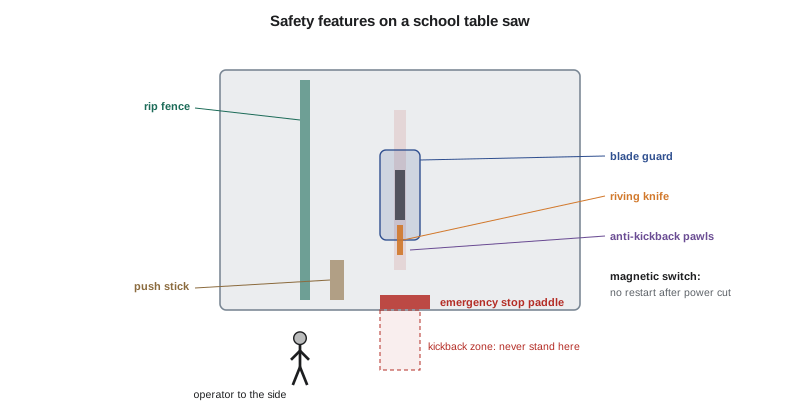
A guard that is removed, tied up or adjusted out of the way protects nobody. In many shop injuries, the guard was off because it was inconvenient for a particular cut. The teacher sets the standard: if the teacher demonstrates with the guard off, students will work with the guard off. Where a cut cannot be made with the standard guard, the answer is a different setup, a jig, or a different machine, not removing the guard.
Choosing machines for a school shop
Not every industrial machine belongs in a school. When replacing equipment, the district considers machines with stronger built-in safety features, such as table saws with flesh-sensing technology, magnetic switches that do not restart after a power cut, and emergency stop paddles that can be hit with a knee. Some machines, such as radial arm saws and some older jointers without proper guards, are restricted or removed in many school systems because their hazards are hard to control with students. Each machine should also have a clearly marked work zone on the floor and enough space around it that a student working at it cannot be bumped. Before any new machine is used with students, the teacher should read the manual, check every guard and safety device, and practice with it until the operations are routine.
Student training and testing
Students should never operate a machine until they have been taught how to use it, seen it demonstrated, passed a test, and been signed off by the teacher. A typical sequence at Pinecrest High School is:
- General shop safety: rules, protective equipment, emergency stops, housekeeping, and what to do if something goes wrong.
- Machine-specific instruction: the machine's hazards, guards, adjustments and the safe way to make each type of cut.
- Demonstration by the teacher, with the guards in place.
- A written test on that machine, usually requiring a perfect or near-perfect score.
- A practical test, where the student performs the operation under the teacher's direct observation.
- A record of which students are signed off on which machines, posted or kept where the teacher can check it quickly.
Greg keeps a sign-off chart for every student in his wood classes. A student who is not signed off on the band saw does not use it, however simple the cut seems. The chart also tells a substitute teacher which students may use which machines, although the district's rule is that powered machines are not used at all when a qualified shop teacher is absent.
# Who may use which machine today? Students must have passed both tests.
signoffs = {
    "Aisha":  {"drill press": (100, True), "band saw": (95, True), "table saw": (90, False)},
    "Ben":    {"drill press": (100, True), "band saw": (80, True)},
    "Chloe":  {"drill press": (100, True), "band saw": (100, True), "table saw": (100, True)},
    "Dev":    {"drill press": (90, True)},
}
PASS = 90   # written test pass mark (%) used by this shop
machine = "band saw"
for name, rec in signoffs.items():
    score, practical = rec.get(machine, (0, False))
    ok = score >= PASS and practical
print(f"{name:6} {machine}: {'YES' if ok else 'no'} (written {score}%, practical {'passed' if practical else 'not passed'})")Aisha band saw: YES (written 95%, practical passed) Ben band saw: no (written 80%, practical passed) Chloe band saw: YES (written 100%, practical passed) Dev band saw: no (written 0%, practical not passed)
In this example, Ben passed the practical test on the band saw but scored below the shop's written pass mark, so he retakes the written test before using it. Dev has not been tested on the band saw at all.
Safe operation
Rules for the shop floor are part of every school's shop procedures. The most important ones are:
- Eye protection at all times in the shop, not just at the machines, and hearing protection where noise is high.
- No loose clothing, ties, scarves, jewelry or long hair near rotating machines; hair is tied back and sleeves are rolled up or close-fitting. Gloves are not worn near rotating blades, bits or chucks, where they can be caught and pull the hand in.
- One student at a machine at a time, with others outside the marked work zone.
- Machines are adjusted, cleaned and measured only when they are switched off and have come to a complete stop.
- Scraps are cleared with a push stick or brush, never with fingers, and never while the blade is moving.
- The operator stays at the machine until the blade or cutter has stopped, so the next person does not walk up to a coasting blade.
- Anyone who sees an unsafe act can hit the emergency stop.
Lockout
Many serious machine injuries happen during maintenance, cleaning, blade changes and clearing jams, when someone reaches into a machine that starts unexpectedly. Lockout is the procedure that prevents this: the machine is shut down, isolated from its energy sources, locked so it cannot be restarted, and tested to confirm it is safe before anyone reaches in.
OSHA's control of hazardous energy standard (29 CFR 1910.147), enforced by MNOSHA, requires a written energy control program, specific procedures for each machine, training, and periodic inspections of the procedures.
For a typical school shop machine, the lockout steps are:
- Tell others the machine is being serviced.
- Shut the machine off with its normal control.
- Isolate it from its energy source, usually by switching off and locking the disconnect or unplugging it, and for some machines releasing stored energy such as springs, compressed air or a coasting flywheel.
- Apply a personal lock and tag, so only the person doing the work can remove them.
- Test that it cannot start by pressing the start button, then return the control to off.
- Do the work, then remove tools, replace guards, tell others, and remove the lock.
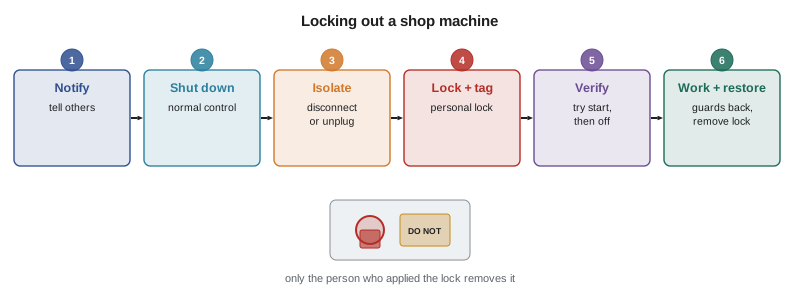
For cord-connected machines, unplugging the machine and keeping the plug under the exclusive control of the person doing the work can serve as isolation, which is why many school shops use plug lockout covers. Blade changes on table saws, band saws and jointers should always be done with the machine unplugged or locked out, never just switched off.
Students are generally not expected to perform full lockout maintenance, but they should know what lockout is, why the teacher does it, and never to remove anyone else's lock or tag. Custodians who clean shops after hours also need to know that machines are off-limits to them and that a tagged machine must not be touched.
Digital fabrication and computer-controlled machines
Modern technology programs increasingly use CNC routers, laser cutters, vinyl cutters and 3D printers. Computer control reduces some hazards, since the operator is no longer guiding material by hand, but introduces others: unexpected movement when a program starts, fires inside laser cutters when material ignites, and fumes from cutting and printing plastics. These machines need enclosures or barriers, interlocks, emergency stops, and the same training and sign-off approach as manual machines. Laser cutters in particular should never be left running unattended. Fumes from laser cutting and 3D printing are covered in Lesson 7.
Worked problem
The guard that kept coming off
During a visit to the wood shop, Daniel notices that the table saw's blade guard is sitting on a shelf. Greg explains that he takes it off for narrow rip cuts and sometimes forgets to put it back for the next class. What should happen?
Show solution
- Lock out the saw until the guard is reinstalled and checked.
- Discuss why the guard is removed: narrow rips are a common reason, and a guard that interferes with routine cuts is a sign the setup needs to change.
- Find a safer method for narrow rips, such as a jig, a narrow-rip push block, or using the band saw, so the guard can stay on.
- If the saw's guard design makes ordinary cuts impractical, add it to the list for replacement with a better guard system or a saw with flesh-sensing technology.
- Remind Greg that students copy what they see, and record the discussion and the fix in the shop's safety log.
Answer: Lock out the saw until the guard is back, change the method for narrow rips so the guard can stay on, plan for better equipment if needed, and record the fix.
Common mistakes
MistakeTaking the guard off for a difficult cut.
InsteadChange the setup, use a jig or another machine; never remove the guard.
MistakeWearing gloves near a rotating blade or chuck.
InsteadNo gloves near rotating tools; they can be caught and pull the hand in.
MistakeLetting students use machines after a demonstration only.
InsteadStudents pass written and practical tests and are signed off first.
MistakeChanging a blade with the machine just switched off.
InsteadUnplug or lock out the machine before changing blades.
MistakeLeaving a laser cutter running while stepping out.
InsteadNever leave laser cutters unattended.
Summary and key terms
- Machines injure at the point of operation, power transmission parts, other moving parts and through ejected material.
- Guards and safety devices are required wherever a hazard can be reached during normal operation.
- Kickback on the table saw is controlled by riving knives, anti-kickback pawls, correct setup and standing out of line.
- Students must pass written and practical tests and be signed off before using each machine.
- Basic shop rules cover eye and hearing protection, clothing and hair, one operator per machine, and stopping the machine before adjusting.
- Lockout isolates and locks a machine so it cannot start during maintenance.
- CNC machines, laser cutters and 3D printers need enclosures, interlocks, training and supervision.
- Point of operation
- The place where a machine cuts, shapes or works on material.
- Kickback
- When a saw blade grabs a workpiece and throws it back toward the operator.
- Riving knife
- A metal plate behind a saw blade that keeps the cut open and reduces kickback.
- Interlock
- A device that stops a machine or prevents start-up when a guard or door is opened.
- Lockout
- Isolating a machine from its energy sources and locking it so it cannot start during work on it.
Practice problems
Work each problem on paper first, then reveal the answer to check.
Name the four main places where machines injure people.
Show answer
The point of operation, power transmission parts, other moving parts and ejected material.
Why are gloves not worn near rotating blades or chucks?
Show answer
They can be caught and pull the hand into the machine.
What must a student do before using a shop machine?
Show answer
Receive instruction, watch a demonstration, pass written and practical tests and be signed off.
What are the main steps of lockout?
Show answer
Notify, shut down, isolate, lock and tag, verify it cannot start, then work and restore.
Why should the operator stay at a machine until the blade stops?
Show answer
So nobody walks up to a coasting blade.
Lesson quiz · 5 questions
Score 60% or more to complete this lesson.
Create a free account to save your progress, take quizzes and earn a certificate.