
HSE-361 · Lesson 3 of 12 · 21 min
Chemical inventory, storage and clearing out old stock
School science prep rooms are where chemical hazards accumulate quietly. Chemicals are bought for one teacher's favorite experiment, the teacher retires, the curriculum changes, and the bottle stays on the shelf for twenty years. Labels fade, caps crack, some chemicals slowly change into something more dangerous, and nobody is quite sure what is in the back of the cupboard. Good chemical management in a school rests on three habits: knowing exactly what you have, storing it so that incompatible chemicals cannot meet, and regularly getting rid of what you no longer need. This lesson covers all three, from the point of view of the lab assistant and the teachers who share a prep room.
Buy less, keep less
The cheapest and safest chemical is the one a school never buys. Before ordering, the question is whether the curriculum really needs the chemical, in what quantity, and at what concentration. Many school activities can use dilute solutions bought ready-made instead of concentrated stock that must be diluted in the prep room. Microscale techniques, which use drops instead of tens of milliliters, cut quantities, waste and exposure dramatically and are encouraged by science teachers' associations in both Canada and the United States.
Some chemicals have no place in a school at all, or only in very small quantities under strict control. Lists of chemicals not recommended for schools are published by science teachers' associations and education departments. They typically include highly toxic or carcinogenic substances, chemicals that can become explosive with age, and chemicals whose hazards far outweigh their teaching value. Examples often listed include benzene, carbon tetrachloride, picric acid, elemental mercury and mercury compounds, diethyl ether stored for long periods, and many heavy-metal salts. A school that finds these on its shelves should arrange for them to be removed by a qualified contractor rather than using them up.
At Pinecrest High School, every chemical order now goes through Hannah as department head, and she checks it against the district's chemical hygiene plan and its list of restricted chemicals before Kevin places it. Minnesota law also restricts mercury and mercury-containing instruments in schools, so mercury thermometers and barometers have been removed.
The inventory
An inventory lists every chemical in the building, with its name, quantity, concentration, location, date received, hazard class and SDS. It serves several purposes at once. It tells teachers what is available, so they do not order duplicates. It tells the fire department what is stored where, which matters in a fire. It shows which chemicals are old and should be reviewed. And it is the basis for HazCom compliance, since every hazardous product on the inventory needs a current SDS.
A spreadsheet or a simple database is enough for most schools. Commercial and free chemical inventory systems exist, some with barcode labels that make annual counts quicker. Whatever the system, the inventory is only useful if it is kept up to date: chemicals are added when they arrive and removed when they are used up or disposed of, and a full physical count is done at least once a year. The district asks every secondary science department to complete its count in June and send a summary to Daniel.
# Flag inventory items for review: old, restricted, or past a shelf-life limit.
from datetime import date
today = date(2026, 6, 15)
restricted = {"picric acid", "mercury(II) chloride", "benzene"}
shelf_life_years = {"diethyl ether": 1, "sodium metal": 3, "hydrogen peroxide 30%": 2}
inventory = [
    ("copper(II) sulfate", 500, "g", date(2019, 9, 1)),
    ("diethyl ether", 250, "mL", date(2023, 2, 10)),
    ("picric acid", 100, "g", date(1994, 5, 1)),
    ("hydrochloric acid 6 M", 2500, "mL", date(2025, 8, 20)),
    ("hydrogen peroxide 30%", 500, "mL", date(2022, 11, 3)),
    ("sodium chloride", 2000, "g", date(2015, 1, 12)),
]
for name, qty, unit, got in inventory:
    age = (today - got).days / 365.25
    reasons = []
    if name in restricted: reasons.append("restricted: arrange removal")
    if name in shelf_life_years and age > shelf_life_years[name]: reasons.append("past shelf life")
    if age > 10 and not reasons: reasons.append("over 10 years: still needed?")
    if reasons:
print(f"{name:24} {qty:5d} {unit:3} {age:5.1f} y " + "; ".join(reasons))diethyl ether 250 mL 3.3 y past shelf life picric acid 100 g 32.1 y restricted: arrange removal hydrogen peroxide 30% 500 mL 3.6 y past shelf life sodium chloride 2000 g 11.4 y over 10 years: still needed?
Three items are flagged in this example: a decades-old container of picric acid that must be removed by a specialist, diethyl ether and hydrogen peroxide past their shelf lives, and table salt that is old but harmless. The program is crude, but it turns the inventory into a to-do list.
Storing chemicals by compatibility
The single most important storage rule is that chemicals are stored by compatibility, not alphabetically. An alphabetical shelf can put acetic acid beside acetone, or nitric acid beside naphthalene, and a single broken bottle or a slow leak can start a fire or release toxic gases. Compatibility storage groups chemicals into families that can safely sit together and separates families that react with each other.
Several storage schemes are in use in schools, and the details differ, but most separate at least the following groups:
- Flammable liquids, such as alcohols, acetone and other solvents, in an approved flammable liquids cabinet.
- Inorganic acids, such as hydrochloric and sulfuric acid, in a corrosives cabinet, with nitric acid kept separate from other acids and from organics because it is also a strong oxidizer.
- Organic acids, such as acetic acid, apart from oxidizing acids.
- Bases, such as sodium hydroxide and ammonia solution, apart from acids.
- Oxidizers, such as nitrates, permanganates and peroxides, apart from flammables and other combustible materials.
- Water-reactive chemicals, such as sodium and potassium metal, kept dry and away from sinks and sprinklers.
- Toxic chemicals, locked and limited to the smallest practical quantity.
- General low-hazard chemicals, which can be stored together on ordinary shelving.
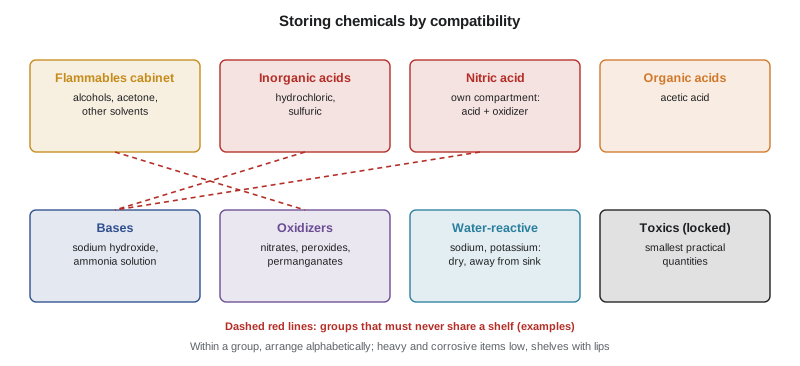
Within each group, chemicals can then be arranged alphabetically for convenience. Shelves should have lips or edges so bottles cannot slide off, heavy and large containers belong on low shelves, and nothing corrosive should be stored above eye level. Chemicals should not be stored on the floor, in the fume hood, under sinks unless the cabinet is designed for it, or in direct sunlight.
Flammable liquids above small working quantities belong in an approved flammable storage cabinet, which is built to keep its contents below their ignition temperature for a period in a fire. Fire codes limit how much flammable liquid can be kept in a lab outside such cabinets, and the limits for schools are often stricter than for industry. Large bulk containers, such as 1 gal (4 L) bottles of methanol or ethanol, should not be kept at the bench; Lesson 4 explains why that matters so much.
Labels and containers
Every container in a prep room needs a label that identifies its contents and hazards. Original supplier containers carry the supplier label. When a chemical is decanted or a solution is made up for a class, the new container needs a workplace label with at least the chemical name and concentration, the hazards, and a reference to the SDS, plus the date it was made and the initials of the person who made it. Kevin labels every stock solution he prepares with all of these, and he discards unlabeled containers through the waste system rather than guessing what is in them.
Food and drink containers should never be used for chemicals. A clear liquid in a water bottle in a lab fridge is an accident waiting to happen. Lab refrigerators should be labeled for chemicals only, and food should never be stored in them; flammable chemicals that need refrigeration need a refrigerator designed for flammable storage, because an ordinary fridge has internal sparks that can ignite vapors.
Chemicals that get more dangerous with age
A small group of chemicals deserves special attention because they become more hazardous as they sit on the shelf. Some ethers and other solvents slowly form explosive peroxides when exposed to air, especially once the bottle has been opened. Picric acid, once common in schools, becomes shock-sensitive if it dries out. Some reactive metals develop a crust of oxides and peroxides. Concentrated hydrogen peroxide slowly decomposes and can build up pressure in its container.
For these chemicals, the controls are simple but strict: buy only small quantities, write the date received and the date opened on the container, use or dispose of them within the recommended period, and never open, move or try to clean an old container that looks crystallized, bulging or crusted. A suspect container is left exactly where it is, the area is secured, and a specialist is called. Lesson 11 describes what happened when Kevin found an old container of picric acid at the back of a cupboard.
Security and access
Prep rooms should be locked when not supervised, and students should not have unsupervised access. Some chemicals found in schools could be misused, and a few are subject to specific security or reporting rules. Keys should be limited to science staff, the principal and custodial supervisors, and custodians should know which cabinets they must never open. A clear sign on the prep room door listing the main hazards inside helps the fire department in an emergency.
Sharing a prep room
Most secondary schools have several teachers sharing one or two prep rooms, and the system only works if everyone follows it. Hannah's department agreed on a few simple rules: chemicals go back to their group shelf at the end of each day, not left on the bench for tomorrow; anyone who uses the last of a chemical tells Kevin so the inventory can be updated; solutions made for a class are labeled before they leave the prep room; and nobody brings chemicals into the school without going through the department head. New teachers and occasional teachers get a short tour of the prep room before they are given a key, so they know where the storage groups are, where the SDSs are kept and which cabinets are locked.
The annual clear-out
Every chemical inventory should be reviewed at least once a year to identify chemicals that are no longer used, past their shelf life, deteriorating, unlabeled or restricted. These are removed through a licensed hazardous waste contractor, not poured down the drain or put in the garbage. Disposal is covered in Lesson 11. The clear-out should be planned with enough time and budget for the contractor, and it works best when several schools in a district combine their waste into one pickup to reduce the cost.
When the district ran its first combined clear-out after the picric acid incident at Pinecrest High School, the contractor removed several hundred containers from 11 schools, including old mercury thermometers, unlabeled bottles, chemicals for experiments dropped from the curriculum decades ago, and three more containers of chemicals on the restricted list. Hannah describes the result as the single biggest improvement in lab safety in her career.
Worked problem
Reorganizing the prep room
Kevin inherits a prep room where chemicals are stored alphabetically on open shelves, with flammables scattered among them and a 4 L bottle of methanol on the bench. How should he reorganize it?
Show solution
- Update the inventory first, so he knows what is there and can flag restricted, old and unneeded chemicals for removal.
- Separate the chemicals into compatibility groups using a recognized storage scheme.
- Move flammable liquids into the flammables cabinet and return the bulk methanol to it, dispensing only small labeled quantities for each class.
- Put acids and bases in separate corrosives cabinets, with nitric acid isolated, and keep oxidizers away from flammables.
- Within each group, arrange alphabetically, with heavy and corrosive containers on low shelves with lips, and label the shelves by group so the system survives the next person.
Answer: Inventory first, then group by compatibility, move flammables into their cabinet, separate acids, bases and oxidizers, and label the shelves so the system lasts.
Common mistakes
MistakeStoring chemicals alphabetically.
InsteadStore by compatibility group, then alphabetically within each group.
MistakeKeeping bulk flammable liquids on the bench.
InsteadStore them in the flammables cabinet and dispense small amounts.
MistakeKeeping old chemicals in case they are needed one day.
InsteadReview the inventory yearly and remove what is not needed.
MistakeTrying to open an old, crusted container to see what it is.
InsteadLeave it in place, secure the area and call a specialist.
MistakeStoring food in a lab refrigerator.
InsteadLab fridges are for chemicals only; food goes elsewhere.
Summary and key terms
- Buy only what the curriculum needs, in the smallest practical quantity and concentration.
- Some chemicals should not be in schools at all and should be removed by a specialist.
- Keep an up-to-date inventory and count it at least once a year.
- Store by compatibility, separating flammables, acids, bases, oxidizers, water-reactives and toxics.
- Label every container, including solutions made up in the prep room.
- Date chemicals that become more dangerous with age, and never disturb a suspect container.
- Lock prep rooms and clear out unneeded chemicals through a licensed contractor every year.
- Chemical inventory
- A list of every chemical held, with quantity, location, date and hazard information.
- Compatibility storage
- Grouping chemicals so that those that react with each other are kept apart.
- Flammable storage cabinet
- A cabinet designed to protect flammable liquids from fire for a period of time.
- Peroxide former
- A chemical that slowly forms explosive peroxides when exposed to air.
- Microscale
- Experiments done with very small quantities of chemicals.
Practice problems
Work each problem on paper first, then reveal the answer to check.
Why should chemicals not be stored alphabetically?
Show answer
Alphabetical order can put incompatible chemicals side by side.
Why is nitric acid stored apart from other acids?
Show answer
It is also a strong oxidizer and reacts with organic materials.
What should be on a label for a solution made up in the prep room?
Show answer
The chemical name and concentration, hazards, SDS reference, date made and the preparer's initials.
What should you do if you find a crystallized or bulging old container?
Show answer
Leave it in place, secure the area and call a specialist.
How often should a school chemical inventory be counted?
Show answer
At least once a year.
Name one benefit of microscale experiments.
Show answer
They cut quantities, waste and exposure.
Lesson quiz · 5 questions
Score 60% or more to complete this lesson.
Create a free account to save your progress, take quizzes and earn a certificate.