
HSE-361 · Lesson 4 of 12 · 20 min
Experiments and demonstrations: planning, flames and flammable liquids
Demonstrations are some of the most memorable moments in school science. A flame turning green, a balloon of hydrogen popping, a solution changing color on cue: these are often what students remember years later. They are also where some of the worst injuries in school science have happened, because demonstrations are done in front of an audience, sometimes with larger quantities than student experiments, and sometimes copied from a video without the hazard review that should come first. This lesson covers how to plan experiments and demonstrations safely, with special attention to flammable liquids and the flash fires they can cause. It does not give instructions for any hazardous reaction; its focus is on deciding whether, and under what controls, an activity should go ahead.
Every activity needs a hazard review
Before any experiment or demonstration, the teacher should be able to answer a short set of questions:
- What chemicals and equipment are involved, and what are their hazards? The SDS and the label answer the first part.
- What could go wrong? Splashes, fires, toxic gases, broken glass, burns from hot equipment, unexpected reactions.
- Who could be harmed? The teacher, students at the bench, students watching, and anyone passing by.
- What controls are needed? Smaller quantities, a fume hood, a safety shield, eye protection, distance, a fire extinguisher at hand.
- Have I done this before, successfully, under the same conditions? If not, a trial run without students comes first.
- Is there a safer way to teach the same idea? A video, a simulation, a microscale version, or a different reaction.
Many schools put these questions on a short written form for any activity that involves flammables, open flames, toxic or corrosive chemicals, or gases. The form takes ten minutes and becomes part of the teacher's plan. It also gives a department head a chance to spot a problem before it reaches the classroom.
The flash fire hazard
The most serious repeated pattern of injuries in school demonstrations involves flammable liquids, especially methanol, being added to a flame or a hot surface from a bulk container. In 2014, the United States Chemical Safety Board (CSB) issued a safety bulletin after several incidents in which methanol flash fires injured children and adults during educational demonstrations, including incidents at a science museum in Reno, Nevada, a high school in Denver, Colorado, and a youth group event in Illinois. The bulletin also referred to an earlier incident at an Ohio high school. Many of these involved the 'rainbow' demonstration, in which metal salts are burned with a flammable liquid to show different flame colors. In the same year, a similar demonstration at a New York City high school left a student with severe burns.
The mechanism is the same in most of these incidents. A flammable liquid with a low flash point, such as methanol, gives off vapor at room temperature. When the first flame dies down or seems to go out, the demonstrator adds more liquid from the bulk bottle. The vapor around the bottle's mouth meets the remaining flame or a hot surface, the fire flashes back toward the bottle and out along the stream of liquid, and burning liquid and vapor spray toward the audience. Methanol flames can also be nearly invisible in a lit room, so people may not realize something is still burning.
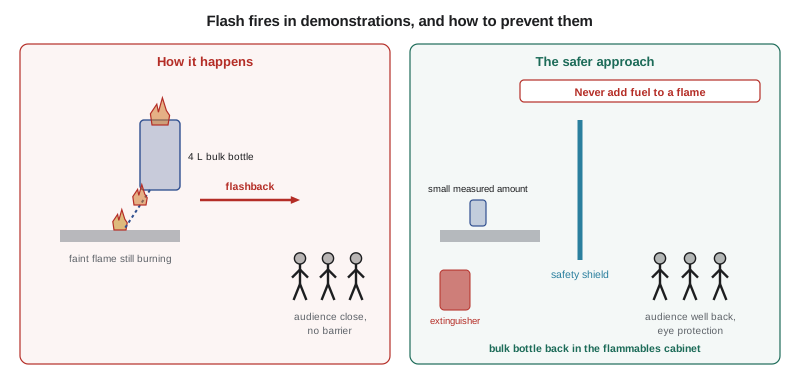
The CSB's key lessons are simple and apply to every school:
- Do not use bulk containers of flammable liquids during demonstrations. Dispense only the small amount needed, away from any flame, and put the bulk container back in the flammables cabinet before lighting anything.
- Never add a flammable liquid to a flame, a smoldering material or a hot surface, even if the fire seems to have gone out.
- Do a thorough hazard review before any demonstration involving flammables, and have written procedures.
- Provide a barrier between the demonstration and the audience, keep the audience at a safe distance, and make sure everyone, including the demonstrator, wears appropriate protective equipment.
Many organizations, including the American Chemical Society and the National Science Teaching Association, and many school districts now advise against the methanol rainbow demonstration altogether and suggest safer ways of showing flame colors, such as using wooden splints soaked in salt solutions held in a burner flame, or spray bottles of salt solution directed into a flame by an experienced teacher with a shield. Fire codes such as NFPA 45 also include provisions on demonstrations with flammable liquids in instructional labs. The district's procedure says that methanol or other flammable liquids may not be used as a fuel for flame tests or any other demonstration in its schools.
Burners and open flames
Gas burners are standard equipment in many school labs and are generally safe when used properly. Students should be taught to check tubing for cracks, light the burner with a striker or long lighter rather than matches held at the tap, keep hair tied back and loose clothing tucked in, and never leave a lit burner unattended. Flammable liquids should not be on the same bench as an open flame. Butane cartridge burners, used in some labs without piped gas, need care with cartridge changes and storage.
Teachers should make it a habit to check that every gas tap is off at the end of the class, and to close the master valve. A faint gas smell at the start of a class means checking the taps, ventilating, and keeping all flames off until the source is found; a strong smell means evacuating and calling for help.
Heating and glassware
Many lab injuries come from ordinary activities rather than dramatic ones. Heating a test tube with the mouth pointed at a neighbor, heating a closed container, picking up hot glassware that looks cold, and pushing glass tubing into a rubber stopper are all classic causes of burns and cuts. The controls are part of good teaching: point test tubes away from people, never heat a sealed container, use tongs and heat-resistant gloves, assume all glassware on a hot plate is hot, use borosilicate glass for heating, and check glassware for cracks and chips before use. Glass tubing and thermometers should be lubricated and inserted with a towel around them, or replaced with flexible tubing and connectors.
Gases and pressure
Some school experiments produce or use gases: hydrogen, oxygen, carbon dioxide, ammonia, chlorine. Hydrogen mixed with air is explosive over a wide range of concentrations, so collecting it in small test tubes is very different from filling a large container. Toxic gases need a fume hood, and the quantities generated should be the smallest that show the result. Compressed gas cylinders, where a school has them, must be secured upright with a chain or strap, capped when not in use, and moved only with a cart.
Closed containers can build up pressure from a reaction or from heating. A tightly capped bottle of a reaction mixture, or a sealed container left in a warm room, can burst and spray its contents. Waste containers for reactions that may continue to give off gas need vented caps.
Students doing experiments
Student experiments carry the same hazards as demonstrations, multiplied by the number of stations and reduced by the smaller quantities. The teacher's planning should include:
- Written instructions that include the safety steps, not just the procedure.
- A pre-lab discussion of the hazards, the protective equipment and what to do if something goes wrong.
- Chemicals dispensed in small labeled containers at each station or a central dispensing point, rather than students handling stock bottles.
- Clear rules: eye protection on from the start of the lab until everyone has finished cleaning up, no eating or drinking, no unauthorized experiments, and report every spill and injury.
- A cleanup and waste plan, so students know which waste goes in which container and that nothing goes down the drain unless the teacher says so.
The program below shows a simple way to decide whether an activity needs extra controls. It is not a substitute for judgment, but it helps teachers spot the activities that need a second look.
# Score an activity on hazard factors; high scores need a written review and the department head's approval.
factors = {
    "flammable liquid present": 3,
    "open flame or hot surface": 2,
    "toxic or corrosive chemical": 2,
    "gas generated": 2,
    "done in front of an audience": 2,
    "teacher has not done it before": 3,
    "bulk container at the bench": 5,
}
activities = {
    "flame test with soaked splints": ["open flame or hot surface"],
    "methanol rainbow demonstration": ["flammable liquid present", "open flame or hot surface",
                                       "done in front of an audience", "bulk container at the bench"],
    "acid-base titration (dilute)": ["toxic or corrosive chemical"],
    "new gas-producing demo from a video": ["gas generated", "done in front of an audience",
                                            "teacher has not done it before"],
}
for name, fs in activities.items():
    score = sum(factors[f] for f in fs)
    level = "do not run" if "bulk container at the bench" in fs else ("written review + approval" if score >= 6 else "normal planning")
print(f"{name:38} score {score:2d} {level}")flame test with soaked splints score 2 normal planning methanol rainbow demonstration score 12 do not run acid-base titration (dilute) score 2 normal planning new gas-producing demo from a video score 7 written review + approval
The methanol demonstration is ruled out entirely because it involves a bulk flammable container, and the untested demonstration copied from a video needs a written review, a trial run without students and the department head's approval. The splint flame test and the dilute titration need ordinary planning.
Copying activities from the internet
Online videos of dramatic chemistry demonstrations are a constant temptation. Many are filmed in professional settings with controls that are not visible, some are staged, and some are simply dangerous. A teacher who wants to try a new demonstration should find a written procedure from a reputable education source, do the hazard review, consult the department head, and run it first without students. Students who see a video and want to try it themselves at home or in the lab need a clear message about why that is not allowed, which can itself be a useful lesson.
Worked problem
The demonstration that was canceled
A new teacher at Pinecrest High School plans to show the classic 'whoosh bottle' demonstration she saw online, igniting alcohol vapor in a large plastic water jug, for a tenth-grade class on combustion. She mentions it to Hannah the day before. What should Hannah do?
Show solution
- Ask to see the written procedure and the hazard review; there is none, only a video.
- Point out the hazards: a large volume of flammable vapor, a bulk alcohol container, an audience, and a container that can split or launch.
- Explain that the district's procedure does not allow flammable liquids as fuels for demonstrations.
- Suggest a safer way to teach the same idea, such as a small, enclosed combustion demonstration from the department's approved list, or a high-quality video with discussion of why the teacher is not doing it live.
- Offer to plan the lesson together, and use it as a chance to show the new teacher the department's review form and approved demonstrations.
Answer: Stop the demonstration, explain the hazards and the board rule, offer a safer alternative that teaches the same concept, and help the teacher with the review process.
Common mistakes
MistakeAdding more flammable liquid when a flame seems to have gone out.
InsteadNever add fuel to a flame, smoldering material or hot surface.
MistakeKeeping the bulk bottle of methanol at the demonstration bench.
InsteadNo bulk flammables at the bench; dispense small amounts away from flames.
MistakeDoing a demonstration for the first time in front of students.
InsteadDo a trial run without students after a written hazard review.
MistakeHaving the audience sit close with no barrier.
InsteadUse a safety shield and keep the audience well back.
MistakeCopying a demonstration from an online video.
InsteadUse a written procedure from a reputable education source and review it first.
Summary and key terms
- Every experiment and demonstration needs a hazard review before it is done with students.
- Methanol and other flammable liquids added to flames from bulk containers have caused serious flash fires during demonstrations.
- Never add flammable liquid to a flame or hot surface, and keep bulk containers away from the bench.
- Many organizations and boards now advise against the methanol rainbow demonstration; safer flame tests exist.
- Use safety shields, distance and eye protection for everyone during demonstrations.
- Ordinary activities, such as heating test tubes and inserting glass tubing, cause many injuries and need good technique.
- Never copy a demonstration from a video without a written procedure, a review and a trial run.
- Flash fire
- A sudden, short-lived fire spreading through a mixture of flammable vapor and air.
- Flash point
- The lowest temperature at which a liquid gives off enough vapor to ignite.
- Safety shield
- A transparent barrier placed between a demonstration and the audience.
- Hazard review
- A planned look at what could go wrong in an activity and the controls needed.
- Bulk container
- A large stock container, such as a 4 L bottle, used for storage rather than dispensing at the bench.
Practice problems
Work each problem on paper first, then reveal the answer to check.
What pattern caused many of the flash fires in educational demonstrations?
Show answer
Adding methanol from a bulk container to a flame or hot surface that seemed to be out.
Name two of the CSB's key lessons for demonstrations.
Show answer
No bulk flammable containers at the demonstration, and a barrier between the demonstration and the audience; also a hazard review, written procedures and protective equipment.
What is a safer way to show flame colors?
Show answer
Wooden splints soaked in salt solutions held in a burner flame.
Why should a test tube never be pointed at a neighbor while heating?
Show answer
The contents can bump and spray out.
What should a teacher do before trying a demonstration for the first time?
Show answer
Find a written procedure, do a hazard review, consult the department head and do a trial run without students.
Lesson quiz · 5 questions
Score 60% or more to complete this lesson.
Create a free account to save your progress, take quizzes and earn a certificate.