
HSE-361 · Lesson 11 of 12 · 20 min
Chemical waste, spills and responding to incidents
Every lab, shop, studio and kitchen produces waste, and every one of them will sooner or later have a spill, an exposure or an injury. How a school handles waste and responds to incidents says a great deal about its safety culture. Waste poured down the drain or thrown in the garbage puts custodians, plumbers, waste haulers and the environment at risk. A spill handled calmly with the right kit becomes a minor event; a spill handled with panic and paper towels can become a serious one. This lesson covers both: getting rid of waste safely, and responding well when things go wrong.
What counts as hazardous waste
In schools, hazardous waste typically includes:
- Unused, old or unwanted lab chemicals, including anything restricted or past its shelf life.
- Waste solutions from experiments that contain heavy metals, solvents, strong acids or bases, or other hazardous substances.
- Used solvents, paints, finishes and thinners from shops and art rooms.
- Used oil, antifreeze, brake fluid and batteries from automotive programs.
- Photographic chemicals, especially used fixer containing silver.
- Mercury-containing items, such as old thermometers, thermostats and fluorescent tubes.
- Biological waste, which follows the separate procedures in Lesson 5.
Hazardous waste in Minnesota is regulated by the Minnesota Pollution Control Agency (MPCA) and, in the Twin Cities metro area, by the counties. Schools that generate hazardous waste are generators and generally need a license or registration and must use licensed haulers and facilities, with requirements that depend on how much waste they produce. The district holds the licenses for its schools and contracts a licensed company to collect lab and shop waste on a schedule.
What can and cannot go down the drain
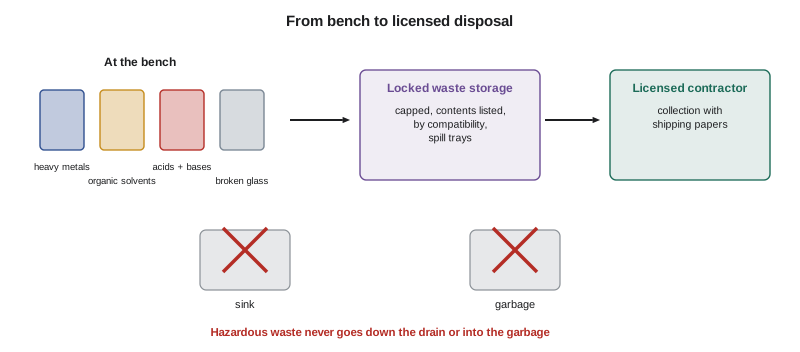
The default rule in a school is that nothing goes down the drain unless the teacher has confirmed it is allowed. Small amounts of some dilute, low-hazard solutions, such as dilute salt or sugar solutions, may be permitted by the local sewer rules and the district's procedure, and dilute acids and bases may sometimes be neutralized and flushed with plenty of water. Heavy metals, solvents, oils, paints, and anything that is flammable, toxic or reactive never go down the drain. Waste should never be put in the ordinary garbage, where it can injure custodians or react with other waste.
Kevin sets out labeled waste containers at the front of the lab for each class: one for heavy metal solutions, one for organic solvents, one for broken glass, and so on, depending on the experiment. Students are told exactly which container each waste goes into, and the containers are capped, labeled with their contents as they fill, and moved to the waste storage area at the end of the day.
Storing waste
Waste awaiting collection is stored like the chemicals it came from: by compatibility, in labeled, closed containers in good condition, with secondary containment such as trays to catch leaks, in a secure, ventilated area. Waste containers should not be filled to the brim, and incompatible wastes must never be combined in one container. A container's label should list everything in it and the date it was started, since the waste contractor needs to know the contents to transport and dispose of it legally.
Spills
Every room that uses chemicals needs a spill kit matched to the chemicals it holds. A typical school lab kit includes absorbent pads or granules, neutralizers for acids and bases, a scoop and dustpan, heavy-duty bags, gloves, goggles, and a sign to keep people away. Kits for shops may focus on oil and solvent absorbents, and kits for art rooms on solvents and paints. Staff should know where the kit is and how to use it, and it should be restocked after every use.
Spills can be sorted into two groups. A minor spill is a small quantity of a known, low-to-moderate hazard chemical that staff can clean up safely with the kit and their normal protective equipment. A major spill is a larger quantity, a highly toxic, flammable or reactive chemical, a spill that is spreading or giving off vapors, any spill with injuries, or any spill where staff are unsure. Major spills call for evacuation and outside help.
For a minor spill, the steps are:
- Alert people nearby and keep students away.
- Attend to anyone who has been splashed, using the eyewash or shower first.
- Check the label and SDS, especially Section 6, for the right cleanup method and protective equipment.
- Put on gloves, eye protection and any other protection the SDS calls for.
- Contain the spill from the outside in with absorbent, and neutralize acids or bases if appropriate.
- Collect the waste into a labeled bag or container for hazardous waste disposal.
- Clean the area, restock the kit and report the spill.
For a major spill, the steps are to get everyone out, close the door, shut off ignition sources if it can be done safely from the doorway, call for help according to the school's emergency plan, and prevent anyone from going back in. The SDS and the chemical name are given to the responders when they arrive.
Exposures and injuries
The first minutes after an exposure or injury matter most, and teachers should be ready to act without waiting for instructions:
- Chemical in the eye: flush at the eyewash for at least 15 minutes, holding the eyelids open, and get medical help.
- Chemical on the skin: remove contaminated clothing and flush with water for at least 15 minutes; use the safety shower for large splashes.
- Inhalation: move the person to fresh air, and call for help if they have trouble breathing.
- Swallowing: do not induce vomiting; call poison control or emergency services with the SDS in hand.
- Burns: cool with cool running water for about 20 minutes.
- Cuts: apply firm pressure with a clean dressing, raise the limb, and get help for deep cuts or amputations, keeping any amputated part cool and dry in a clean bag on ice, not in direct contact with ice.
- Clothing on fire: stop, drop and roll, or use the safety shower.
Teachers should send a student for help rather than leaving the injured person, and the school's first aiders and emergency plan should be clear about who responds. Every school should have the number for poison control posted in every specialized room.
Reporting and investigating
Every spill, exposure, injury and near miss in a specialized room should be reported through the district's incident reporting system. Employee injuries must be recorded and, where they meet the criteria, reported to MNOSHA within the deadlines covered in HSE-360, and reported to the workers' compensation insurer. Student injuries are not recordable under OSHA rules, but the district records and reviews them, and parents are informed.
Incidents in labs and shops should be investigated with the same approach used anywhere else: find out what happened, why it happened, and what will prevent it happening again, focusing on causes rather than blame. Near misses deserve attention because they show where the next injury could come from.
The picric acid container
During her first inventory as department head, Hannah asked Kevin to check every cupboard in both prep rooms. At the back of a locked cabinet in the old prep room, behind boxes of glassware, Kevin found a brown glass bottle labeled picric acid, dated 1994, with yellow crystals around the cap and only a little liquid left. He remembered that dried picric acid can be shock-sensitive and did not touch it. He closed the cabinet, locked the prep room, put a sign on the door and called Hannah, who called Daniel. The district arranged for a specialist contractor, who stabilized the material in place and removed it. No one was hurt, and the incident led to the district-wide clear-out described in Lesson 3.
The program below shows how Hannah's department tracks incidents in its rooms over a year, to see where to focus.
# Summarize a year of incident reports from specialized rooms by room and type.
from collections import Counter
reports = [
    ("Lab 204", "spill"), ("Lab 206", "spill"), ("Lab 206", "eye splash"), ("Lab 204", "cut, glass"),
    ("Wood shop", "cut"), ("Wood shop", "near miss, kickback"), ("Metal shop", "burn"),
    ("Metal shop", "near miss, grinder"), ("Food room", "burn"), ("Food room", "cut, knife"),
    ("Food room", "burn"), ("Art 112", "cut, linocut"), ("Lab 206", "spill"),
]
by_room = Counter(r for r, _ in reports)
by_type = Counter(t.split(",")[0] for _, t in reports)
print("By room:", dict(by_room.most_common()))
print("By type:", dict(by_type.most_common()))By room: {'Lab 206': 3, 'Food room': 3, 'Lab 204': 2, 'Wood shop': 2, 'Metal shop': 2, 'Art 112': 1}
By type: {'cut': 4, 'spill': 3, 'burn': 3, 'near miss': 2, 'eye splash': 1}Lab 206, the older lab, has the most reports, mostly spills, which supports moving more chemical work to the renovated Lab 204 and reviewing how chemicals are dispensed in 206. Burns cluster in the food room and the metal shop, and the two near misses are worth discussing at the next department meeting before they turn into injuries.
Worked problem
Acid on the bench
During a eleventh-grade chemistry lab, a student knocks over a 250 mL beaker of 1 M hydrochloric acid. Some splashes onto her forearm, and the rest spreads across the bench and drips onto the floor. What should Hannah do?
Show solution
- Send the student to the sink or eyewash to flush her arm with water for at least 15 minutes, and check that nothing reached her eyes.
- Move other students away from the bench and floor, and send a student for help if she needs it.
- Check the SDS: this is a modest quantity of a dilute acid, a minor spill she can handle with the kit.
- Put on gloves and goggles, contain the spill with absorbent, neutralize it with the acid neutralizer from the kit, and collect the residue into a labeled waste bag.
- Report the spill and the student's exposure, inform the student's parents, restock the kit, and consider whether dispensing smaller volumes would prevent a repeat.
Answer: Flush the student first, clear the area, confirm it is a minor spill, contain and neutralize it with the kit, then report, inform and restock.
Fires in specialized rooms
Each specialized room has its own likely fires: a flammable solvent in the lab, sawdust or a finishing rag in the wood shop, a spark in the welding area, a grease fire in the food room, or a kiln overheating nearby combustibles. Teachers should know the right first response for their room, which extinguisher is mounted there and how to use it, and above all when not to fight a fire. The general rule is that staff fight only small fires in their early stages, with a clear exit behind them, and only if they are trained. Otherwise they get students out, close the door to slow the fire, pull the alarm and leave the building. Shutting off gas and power at the emergency shut-off on the way out, if it is beside the door, can help responders.
After the incident
When an incident is over, a few things should happen before the room is used again. The area is cleaned and made safe, equipment involved is checked or taken out of service, used spill kit supplies and first aid items are restocked, and a short debrief is held with the staff involved and, where appropriate, the students. Students who saw a frightening incident, such as a classmate being burned, may need support, and the school's usual supports for staff and students apply. The written report should be completed promptly, while memories are fresh, and the follow-up actions should be tracked to completion by the department head and the safety committee.
Common mistakes
MistakePouring waste down the drain to save time.
InsteadNothing goes down the drain unless the teacher has confirmed it is allowed.
MistakeCombining all waste into one container.
InsteadKeep incompatible wastes in separate labeled containers.
MistakeCleaning up a spill before helping the person who was splashed.
InsteadFlush the person first, then deal with the spill.
MistakeHandling a major spill alone with paper towels.
InsteadEvacuate, close the door and call for help for major spills.
MistakeNot reporting near misses.
InsteadReport near misses; they show where the next injury could come from.
Summary and key terms
- Schools generate hazardous waste from labs, shops, art rooms and automotive programs.
- Hazardous waste goes to licensed contractors, never down the drain or into the garbage.
- Collect waste in labeled, compatible, closed containers and store it securely with spill trays.
- Every room using chemicals needs a matching spill kit that staff know how to use.
- Minor spills can be cleaned up with the kit; major spills mean evacuate and call for help.
- For exposures, act immediately: flush eyes and skin for at least 15 minutes, cool burns, and get help.
- Report and investigate every incident and near miss, and look for patterns.
- Hazardous waste
- Waste that is flammable, toxic, corrosive, reactive or otherwise regulated, needing special disposal.
- Spill kit
- A set of absorbents, neutralizers, tools and protective equipment for cleaning up spills.
- Minor spill
- A small spill of a known, manageable chemical that staff can safely clean up.
- Major spill
- A spill that is large, highly hazardous, spreading, involves injuries or causes uncertainty, requiring evacuation.
- Secondary containment
- A tray or container that catches leaks from a primary container.
Practice problems
Work each problem on paper first, then reveal the answer to check.
Name three types of hazardous waste schools produce.
Show answer
Old lab chemicals, used solvents and paints, used oil and batteries, photographic fixer, mercury items.
What is the default rule about pouring things down the drain?
Show answer
Nothing goes down the drain unless the teacher has confirmed it is allowed.
What makes a spill a major spill?
Show answer
A large quantity, a highly hazardous chemical, spreading or vapors, injuries, or uncertainty.
What comes first when a student is splashed during a spill?
Show answer
Flushing the student, before cleaning up the spill.
What did Kevin do when he found the old picric acid?
Show answer
He did not touch it, locked the room, posted a sign and called for a specialist.
Lesson quiz · 5 questions
Score 60% or more to complete this lesson.
Create a free account to save your progress, take quizzes and earn a certificate.