
HSE-361 · Lesson 8 of 12 · 20 min
Welding, metalwork, automotive and construction technology
Metal, automotive and construction technology shops prepare students for skilled trades that are in high demand, and they bring a set of hazards that wood shops do not: welding arcs and fumes, hot metal, compressed gases, vehicles on lifts, batteries, fuels and the tools of the construction site. Tom Brennan runs the metal and automotive shops at Pinecrest High School, and Greg Mahler's construction technology class builds a small shed each year in the yard behind the school. This lesson follows their work.
Welding and cutting: the hazards
Welding and cutting are among the most valuable skills a technology program teaches and among the most hazardous. The main hazards are:
- Radiation from the arc. Arc welding produces intense ultraviolet and infrared light. A few seconds of unprotected exposure can cause arc eye, a painful burn of the cornea that feels like sand in the eye a few hours later, and the light can burn exposed skin like severe sunburn. People nearby are exposed too, not just the welder.
- Fumes and gases. Welding produces a fume of tiny metal oxide particles and gases, which vary with the metal, the coating, the rod or wire and the process. Welding fume is classified as a carcinogen by the International Agency for Research on Cancer. Welding galvanized steel releases zinc oxide fume that can cause metal fume fever, a flu-like illness, and welding stainless steel releases chromium compounds that are particularly harmful.
- Burns and fires. Sparks and spatter travel several meters and can ignite clothing, rags, sawdust and anything combustible nearby. Freshly welded metal looks the same hot or cold.
- Electric shock, especially when working in damp conditions or with damaged cables.
- Compressed gas cylinders for oxy-fuel cutting and shielding gas, which can become missiles if a valve is knocked off, and fuel gases that can leak and explode.
Welding and cutting: the controls
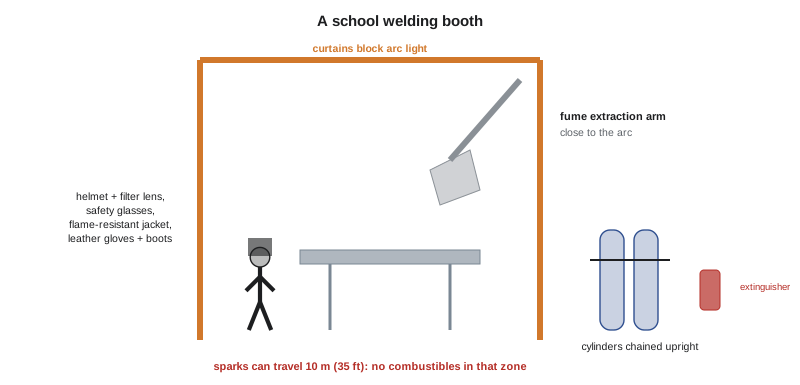
School welding areas are usually arranged as individual booths, each with walls or curtains that block arc light from others, local exhaust ventilation, a non-combustible floor and work surface, and a fire extinguisher nearby.
- Ventilation: a fume extraction hood or arm positioned close to the arc captures fume before it reaches the welder's breathing zone. General ventilation alone is not enough for regular welding. Galvanized and coated metals should be avoided in school projects, or the coating removed before welding with suitable controls.
- Eye and face protection: a welding helmet with a filter lens of the correct shade for the process and current, and safety glasses underneath. Auto-darkening helmets are common in schools and must be checked to make sure they switch properly. Booth curtains protect others nearby.
- Clothing: flame-resistant jackets or sleeves, leather gloves, leather boots and no synthetic clothing, which can melt onto the skin. Pockets and cuffs that catch sparks should be closed or avoided.
- Fire prevention: no combustibles within the area sparks can reach, a fire watch after cutting, and never welding on drums or containers that held flammable materials.
- Cylinders: chained upright, capped when not in use, separated by type, moved with a cart, and with regulators and hoses inspected before use.
OSHA's welding, cutting and brazing standards (29 CFR 1910 Subpart Q), enforced by MNOSHA, together with ANSI Z49.1, the American standard on safety in welding and cutting, are the usual references for school welding shops.
Tom introduces welding in stages. Students first learn about the hazards and the protective equipment, then watch demonstrations, then practice on scrap with the teacher beside them. He does not allow students to weld galvanized metal at all, and stainless steel only in senior classes with the extraction arm checked and positioned before each weld.
Grinding and metal machining
Bench grinders, angle grinders, metal lathes and milling machines are common in metal shops. Grinders throw sparks and fragments, and a cracked or wrongly mounted wheel can shatter. On a bench grinder, the tool rest should be adjusted close to the wheel, with a gap of about 3 mm (1/8 in), and the tongue guard at the top close to the wheel as well, so a workpiece cannot be pulled in. New wheels should be checked for cracks and rated for at least the machine's speed. Students should stand to the side when starting a grinder, wear a face shield over safety glasses, and never use the side of a wheel not designed for it.
Angle grinders are among the most dangerous hand tools in any shop, because they spin very fast, can kick back and are easy to misuse. In many school shops they are used only by the teacher or by senior students under direct supervision, with the guard always in place and the side handle fitted. Metal lathes share the entanglement hazards of wood lathes, plus sharp, hot swarf (chips) that should be cleared with a brush or hook, never by hand. The chuck key must never be left in the chuck; many shops use spring-loaded keys that fall out if released.
The automotive shop
Automotive programs work on real vehicles, which bring heavy loads, fuels, batteries, hot fluids and exhaust gases into the classroom.
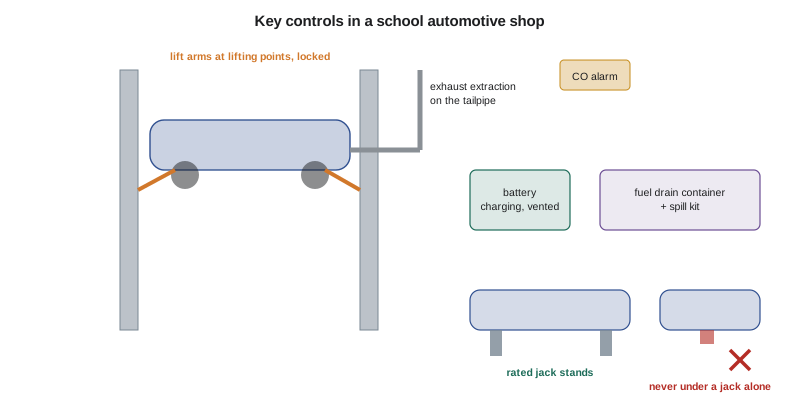
- Lifts and jacks. A vehicle on a lift or jack can fall and crush anyone underneath. Vehicles must be raised only at the manufacturer's lifting points, lift arms must be positioned and locked, lifts must be inspected regularly, and nobody works under a vehicle supported only by a jack; jack stands rated for the load are always used. Only trained students operate the lift, with the teacher's permission each time.
- Exhaust gases. Running engines produce carbon monoxide, a colorless, odorless gas that can kill. Engines run indoors only with an exhaust extraction hose connected to the tailpipe, and the shop should have a carbon monoxide detector.
- Fuels. Gasoline is highly flammable and its vapor travels along the floor to ignition sources. Fuel is drained only into approved containers, spills are cleaned immediately, and nobody smokes or creates sparks nearby.
- Batteries. Lead-acid batteries contain sulfuric acid and give off hydrogen when charging, which can explode if sparked. Batteries are charged in a ventilated area, and connections are made and broken with the charger off. Hybrid and electric vehicles add high-voltage systems that can cause fatal shocks, and work on them requires specific training and procedures that many school programs restrict to the teacher.
- Fluids and parts. Used oil, coolant, brake fluid and solvents are hazardous and must be collected for recycling or disposal. Brake dust on older vehicles may contain asbestos, so brakes are cleaned with wet methods or a dedicated brake washer, never blown out with compressed air.
- Compressed air and tires. Compressed air can drive particles into the eyes or skin, and over-inflated or damaged tires can burst; tires are inflated in a cage or with a clip-on chuck and remote gauge.
Construction technology
Construction technology programs teach framing, roofing, concrete, drywall, electrical and plumbing basics, often by building a real structure. Greg's class builds a garden shed each spring in a fenced area behind Pinecrest High School. The work brings construction site hazards into the school: falls from ladders and roofs, nail guns, power saws used outdoors, lifting heavy materials, and weather.
- Falls. Students work from the ground, platforms with guardrails, or low scaffolds wherever possible. Roof work on the shed is done at low height with guardrails or from scaffolding, and ladders are set up at the correct angle and tied off. Construction safety law sets fall protection requirements at defined heights, and school projects should be designed so students rarely need to work above the lowest of them.
- Nail guns. Pneumatic and cordless nailers cause many serious construction injuries. Nailers with a sequential trigger, which fire only when the nose is pressed and then the trigger pulled, are much safer than contact-trip nailers and should be used in schools. Students are trained and signed off, keep hands away from the nose, and never point a nailer at anyone.
- Electrical. Outdoor power tools are plugged into GFCI-protected outlets, and cords are inspected for damage.
- Site conditions. The work area is fenced and kept tidy, with materials stacked securely, and work stops in lightning or high winds.
Planning the high-risk tasks
Tom and Greg use a simple risk score to decide which tasks need extra supervision. The program below ranks a few tasks by likelihood and severity on a five-point scale, the same approach used in HSE-360.
# Rank shop tasks by risk = likelihood x severity (1-5 each) and set the supervision level.
tasks = [
    ("MIG welding mild steel in booth", 2, 4),
    ("using angle grinder", 3, 5),
    ("raising car on two-post lift", 2, 5),
    ("charging lead-acid battery", 2, 4),
    ("framing shed wall with sequential nailer", 3, 4),
    ("cutting shingles on the roof", 3, 4),
    ("sweeping the metal shop", 2, 2),
]
def level(score):
    return "teacher only or 1:1 direct supervision" if score >= 15 else ("close supervision, signed-off students" if score >= 8 else "normal supervision")
for name, lik, sev in sorted(tasks, key=lambda t: -t[1] * t[2]):
print(f"{name:42} {lik*sev:2d} {level(lik*sev)}")using angle grinder 15 teacher only or 1:1 direct supervision framing shed wall with sequential nailer 12 close supervision, signed-off students cutting shingles on the roof 12 close supervision, signed-off students raising car on two-post lift 10 close supervision, signed-off students MIG welding mild steel in booth 8 close supervision, signed-off students charging lead-acid battery 8 close supervision, signed-off students sweeping the metal shop 4 normal supervision
The angle grinder rises to the top and is restricted to the teacher or one-to-one supervision. Lift work, welding and roof work need close supervision of signed-off students, and cutting on the roof is a candidate for redesign: cutting shingles on the ground and passing them up removes the need for a power tool at height.
Worked problem
Haze in the metal shop
On a busy afternoon, four students are welding in the booths and two are grinding. Tom notices a visible haze near the ceiling of the metal shop, and one student complains of a headache. What should he do?
Show solution
- Stop welding and grinding, and move students away from the haze to a ventilated area.
- Check the student with the headache, and ask whether anyone is welding galvanized or coated metal, which would point to zinc or other metal fumes.
- Check the extraction arms and booth fans: are they switched on, positioned close to the work, and drawing air? A tripped breaker or a clogged filter would explain the haze.
- Do not restart welding until the ventilation is working, and report the problem for repair and the student's symptoms as an incident.
- Afterwards, review how many booths can run at once with the available extraction, and remind students how to position the arm before every weld.
Answer: Stop hot work, move students to fresh air, check for coated metal and the ventilation, restart only when extraction works, and report and review.
Clothing and protective equipment in metal and auto shops
Protective equipment in these shops is task-specific. Safety glasses with side shields are worn throughout, with a face shield added for grinding and chipping slag. Safety footwear protects against dropped parts and hot metal. Gloves are chosen for the job: leather for welding and handling hot or sharp metal, chemical-resistant gloves for fuels and solvents, and no gloves at all on rotating machines such as lathes and drill presses. Students should not wear synthetic fleece or nylon in the welding area, because it melts and sticks to the skin if a spark lands on it; cotton or wool clothing under a flame-resistant jacket is much safer.
Common mistakes
MistakeWatching a welding arc without eye protection, even briefly.
InsteadUse booth curtains and proper filter lenses; a few seconds can cause arc eye.
MistakeWelding galvanized metal in a school shop.
InsteadAvoid galvanized and coated metals; they release harmful fumes.
MistakeWorking under a car held only by a jack.
InsteadAlways use rated jack stands or a properly set lift.
MistakeRunning an engine indoors without exhaust extraction.
InsteadConnect an extraction hose to the tailpipe and have a CO detector.
MistakeBlowing brake dust off with compressed air.
InsteadUse wet methods or a brake washer; older brakes may contain asbestos.
Summary and key terms
- Welding produces arc radiation, carcinogenic fumes, sparks, shock and cylinder hazards.
- Welding booths need curtains, local fume extraction, correct filter lenses, flame-resistant clothing and no combustibles nearby.
- Grinders need correct tool rest and tongue guard gaps, sound wheels and face shields; angle grinders are often restricted.
- Automotive shops must control lifts and jacks, carbon monoxide, fuels, batteries, high-voltage systems and brake dust.
- Construction technology brings falls, nail guns and outdoor electrical hazards into the school.
- Sequential-trigger nailers and work from the ground or guarded platforms reduce construction risks.
- Rank tasks by risk to decide which need direct supervision or redesign.
- Arc eye
- A painful burn of the cornea caused by ultraviolet light from a welding arc.
- Metal fume fever
- A flu-like illness caused by breathing metal oxide fumes, such as zinc from galvanized steel.
- Fume extraction arm
- A movable hood that captures welding fume close to the arc.
- Jack stand
- A rated support that holds a raised vehicle securely once it has been lifted with a jack.
- Sequential trigger
- A nail gun trigger that fires only when the nose is pressed first and then the trigger is pulled.
Practice problems
Work each problem on paper first, then reveal the answer to check.
What is arc eye?
Show answer
A painful burn of the cornea from the ultraviolet light of a welding arc.
Why is galvanized metal avoided in school welding?
Show answer
It releases zinc oxide fumes that can cause metal fume fever.
What gap is usually recommended between a bench grinder wheel and the tool rest?
Show answer
About 3 mm, or 1/8 in.
What must be connected before running an engine indoors?
Show answer
An exhaust extraction hose to the tailpipe.
Which type of nail gun trigger is safer for schools?
Show answer
A sequential trigger.
Lesson quiz · 5 questions
Score 60% or more to complete this lesson.
Create a free account to save your progress, take quizzes and earn a certificate.