
HSE-360 · Lesson 3 of 12 · 22 min
Finding and controlling hazards in a school
Lesson 1 described the hazards found in schools and Lesson 2 set out who is responsible for dealing with them. This lesson is about how. It covers the three main ways hazards are found in a school, a simple method for rating how serious a hazard is, the hierarchy of controls that guides what to do about it, and the work order and follow-up system that turns a report into a repair. These are the tools that the rest of the course uses for slips, lifting, chemicals, violence and everything else.
Three ways hazards are found
Hazards come to light in three main ways, and a good school uses all three.
- Planned looking: workplace inspections, hazard assessments for particular jobs, and audits. These are scheduled and use checklists, so they catch things people have stopped noticing.
- Reports from staff: hazard reports, near-miss reports, injury reports and concerns raised at staff meetings or with committee members. These come from the people who do the work and know where the problems are.
- Learning from events: investigations after incidents, inspection reports from MNOSHA, alerts from the district about something that happened in another school, and product recalls.
Each has blind spots. Inspections tend to find physical conditions, such as broken equipment and blocked exits, but miss how work is actually done and psychosocial hazards. Staff reports depend on people feeling it is worth reporting. Learning from events is, by definition, after the fact. Using all three gives a much fuller picture.
Workplace inspections
Minnesota's AWAIR program must describe how the employer will find and correct hazards, and in practice school districts do this through regular workplace inspections, often carried out by members of the safety committee together with a facilities supervisor. MNOSHA does not set a fixed inspection frequency for schools, but monthly inspections of high-hazard areas such as shops, labs, kitchens and boiler rooms, and at least yearly inspection of every part of every building, are common practice. At Pinecrest, Hannah and a facilities supervisor split the building into zones and inspect one or two each month.
A good inspection is more than a tick sheet. Hannah's approach is:
- Bring the checklist for the zone, the last inspection report and the list of open work orders, so you can see what was found before and whether it was fixed.
- Walk the area with someone who works there, such as the shop teacher or the cafeteria lead. They know what goes wrong and when.
- Look up, down and behind. Check ceilings for stains, floors for damage, and the backs of storage rooms for blocked exits and stacked chairs.
- Watch work being done if you can. A ladder may be in perfect condition but used on a slippery floor.
- Ask people what worries them. Some of the most useful findings come from a casual question.
- Write findings in plain language with a location, a photo if possible, a risk rating and a suggested fix.
Rating a hazard
Not every finding is equally urgent. A frayed cord on a classroom kettle and a missing guard on the table saw in the wood shop are both hazards, but one needs action today. A simple way to rate a hazard is to think about two things: how likely it is to cause harm, and how bad the harm could be. Each is scored from 1 to 5, and the two numbers are multiplied.
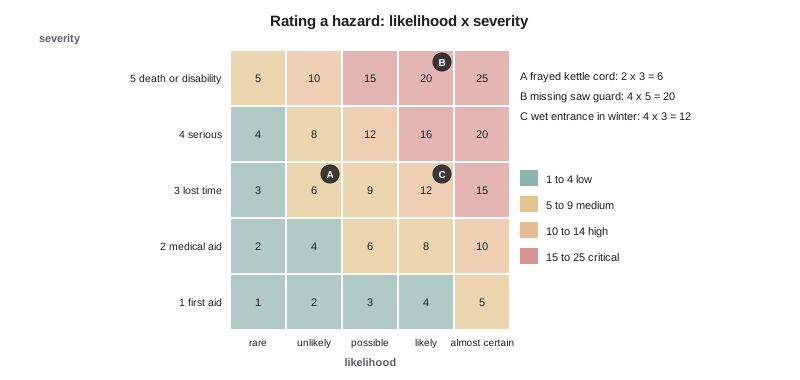
The scores then set the response time. At Riverbend Public Schools, the rule is:
| Score | Rating | Response |
|---|---|---|
| 15 to 25 | Critical | Stop the activity or isolate the hazard immediately; repair or control before work continues |
| 10 to 14 | High | Temporary control the same day; permanent fix within a week |
| 5 to 9 | Medium | Fix within 30 days; temporary control if needed |
| 1 to 4 | Low | Fix at the next opportunity; monitor |
The scoring is a guide, not a calculation that replaces judgment. Two people may score the same hazard differently, and that is fine as long as they discuss why. The real value of the matrix is that it makes people think about both likelihood and severity, and it gives a common language for deciding what comes first.
The program below takes the findings from one of Hannah's monthly inspections, scores them and sorts them so that the most serious come first.
# Score and sort inspection findings: likelihood (1-5) x severity (1-5).
findings = [
    ("Wood shop: table saw blade guard missing", 4, 5),
    ("Main entrance: floor wet, no mat (winter)", 4, 3),
    ("Room 214: frayed cord on kettle", 2, 3),
    ("Chem prep room: eyewash not flushed in 3 months", 3, 4),
    ("Stage: chairs stacked in front of rear exit", 3, 5),
    ("Staff room: drawer handle loose", 2, 1),
]

def rating(score):
    if score >= 15: return "CRITICAL - act now"
    if score >= 10: return "HIGH - same day"
    if score >= 5:  return "MEDIUM - 30 days"
    return "LOW - next opportunity"

scored = sorted(((l * s, l, s, what) for what, l, s in findings), reverse=True)
for score, l, s, what in scored:
print(f"{score:2} (L{l} x S{s}) {rating(score):24} {what}")20 (L4 x S5) CRITICAL - act now Wood shop: table saw blade guard missing 15 (L3 x S5) CRITICAL - act now Stage: chairs stacked in front of rear exit 12 (L4 x S3) HIGH - same day Main entrance: floor wet, no mat (winter) 12 (L3 x S4) HIGH - same day Chem prep room: eyewash not flushed in 3 months 6 (L2 x S3) MEDIUM - 30 days Room 214: frayed cord on kettle 2 (L2 x S1) LOW - next opportunity Staff room: drawer handle loose
The saw guard and the blocked exit come out on top, which matches common sense. The eyewash station is next: it is unlikely to be needed on any given day, but if a student or teacher splashes a chemical in their eye, a working eyewash in the first seconds makes a large difference. The loose drawer handle can wait.
The hierarchy of controls
Once a hazard is found and rated, the question is what to do about it. The hierarchy of controls ranks the options from most to least effective. The rule is to start at the top and work down, using the lower levels only when the higher ones are not practical, and often combining several.
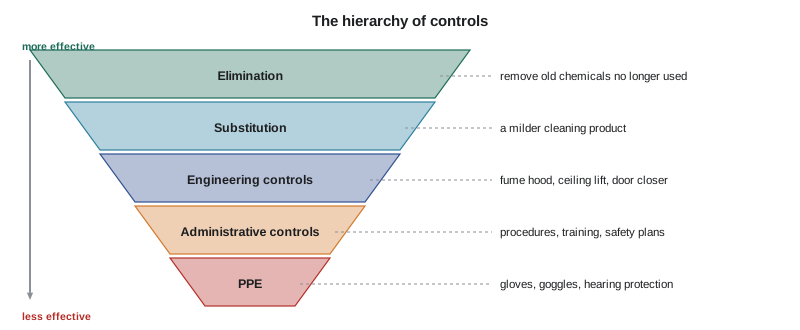
- Elimination removes the hazard completely. A school that clears out old chemicals it no longer uses, removes a broken piece of gym equipment, or stops storing boxes on top of tall cupboards has eliminated those hazards.
- Substitution replaces something hazardous with something less hazardous. Examples include a less corrosive cleaning product, water-based paints instead of solvent-based ones in art rooms, or a lighter-weight cart.
- Engineering controls change the workplace to separate people from the hazard. Examples include fume hoods, local exhaust on a welding bench, machine guards, ceiling lifts for student transfers, non-slip flooring, door closers, and a buzzer system so a teacher can call the office.
- Administrative controls change how work is done: procedures, training, warning signs, schedules, supervision, student safety plans, rotating heavy tasks and limiting who can use a machine.
- Personal protective equipment (PPE) is the last line of defense: gloves, goggles, face shields, aprons, hearing protection, slip-resistant footwear and, for some behavior incidents, protective sleeves.
Schools rely heavily on administrative controls and PPE, because they are cheap and quick. They are also the least reliable, because they depend on people remembering and complying every time. A wet floor sign helps, but a mat at the entrance and a better door closer help more. Training in safe lifting helps, but a ceiling lift helps more. Wherever possible, look for a control higher up the list.
From report to repair
A hazard is not controlled when it is written down. It is controlled when it has been fixed and someone has checked. Most districts use a work order system for repairs, and the weak point is usually the gap between the school and the maintenance department. Requests sit in a queue, get closed without the work being done, or are done in a way that does not actually fix the problem.
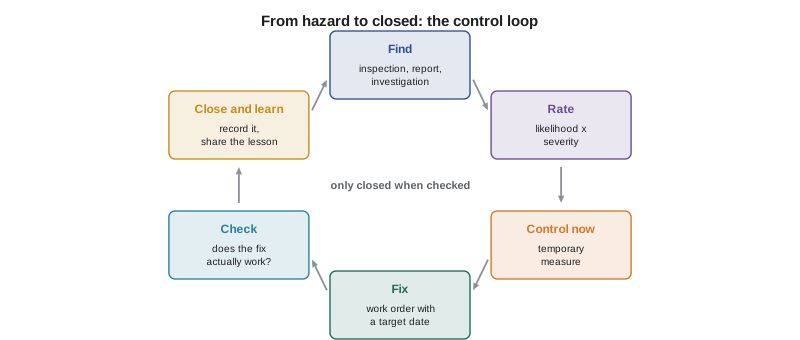
At Pinecrest, Marion and Victor keep a simple hazard log alongside the work order system. Each entry has the hazard, the location, the date found, the rating, the temporary control, the work order number, the target date, the date fixed and who checked it. Once a month, the safety committee reviews every entry older than its target date. That one habit has cut the number of long-overdue repairs in half.
Temporary controls matter. When the gym's emergency door alarm failed, the permanent fix took three weeks because a part had to be ordered. In the meantime, Victor checked the door at the start and end of every day and a sign reminded staff to keep it clear. Without the temporary control, the hazard would simply have been waiting.
Making staff reports easy
Inspections happen once a month at most; staff are in the building every day. The quickest way to find more hazards is to make reporting easier. At Willow Park, Priya keeps a short hazard report form at the office counter and a link to the online version on the staff room screen. The form asks only five things: what the hazard is, where it is, when it was noticed, whether anyone was hurt, and a suggested fix if the reporter has one. Reports go to the principal and are copied to the safety committee members for the school.
Two things decide whether people keep reporting: whether they hear back, and whether anything changes. Marion makes a point of replying to every hazard report within two school days, even if the answer is only 'work order submitted, target date next Friday'. At each staff meeting she spends two minutes on 'you reported, we fixed', naming the fix but not the reporter unless they want to be named. Reports at Pinecrest roughly doubled in the year after she started doing this, and most of the extra reports were about small things that would otherwise have become injuries.
Psychosocial hazards need a different route. A teacher worried about workload, or a paraprofessional who feels unsafe with a particular student, is unlikely to write it on a form at the front counter. Lessons 9 and 10 cover how those concerns are raised and handled.
Job hazard assessments
Some hazards are not about the building at all but about a particular job or task: a custodian stripping and waxing floors, a cafeteria worker using a commercial slicer, a teacher taking a class on a field trip, or a paraprofessional helping a student use the restroom. For these, a job hazard assessment breaks the task into steps, lists the hazards in each step, and sets out the controls. The result often becomes a safe work procedure that is used in training.
Worked problem
Stripping and waxing the gym floor
Victor's crew strips and refinishes the floors in the hallways every summer. A new custodian slipped on stripper solution last year and strained his back. Victor and Daniel do a job hazard assessment. What might they find and do?
Show solution
- Steps: move furniture, apply stripper, scrub with the floor machine, pick up the slurry, rinse, apply finish in several coats, let it dry, return furniture.
- Hazards: lifting furniture; the stripper is corrosive and very slippery; the floor machine can kick and its cord can be a trip hazard; vapors from finish in a closed space; long hours of kneeling and pushing.
- Controls, working down the hierarchy: substitute a lower-odor, less corrosive stripper; use a wet-vac rather than mops for the slurry; work in sections with the wet area clearly roped off; use slip-resistant overshoes; open doors and run ventilation; use a two-person lift and dollies for furniture; rotate tasks every hour.
- Victor writes it up as a safe work procedure, trains the crew on it before the summer and watches the first day's work to check it is followed.
Answer: Break the task into steps, list the hazards, choose controls from the top of the hierarchy where possible and turn it into a trained procedure.
Common mistakes
MistakeRelying only on inspections to find hazards.
InsteadUse inspections, staff reports and learning from events together.
MistakeTreating the risk score as an exact calculation.
InsteadUse it as a guide to discussion and priorities.
MistakeGoing straight to a sign or PPE.
InsteadStart at the top of the hierarchy and look for elimination, substitution or engineering controls first.
MistakeClosing a hazard when the work order is submitted.
InsteadClose it only when the fix has been done and checked.
MistakeLeaving a hazard uncontrolled while waiting for a repair.
InsteadPut a temporary control in place straight away.
Summary and key terms
- Hazards are found through planned inspections, staff reports and learning from events.
- Regular inspections, usually monthly for high-hazard areas, are part of a district's AWAIR program.
- Likelihood times severity gives a risk score that sets the response time.
- The hierarchy of controls runs from elimination and substitution through engineering and administrative controls to PPE.
- Schools rely on the lower levels too much; look for higher controls.
- A hazard is closed only when the fix has been checked; use temporary controls while waiting.
- Job hazard assessments break tasks into steps and lead to safe work procedures.
- Risk
- The combination of how likely harm is and how severe it would be.
- Risk matrix
- A grid used to rate hazards by likelihood and severity.
- Hierarchy of controls
- A ranking of ways to control hazards from most to least effective.
- Engineering control
- A physical change that separates people from a hazard.
- Job hazard assessment
- A step-by-step review of a task to find its hazards and controls.
Practice problems
Work each problem on paper first, then reveal the answer to check.
What are the three main ways hazards are found?
Show answer
Planned looking such as inspections, reports from staff, and learning from events.
A hazard has likelihood 3 and severity 5. What is its score and rating?
Show answer
15, critical: act immediately.
List the five levels of the hierarchy of controls in order.
Show answer
Elimination, substitution, engineering controls, administrative controls, PPE.
Give a school example of an engineering control.
Show answer
Any of: fume hood, machine guard, ceiling lift, door closer, non-slip flooring, local exhaust.
When should a hazard be marked as closed?
Show answer
When the fix has been done and someone has checked that it works.
Why are temporary controls important?
Show answer
They reduce the risk while waiting for a permanent repair.
Lesson quiz · 5 questions
Score 60% or more to complete this lesson.
Create a free account to save your progress, take quizzes and earn a certificate.