
HSE-360 · Lesson 4 of 12 · 21 min
Slips, trips and falls in schools
Slips, trips and falls are the most common cause of injury to school staff. They happen at entrances on snowy mornings, on cafeteria floors at lunch, on stairs crowded with students, in gyms, on playgrounds and parking lots, and in classrooms when a teacher stands on a chair to hang a display. Most result in bruises and sprains, but falls cause broken wrists, hips and ankles, head injuries and long absences, especially for older staff. This lesson looks at why people slip, trip and fall, where it happens in schools, and the controls that work.
Slips, trips and falls are different
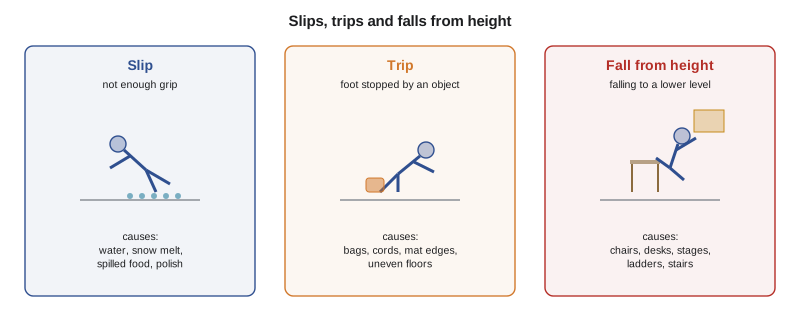
A slip happens when there is too little grip between the shoe and the floor, usually because the floor is wet, greasy, icy or polished, or the shoe sole is smooth. The foot slides forward and the person falls backward. A trip happens when the foot hits something and stops while the body keeps moving, so the person falls forward. Common causes are cords, bags, uneven flooring, mat edges, a change in floor level or an object left on the floor. A fall from height happens when someone falls from one level to another: off a chair, step stool, ladder, stage, loading dock or stairs.
The difference matters because the controls are different. Slips are controlled by keeping floors dry and clean and choosing the right flooring and footwear. Trips are controlled by housekeeping and by fixing uneven surfaces. Falls from height are controlled by using the right equipment for working above the floor and by guarding edges.
Where it happens in schools
When Daniel sorted last year's 118 slip, trip and fall reports by location, a clear pattern appeared.
| Location | Reports | Typical cause |
|---|---|---|
| Entrances and vestibules | 27 | Snow, slush and rain tracked in, especially at bell times |
| Parking lots and walkways | 22 | Ice, particularly early mornings and after a thaw and refreeze |
| Hallways and stairs | 19 | Crowds, backpacks, spills, worn stair nosings |
| Classrooms | 16 | Standing on chairs or desks, bags and cords on the floor |
| Cafeterias and kitchens | 13 | Food and liquid spills, grease, wet floors after cleaning |
| Gyms and playgrounds | 12 | Equipment, students running, uneven ground, wet gym floors |
| Other | 9 | Loading docks, stages, washrooms, storage rooms |
Almost half the reports came from outside or from the first few meters inside the doors, and most of those were between December and March. That points straight at winter maintenance and entrance matting. Classrooms were next, and nearly every classroom fall involved a staff member standing on furniture.
Entrances: stopping water at the door
Every student who walks in on a slushy morning brings water and grit on their boots. At bell times, several hundred students may come through one set of doors in ten minutes. The water spreads across the floor and the grit scratches and dulls it, and the first few meters inside the door become the most slippery floor in the building.
The most effective control is to stop the water before it spreads. Entrance matting does this: a coarse scraper mat outside or in the vestibule to remove snow and grit, followed by a wiper mat inside to absorb water. Industry guidance commonly suggests several meters of matting, enough for each foot to land on the mat several times, because each step removes only part of the water. A short mat removes some; a long run removes most.
The program below uses a simple model to show why the length of matting matters. It assumes each step on a mat removes a fixed share of the water left on the sole. The numbers are illustrative, but the shape of the result is the reason long runs of matting are worth the space.
# Illustrative model: share of water left on shoe soles after walking over entrance matting.
# Assume each step on matting removes 35% of the water still on the sole,
# and an average stride of about 0.75 m, so each foot lands once every 1.5 m.
removal_per_step = 0.35
stride_m = 0.75

for mat_length_m in (1, 2, 3, 4.5, 6):
    steps_per_foot = int(mat_length_m / (2 * stride_m)) + 1
    left = (1 - removal_per_step) ** steps_per_foot
    print(f"{mat_length_m:>4} m of matting: each foot lands about {steps_per_foot} times, "
f"{left:.0%} of the water reaches the floor")1 m of matting: each foot lands about 1 times, 65% of the water reaches the floor 2 m of matting: each foot lands about 2 times, 42% of the water reaches the floor 3 m of matting: each foot lands about 3 times, 27% of the water reaches the floor 4.5 m of matting: each foot lands about 4 times, 18% of the water reaches the floor 6 m of matting: each foot lands about 5 times, 12% of the water reaches the floor
In the model, one meter of matting lets about two thirds of the water through, while six meters lets through only a small share. Real results depend on the mat, how saturated it is and the weather. Mats also need to be cleaned and changed when they are soaked, laid flat with no curled edges, and sized to cover the full width of the door so that people cannot step around them.
Matting is backed up by other controls. Custodians mop entrances before and after bell times on wet days, wet floor signs go out when the floor is wet and come in when it is dry, and some schools use a 'wet weather' routine in which one custodian is assigned to entrances for the first half hour of the day.
Outside: ice, snow and the parking lot
Staff usually arrive before students, often in the dark in winter, and the parking lot and walkways may not have been cleared or salted yet. Many districts contract out snow clearing and salting, which makes it important that the contract is clear about timing: clearing before staff arrive, salting before the morning freeze, and checking again after a thaw. Victor checks the walkways at Pinecrest High School at 6:30 a.m. on winter days and calls the contractor if they have not been done.
Staff can help themselves too: wear winter boots with good grip and change into indoor shoes inside, walk with short, flat-footed steps on ice, keep hands free rather than in pockets, use handrails and take the route that has been cleared even if it is longer. Ice cleats that slip over boots are cheap and effective for walking outside but must be taken off before walking on smooth indoor floors.
Inside: spills, cords, stairs and clutter
Most indoor slips and trips come from a few causes that good housekeeping controls:
- Spills: clean them up straight away, or guard the area and tell the custodian. Cafeterias need spill kits and a clear rule that whoever sees a spill deals with it or reports it.
- Cords: route cords along walls or under covers, not across walkways. Use cord covers for temporary setups such as assemblies and science fairs.
- Bags and clutter: give students a place for backpacks so they are not in aisles, keep hallways and stairwells clear of displays and furniture, and keep storage rooms tidy.
- Floors: report and repair torn carpet, lifted tiles, worn stair nosings and loose mat edges.
- Stairs: handrails on both sides, good lighting, contrasting nosings so the edge of each step is visible, and a rule that staff hold the rail and do not carry loads that block their view of the steps.
- Lighting: replace burnt-out lights quickly, especially on stairs and in storage rooms.
Floor cleaning itself can create slips. Floors should be cleaned outside busy times where possible, wet areas should be signed and roped off, and the cleaning product should be the right one at the right dilution. Too much floor finish or a product left on the floor without rinsing can make the floor more slippery than before.
Classrooms: the chair problem
Teachers hang student work, decorations, maps and projectors at heights they cannot reach from the floor. Most use whatever is closest: a student chair, a desk, a rolling office chair or a stack of books. These were never meant to be stood on. Student chairs tip, rolling chairs roll, and desks can shift or collapse at the corners. Falls from chairs and desks cause some of the most serious injuries in Daniel's data, including a broken wrist and a concussion last year.
The fix is simple and cheap: every classroom or every hallway has a proper step stool or a small platform ladder rated for the user's weight, and staff are told plainly that standing on chairs and desks is not allowed. For anything higher than a step stool can safely reach, such as ceiling-mounted projectors, staff ask the custodians, who have ladders and training. The ladder rules are covered in Lesson 8.
Gyms, stages and playgrounds
Physical education teachers and coaches are on their feet all day on surfaces that can be slippery from sweat, dust or water, among students who are running, jumping and throwing. Sam's injuries over the years include a sprained ankle from stepping on a ball and a knee injury from slipping on a wet patch near the water fountain. In the gym, the controls are good housekeeping, mopping wet spots straight away, storing equipment off the floor, checking mats and equipment before each class, and wearing proper athletic footwear.
Stages have edges, steps without handrails, trap doors, cables and dark backstage areas. A stage edge more than a small step above the floor should be marked with a contrasting strip, and staff working near an open edge, for example setting up lights, need guardrails or must keep well back. Storage behind stage curtains is a common trip hazard and can block exits.
Playground supervision takes staff outside in all weather, onto uneven ground, wet grass, ice and gravel, often while watching students rather than their own feet. Good footwear, clearing ice from supervision areas and doorways, and choosing a supervision position on firm ground all help.
Worked problem
The Willow Park front entrance
Willow Park has had four slip reports at its front entrance this winter, one of which led to a lost-time injury. The entrance has a 4 ft (1.2 m) mat inside the doors, no vestibule and a hard tile floor. What should the school do?
Show solution
- Rate it: slips at the entrance are likely in winter (4) and can cause fractures (3 or 4), giving a high score of 12 to 16.
- Engineering controls: add a scraper mat outside the doors and extend the inside wiper matting to 15 ft (about 4.5 m), covering the full width of the doorway, so each foot lands several times before reaching the tile.
- Administrative controls: a custodian mops the entrance before and after bell times on wet days, and the matting is changed when saturated. Wet floor signs go out when needed.
- Personal measures: staff are reminded to wear winter boots with good grip and change into indoor shoes.
- Check: the safety committee reviews the slip reports at the end of the winter to see whether the changes worked.
Answer: Extend the matting and add a scraper mat, back it with a mopping routine and signs, and check the results at the end of the season.
Common mistakes
MistakeStanding on a chair or desk to hang displays.
InsteadUse a proper step stool or platform ladder, or ask a custodian.
MistakeRelying on a short mat at the door.
InsteadUse several meters of matting covering the full width, changed when soaked.
MistakeLeaving a wet floor sign out all day.
InsteadPut signs out when the floor is wet and remove them when it is dry, so people take them seriously.
MistakeRunning cords across walkways for assemblies.
InsteadRoute cords along walls or use cord covers.
MistakeWearing smooth-soled shoes outside in winter.
InsteadWear boots with good grip and change indoors.
Summary and key terms
- Slips, trips and falls from height have different causes and need different controls.
- Most slip reports come from entrances, parking lots and walkways in winter.
- Several meters of entrance matting covering the full width stop most water at the door.
- Snow clearing and salting need to be done before staff arrive and checked after thaws.
- Good housekeeping controls spills, cords, bags, floors, stairs and lighting.
- Staff must not stand on chairs or desks; every classroom needs a proper step stool.
- Gyms, stages and playgrounds need housekeeping, marked edges and good footwear.
- Slip
- A fall caused by too little grip between shoe and floor.
- Trip
- A fall caused when the foot hits an object and stops while the body keeps moving.
- Fall from height
- A fall from one level to a lower level.
- Entrance matting
- Scraper and wiper mats that remove dirt and water from shoes at the door.
- Stair nosing
- The front edge of a stair tread, often marked with a contrasting strip.
Practice problems
Work each problem on paper first, then reveal the answer to check.
What is the difference between a slip and a trip?
Show answer
A slip is too little grip, usually on a wet floor; a trip is when the foot hits an object and stops.
Where do most slip reports in schools come from?
Show answer
Entrances, parking lots and walkways in winter.
Why does the length of entrance matting matter?
Show answer
Each step removes only part of the water, so more steps on the mat leave less water for the floor.
What should a teacher use to hang a display above head height?
Show answer
A proper step stool or platform ladder, never a chair or desk.
Name three housekeeping controls for indoor trips.
Show answer
Any three of: clean spills, route cords along walls, store bags out of aisles, repair floors, keep stairs and halls clear, replace burnt-out lights.
What should a snow clearing contract specify for a school?
Show answer
Clearing and salting before staff arrive and checking again after a thaw.
Lesson quiz · 5 questions
Score 60% or more to complete this lesson.
Create a free account to save your progress, take quizzes and earn a certificate.