
HSE-360 · Lesson 11 of 12 · 21 min
Reporting and investigating incidents
When something goes wrong at work, what happens next matters almost as much as what happened. Prompt reporting gets injured staff the care and compensation they are entitled to, meets the legal deadlines, and gives the school the information it needs to prevent the next incident. Good investigation turns a bad day into a lesson that protects others. Poor reporting and blame-focused investigations do the opposite: people hide incidents, the same hazards cause the same injuries, and trust breaks down. This lesson explains what to report, to whom and by when, and how to investigate an incident in a way that finds real causes and real fixes.
What to report
At Riverbend Public Schools, staff report all of the following, using the district's incident report form, which is available online and in paper form at each school office:
- Injuries of any kind, however minor, including those that need only first aid.
- Illnesses that may be caused by work, such as dermatitis from a cleaning product or a respiratory problem after a chemical spill.
- Near misses: events that could have caused an injury but did not, such as a ceiling tile falling in an empty classroom.
- Workplace violence incidents and threats, including those that did not cause injury.
- Workplace harassment, reported through the harassment procedure described in Lesson 10.
- Exposures to chemicals or bodily fluids, including needle-sticks and bites.
- Hazards, through the hazard report process described in Lesson 3.
Reporting is a duty, not a choice, but it works best when people see the point. The question Marion asks her staff is: would you want to know if this had happened to someone in your department? If the answer is yes, it should be reported.
Legal reporting duties
Some incidents trigger legal reporting duties with tight deadlines. Principals and the district safety coordinator handle most of these, but every staff member should know the basics, so that nothing is delayed.
| Event | Who must be told | Deadline |
|---|---|---|
| A work-related fatality | MNOSHA | Within 8 hours |
| An in-patient hospitalization, amputation or loss of an eye | MNOSHA | Within 24 hours |
| A recordable injury or illness | Entered on the district's injury and illness log | Within 7 calendar days |
| An injury that may lead to a workers' compensation claim | The district's workers' compensation insurer or administrator, on the first report of injury | Promptly, with short legal deadlines for deaths, serious injuries and lost time over three days |
| An employee injury of any kind | The supervisor and the district, on the incident report | As soon as possible, the same day |
| The yearly summary of injuries | Posted in each workplace | February 1 to April 30 each year |
In Minnesota, as a state plan, public employers such as school districts keep injury and illness records on the same forms used under federal OSHA rules: a log of recordable cases, an incident report for each, and a yearly summary posted from February to April. A recordable case is generally one that results in death, days away from work, restricted work or job transfer, medical treatment beyond first aid, loss of consciousness, or a significant diagnosed injury or illness. A broken arm from a fall down the stairs, or a concussion with loss of consciousness during a behavior incident, would both be recordable, and an in-patient hospital admission would need a report to MNOSHA within 24 hours.
The first hour after an incident
When a staff member is injured, the first priorities are care and safety, not paperwork:
- Make the area safe so no one else is hurt, and look after any students.
- Give first aid, or get a trained first aider, and call 911 for anything serious.
- Tell the principal or the person in charge.
- Preserve the scene for serious incidents, so that it can be examined.
- Write down what happened while it is fresh: time, place, who was there, what was happening, and what each witness saw.
- Fill in the incident report the same day, even if the injury seems minor. Some injuries, especially back strains and concussions, are worse the next day.
Every school needs enough trained first aiders, spread across shifts and wings, with their names posted near the first aid stations, and first aid kits that are checked and restocked on a schedule. At Pinecrest High School, the office keeps a list of first aiders for the day shift, the evening custodial shift and weekend events, and each kit has a checklist taped inside the lid. First aid given is recorded every time, because a cut that needed only a bandage today may turn out to be part of a pattern, such as a box cutter that keeps slipping in the cafeteria storeroom.
Investigating to learn
An investigation asks what happened, why, and what will stop it happening again. It should not be a search for someone to blame. Most incidents have several causes, and the person closest to the event is usually the last link in a chain that includes equipment, the building, procedures, training, staffing and decisions made far from the scene.
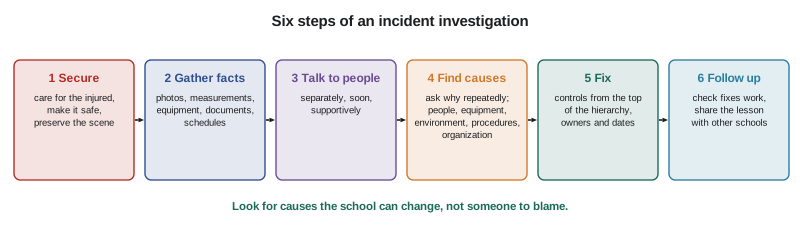
One simple method for getting beyond the first, obvious cause is to ask 'why?' several times. Each answer leads to the next question, until you reach something that the school or district can change. Another is to look at five areas in turn: the people involved, the equipment and materials, the environment, the procedures, and the organization, meaning staffing, scheduling, supervision and budgets.
Investigations are usually led by the principal or supervisor, with a worker member of the safety committee taking part where the law or the district's procedure calls for it, and the district safety coordinator helping with serious incidents. People involved should be interviewed separately, soon, and in a way that makes them comfortable telling the whole story, including their own mistakes. Statements like 'she should have been more careful' are a sign that the investigation has stopped too early.
Measuring performance
Over time, incident reports also tell the district how well its safety program is working. One common measure is the injury rate: the number of injuries for every 100 full-time workers per year. Rates allow comparison between schools of different sizes and from year to year. The program below works out the rates for three of the district's schools from the number of recordable injuries and the hours worked.
# Injury rate per 100 full-time workers per year:
# rate = injuries x 200,000 / hours worked   (200,000 = 100 workers x 40 h x 50 weeks)
schools = [
    ("Pinecrest (secondary)", 14, 196_000),
    ("Willow Park (elementary)", 11, 88_000),
    ("Oak Hill (elementary)", 3, 79_000),
]
for name, injuries, hours in schools:
    rate = injuries * 200_000 / hours
    ftes = hours / 2_000
print(f"{name:26} {injuries:2} injuries, about {ftes:4.0f} FTEs, rate {rate:4.1f} per 100 workers")Pinecrest (secondary) 14 injuries, about 98 FTEs, rate 14.3 per 100 workers Willow Park (elementary) 11 injuries, about 44 FTEs, rate 25.0 per 100 workers Oak Hill (elementary) 3 injuries, about 40 FTEs, rate 7.6 per 100 workers
Willow Park has fewer injuries than Pinecrest but a much higher rate, because it is a smaller school. Most of its injuries came from behavior incidents in the resource room, which is why so much of the attention in Lesson 9 went there. Rates have limits: a low rate can mean a safe school, or a school where people do not report. That is why boards also track leading indicators, such as inspections completed, hazards fixed on time, training completed and near misses reported, which show whether the safety work is being done before injuries happen.
Workers' compensation
Minnesota school districts carry workers' compensation coverage, often through a self-insurance pool, and injured staff are entitled to benefits for lost wages and medical costs for work-related injuries and illnesses, regardless of fault. The employee should report the injury to the supervisor right away, get medical care and tell the provider that the injury happened at work. Districts must not retaliate against employees for claiming, and they work with the insurer and the employee on a safe return to work, covered in Lesson 12.
Supporting the people involved
An incident affects more than the injured person. Witnesses may be shaken, especially after a violent incident or a serious fall, and colleagues may feel guilty that they did not see it coming or could not help. The injured worker may worry about their job, their income and what others think. Principals can make a large difference by checking in with the injured worker within a day or two, making sure they know how to claim compensation, keeping in touch during any absence, and talking to witnesses about how they are doing as well as what they saw. The employee assistance program is available to everyone involved, not only the injured person.
Sharing what was learned
An investigation is only finished when the lesson reaches the people who need it. Within the school, that means telling staff what happened and what is being changed, without naming or blaming anyone. Across the district, Daniel sends a short safety alert after serious incidents and near misses, describing what happened, why, and what other schools should check. After the stage fall described below, three other secondary schools found similar steps without handrails and fixed them before anyone was hurt. The safety committee at each school reviews these alerts at its next meeting, so that one school's bad day becomes every school's warning.
Worked problem
A fall on the stage stairs
During set-up for a concert, a teacher at Pinecrest High School falls down the four steps at the side of the stage while carrying a speaker. She breaks her arm. The stage lights were off, and the steps have no handrail. What should happen, and what might the investigation find?
Show solution
- A broken arm needing medical treatment and time off is a recordable injury, so it goes on the district's injury log within 7 days, and the district files a first report of injury with its workers' compensation administrator. She is treated in the emergency department and sent home, so no MNOSHA report is needed; if she had been admitted, the district would have had 24 hours to report it.
- The investigation, led by Marion with Hannah as the worker member of the committee, asks why she fell. She could not see the steps clearly because the stage lights were off. Why were they off? The work lights are controlled from the booth at the back of the auditorium, and no one had turned them on.
- Why was she carrying a speaker down steps? The speakers are stored backstage and there is no ramp or cart route. Why is there no handrail? The steps were built in 1968 and never upgraded.
- Fixes: a handrail and contrasting nosings on the stage steps, a light switch at the side of the stage, a cart and a route for audio equipment, and a rule that heavy equipment is moved by two people or the custodial crew.
- Follow-up: the safety committee checks the work is done, and Daniel shares the findings with other secondary schools, three of which find similar steps.
Answer: Meet the reporting deadlines, then ask why repeatedly to find the lighting, storage and handrail causes, fix them, and share the lesson.
Common mistakes
MistakeNot reporting an injury because it seems minor.
InsteadReport every injury the same day; some get worse and records matter.
MistakeCleaning up the scene of a serious injury straight away.
InsteadPreserve the scene, except to save life or prevent further harm, until it can be examined.
MistakeConcluding that the injured person should have been more careful.
InsteadKeep asking why until you reach causes the school can change.
MistakeInterviewing witnesses together.
InsteadInterview people separately, soon and supportively.
MistakeJudging safety only by a low injury rate.
InsteadTrack leading indicators too, because low rates can reflect under-reporting.
Summary and key terms
- Report every injury, illness, near miss, violence incident and exposure, the same day.
- Fatalities go to MNOSHA within 8 hours and in-patient hospitalizations within 24 hours; recordable cases go on the log within 7 days.
- Injuries that may lead to claims are reported promptly to the workers' compensation insurer or administrator.
- In the first hour, focus on care, safety and preserving the scene, then record the facts.
- Investigations look for causes, not blame, by asking why repeatedly and looking at people, equipment, environment, procedures and organization.
- Injury rates allow comparisons, but leading indicators show whether the safety work is being done.
- Injured staff are entitled to workers' compensation benefits regardless of fault.
- Recordable case
- An injury or illness that must be entered on the injury and illness log.
- Near miss
- An event that could have caused an injury but did not.
- Root cause
- An underlying cause that, if fixed, prevents the incident from happening again.
- Injury rate
- The number of injuries per 100 full-time workers per year.
- Leading indicator
- A measure of safety work done before injuries happen, such as inspections or hazards fixed.
Practice problems
Work each problem on paper first, then reveal the answer to check.
List four kinds of events staff should report.
Show answer
Any four of: injuries, work-related illnesses, near misses, violence incidents and threats, harassment, exposures, hazards.
What must happen when a worker is admitted to hospital after a work injury?
Show answer
A report to MNOSHA within 24 hours, and the case entered on the injury log.
What should be done in the first hour after an injury?
Show answer
Make the area safe, give first aid, tell the principal, preserve the scene if serious, and record the facts.
Why ask why several times in an investigation?
Show answer
To get past the first, obvious cause to underlying causes the school can fix.
A school has 11 injuries and 88,000 hours worked. What is its injury rate?
Show answer
About 25 per 100 workers (11 x 200,000 / 88,000).
Why are leading indicators useful?
Show answer
They show whether safety work is being done before injuries happen, and low injury rates can reflect under-reporting.
Lesson quiz · 5 questions
Score 60% or more to complete this lesson.
Create a free account to save your progress, take quizzes and earn a certificate.