
HSE-360 · Lesson 6 of 12 · 21 min
Chemicals and cleaning products
Schools use more chemicals than most people realize. Custodians clean and disinfect every day with concentrated products. Science departments store acids, bases, solvents and reactive chemicals. Art rooms use glazes, solvents, spray fixatives and paints. Technology shops produce wood dust and welding fumes and use oils, finishes and adhesives. Cafeterias use degreasers, sanitizers and oven cleaners. The grounds crew may use fertilizers, de-icers and occasionally pesticides. This lesson explains how the hazards of these products are communicated, how they are stored and used safely, and what to do when something goes wrong.
How chemical hazards cause harm
Chemicals can harm people in four main ways, called routes of exposure:
- Breathing in vapors, mists, dusts or fumes, which is the most common route in schools, for example the vapor from a strong cleaner in a small restroom or the fumes from heating a chemical in a lab.
- Skin and eye contact, from splashes, spills or handling without gloves. Corrosive products can burn skin and eyes within seconds.
- Swallowing, usually by accident, for example from contaminated hands or a product decanted into an unlabeled drink bottle.
- Injection through the skin, which in schools usually means a needle or sharp contaminated with something, covered in Lesson 8.
Effects can be acute, happening quickly, such as burns, eye damage, dizziness or breathing problems, or chronic, building up over months or years, such as dermatitis, asthma or, for some chemicals, cancer. Some products cause both.
Hazard communication: HazCom
In the United States, chemical hazards at work are communicated under OSHA's Hazard Communication standard, often called HazCom, which Minnesota enforces through MNOSHA, along with Minnesota's own Employee Right-to-Know rules. HazCom has three main parts: labels on containers, safety data sheets (SDSs) and training, backed by a written hazard communication program. OSHA updated HazCom in 2024 to line up more closely with a newer edition of the Globally Harmonized System (GHS), with compliance dates phased in from 2026 into 2028 after OSHA extended them. Products arriving in schools now may carry updated labels and SDSs, and older stock will still have the previous versions.
Labels and pictograms
A supplier label is on the container a product comes in. It carries the product name, a signal word (Danger for the more severe hazards, and a second, milder signal word for less severe ones), hazard statements describing the hazards, precautionary statements describing how to use it safely, pictograms and the supplier's details. When a product is moved into another container, such as a spray bottle, that container needs a workplace label with at least the product name, safe handling information and a reference to the SDS.
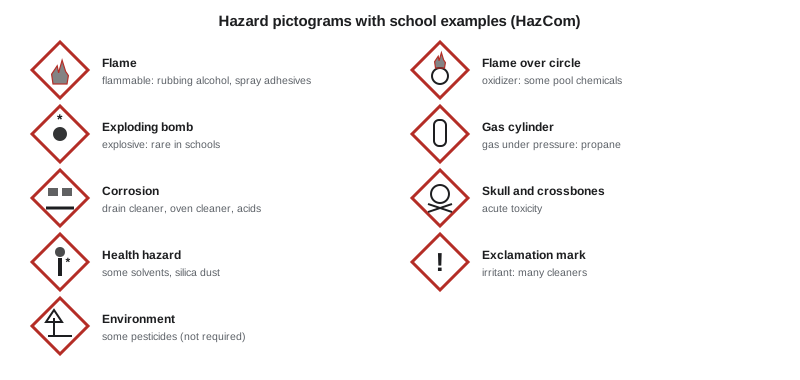
The pictograms are the quickest way to recognize a hazard at a glance. In a typical school, the ones staff see most are the exclamation mark on many cleaners, the corrosion symbol on drain cleaners, oven cleaners and concentrated acids and bases, the flame on alcohols, aerosols and solvents, and the health hazard symbol on some solvents, art materials and products that contain crystalline silica.
Safety data sheets
An SDS gives detailed information about a product in 16 standard sections, including its hazards, first aid measures, firefighting measures, what to do if it is spilled, safe handling and storage, exposure limits and the protective equipment needed. Staff do not need to memorize SDSs, but they need to know where to find them quickly and how to use the most important sections:
| Section | What it tells you | When you need it |
|---|---|---|
| 2 Hazard identification | The hazards, signal word and pictograms | Before using a product for the first time |
| 4 First aid measures | What to do for eye, skin, inhalation and swallowing exposure | Immediately after an exposure |
| 6 Accidental release measures | How to deal with a spill | When something is spilled |
| 7 Handling and storage | How to use and store it, including incompatible products | Setting up storage and procedures |
| 8 Exposure controls and personal protection | Ventilation and protective equipment needed | Choosing gloves, goggles and ventilation |
Every school keeps SDSs for every hazardous product on site, either in a binder in a known location or in an online database that staff can reach from any computer or phone. Victor keeps the custodial SDSs in a binder in the custodial office and Hannah keeps the science SDSs in the prep room, with both also available online. An SDS that cannot be found in an emergency is not much use.
Training
HazCom requires training for employees who may be exposed to hazardous chemicals, covering how to read labels and SDSs, the hazards of the chemicals in their work area and how to protect themselves, given when they are first assigned and when a new hazard is introduced. Minnesota's Employee Right-to-Know rules add that training is to be refreshed at least once a year. In a school, custodians, science and art teachers, shop teachers, food service staff and maintenance staff all need it.
Cleaning products: the everyday hazard
The chemicals most staff handle are cleaning and disinfecting products. Many are bought as concentrates and diluted in the school, often through wall-mounted dispensers that mix the right amount with water automatically. Dispensers are a good engineering control: they reduce splashes and get the dilution right every time. Problems arise when products are mixed by hand, poured into unlabeled bottles, or brought from home by staff who want something stronger.
One rule matters more than any other: never mix cleaning products. Mixing bleach with ammonia, which is found in some glass cleaners, releases toxic chloramine gases. Mixing bleach with acidic products, such as some toilet bowl cleaners and descalers, releases chlorine gas. Both can cause serious breathing problems in a small room within minutes, and incidents of this kind have sent custodians and teachers to hospital. If a product label or SDS says it is incompatible with another, store them apart and never use them together.
Getting the dilution right matters too. Too weak, and a disinfectant does not work. Too strong, and it wastes money, leaves residue that can make floors slippery and exposes staff to more of the chemical than they need. The program below works out how much concentrate to use for a few common dilutions.
# How much concentrate for a given dilution ratio?
# A ratio of 1:64 means 1 part concentrate in 64 parts of finished solution (common label convention).
def concentrate_ml(final_l, ratio):
    return final_l * 1000 / ratio

jobs = [
    ("mop bucket, general floor cleaner 1:64", 12, 64),
    ("spray bottle, disinfectant 1:128", 0.95, 128),
    ("sink, cafeteria sanitizer 1:256", 20, 256),
]
for name, vol_l, ratio in jobs:
    ml = concentrate_ml(vol_l, ratio)
print(f"{name:42} {vol_l:5.2f} L total -> {ml:6.1f} mL concentrate")mop bucket, general floor cleaner 1:64 12.00 L total -> 187.5 mL concentrate spray bottle, disinfectant 1:128 0.95 L total -> 7.4 mL concentrate sink, cafeteria sanitizer 1:256 20.00 L total -> 78.1 mL concentrate
A 12 L mop bucket at 1:64 needs under 200 mL of concentrate, less than many people would pour by eye. That is one reason dispensers and measuring cups beat guesswork.
Science labs and prep rooms
School science departments often hold a wide range of chemicals, some of which have been on the shelves for decades. The main controls are:
- An up-to-date inventory of every chemical, its quantity, its location and the date it arrived.
- Storage by compatibility, not alphabetically: acids apart from bases, oxidizers apart from flammables and organics, water-reactive chemicals kept dry. Flammable liquids above small quantities go in an approved flammables cabinet.
- Regular removal of chemicals that are old, unneeded, deteriorating or no longer used in the curriculum, through a licensed waste contractor. Some old chemicals become more dangerous with age.
- Working fume hoods, checked regularly for airflow, for any work that gives off hazardous vapors.
- Eyewash stations and safety showers within easy reach, flushed regularly so the water is clean and the equipment works.
- Clear rules about which chemicals students may handle, and in what quantities.
When Hannah took over as head of science, the inventory showed several chemicals that had not been used for at least fifteen years, including a container of picric acid, which can become shock-sensitive when it dries out. The district arranged for a specialist contractor to remove it safely. The episode led to a district-wide clear-out and a rule that every science department reviews its inventory each June.
Art rooms, shops and other areas
Art rooms may use solvents, aerosol fixatives, glazes containing metals, and clay, which produces silica dust when dry. Controls include water-based products where possible, ventilation, wet cleaning rather than sweeping clay dust, and keeping glazes and solvents in labeled containers. Technology shops produce wood dust, which can cause asthma and, for some hardwoods, more serious disease; dust collection, good housekeeping and avoiding compressed air for cleaning are the main controls. Welding fumes need local exhaust. Cafeteria staff use degreasers and oven cleaners that are often strongly corrosive and need gloves and eye protection.
Products from home, and choosing safer products
Teachers sometimes bring cleaning wipes, air fresheners, glue guns, aerosol sprays or craft supplies from home. These products have not been reviewed, there is no SDS on file, and staff and students may not know what is in them. Air fresheners and scented products can also trigger asthma and headaches in people who are sensitive to them, which is why many schools have scent-reduced policies. Riverbend Public Schools's rule is simple: products used in the school are bought through the district, so they are reviewed, labeled and backed by an SDS. A teacher who needs something for a project asks the principal, who checks with Daniel.
The district also uses its buying power to choose safer products. When a cleaning contract comes up for renewal, Daniel and the custodial supervisors look for products certified to a recognized environmental or low-hazard standard, concentrated products sold for dispenser systems, and fewer products overall. The custodial crew at Pinecrest High School went from 22 different products to nine in two years, which made training simpler and cut the chances of the wrong product being used.
When something goes wrong
Every area that uses hazardous products needs a simple plan for spills and exposures:
- For eye contact, flush with clean running water or an eyewash for at least 15 minutes, holding the eyelids open, and get medical help. Do not wait to read the SDS before starting to flush.
- For skin contact with a corrosive, remove contaminated clothing and flush the skin with plenty of water, then follow the SDS first aid section.
- For inhalation, move the person to fresh air and get help if they have trouble breathing.
- For spills, keep people away, ventilate if safe, and use the spill kit following the SDS. Large spills or spills of very hazardous chemicals need the school's emergency procedures and possibly the fire department.
- Report every exposure and every significant spill.
Worked problem
A strong smell in the restroom
A teacher at Willow Park finds a custodian coughing outside a staff restroom, where there is a strong chlorine-like smell. The custodian says he used a toilet bowl cleaner and then bleach because the toilet was badly stained. What should happen?
Show solution
- Get people out and away: close the door, keep others out and move the custodian to fresh air.
- Check how he is: coughing, chest tightness or difficulty breathing need first aid and medical attention. Call for help if his breathing gets worse.
- Ventilate if it can be done safely, for example by turning on the exhaust fan from outside the room or opening an outside door, but do not go back in to clean up until the air has cleared.
- Report it as an exposure incident, and check the SDSs for both products.
- Follow up: the custodial crew gets a reminder on never mixing products, the bleach is removed from that cart, and a product that removes stains without bleach is chosen for that job.
Answer: Get everyone out, care for the custodian, ventilate safely, report it and fix the cause by removing the incompatible product.
Common mistakes
MistakeMixing cleaning products to make them stronger.
InsteadNever mix products; bleach with ammonia or acids produces toxic gases.
MistakePutting a product in an unlabeled spray bottle.
InsteadEvery container needs a workplace label.
MistakeStoring lab chemicals alphabetically.
InsteadStore by compatibility, with flammables in an approved cabinet.
MistakeReading the SDS before flushing an eye.
InsteadStart flushing immediately for at least 15 minutes, then check the SDS.
MistakeKeeping old chemicals in case they are needed.
InsteadReview the inventory and remove old and unneeded chemicals regularly.
Summary and key terms
- Chemicals harm people by breathing, skin and eye contact, swallowing and injection.
- HazCom uses labels, SDSs and training; OSHA's 2024 update is being phased in from 2026 into 2028.
- Pictograms show the main hazards at a glance; SDSs give the detail in 16 sections.
- Never mix cleaning products, and never use unlabeled containers.
- Dispensers and measuring cups get dilutions right and reduce exposure.
- Labs need an inventory, compatible storage, working fume hoods and eyewash stations, and regular clear-outs.
- Flush eyes immediately for at least 15 minutes, and report every exposure.
- Route of exposure
- The way a chemical enters the body: breathing, skin and eye contact, swallowing or injection.
- Safety data sheet (SDS)
- A 16-section document describing a product's hazards and safe use.
- Workplace label
- A label on a container a product has been transferred to, with its name, safe handling and an SDS reference.
- Signal word
- One of two words on a label that shows how severe the hazard is, Danger being the more severe.
- Incompatible
- Products that react dangerously if mixed or stored together.
Practice problems
Work each problem on paper first, then reveal the answer to check.
Name the four routes of exposure.
Show answer
Breathing in, skin and eye contact, swallowing and injection.
What gas is released when bleach is mixed with ammonia?
Show answer
Toxic chloramine gases.
Which SDS section gives first aid measures?
Show answer
Section 4.
What must a workplace label include?
Show answer
The product name, safe handling information and a reference to the SDS.
How long should an eye be flushed after a chemical splash?
Show answer
At least 15 minutes.
How should lab chemicals be stored?
Show answer
By compatibility, with flammables in an approved cabinet, not alphabetically.
Lesson quiz · 5 questions
Score 60% or more to complete this lesson.
Create a free account to save your progress, take quizzes and earn a certificate.