
HSE-331 · Lesson 9 of 12 · 26 min
Rig moves, rig-up and rig-down
A drilling rig spends a surprising share of its life in pieces. A conventional land rig may be torn down, trucked 50 or 100 km and rigged up again every few weeks; a service rig may move every day or two. Rig moves bring together many of the most dangerous hazards in the industry at once: heavy loads lifted by cranes and winch trucks, tall and wide loads on public roads and lease roads, overhead power lines, the mast being raised and lowered, many contractors working together under time pressure, and often darkness and winter weather. A large share of serious rig incidents happen during moves. This lesson covers planning a move, the hazards of transport, lifting and rigging on the lease, raising and lowering the mast, and walking or skidding a pad rig between wells. HSE-219 covers cranes, hoisting and rigging in general, and HSE-218 covers mobile equipment.
Planning the move
A safe move starts days before the first load leaves. The rig manager, the trucking company's move supervisor (often called the truck push), the operator's representative and any crane company meet to agree on a move plan. The plan typically covers: the route from the old lease to the new one, including road bans, bridges, overhead lines and railway crossings; permits for oversize and overweight loads; the order in which loads leave and arrive; the lifting plan for each heavy load; who is in charge at each end; communication methods; weather limits; and how the new lease will be laid out, including the position of the rig over the well center and the locations of tanks, pipe racks, camp and muster points.
Lease preparation matters as much as the trucks. The new lease must be built and graded to carry the loads, with matting where the ground is soft, and the operator must confirm that there are no buried lines under the rig footprint or anchor locations (HSE-330, Lesson 9). On an existing pad such as Pinecrest, the producing wells, flowlines and battery must be identified, protected and sometimes shut in before the rig and its loads arrive.
Transport hazards
Rig components are among the heaviest and largest loads on rural roads: the substructure, drawworks, mud pumps, engines and mast sections can each weigh 20 to 50 metric tons. Winch tractors and bed trucks load them using their own winches and tilting decks, and tandem winch moves can move the heaviest pieces. Hazards include loads shifting or falling during loading and unloading, winch lines parting under tension, workers caught between trucks and loads, trucks rolling over on soft lease roads or tight corners, collisions with other traffic on the highway, and fatigue from long move days.
Lease roads are often narrow, steep and slippery, with soft shoulders and poor sight lines. HSE-330, Lesson 3, covered lease road driving and journey management; during a move the traffic is heavier and the vehicles are larger and slower. Pilot vehicles, radio communication on an agreed channel, speed limits, designated passing places and keeping light vehicles out of the way of heavy loads all reduce the risk.
Overhead power lines
Contact with overhead power lines is one of the classic killers in rig moves. A mast section on a high trailer, a raised crane boom, a winch truck's gin poles or the mast itself during raising can reach or come close to a line. Electricity can arc across air gaps, so contact is not necessary for a fatal shock, and everyone touching the truck or load, or standing nearby on the ground, is at risk. HSE-214 and HSE-224 explain electrical hazards and limits of approach in general.
Controls include surveying the route and the lease for overhead lines during planning, contacting the utility to have lines de-energized, raised or covered where needed, measuring load heights, posting a spotter whose only job is to watch the clearance, marking lines with flags or goal posts, and never raising a mast or boom near a line without a specific plan. Minimum approach distances depend on voltage and are set by provincial OHS law in Canada and by OSHA in the United States. The program below checks invented loads against illustrative clearances; real limits must come from the applicable regulation and the utility.
# Illustrative minimum clearances by line voltage (teaching values only).
# Real limits come from provincial OHS law or OSHA and the utility.
def min_clearance_m(kv):
    if kv <= 50:
        return 3.0
    return 3.0 + 0.1 * ((kv - 50) / 10)     # extra distance for higher voltages

lines = {"Distribution line on lease road": (25, 8.5),
         "Transmission line at highway":    (240, 18.0)}   # (kV, height above road m)
loads = {"Mast section on trailer": 5.2, "Substructure on bed truck": 4.6,
         "Crane boom raised": 16.0}
for lname, (kv, height) in lines.items():
    need = min_clearance_m(kv)
    print(f"{lname}: {kv} kV at {height} m ({height * 3.281:.0f} ft), "
          f"clearance needed {need:.1f} m ({need * 3.281:.0f} ft)")
    for load, top in loads.items():
        gap = height - top
        status = "OK" if gap >= need else "TOO CLOSE - stop, replan"
print(f" {load:26} top {top:4.1f} m, gap {gap:4.1f} m ({gap * 3.281:4.1f} ft) {status}")Distribution line on lease road: 25 kV at 8.5 m (28 ft), clearance needed 3.0 m (10 ft) Mast section on trailer top 5.2 m, gap 3.3 m (10.8 ft) OK Substructure on bed truck top 4.6 m, gap 3.9 m (12.8 ft) OK Crane boom raised top 16.0 m, gap -7.5 m (-24.6 ft) TOO CLOSE - stop, replan Transmission line at highway: 240 kV at 18.0 m (59 ft), clearance needed 4.9 m (16 ft) Mast section on trailer top 5.2 m, gap 12.8 m (42.0 ft) OK Substructure on bed truck top 4.6 m, gap 13.4 m (44.0 ft) OK Crane boom raised top 16.0 m, gap 2.0 m ( 6.6 ft) TOO CLOSE - stop, replan
The check flags the raised crane boom under both lines; under the distribution line the boom would actually reach above the wires. It passes the transport loads, although the mast section clears the distribution line by only 1 ft (0.3 m) more than the illustrative minimum. In practice the line's sag on a hot day, uneven ground and the movement of loads mean that margins must be generous, and a spotter is still needed even when the numbers look acceptable.
Lifting and rigging on the lease
During rig-up and rig-down, cranes, picker trucks and winch trucks lift and place rig components, and the floor crew helps with tag lines, pins and connections. Each lift should have a lift plan appropriate to its complexity, with a critical lift plan for heavy, tandem or unusual lifts. The core rules from HSE-219 apply: inspect rigging before use, know the load weight and center of gravity, use the right sling configuration, keep everyone out from under the load, use tag lines to control it, have one designated signal person and stop if conditions change. Rig-specific hazards include pinning and unpinning heavy components, where hands and fingers are close to large moving parts; working on top of loads at height; and lifting in wind, which affects large, light components such as mast sections and windwalls.
Workers are often caught between components as they are positioned, such as between the substructure and a mud tank, or between a load and a truck. Nobody should place a hand or body between a load and a fixed object, and loads should be guided with tag lines or push-pull tools rather than hands. When a pin will not line up, the answer is to adjust the load with the crane or winch, not to reach in.
Raising and lowering the mast
Raising the mast is the single most hazardous step in most rig-ups. Most land rigs use a telescoping or cantilever mast that is raised from horizontal to vertical in one continuous lift, using the drawworks and raising lines or hydraulic cylinders. During the raise, the mast passes through angles where loads on the raising system are highest, and any failure of a line, pin, sheave or cylinder can drop the mast. Lowering carries similar risks in reverse.
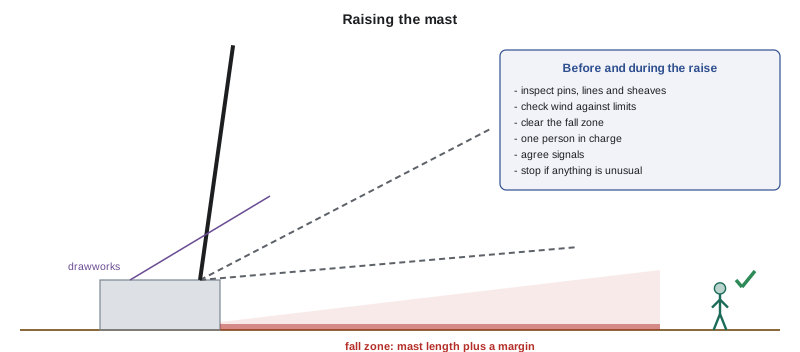
Controls follow the manufacturer's raising procedure and the drilling contractor's own rules. A pre-raise inspection checks the raising lines, sheaves, pins, keepers and hydraulic system; the area in front of the mast is cleared for at least its full length plus a margin; wind is checked against the manufacturer's limits; one person, usually the rig manager, is in charge and communicates with the driller at the drawworks; and everyone not directly involved stays well clear. Workers must never stand on, under or in front of the mast during the raise. Once the mast is vertical, it is pinned, guy lines are installed and tensioned to the correct anchors, and the derrick emergency escape line is installed (Lesson 5).
Guy lines and their anchors hold the mast against wind and loads. Anchors must be installed and tested to the manufacturer's specifications, and the operator must confirm there are no buried lines at anchor locations. Guy lines across walkways or roads must be flagged and, where vehicles pass, protected.
Walking and skidding on pads
On multi-well pads, the rig moves between wells without being torn down. Walking rigs use hydraulic feet to lift and step the whole rig, and skidding systems slide it along rails. Moves between wells take hours rather than days and keep the heaviest loads off public roads. But they bring the rig very close to wells that may be completed, producing or shut in under pressure, and the move itself carries risks of the rig shifting, tilting or striking equipment.
Before walking or skidding, the crew checks the path for obstructions, verifies that the pad can carry the loads, disconnects or reroutes lines that cross the path, confirms the status of every adjacent well and, where required, has those wells secured, shut in or protected with barriers. Simultaneous operations, such as drilling one well while another is being fractured or produced on the same pad, need a SIMOPS plan agreed between the operator, the drilling contractor and the other crews. HSE-333 covers the permit side of SIMOPS.
Rig-up and rig-down culture
Moves create pressure to hurry. The rig is not earning money while it moves, and everyone wants to spud the next well. Many incidents happen late in a move day, when people are tired and shortcuts start to look reasonable. Strong rigs counter this with clear plans, enough people, stop-work authority that is actually used, breaks, and supervisors who resist pressure to cut corners. Each new lease also needs a fresh orientation for everyone, because the layout, muster points and hazards change with every location.
Worked problem
Walking Rig 31 from Well 10 to Well 11
Rig 31 has finished drilling Pinecrest Well 10 and is about to walk 26 ft (8 m) to Well 11. Wells 1 to 8 are producing on the north side of the pad, and Well 9 has just been fractured and is shut in awaiting flowback. A pipeline crew is working at the riser. What should the walk plan cover?
Show solution
- Confirm the status of every well near the path: Wells 9 and 10 secured with barriers, and the producing wells protected or shut in as the SIMOPS plan requires.
- Inspect the path for obstructions, ground condition and matting, and disconnect or reroute hoses, cables and lines that cross it.
- Coordinate with the operator's supervisor, the production operator and the pipeline crew so that nobody is working near the path or under the mast during the walk.
- Hold a pre-job meeting covering the walk procedure, who controls the walking system, spotters at each corner, communication and stop signals.
- After the walk, re-level and re-center the rig, recheck guy lines and the escape line, run a dropped object check and update the site plan and orientation for the new well position.
Answer: The walk plan secures adjacent wells, clears and checks the path, coordinates with other crews, assigns spotters and a single person in control, and finishes with checks of the rig and an updated orientation.
Common mistakes
MistakeAssuming a load will clear an overhead line because it did on the last move.
InsteadMeasure load heights and line clearances for every move and post a spotter.
MistakeReaching between a load and the substructure to line up a pin.
InsteadAdjust the load with the crane or winch and keep hands out of pinch points.
MistakeStanding in front of the mast to watch it go up.
InsteadStay outside the fall zone, which extends beyond the length of the mast.
MistakeWalking a pad rig without checking adjacent wells.
InsteadConfirm the status of every nearby well and follow the SIMOPS plan.
MistakeRushing the last loads at the end of a long move day.
InsteadPlan breaks, keep enough people and stop when fatigue or conditions make work unsafe.
Summary and key terms
- Rig moves combine heavy loads, transport, cranes, overhead lines, mast raising and many contractors under time pressure.
- A move plan covers the route, permits, load order, lifting plans, communication, weather limits and the new lease layout.
- Overhead power lines can kill without contact; survey, coordinate with utilities, measure clearances and use spotters.
- Lifts follow lift plans with inspected rigging, tag lines, one signal person and nobody under or between loads.
- Raising and lowering the mast is the highest-risk step; clear the fall zone, inspect the system, check wind and have one person in charge.
- Walking and skidding on pads avoids road moves but brings the rig close to live wells, requiring SIMOPS planning.
- Fatigue and time pressure drive shortcuts late in move days; plans, breaks and stop-work authority counter them.
- Rig move
- Tearing down a rig, transporting it and rigging it up at a new location.
- Truck push
- The trucking company's supervisor who directs loading and transport during a rig move.
- Winch tractor
- A truck with a heavy winch used to load and move rig components.
- Lift plan
- A written plan for a lift covering the load, equipment, rigging, people and controls.
- Guy line
- A wire rope anchored to the ground that steadies the mast against wind and loads.
- Walking rig
- A rig that moves between wells on a pad using hydraulic feet.
- SIMOPS
- Simultaneous operations by different crews on the same site that could affect each other.
Practice problems
Work each problem on paper first, then reveal the answer to check.
Why are rig moves high-risk?
Show answer
They combine heavy loads, transport, cranes, power lines, mast raising and many contractors under time pressure.
Name four items a move plan should cover.
Show answer
Any four of: route, permits, load order, lift plans, who is in charge, communication, weather limits, lease layout.
Why can a power line kill without contact?
Show answer
Electricity can arc across an air gap to a nearby load or boom.
In the program, which item was too close to a line?
Show answer
The raised crane boom under the distribution line.
What should you do if a pin will not line up during rig-up?
Show answer
Adjust the load with the crane or winch rather than reaching in.
How far should the area in front of a mast be cleared during raising?
Show answer
At least the full length of the mast plus a margin.
What must be confirmed before installing guy line anchors?
Show answer
That there are no buried lines at the anchor locations, and that anchors meet specifications.
What is the main new hazard of walking rigs?
Show answer
Working close to completed, producing or pressurized wells on the same pad.
Why must a new orientation be given at each lease?
Show answer
The layout, muster points and hazards change at every location.
Give two ways to resist time pressure at the end of a move day.
Show answer
Breaks, enough people, clear plans, using stop-work authority, supervisors resisting shortcuts (any two).
Lesson quiz · 5 questions
Score 60% or more to complete this lesson.
Create a free account to save your progress, take quizzes and earn a certificate.