
HSE-331 · Lesson 2 of 12 · 26 min
Crews, roles and new-worker programs
A drilling rig runs around the clock with a small crew on each shift, and every person on that crew has a defined place in a chain of command that has evolved over a century of rig work. Knowing who does what, who can stop the job and who is responsible for your orientation is part of staying safe. This lesson describes the crew structure on drilling and service rigs, the people from other companies who share the lease, the special risks faced by new and short-service workers, and the programs that bring a new hand up to speed.
The drilling crew
Job titles vary a little between companies and between Canada and the United States, but the structure is remarkably consistent. A land drilling rig usually works two 12-hour shifts, called tours (pronounced towers), with a crew of four or five on each tour, plus a rig manager who is on site for the whole hitch.
| Role | Other names | Main duties | Safety responsibilities |
|---|---|---|---|
| Rig manager | Toolpush, toolpusher | Runs the rig for the drilling contractor; manages crews, equipment and the contractor's safety program | Orientation, hazard assessments, inspections, incident reporting, supervising the drillers |
| Driller | Operates the drawworks, top drive and pumps from the driller's cabin; leads the tour | First-line supervisor for the tour; watches for kicks; directs the crew; stops work | |
| Derrickhand | Derrickman | Works on the monkeyboard during trips; looks after the mud system and pumps | Fall protection and emergency escape at height; mud and chemical handling |
| Motorhand | Motorman | Maintains engines, generators and other equipment | Energy isolation for maintenance; hot surfaces; fuel |
| Floorhand | Roughneck, rig hand | Handles pipe, slips and tongs on the floor; general rig work | Line of fire, pinch points, hand safety, communication with the driller |
| Leasehand | Roustabout, lease hand | Entry-level; cleaning, painting, helping on the lease and floor | Often the newest worker; needs close supervision |
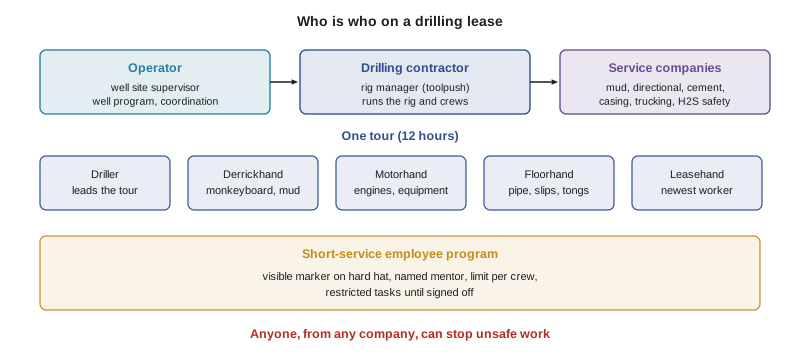
On the operator's side, a well site supervisor, often still called the company man or company representative, represents Larchwood on the lease. The well site supervisor directs the drilling program, makes decisions about the well, coordinates the many service companies that arrive and leave, and, under Canadian and US multi-employer rules, often carries significant responsibility for coordinating safety across the site. On a pad drilling sour wells there may be a day and a night supervisor, and a separate completions supervisor later in the life of the well.
Everyone else on the lease
A typical day on a drilling lease brings many other companies: a mud engineer or drilling fluids specialist, directional drillers and measurement-while-drilling (MWD) hands who steer the horizontal section, a mud logger or geologist who examines cuttings and monitors gas, cementing and casing crews, solids control technicians, trucking companies delivering pipe, fuel, water and chemicals, crane and picker truck operators, rental equipment technicians, vacuum truck operators and, on sour wells, an H2S safety services company providing detection, breathing air and safety watch personnel. Each of these workers belongs to a different employer with its own safety program, and all of them are exposed to the rig's hazards.
Coordinating so many employers is why the multi-employer rules discussed in HSE-330, Lesson 10, matter so much on a rig lease. Lesson 12 of this course returns to contractor management, bridging documents and the operator's role. For now, recognize that the person standing next to you on the floor may work for a different company, may have different training and may not know your rig's signals or rules unless someone has told them.
Communication on the floor
The rig floor is loud, the driller's view is partly blocked by equipment, and the crew often wears hearing protection. Clear communication is therefore a safety system in its own right. Crews use standard hand signals for hoisting and pipe handling, radios with headsets on many rigs, and a strict rule that only one designated person gives signals to the driller during a lift. Before any non-routine job, the driller or rig manager leads a pre-job safety meeting, often called a tailgate or toolbox meeting, that covers the task, the hazards, the controls, who does what and what to do if something changes.
Every crew member has the right and the duty to stop work that is unsafe. On a rig, stop-work authority means that a floorhand can raise a hand and stop the driller, and a service hand from another company can stop a rig crew, without fear of reprisal. Many drilling contractors and operators reinforce this with stop-work cards and by publicly recognizing people who use it. Stopping work early is almost always cheaper than finishing a job that goes wrong.
New workers and short-service employees
New workers are injured far more often than experienced ones, and the oil and gas industry has known this for decades. Rig work has a steep learning curve: a newcomer does not yet know where the line of fire is during a connection, which sounds signal trouble or what the driller is about to do. High turnover during booms and busts means that, at any time, a large share of the workforce may be new to the industry, to the company or to the rig.
Industry has responded with short-service employee (SSE) programs. A short-service employee is usually defined as a worker with less than six months in the same type of job or with the current employer. Typical program elements include: identifying SSEs visibly, often with a colored hard hat or a hard hat sticker; assigning each SSE a designated mentor; limiting the number of SSEs on a crew, often to one SSE per crew of five or a set percentage; restricting the tasks an SSE may do without direct supervision; and formally signing off the SSE when they have shown competence. Operators frequently require their contractors to run SSE programs and to report SSE numbers before a job starts.
In the United States, the International Association of Drilling Contractors (IADC) sets training and accreditation programs for drilling crews, including its RigPass orientation for new rig workers and the WellSharp well control programs discussed in Lesson 3. API Recommended Practice 54 for occupational safety on drilling and servicing operations addresses training and supervision. Basic orientation programs such as SafeLandUSA give many oilfield workers a shared foundation, and OSHA expects employers to train workers on the hazards of their jobs, including new workers, under its training requirements and the general duty clause.
Mentoring is the part of SSE programs that makes the biggest difference. A good mentor explains why, not just what; shows the newcomer where to stand during each operation; watches and corrects; and gradually hands over tasks as competence grows. A poor mentor, or a mentor who is too busy with their own work, gives the newcomer a colored hard hat and little else. Rig managers should choose mentors deliberately and give them time to mentor.
The program below models a simple question that rig managers face: how many short-service employees can a rig take on without exceeding the operator's limit, given current crew experience? It uses an invented crew list for Rig 31.
# Invented crew list for Rig 31 (two tours plus rig manager).
# Months of experience in the same role with this employer.
crew = {
    "Day tour":   [("Driller", 96), ("Derrickhand", 30), ("Motorhand", 14),
                   ("Floorhand", 8), ("Leasehand", 2)],
    "Night tour": [("Driller", 60), ("Derrickhand", 5), ("Motorhand", 22),
                   ("Floorhand", 3), ("Floorhand", 4)],
}
SSE_MONTHS = 6          # short-service threshold
MAX_SSE_PER_TOUR = 1    # operator limit used in this example

for tour, people in crew.items():
    sse = [role for role, months in people if months < SSE_MONTHS]
    status = "OK" if len(sse) <= MAX_SSE_PER_TOUR else "OVER LIMIT"
    print(f"{tour}: {len(people)} crew, SSEs = {sse} -> {status}")
    mentors = [role for role, months in people if months >= 24]
print(f" possible mentors (24+ months): {mentors}")Day tour: 5 crew, SSEs = ['Leasehand'] -> OK possible mentors (24+ months): ['Driller', 'Derrickhand'] Night tour: 5 crew, SSEs = ['Derrickhand', 'Floorhand', 'Floorhand'] -> OVER LIMIT possible mentors (24+ months): ['Driller']
The night tour has three short-service workers, including the derrickhand, which breaks the example limit and puts an inexperienced worker on the monkeyboard. The fix is not simply to swap names on paper. It might mean moving an experienced derrickhand from another rig, delaying a trip until a qualified derrickhand is on tour, or getting a variance approved by the operator with extra supervision. Lesson 5 explains why the derrickhand's job carries particular risk.
Fitness for duty, fatigue and camp life
Rig crews often work 14 days on and 7 or 14 days off, sometimes with long drives to and from remote leases at the start and end of each hitch. Twelve-hour tours, night work and shift changes all bring fatigue, and fatigue reduces attention exactly when attention matters most: during a trip, a connection or a well control drill. Many contractors and operators have fatigue management plans that limit consecutive shifts, require minimum rest periods, control overtime and set rules for driving after a night tour. HSE-330, Lesson 3, covers journey management, and HSE-252 covers defensive driving.
Fitness for duty also includes freedom from impairment by alcohol, cannabis and other drugs. Rig work is safety-sensitive by any definition, and both Canadian and US operators commonly require pre-access and post-incident testing. The law differs between the two countries. In Canada, recreational cannabis is legal, but employers can still prohibit impairment at work and must balance testing programs against human rights law and the duty to accommodate addiction as a disability. In the United States, drug testing rules depend on state law and, for some workers such as commercial drivers, on federal Department of Transportation requirements.
Many remote rigs house crews in a camp on or near the lease. Camps bring their own hazards: food safety, fire in sleeping quarters, carbon monoxide from heaters, wildlife around waste, and the social pressures of living and working with the same people for weeks. Camp rules, fire drills and good housekeeping are part of rig safety.
Worked problem
A new floorhand on night tour
Jordan, 19, joins Rig 31's night tour as a floorhand. He has completed industry orientation and H2S training but has never worked on a rig. On his first night the driller is short a hand and asks Jordan to help on the floor during a trip out of the hole. What should happen before Jordan touches the slips or tongs?
Show solution
- The rig manager should have completed a rig-specific orientation, including the rig layout, muster points, alarms, H2S equipment, stop-work authority and the SSE program.
- Jordan should be identified as an SSE and assigned a named mentor on his tour, ideally the experienced floorhand or the driller.
- Before the trip, the driller should hold a pre-job meeting that explains the trip, where Jordan will stand, what he will do and what signals the driller will use.
- Jordan should start with tasks that keep him out of the line of fire, such as watching and helping with pipe on the catwalk under supervision, rather than working the slips on his first stand.
- The mentor should explain each step, watch Jordan and stop him if he moves into a pinch point or under a load.
Answer: Jordan needs a rig-specific orientation, SSE identification and a mentor, a pre-job meeting and a gradual introduction to tasks before he works at well center. Being short-handed is not a reason to skip these steps.
Common mistakes
MistakeAssuming everyone on the floor knows your rig's signals and rules.
InsteadCheck that workers from other companies have been oriented to the rig before they work near it.
MistakeTreating an SSE program as a hard hat sticker.
InsteadAssign a real mentor with time to teach, and sign off competence task by task.
MistakeLetting several people give signals to the driller.
InsteadAgree on one designated signaler for each lift or pipe-handling operation.
MistakeHesitating to stop the driller because you are new or work for another company.
InsteadUse stop-work authority whenever you see an unsafe act or condition.
MistakeDriving home immediately after a night tour at the end of a long hitch.
InsteadFollow the fatigue and journey management plan, including rest before driving.
Summary and key terms
- A drilling crew includes a rig manager, a driller, a derrickhand, a motorhand, floorhands and often a leasehand, working two 12-hour tours.
- The operator's well site supervisor directs the well and coordinates the many service companies on the lease.
- Clear communication, one designated signaler, pre-job meetings and stop-work authority are safety systems in their own right.
- Short-service employees are injured more often, so SSE programs identify them, limit their number, assign mentors and sign off competence.
- Industry orientation is a foundation, but each rig must give its own orientation and supervision.
- Fatigue from long hitches, night tours and long drives, and impairment from alcohol or drugs, are serious risks on rigs.
- Camps bring hazards of their own, including fire, carbon monoxide, food safety and wildlife.
- Tour
- A shift on a drilling rig, usually 12 hours; pronounced towers.
- Rig manager
- The drilling contractor's senior person on the rig, also called the toolpush.
- Driller
- The person who operates the hoisting, rotating and pumping controls and leads the tour.
- Derrickhand
- The crew member who works on the monkeyboard during trips and looks after the mud system.
- Well site supervisor
- The operator's representative on the lease, often called the company man.
- Short-service employee
- A worker with less than a set period, often six months, in the job or with the employer.
- Stop-work authority
- The right and duty of every worker to stop work they believe is unsafe.
Practice problems
Work each problem on paper first, then reveal the answer to check.
What is a tour on a drilling rig?
Show answer
A shift, usually 12 hours long.
Who leads the crew on each tour?
Show answer
The driller.
Who represents the operator on the lease?
Show answer
The well site supervisor, often called the company man.
Name three companies other than the drilling contractor that may work on a drilling lease.
Show answer
Any three of: mud company, directional drilling, MWD, mud logging, cementing, casing, trucking, crane, rentals, vacuum trucks, H2S safety services.
What is a typical definition of a short-service employee?
Show answer
A worker with less than six months in the same job or with the current employer.
List three elements of an SSE program.
Show answer
Visible identification, a named mentor, a limit on SSEs per crew, restricted tasks and formal sign-off (any three).
Why should only one person give signals to the driller during a lift?
Show answer
To prevent conflicting signals that could move a load unexpectedly.
Why are night tours at the end of a hitch a driving hazard?
Show answer
Workers are fatigued, and long drives home follow.
What should happen before a new floorhand works at well center?
Show answer
A rig-specific orientation, SSE identification and mentor, a pre-job meeting and gradual introduction to tasks.
In the Rig 31 program, which tour broke the SSE limit and why did it matter?
Show answer
The night tour, with three SSEs including the derrickhand on the monkeyboard.
Lesson quiz · 5 questions
Score 60% or more to complete this lesson.
Create a free account to save your progress, take quizzes and earn a certificate.