
HSE-331 · Lesson 3 of 12 · 26 min
Law, standards and certification for drilling and servicing
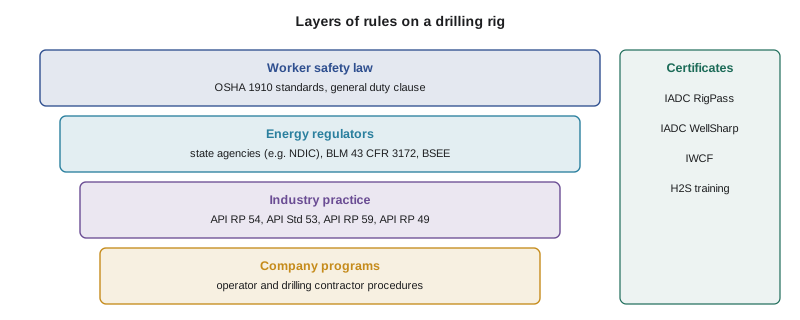
HSE-330, Lesson 2, mapped the two kinds of regulator that touch every oil and gas site: the worker safety regulator, which protects employees, and the energy regulator, which oversees wells, facilities and pipelines and protects the public and the environment. On a drilling or service rig both are very visible. The worker safety rules govern fall protection on the mast, guarding on the drawworks and the training of the crew. The energy regulator's rules govern how the well is designed, how blowout preventers are tested and who must hold well control certificates. Industry standards and recommended practices fill in much of the detail. This lesson maps those layers for rigs, then looks at the certifications a rig worker can expect to need.
Laws, directives and standards change. The dates and editions below were checked in October 2026, but before relying on a specific requirement always check the current version from the regulator or standards body. This course names documents so that you know where to look; it does not reproduce their clauses.
Worker safety law on the rig
In the United States, OSHA's general industry standards (29 CFR 1910) apply to drilling and servicing rigs, together with the general duty clause of the OSH Act, which requires employers to protect workers from recognized serious hazards. OSHA has no standard written specifically for oil and gas well drilling; a proposed drilling standard from the 1980s was never finalized. Some general industry standards expressly exclude oil and gas well drilling and servicing from their scope, including the lockout/tagout standard (1910.147) and the process safety management standard (1910.119). Others apply in full, such as walking-working surfaces and fall protection, hazard communication, respiratory protection, noise and the respirable crystalline silica standard (1910.1053). OSHA enforces through inspections and citations, often using the general duty clause together with industry recommended practices such as API RP 54 as evidence of recognized hazards and feasible controls. States with their own approved OSHA plans, such as New Mexico and Wyoming, enforce equivalent rules. North Dakota is a federal OSHA state.
Energy regulators and well requirements
In the United States, wells on private and state land are regulated by state oil and gas agencies. In North Dakota the Industrial Commission's Oil and Gas Division issues permits and sets drilling, casing, cementing, blowout prevention and plugging requirements; in Texas the Railroad Commission plays the same role, including Statewide Rule 36 for hydrogen sulfide operations. On federal and tribal onshore leases, the Bureau of Land Management sets drilling requirements in its regulations at 43 CFR 3172, which replaced the former Onshore Order 2, including blowout preventer and testing requirements. Offshore, the Bureau of Safety and Environmental Enforcement regulates drilling under 30 CFR 250, including the well control rule first issued in 2016 and later revised, and requires a safety and environmental management system (SEMS) based on API RP 75.
Energy regulators focus on the well and the public, but their rules protect rig workers too. A properly designed casing program, a correctly rated and tested BOP stack and a trained crew that practices kick drills are exactly what keep a kick from becoming a blowout that kills the people on the floor. Conversely, worker safety regulators increasingly look at process safety and well control when they investigate rig incidents.
Industry standards and recommended practices
The American Petroleum Institute (API) publishes the standards and recommended practices most widely used on US rigs. API RP 54 covers occupational safety and health for oil and gas well drilling and servicing operations. API Standard 53 sets requirements for well control equipment systems, including blowout preventers, accumulators and testing. API RP 59 covers well control operations, API RP 49 covers drilling and well servicing operations involving hydrogen sulfide, and API RP 75 covers safety and environmental management for offshore operations. The International Association of Drilling Contractors (IADC) publishes its own guidelines, including the HSE case guidelines for drilling contractors and a large library of safety alerts that share lessons from incidents.
Recommended practices are not law in themselves, but they carry weight in three ways. Regulators may require them by reference. Contracts between operators and contractors often require them. And when an incident is investigated, inspectors and courts look at recognized industry practice to decide whether a hazard was known and whether a feasible control existed. A rig that ignores a widely used recommended practice will find it hard to show it took every reasonable precaution.
Certifications on a rig
Rig workers collect certificates. Some are required by law or regulation, some by the operator's contract and some by the drilling contractor's own program. The common ones fall into four groups.
| Group | Typical certificates (US) | Who needs them |
|---|---|---|
| Orientation | IADC RigPass or SafeLandUSA basic orientation; rig-specific orientation | Everyone entering the lease |
| Hazard-specific | H2S training to ANSI Z390.1 or company equivalent, first aid and CPR, hazard communication, fall protection, confined space, fire extinguisher | Most rig and service workers; depends on tasks |
| Well control | IADC WellSharp or IWCF well control at the level for the role (introductory, driller, supervisor), WellSharp well servicing | Drillers, rig managers, well site supervisors and service rig supervisors as required by operators and, offshore, by BSEE |
| Equipment | Crane operator certification, rigger and signal person qualification, forklift and telehandler, wireline and coiled tubing operator qualifications | Workers who operate that equipment |
Certificates expire, usually after one to three years depending on the course, and a lapsed well control or H2S certificate can stop a worker from going to the floor. Rig managers track certificates for their crews, and many operators audit contractor training records before a rig starts work. A certificate shows that a person completed training at one point in time; it does not guarantee competence today. That is why rigs combine certificates with mentoring, drills and supervisors who watch how people actually work.
The program below checks invented certificate records for part of the Rig 31 crew against an invented spud date and lists anything that has expired or will expire during the planned 40-day program on the pad.
from datetime import date, timedelta

spud = date(2027, 2, 1)                 # invented start of drilling
end = spud + timedelta(days=40)         # planned program length
records = [
    ("Driller A",      "Well control (driller level)", date(2027, 6, 30)),
    ("Driller B",      "Well control (driller level)", date(2027, 2, 20)),
    ("Rig manager",    "Well control (supervisor)",    date(2028, 1, 15)),
    ("Derrickhand A",  "H2S",                          date(2027, 1, 10)),
    ("Floorhand C",    "First aid and CPR",            date(2027, 3, 5)),
    ("Motorhand B",    "H2S",                          date(2027, 9, 1)),
]
for who, cert, expiry in records:
    if expiry < spud:
        status = "EXPIRED before spud"
    elif expiry <= end:
        status = f"expires day {(expiry - spud).days} of program"
    else:
        status = "valid for program"
print(f"{who:14} {cert:30} {expiry} {status}")Driller A Well control (driller level) 2027-06-30 valid for program Driller B Well control (driller level) 2027-02-20 expires day 19 of program Rig manager Well control (supervisor) 2028-01-15 valid for program Derrickhand A H2S 2027-01-10 EXPIRED before spud Floorhand C First aid and CPR 2027-03-05 expires day 32 of program Motorhand B H2S 2027-09-01 valid for program
Three records need action before or during the program. Derrickhand A cannot work on the lease until the H2S certificate is renewed, and the renewals for Driller B and Floorhand C should be booked now so that neither has to leave the rig partway through. Simple checks like this are easy to automate and save rigs from discovering a lapsed certificate during an operator audit or, worse, after an incident.
Who holds which duty
Law places duties on several parties at once, and on a rig they overlap. The drilling contractor, as employer, must protect its workers, train them, supervise them and maintain its equipment. The operator, as licensee and usually the party in control of the site, has duties for the well design, the overall site, coordination of employers and, in many jurisdictions, as prime contractor or as a controlling employer. Service companies have the same employer duties to their own workers. Supervisors have personal duties to ensure that workers under them follow safe practices. And every worker has a duty to follow the rules, use the protective equipment provided, report hazards and refuse or stop unsafe work. Lesson 12 returns to how these duties are written down in bridging documents.
Worked problem
Which rule applies?
During a trip on Rig 31, the derrickhand's fall arrest lanyard is found frayed, a blowout preventer pressure test is due, and a new floorhand's H2S certificate is found to have lapsed. Which kind of rule or standard is most relevant to each issue?
Show solution
- Frayed lanyard: OSHA walking-working surfaces and fall protection requirements, supported by API RP 54; the equipment must be removed from service.
- BOP pressure test: the state oil and gas agency's requirements or, on federal and tribal leases, BLM's 43 CFR 3172, together with API Standard 53 and the operator's program.
- Lapsed H2S certificate: the operator's and contractor's training requirements and the general OHS duty to train workers for the hazards they face; the floorhand cannot work in areas where H2S may be present until retrained.
Answer: Fall protection is mainly a worker safety law issue, BOP testing is mainly an energy regulator and industry standard issue, and the lapsed certificate is a training issue under both law and contract. On a real rig all three layers overlap.
Inspections, incidents and reporting
Both kinds of regulator inspect rigs. A worker safety officer may arrive unannounced, walk the lease, check fall protection on the mast, guarding, housekeeping and training records, interview workers and issue orders or citations. An energy regulator inspector is more likely to check the BOP stack and accumulator, test records, kick drill logs, the flare system, the sour gas emergency plan and the casing and cementing program. Inspectors from both often look at the same documents, such as the hazard assessment and the orientation records, for different reasons. Crews should treat an inspection as a free second set of eyes rather than an interruption.
Serious incidents must be reported quickly. Under OSHA's recordkeeping rules, an employer must report a work-related fatality within 8 hours and an in-patient hospitalization, amputation or loss of an eye within 24 hours. State oil and gas agencies, BLM and BSEE have their own requirements for reporting blowouts, fires, spills and other well incidents, and some states require immediate notice of hydrogen sulfide releases. The rig's emergency response plan should list who calls which agency and when, and the scene should be preserved, except to protect people or prevent further harm, until investigators allow work to resume.
Industry sharing adds a further layer. Safety alerts from IADC, Energy Safety Canada and individual companies describe what went wrong in incidents and near misses so that other crews can learn without repeating them. Many of the hazards in the following lessons, such as mismatched hammer unions and dropped objects from the mast, are known largely because crews reported near misses and companies shared the lessons. Reading the latest alerts at the pre-tour meeting is a simple, cheap habit that keeps those lessons alive.
Common mistakes
MistakeAssuming that because a recommended practice is not law it can be ignored.
InsteadTreat widely used recommended practices as the expected standard of care; regulators, contracts and courts rely on them.
MistakeThinking state oil and gas agencies only care about production and royalties.
InsteadRecognize that well design, BOP and well control rules protect rig workers directly.
MistakeTreating a valid certificate as proof of competence.
InsteadCombine certificates with mentoring, drills and observation of how people actually work.
MistakeLetting certificates lapse and discovering it during an audit.
InsteadTrack expiry dates for the whole crew against the planned program and renew early.
MistakeQuoting a clause number from memory.
InsteadCheck the current edition of the law, directive or standard before relying on a requirement.
Summary and key terms
- OSHA general industry standards and the general duty clause apply on US rigs; there is no drilling-specific OSHA standard.
- State agencies, BLM's 43 CFR 3172 on federal and tribal land, and BSEE offshore set well requirements.
- API RP 54, API Standard 53, API RP 59 and API RP 49 set detailed good practice.
- Recommended practices gain force through regulatory reference, contracts and the standard of care used in investigations.
- Rig workers need orientation, hazard-specific, well control and equipment certificates appropriate to their roles.
- Certificates expire and must be tracked, but they do not replace mentoring and supervision.
- Contractors, operators, supervisors and workers all hold overlapping legal duties on a rig.
- General duty clause
- The part of the US OSH Act requiring employers to protect workers from recognized serious hazards.
- Directive
- A document issued by the Alberta Energy Regulator that sets requirements for licensees.
- Industry recommended practice
- A document setting out detailed good practice for an operation, such as Energy Safety Canada IRPs or API RPs.
- Critical sour well
- A well whose hydrogen sulfide release potential is high enough to trigger extra regulatory requirements.
- Well control certificate
- A qualification showing that a worker has completed well control training for their role.
- Standard of care
- The level of precaution a reasonable employer would take, judged partly by industry practice.
Practice problems
Work each problem on paper first, then reveal the answer to check.
Name the two kinds of regulator that apply to a drilling rig.
Show answer
The worker safety regulator and the energy regulator.
Which BLM regulation sets drilling requirements on federal and tribal onshore leases?
Show answer
43 CFR 3172, which replaced Onshore Order 2.
Which API document covers occupational safety for drilling and servicing operations?
Show answer
API RP 54.
Give two ways a recommended practice can gain legal force.
Show answer
Reference in regulations, contract requirements, or use as evidence of the standard of care (any two).
Name the four groups of certificates common on rigs.
Show answer
Orientation, hazard-specific, well control and equipment certificates.
Why is a certificate not proof of competence?
Show answer
It shows training was completed at one time, not that the person can do the job safely today.
In the certificate program, why must Derrickhand A stay off the lease?
Show answer
The H2S certificate expired before the spud date.
Who has duties for the overall site and coordination of employers on a typical lease?
Show answer
The operator, as licensee and party in control of the site.
What duty does every worker hold?
Show answer
To follow the rules, use protective equipment, report hazards and refuse or stop unsafe work.
Why should you check the current edition of a directive or standard?
Show answer
Requirements and clause numbers change between editions.
Lesson quiz · 5 questions
Score 60% or more to complete this lesson.
Create a free account to save your progress, take quizzes and earn a certificate.