
HSE-331 · Lesson 4 of 12 · 26 min
Rig floor hazards: pipe handling, tongs and pinch points
The rig floor is where most drilling injuries happen. It is a small, wet, noisy platform where a heavy rotating machine hangs overhead, pipe weighing hundreds of kilograms per joint swings in and out of the well, and workers handle slips and tongs within arm's reach of moving steel. HSE-330 showed that contact injuries, being struck by, caught in or crushed by objects and equipment, were the second largest cause of oil and gas extraction deaths in US data from 2014 to 2019, after vehicle incidents. On rigs, those contact injuries cluster around pipe handling. This lesson explains how pipe moves on the floor, where the line of fire and pinch points are, and the engineering, procedural and personal controls that keep hands and bodies out of them.
How pipe moves
A drill string is built from joints of drill pipe, typically 31 ft (about 9.5 m) long, screwed together with tool joints. During drilling, the crew adds a joint or a stand (usually three joints already made up) at each connection. During a trip, the crew pulls the whole string out of the hole, stand by stand, to change the bit or run casing, and then runs it back in. A trip on a deep horizontal well can involve more than 200 stands each way, and every stand involves the same sequence: set the slips, break the connection, spin out, lift the stand clear, rack it back, latch the elevators onto the next stand and pull the slips. Repetition breeds speed, and speed breeds shortcuts, which is why trips are a high-risk time even for experienced crews.
Pipe also moves between the pipe racks and the floor. Joints are rolled onto the catwalk, pushed or pulled up the V-door ramp or lifted by a pipe-handling machine, and picked up by the elevators. Casing runs bring larger, heavier pipe and often a separate casing crew with its own power tongs. Each transfer is a chance for pipe to roll, swing, slide or drop.
Line of fire and pinch points
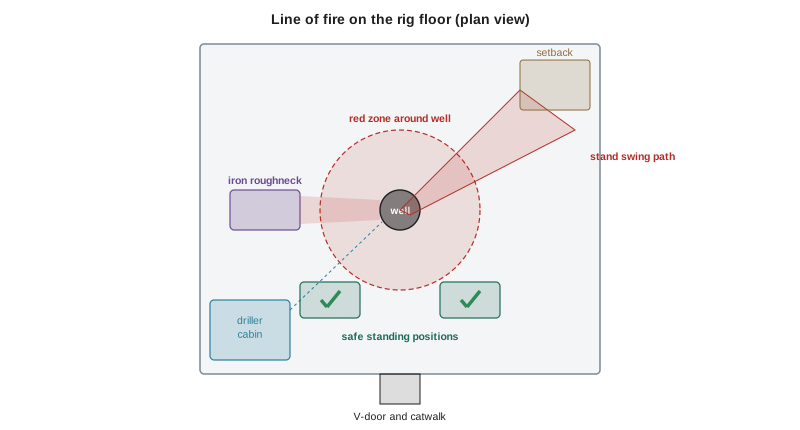
Line of fire means any position where a moving or released object could strike you. On the floor, the line of fire includes the swing path of a stand as it is racked back, the area under the traveling block and top drive, the path of the iron roughneck or pipe-handling arm, the space behind a manual tong if its snub line or backup line fails, and the area around the slips when the driller picks up or slacks off. Pinch points are places where two objects come together and can catch a hand, finger or body: between a tong and the pipe, between the slips and the rotary table, between the elevators and the tool joint, between a stand and the derrick fingers, and between pipe on the catwalk.
The driller cannot see everything from the cabin, and the floor crew cannot always see what the driller is about to do. Good crews therefore agree on clear rules: hands off the pipe before the driller moves it; no one in the swing path when a stand is moving; use of tag lines or push-pull tools rather than hands to guide pipe; and a clear signal before any movement. Many rigs paint red zones on the floor to show where workers must not stand when equipment is moving, and some use light curtains or zone management systems that stop machines when a person enters a red zone.
Tongs and torque
Making up a connection to the right torque is essential for the integrity of the drill string, but the forces involved are large. Manual tongs are long wrenches with jaws that close around the pipe. The lead tong turns the connection while the backup tong holds the lower joint. The tongs are pulled by a cathead line, a hydraulic cylinder or a winch, and their reaction is held by a snub line anchored to the derrick. If a tong jaw slips, a die breaks or a snub line fails, the tong can swing violently and strike anyone in its path. Spinning chains, once common for spinning connections in and out, have caused many hand and finger amputations and are now rare on modern rigs, replaced by pipe spinners and iron roughnecks.
An iron roughneck combines a spinner and a torque wrench in one machine that moves to well center, grips the pipe, spins and torques the connection and moves away. It removes the need for workers to handle tongs during routine connections, which has greatly reduced floor injuries. But the machine moves on its own path and grips with great force, so the crew must stay clear while it operates, and maintenance on it requires proper energy isolation. Hydraulic power tongs used by casing crews bring similar hazards, often operated close to workers on the floor.
Slips, elevators and dropped pipe
Slips hold the entire weight of the string when it is hanging in the rotary table. Manual slips are lifted and set by two or three hands using handles; power slips are set pneumatically or hydraulically. Hazards include back injuries from lifting slips, hands caught between slips and pipe, and slips that fail to hold if the inserts are worn or the wrong size, allowing pipe to drop into the hole. Elevators latch around the pipe below the tool joint and carry it up and down; an elevator that is not fully latched can release a stand at height. Crews check that elevators are latched and that the latch is locked before giving the signal to lift.
A dropped string is a serious well control and financial event; a dropped single joint or stand on the floor is a serious personal safety event. Drill pipe of the size used on Montney and Bakken wells weighs roughly 30 kg/m (20 lb/ft), so a single 9.5 m joint weighs 620 lb (about 280 kg) and a three-joint stand 1,900 lb (about 850 kg) before counting tool joints. The program below works through the hoisting arithmetic: how much the whole string weighs in mud, and how much tension the fast line on the drawworks carries.
# Invented example: string weight in mud and fast line tension on Rig 31.
steel_density = 7850.0      # kg/m3
mud_density = 1200.0        # kg/m3 (about 10 lb/gal)
pipe_mass_per_m = 30.0      # kg/m including tool joints (illustrative)
measured_depth = 6000.0     # m
g = 9.81

buoyancy = 1 - mud_density / steel_density
air_weight_kN = pipe_mass_per_m * measured_depth * g / 1000
mud_weight_kN = air_weight_kN * buoyancy
print(f"Buoyancy factor: {buoyancy:.3f}")
print(f"String weight in air: {air_weight_kN:,.0f} kN ({air_weight_kN * 224.8:,.0f} lbf)")
print(f"String weight in mud: {mud_weight_kN:,.0f} kN ({mud_weight_kN * 224.8:,.0f} lbf)")

# Block and tackle: n lines strung, sheave efficiency e per sheave.
blocks_kN = 150.0           # blocks, top drive, elevators (illustrative)
hook_load = mud_weight_kN + blocks_kN
for n in (8, 10, 12):
    e = 0.96
    efficiency = (1 - e ** n) / (n * (1 - e))
    fast_line = hook_load / (n * efficiency)
print(f"{n:2d} lines: efficiency {efficiency:.3f}, fast line about {fast_line:,.0f} kN")Buoyancy factor: 0.847 String weight in air: 1,766 kN (396,952 lbf) String weight in mud: 1,496 kN (336,271 lbf) 8 lines: efficiency 0.871, fast line about 236 kN 10 lines: efficiency 0.838, fast line about 196 kN 12 lines: efficiency 0.807, fast line about 170 kN
Two lessons come out of the arithmetic. First, the hook load on a deep horizontal well is large, more than 1,500 kN in this example, which is why the hoisting system's brakes, line and mast inspections matter so much. In a horizontal well much of the string lies along the low side of the hole, so the actual hook load also depends on friction, but the vertical part alone is heavy. Second, stringing more lines reduces the fast line tension, but sheave friction means the reduction is less than the simple ratio; the fast line still carries well over 100 kN, enough to whip with lethal force if it parts.
Housekeeping and slips, trips and falls
The floor is often coated in drilling fluid, water, pipe dope and grease, and in winter it can freeze. Mud spills when a wet stand is pulled (a wet trip), when a connection is broken with fluid in the pipe, or when the mud bucket around a connection is not used. Slips and falls on the floor and on stairs are a constant cause of injuries. Controls include mud buckets and pipe wipers, floor drains and grating, regular washing down, anti-slip coatings, good lighting, heated floors in winter and boots with appropriate soles. Keeping tools, chains and hoses off walkways and storing slips and tongs in their proper places reduces trips. HSE-106 covers slips, trips and housekeeping in general.
Hands, gloves and personal protection
Hand and finger injuries are the most common injuries on many rigs, and most of them happen at pinch points. Personal protective equipment is the last line of defense, but it matters: impact-resistant gloves with padding on the back of the hand reduce crush and laceration injuries, and many operators require them on the floor. Safety glasses, hard hats, steel-toed boots, flame-resistant clothing where required and hearing protection complete the floor kit. Gloves must not be so bulky that they catch in moving parts or reduce grip on tools. The best protection for hands, however, is keeping them out of pinch points in the first place: using push-pull tools and tag lines, keeping hands on the handles of slips and tongs, and following the hands-off rule before pipe moves.
Engineering out the hazard
The hierarchy of controls (HSE-103) puts elimination and engineering controls ahead of procedures and PPE. On the rig floor, the biggest improvements in the past two decades have come from engineering: top drives that reduce the number of connections, iron roughnecks and pipe-handling machines that keep hands away from well center, power slips, automated catwalks and pipe racking systems, and zone management systems that stop machines when someone steps into a red zone. Some newer rigs can trip pipe with almost no hands at well center. Where automation is present, crews must still learn the machine's movement paths, never defeat its interlocks and follow lockout procedures before maintenance. Where older equipment remains, rigorous procedures, supervision and mentoring of new hands become even more important.
Worked problem
A stand swings during a trip out
During a trip out of hole on Rig 31's night tour, the derrickhand unlatches a stand at the monkeyboard and the floorhand guides the bottom of the stand toward the setback area. A gust of wind catches the stand and it swings back toward well center, missing the floorhand's head by a few centimeters. What went wrong and what should change?
Show solution
- The floorhand was in the swing path of the stand, guiding it by hand rather than with a push-pull tool or tag line from outside the swing path.
- Wind speed was not considered; many rigs set wind limits for tripping, especially for the derrickhand.
- The crew should stop, report the near miss and review the trip procedure at a short meeting before continuing.
- Controls could include a tag line or push-pull tool for guiding stands, red zone markings for the swing path, a wind speed limit with an anemometer reading in the doghouse, and a clear signal between the derrickhand and floorhand before the stand is released.
- The near miss should be reported and shared so that other crews learn from it.
Answer: The floorhand stood in the line of fire and guided pipe by hand in wind. Tools that keep hands out of the swing path, red zones, wind limits and clear signals would prevent a repeat.
Common mistakes
MistakeGuiding pipe with your hands from inside its swing path.
InsteadUse push-pull tools or tag lines and stand outside the swing path.
MistakeKeeping hands on the pipe or tongs while the driller moves the string.
InsteadFollow the hands-off rule and wait for a clear signal before equipment moves.
MistakeUsing worn slip inserts or tong dies to finish the trip.
InsteadReplace worn inserts and dies; they can let pipe drop or tongs slip violently.
MistakeStanding near the iron roughneck while it moves to well center.
InsteadLearn its movement path and stay out of it; lock it out before maintenance.
MistakeLeaving mud and dope on the floor until the end of the trip.
InsteadUse mud buckets and wipers and wash down regularly to prevent slips.
Summary and key terms
- Contact injuries from pipe, tongs and machines are a leading cause of serious rig floor injuries.
- Trips repeat the same steps hundreds of times, so speed and shortcuts make them a high-risk time.
- The line of fire includes the swing path of stands, the area under the blocks, tong paths and machine paths.
- Pinch points between tongs, slips, elevators and pipe cause most hand injuries.
- Hook loads on deep wells exceed 1,500 kN and the fast line carries over 100 kN, so hoisting equipment must be inspected and respected.
- Housekeeping and mud control prevent slips and falls on the floor.
- Top drives, iron roughnecks, pipe-handling machines and zone management systems engineer hands away from well center.
- Stand
- Two or three joints of pipe made up together and racked in the derrick during a trip.
- Trip
- Pulling the drill string out of the hole and running it back in.
- Line of fire
- Any position where a moving or released object could strike a person.
- Pinch point
- A place where two objects come together and can catch part of the body.
- Snub line
- A line that holds the reaction of a manual tong as torque is applied.
- Elevators
- A hinged clamp hung from the traveling block that latches around pipe to lift it.
- Buoyancy factor
- The fraction of a string's air weight that remains when it hangs in drilling fluid.
Practice problems
Work each problem on paper first, then reveal the answer to check.
What is a stand?
Show answer
Two or three joints of pipe made up together and racked in the derrick during a trip.
Why are trips a high-risk time?
Show answer
The same steps are repeated hundreds of times, encouraging speed and shortcuts.
Name three line-of-fire zones on the rig floor.
Show answer
Any three of: stand swing path, under the blocks, behind tongs, iron roughnecks or pipe-handling paths, around the slips.
What can happen if a snub line fails?
Show answer
The tong can swing violently and strike anyone in its path.
What should be checked before signaling the driller to lift with the elevators?
Show answer
That the elevators are fully latched and the latch is locked.
Using the program, what is the buoyancy factor for 1,200 kg/m³ mud?
Show answer
About 0.847.
Why does stringing more lines not reduce fast line tension in direct proportion?
Show answer
Friction at each sheave reduces efficiency.
Give two controls for slips on the rig floor.
Show answer
Mud buckets and wipers, washing down, anti-slip coatings, heated floors, good lighting, proper boots (any two).
Why must gloves on the floor not be too bulky?
Show answer
They can catch in moving parts or reduce grip on tools.
Name two engineering controls that keep hands away from well center.
Show answer
Top drives, iron roughnecks, pipe-handling machines, power slips, zone management systems (any two).
Lesson quiz · 5 questions
Score 60% or more to complete this lesson.
Create a free account to save your progress, take quizzes and earn a certificate.