
HSE-331 · Lesson 11 of 12 · 26 min
Completions and hydraulic fracturing hazards
After the drilling rig leaves, the well must be completed before it can produce. On a modern horizontal well this means cleaning out the wellbore, perforating the casing in stages along the horizontal section, hydraulically fracturing each stage, drilling out the plugs between stages, flowing back the frac fluid and finally running production tubing. For a few weeks the pad becomes one of the busiest and most energetic industrial sites anywhere: a fleet of high-pressure pumps, blenders, sand storage, chemical units, water transfer lines, a data van, wireline and coiled tubing units, cranes and dozens of trucks a day. This lesson covers the hazards of completions and fracturing for everyone who works on or visits a frac pad.
The frac spread
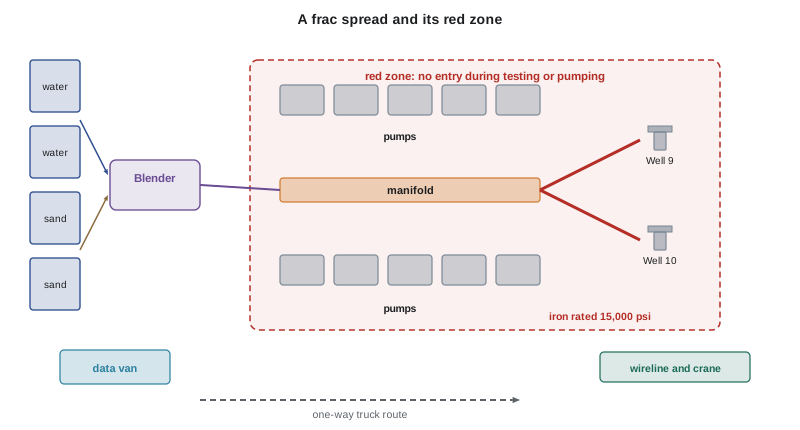
A hydraulic fracturing spread, or frac fleet, typically includes 12 to 20 or more high-pressure pump units, each driven by a diesel engine, a dual-fuel engine, a gas turbine or an electric motor powered by on-site generators. Water is drawn from tanks or a storage pond, mixed with sand (proppant) and chemicals in a blender, and fed to the pumps at low pressure. The pumps raise it to treating pressure and send it through a manifold, often called a missile, and treating iron to the frac tree on the wellhead. Treating pressures on Montney and Bakken wells commonly reach 8,000 to 12,000 psi (55,000 to 85,000 kPa) and can approach the 15,000 psi (103,000 kPa) rating of the iron. Pump rates of 13 to 16 m³/min (80 to 100 bbl/min) are common.
On multi-well pads, operators often use zipper fracturing: while one well is being fractured, the wireline crew perforates the next stage on a neighboring well, and the crews alternate between wells. Simultaneous fracturing of two wells at once is also used. These methods are efficient but mean more live wells, more pressure and more activity on the pad at the same time.
Red zones and high-pressure exclusion
The defining hazard of fracturing is the energy stored in the high-pressure system. Lesson 6 explained iron, hammer unions, restraints and pressure testing; on a frac spread those principles operate at the highest pressures and flow rates on any well site. Every frac operation defines a red zone, also called a high-pressure exclusion zone, around the manifold, treating iron and wellhead. During pressure testing and pumping, nobody enters the red zone without the authorization defined in the job procedure, and any work inside it, such as greasing valves between stages, is done only when the relevant section is isolated and bled down or under a specific procedure designed for that task. Many fleets now use remote-operated valves, automated greasing and remote pressure monitoring to keep people out of the red zone altogether.
Why do red zones need to be so large? The program below compares the energy stored in a section of treating iron filled with water at treating pressure with the same section filled with nitrogen, as in an energized or foam frac. It is a teaching approximation; real exclusion distances come from the service company's procedures and engineering analysis, not from this calculation.
import math

# Teaching approximation of stored energy in a treating line section.
P = 83e6                # Pa, about 12,000 psi treating pressure (illustrative)
length = 30.0           # m of iron
inner_d = 0.076         # m, about 3 in internal diameter
V = math.pi * (inner_d / 2) ** 2 * length     # m3

K_water = 2.2e9         # Pa, bulk modulus of water
E_liquid = P ** 2 * V / (2 * K_water)          # elastic energy of compressed liquid

# Isothermal expansion of an ideal gas from P to atmospheric pressure.
P_atm = 101_325
E_gas = P * V * math.log(P / P_atm)

print(f"Line volume: {V * 1000:.0f} L")
print(f"Water at {P / 1e6:.0f} MPa: about {E_liquid / 1000:,.0f} kJ")
print(f"Nitrogen at {P / 1e6:.0f} MPa: about {E_gas / 1000:,.0f} kJ")
print(f"Gas stores roughly {E_gas / E_liquid:,.0f} times more energy")Line volume: 136 L Water at 83 MPa: about 213 kJ Nitrogen at 83 MPa: about 75,775 kJ Gas stores roughly 356 times more energy
Even the water-filled line stores enough energy to whip a failed section violently, and a gas-energized line stores hundreds of times more. That is why failures of treating iron and frac trees, washouts of eroded iron and separations of connections have killed workers who were standing nearby, and why red zones and remote operation are the main defense. Pumping proppant also erodes iron quickly, especially at bends and swivels, so iron must be inspected and tracked as Lesson 6 described.
Pressure testing, screenouts and pressure spikes
Before each job, the treating iron and wellhead are pressure tested above the maximum expected treating pressure with everyone out of the red zone. During pumping, pressure can spike suddenly if the formation stops taking fluid and sand packs off in the wellbore, called a screenout, or if a valve closes against flow. Overpressure protection, such as pressure relief valves and automatic pump kick-outs set below the rating of the weakest component, limits these spikes. Kick-out settings must never be raised above the iron's rating to finish a stage.
Silica and proppant dust
Hydraulic fracturing uses very large quantities of sand, often thousands of metric tons per well. Moving it from trucks to storage, from storage to conveyors and from conveyors to the blender releases respirable crystalline silica dust. A NIOSH field study, reported in a 2012 hazard alert issued with OSHA, found that silica exposures at many fracturing sites exceeded occupational limits, sometimes by large factors, with the highest exposures around sand movers, transfer belts and blender hoppers. Long-term exposure to respirable crystalline silica causes silicosis, lung cancer, chronic obstructive pulmonary disease and kidney disease (HSE-242).
In the United States, OSHA's respirable crystalline silica standard for general industry and maritime (29 CFR 1910.1053) sets a permissible exposure limit of 50 µg/m³ as an 8-hour time-weighted average, with an action level of 25 µg/m³. The standard requires exposure assessment, engineering and work practice controls, respiratory protection where needed, medical surveillance and a written exposure control plan. It gave hydraulic fracturing operations extra time to implement engineering controls, with that deadline passing on 23 June 2021, so engineering controls are now required.
Engineering controls developed since the NIOSH study include enclosed containerized sand systems that replace pneumatic sand trucks and open sand movers, dust collectors on sand movers and transfer points, enclosed conveyors and blender hoppers, and reduced drop heights. Work practices include keeping workers out of the dust plume, controlling truck traffic and wetting roads. Respirators remain necessary where engineering controls do not bring exposures below limits. The program below estimates a worker's 8-hour TWA from invented sampling results on a sand system and chooses the minimum respirator class by assigned protection factor.
# Invented silica sampling for a sand coordinator on a 12-hour shift (ug/m3).
samples = [(3.0, 60), (4.0, 140), (1.0, 10), (4.0, 90)]   # (hours, concentration)
pel = 50.0                       # ug/m3, OSHA 8-hour PEL
action_level = 25.0
dose_8h = sum(h * c for h, c in samples) / 8
shift_avg = sum(h * c for h, c in samples) / sum(h for h, _ in samples)
print(f"Shift average {shift_avg:.0f} ug/m3, dose as 8-hour TWA {dose_8h:.0f} ug/m3")
ratio = dose_8h / pel
print(f"Exposure is {ratio:.1f} times the PEL (action level {action_level:.0f})")
# Assigned protection factors from OSHA 1910.134 Table 1 (typical values).
apf = [("Half-face particulate respirator", 10),
       ("Full-face particulate respirator", 50),
       ("Loose-fitting PAPR", 25)]
for name, factor in apf:
    ok = "adequate" if factor >= ratio else "not enough"
print(f" {name:34} APF {factor:3d}: {ok}")Shift average 92 ug/m3, dose as 8-hour TWA 139 ug/m3 Exposure is 2.8 times the PEL (action level 25) Half-face particulate respirator APF 10: adequate Full-face particulate respirator APF 50: adequate Loose-fitting PAPR APF 25: adequate
The shift average and the 8-hour dose differ because of the 12-hour shift, as Lesson 7 explained. Respirators can bring this worker's exposure under the limit, but the better answer is to find out why exposures were highest during the four-hour middle period, perhaps a sand transfer or a leaking dust collector, and fix it at the source. Respirators also need fit testing, training and maintenance to deliver their assigned protection.
Chemicals, fuel and fire
Frac fluids contain small percentages of chemicals by volume, but the total quantities on site are large: friction reducers, biocides, scale inhibitors, surfactants, gelling agents, crosslinkers, breakers and acids such as hydrochloric acid used to clean perforations. Many are hazardous in concentrated form, and acid handling needs full eye, face and skin protection and emergency showers. Chemical disclosure rules and registries, such as FracFocus in the United States and provincial disclosure requirements in Alberta and British Columbia, make the composition of frac fluids available after a job, but on site the safety data sheets are the working reference (HSE-102).
A frac spread burns large amounts of fuel, and refueling the pumps during the job, often while they are running, is a significant fire hazard. Hot exhausts, high-pressure fluid that may contain hydrocarbons, and flammable flowback fluids add to the risk. Controls include engineered hot refueling systems, spill containment, fire extinguishers and suppression systems on pumps, bonding and grounding, and keeping ignition sources out of areas where flammable vapors may accumulate. Fleets powered by natural gas add gas supply lines and pressure regulators to the pad.
Flowback and well testing
After fracturing, plugs are drilled out, usually with coiled tubing, and the well is flowed back to recover frac fluid before production. Flowback brings sand, frac fluid, produced water, oil, condensate and gas to surface through temporary equipment: sand separators, choke manifolds, test separators and tanks. Hazards include erosion and washout of flowback iron by sand, pressure surges, flammable vapors at tanks, H2S in sour wells such as at Pinecrest, and NORM in produced water and scale. HSE-330, Lesson 6, described the tank gauging and thief hatch deaths that NIOSH and OSHA have warned about; flowback tanks are a major source of that hazard. Closed flowback systems that route fluids and gas to pressure vessels and flares, rather than open tanks, and remote tank gauging greatly reduce exposure.
Traffic, noise and the crowded pad
A frac job can bring hundreds of truck movements a day to a single pad: sand, water, chemicals, fuel, equipment and crew vehicles. Traffic management plans set one-way routes, parking areas, speed limits and spotters, and keep pedestrians separated from heavy vehicles. Pumps and engines produce noise levels high enough to require hearing protection across much of the pad (HSE-241). Night work, long shifts and the pace of zipper fracturing add fatigue. With many companies on the pad, the operator's coordination role and clear communication, covered in Lesson 12, become critical.
Worked problem
Greasing valves between stages at Pinecrest
During zipper fracturing of Pinecrest Wells 9 and 10, a valve technician from Ridgeback Pressure Pumping needs to grease the frac tree valves on Well 9 between stages, while Well 10 is being pumped. Both wellheads are inside the red zone. How should this be done safely?
Show solution
- Follow the service company's written procedure for work in the red zone during zipper operations, which should define exactly when and how anyone may enter.
- Confirm with the frac supervisor and the data van that Well 9 is isolated from the high-pressure system, its valves are in the correct positions and its pressure is known, and that Well 10's treating line is not routed past the work position.
- Prefer remote or automated greasing systems that let the technician grease from outside the red zone; where manual greasing is still used, enter only with authorization and a clear communication link.
- Stay out of the line of fire of Well 10's iron and connections, and leave the red zone immediately if pumping conditions change.
- Sign out of the red zone and confirm to the supervisor that the area is clear before Well 9's next stage is pressured up.
Answer: Work in the red zone during zipper fracturing follows a specific procedure, with isolation confirmed, authorization from the supervisor, a preference for remote greasing, constant communication and a clear exit before the next stage.
Common mistakes
MistakeEntering the red zone during pumping to check a leak.
InsteadReport it and let the supervisor stop pumping, isolate and bleed down the section before anyone approaches.
MistakeRaising pump kick-out settings to finish a stage after a screenout.
InsteadKeep overpressure protection below the rating of the weakest component.
MistakeTreating silica dust as a nuisance because it is only sand.
InsteadControl respirable crystalline silica at the source; it causes silicosis and lung cancer.
MistakeOpening a flowback tank hatch to check the level.
InsteadUse closed systems and remote gauging; open hatches release dangerous vapors.
MistakeWalking across the pad between trucks without a route.
InsteadFollow the traffic plan and pedestrian routes, and make eye contact with drivers.
Summary and key terms
- A frac spread brings high-pressure pumps, blenders, sand, chemicals, wireline, coiled tubing, cranes and heavy traffic to the pad for weeks.
- Treating pressures can approach the 15,000 psi (103,000 kPa) rating of the iron, so red zones and remote operation are essential.
- Gas-energized fluids store far more energy than liquids, which increases the consequences of failure.
- Pressure testing, overpressure protection and inspection of eroded iron prevent many failures.
- OSHA's silica standard sets a PEL of 50 µg/m³ and now requires engineering controls for fracturing.
- Frac chemicals, acid, fuel and flowback fluids bring chemical and fire hazards.
- Closed flowback systems, traffic management and hearing protection address flowback, vehicle and noise hazards.
- Frac spread
- The set of pumps, blenders, sand and chemical units and iron used for hydraulic fracturing.
- Proppant
- Sand or other particles pumped into fractures to hold them open.
- Red zone
- An exclusion zone around high-pressure equipment that people may not enter during testing or pumping except as procedures allow.
- Zipper fracturing
- Alternating fracturing and perforating between neighboring wells on a pad.
- Screenout
- A sudden pressure rise when proppant packs off and the formation stops taking fluid.
- Flowback
- Recovering frac fluid, sand and formation fluids from a well after fracturing.
- Respirable crystalline silica
- Fine silica dust small enough to reach deep into the lungs.
Practice problems
Work each problem on paper first, then reveal the answer to check.
What is a frac spread?
Show answer
The pumps, blenders, sand and chemical units and iron used for hydraulic fracturing.
What treating pressure range is common on Montney and Bakken wells?
Show answer
About 8,000 to 12,000 psi (55,000 to 85,000 kPa).
What is zipper fracturing?
Show answer
Alternating fracturing and perforating between neighboring wells on a pad.
Why are red zones large?
Show answer
The high-pressure system stores enough energy to cause fatal injuries well beyond the iron if it fails.
According to the program, roughly how many times more energy does nitrogen store than water at the same pressure?
Show answer
Hundreds of times more (about 360 times in the example).
What is a screenout?
Show answer
A sudden pressure rise when proppant packs off and the formation stops taking fluid.
Name two engineering controls for silica on a frac pad.
Show answer
Containerized sand systems, dust collectors, enclosed conveyors and hoppers, reduced drop heights (any two).
What is OSHA's silica PEL?
Show answer
50 µg/m³ as an 8-hour TWA.
Why are open flowback tanks hazardous?
Show answer
Opening hatches can release high concentrations of hydrocarbon vapor and H2S.
What should happen before anyone approaches a leak in treating iron?
Show answer
Stop pumping, isolate and bleed down the section, and verify zero energy.
Lesson quiz · 5 questions
Score 60% or more to complete this lesson.
Create a free account to save your progress, take quizzes and earn a certificate.