
HSE-331 · Lesson 7 of 12 · 25 min
Drilling fluids and chemical exposures
Drilling fluid does many jobs at once, and to do them it is loaded with chemicals: weighting agents, viscosifiers, fluid loss additives, pH control agents, lubricants, shale inhibitors, biocides and, in many wells, a base of diesel, mineral oil or synthetic oil. The derrickhand, motorhand, floorhands and mud specialist mix those chemicals, handle the fluid and breathe the air above the mud tanks and shale shakers. Returns from the well bring up hydrocarbons, hydrogen sulfide in sour zones and sometimes naturally occurring radioactive material. This lesson covers the chemical hazards of the mud system and how to control them. HSE-102 covers WHMIS and hazard communication in general, HSE-240 covers respiratory protection and HSE-244 covers hydrogen sulfide in depth.
Water-based and oil-based muds
Water-based muds use fresh water or brine as the continuous phase, with bentonite clay, polymers, barite and other additives. They are used for many vertical and surface sections. Oil-based and synthetic-based muds use diesel, mineral oil, synthetic hydrocarbons or esters as the continuous phase, with emulsified brine, emulsifiers, wetting agents, lime and organophilic clays. They are favored for long horizontal sections in shale, such as in the Montney and Bakken, because they stabilize reactive shales, reduce friction and improve hole cleaning.
From a health point of view the difference matters. Oil-based muds give off hydrocarbon vapors and oil mist, especially when hot and agitated at the shakers. Skin contact with oil-based mud can cause dermatitis, and some base oils contain aromatic compounds such as benzene, toluene, ethylbenzene and xylenes (BTEX) or polycyclic aromatic hydrocarbons, although modern low-aromatic mineral oils and synthetics contain far less than diesel. Oil-based mud is also flammable when heated and adds to the fire load on the rig. Water-based muds bring fewer vapor hazards but can be strongly alkaline, and both types carry dusty powders and chemical additives during mixing.
Where exposure happens
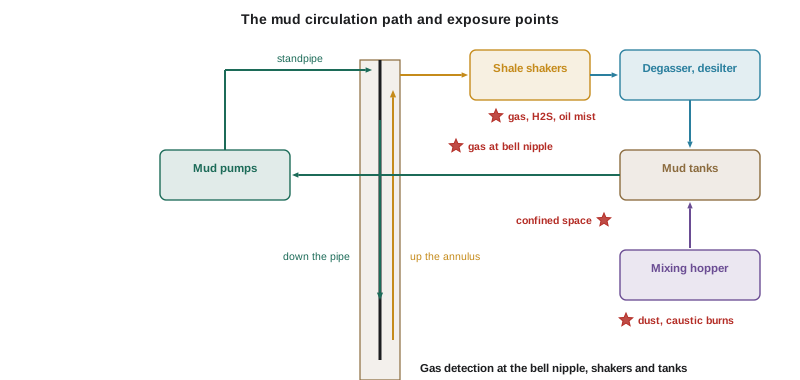
Exposure in the mud system concentrates in a few places and tasks.
| Location or task | Main hazards | Typical controls |
|---|---|---|
| Shale shakers | Oil mist and hydrocarbon vapor, H2S in returns, noise, splashing, slippery surfaces | Enclosed or hooded shakers with extraction, gas detection, hearing protection, splash guards, chemical-resistant gloves and clothing |
| Mixing hopper and sack room | Dust from barite, bentonite, lime, cement and other powders; caustic soda and lime burns; manual handling of sacks | Bulk systems and big bags, local exhaust ventilation, sack cutters, dust masks or respirators, goggles and face shields, eyewash nearby |
| Mud tanks and pits | Vapors, H2S, falls into tanks, confined spaces when cleaning | Grating and guardrails, gas monitoring, confined space entry procedures (HSE-211) |
| Rig floor during trips | Wet trips spraying mud, skin contact, slips | Mud buckets, pipe wipers, chemical-resistant gloves and clothing |
| Cuttings handling and waste | Oily cuttings, vapors, NORM in some formations | Covered bins, gas monitoring, protective clothing, NORM surveys where indicated |
| Mud cleaning and tank cleaning | Confined space, vapors, H2S, residues | Permit, isolation, testing and ventilation (HSE-211, HSE-333) |
Powders, dust and silica
Mixing mud means handling large quantities of fine powders. Barite (barium sulfate) is the main weighting agent and is used in metric tons per well. Bentonite and other clays, lime, cement for spacers, and various polymers and additives come as powders in sacks or bulk. Fine dust irritates the eyes and lungs, and some products contain respirable crystalline silica as an impurity or a component, which can cause silicosis and lung cancer with long-term exposure (HSE-242). Lesson 11 covers silica in hydraulic fracturing, where exposures are much higher.
Controls start with engineering. Bulk handling systems that pneumatically convey barite and bentonite from silos to the mixing hopper remove most manual sack handling. Where sacks are still used, a sack-cutting table with local exhaust ventilation, careful technique and a vacuum rather than a broom for cleanup reduce dust. Respiratory protection, from filtering facepiece respirators to elastomeric respirators with particulate filters, is the last line of defense and requires a proper program with fit testing (HSE-240).
Caustics and other corrosive chemicals
Caustic soda (sodium hydroxide) and lime are added to control pH and alkalinity, and some muds use potassium hydroxide. Caustic soda is strongly corrosive and can cause severe eye injuries and deep skin burns, and dissolving it in water releases heat that can make the solution spit. Acids are used during some operations, especially completions. Controls include mixing caustic only in a designated chemical barrel with a lid, adding caustic slowly to water and never water to caustic, wearing goggles and a face shield, chemical-resistant gloves and an apron or suit, and having an emergency eyewash and shower within a short distance of the mixing area, tested regularly and protected from freezing. HSE-102 explains safety data sheets and labels, which must be available for every mud chemical on the rig.
Gas in the returns
When the bit drills into gas-bearing rock, gas enters the mud and travels up the annulus with the returns. Background gas, connection gas and trip gas are normal in many wells and are monitored by the mud logger. At surface, the gas breaks out of the mud at the bell nipple, the flow line, the possum belly and the shale shakers, which is why those areas must have gas detection for lower explosive limit and, in sour wells, hydrogen sulfide. In the Pinecrest wells, with about 0.5 percent H2S in the formation gas, even a small amount of gas in the returns can produce dangerous H2S concentrations at the shakers. Fixed detectors with alarms at the shakers, bell nipple, mud tanks and rig floor, personal monitors on every worker and breathing air readily available are standard on sour wells. HSE-244 covers H2S hazards and response; Lesson 8 explains how increasing gas in the returns can be an early sign of a kick.
Mud treatment can also remove H2S chemically: zinc-based scavengers and high pH tie up dissolved sulfide in water-based muds, and lime does the same in oil-based muds. Scavengers are a useful control but do not replace detection, because their capacity can be overwhelmed by a large influx.
Long shifts and exposure limits
Occupational exposure limits are usually set as 8-hour time-weighted averages for a 40-hour week. Rig crews work 12-hour tours for 14 days in a row, which means more hours of exposure and less time to recover between shifts. Several jurisdictions require or recommend adjusting exposure limits for extended shifts, and industrial hygienists often use the Brief and Scala model to estimate an adjusted limit. The program below applies that model to an invented hydrocarbon vapor measurement at Rig 31's shakers. The limit used is an illustrative value, not a regulatory limit for any specific substance.
# Invented exposure readings at the shakers over a 12-hour tour (ppm).
readings = [  # (hours, average concentration in that period)
    (2.0, 40), (3.0, 85), (1.0, 20),   # includes a meal break at low exposure
    (4.0, 110), (2.0, 60),
]
hours = sum(h for h, _ in readings)
twa_shift = sum(h * c for h, c in readings) / hours     # average over the shift
twa_8h = sum(h * c for h, c in readings) / 8            # dose expressed as 8 h TWA

limit_8h = 100   # illustrative 8-hour limit, ppm (not a real OEL)
rf = (8 / hours) * ((24 - hours) / 16)                  # Brief and Scala
adjusted = limit_8h * rf
print(f"Shift length {hours:.0f} h, shift average {twa_shift:.1f} ppm")
print(f"Dose as 8-hour TWA: {twa_8h:.1f} ppm vs limit {limit_8h} ppm")
print(f"Brief and Scala factor {rf:.2f}: adjusted limit {adjusted:.0f} ppm for the shift average")
print("Exceeds adjusted limit" if twa_shift > adjusted else "Within adjusted limit")Shift length 12 h, shift average 76.2 ppm Dose as 8-hour TWA: 114.4 ppm vs limit 100 ppm Brief and Scala factor 0.50: adjusted limit 50 ppm for the shift average Exceeds adjusted limit
The shift average of about 76 ppm looks comfortably below the illustrative 100 ppm limit, but the 12-hour tour means the dose expressed as an 8-hour TWA is about 114 ppm, and the Brief and Scala adjusted limit for a 12-hour average is only 50 ppm. Either way of looking at it shows the crew is overexposed. Controls might include enclosing the shakers with extraction, moving the derrickhand's routine tasks away from the shakers, and using respiratory protection while engineering controls are installed. A qualified industrial hygienist should design a real sampling plan and interpret results against the applicable limits.
Skin protection and hygiene
Skin contact with mud is constant on many rigs: hands in mud when handling pipe, splashes at the shakers, soaked clothing on wet trips. Oil-based mud defats the skin and can cause irritant and allergic dermatitis, and prolonged contact with some base oils is linked to more serious skin conditions. Controls include chemical-resistant gloves suited to the base oil (nitrile is common), splash suits or aprons, changing out of soaked clothing promptly, washing skin with soap and water rather than solvents, using barrier and after-work creams, and providing laundry for work clothes so that contaminated clothing is not taken home. Workers should report rashes early; dermatitis is easier to treat before it becomes chronic.
Naturally occurring radioactive material
Some formations contain naturally occurring radioactive material (NORM), mainly radium isotopes that can concentrate in scale inside pipe and equipment or in sludges in tanks. Drilling itself rarely produces significant NORM exposure, but workers handling old tubing, cleaning tanks or dealing with scale on service rigs may be exposed. HSE-330, Lesson 6, introduced NORM and the inverse square law. Where NORM is suspected, surveys with a suitable meter, control of dust and ingestion, and handling under the applicable guidelines are required.
Worked problem
Mixing caustic on night tour
At 3 a.m. the mud engineer asks the derrickhand on Rig 31 to add caustic soda to raise the pH of the water-based mud in the pre-mix tank. The caustic is in 55 lb (25 kg) sacks in the sack room. The eyewash station beside the hopper has a frozen line. What should the derrickhand do?
Show solution
- Stop and report the frozen eyewash; caustic must not be mixed until an emergency eyewash is working within reach.
- Read the safety data sheet and the mixing procedure, and confirm the PPE: goggles and face shield, chemical-resistant gloves, apron or suit, and a dust respirator if the product is dusty.
- Once the eyewash is thawed and tested, use the chemical barrel, adding caustic slowly to water, never water to caustic, and keeping the lid in place to control spitting.
- Use a sack cutter and lift with good technique or with help to avoid back strain.
- Clean up spills promptly, dispose of sacks properly and wash gloves before removing them.
Answer: The job waits until the eyewash works. Then the derrickhand follows the SDS and procedure, wears full eye, face and skin protection, adds caustic slowly to water in the chemical barrel and handles sacks safely.
Common mistakes
MistakeAdding water to dry caustic soda to dissolve it faster.
InsteadAdd caustic slowly to water in a chemical barrel, never water to caustic.
MistakeSweeping up spilled barite or cement with a broom.
InsteadUse a vacuum or wet methods to control dust.
MistakeAssuming H2S scavengers in the mud make detection unnecessary.
InsteadKeep fixed and personal detection in service; scavengers can be overwhelmed.
MistakeComparing a 12-hour tour average directly with an 8-hour limit.
InsteadAccount for extended shifts when judging exposure, with help from an industrial hygienist.
MistakeCleaning oily mud off your hands with diesel or solvent.
InsteadUse soap and water and skin care products; report rashes early.
Summary and key terms
- Drilling fluids contain weighting agents, clays, polymers, caustics and, in oil-based muds, hydrocarbon base fluids.
- Oil-based muds bring vapor, mist, dermatitis and fire hazards; water-based muds can be strongly alkaline.
- The shakers, mixing hopper, mud tanks, rig floor and cuttings handling are the main exposure points.
- Bulk handling, local exhaust ventilation and dust-free cleanup control powder and silica exposures.
- Caustics need eye and skin protection, correct mixing practice and a working eyewash and shower nearby.
- Gas, including H2S, breaks out of returns at the bell nipple and shakers, so detection there is essential.
- Twelve-hour tours increase exposure; limits must be interpreted with extended shifts in mind.
- Oil-based mud
- A drilling fluid with diesel, mineral oil or synthetic oil as the continuous phase.
- Barite
- Barium sulfate powder used to increase the density of drilling fluid.
- Shale shaker
- A vibrating screen that removes cuttings from returning drilling fluid.
- Bell nipple
- The pipe above the BOP stack where returning mud leaves the well toward the flow line.
- H2S scavenger
- A chemical added to drilling fluid to react with and neutralize dissolved sulfide.
- Brief and Scala model
- A method for adjusting 8-hour exposure limits for longer work shifts.
- Dermatitis
- Inflammation of the skin, often caused by repeated contact with irritating substances.
Practice problems
Work each problem on paper first, then reveal the answer to check.
Why are oil-based muds favored for horizontal shale sections?
Show answer
They stabilize reactive shales, reduce friction and improve hole cleaning.
Name two health hazards of oil-based mud.
Show answer
Vapor and mist inhalation, dermatitis, aromatic hydrocarbon exposure, fire (any two).
What is barite used for?
Show answer
To increase the density of drilling fluid.
Give two engineering controls for dust at the mixing hopper.
Show answer
Bulk handling systems, local exhaust ventilation, sack-cutting tables (any two).
What is the rule for mixing caustic soda with water?
Show answer
Add caustic slowly to water, never water to caustic.
Where does gas usually break out of the returns at surface?
Show answer
At the bell nipple, flow line, possum belly and shale shakers.
Why are H2S scavengers not a substitute for detection?
Show answer
Their capacity can be overwhelmed by a large influx.
Using the program, what is the Brief and Scala factor for a 12-hour shift?
Show answer
0.50.
Why should workers not clean skin with diesel or solvents?
Show answer
They damage the skin and increase dermatitis and absorption.
Which workers are most likely to meet NORM?
Show answer
Those handling old tubing, scale or sludges, such as on service rigs and during tank cleaning.
Lesson quiz · 5 questions
Score 60% or more to complete this lesson.
Create a free account to save your progress, take quizzes and earn a certificate.