
HSE-330 · Lesson 7 of 12 · 26 min
Pressure hazards and stored energy
Oil and gas sites are full of pressure. Wells can hold pressures many times higher than those in a household water main, fracturing pumps push fluid into rock at pressures that would burst ordinary pipe, separators and pipelines operate under constant pressure, and even a short length of hose can store enough energy to kill if it fails. Pressure is invisible until something lets go, and when it does, the release is sudden: a line parts and whips, a cap or plug flies off at the speed of a bullet, a jet of fluid cuts skin or flesh. This lesson explains where stored energy hides on a lease, why compressed gas is far more dangerous than liquid at the same pressure, and the rules that keep people out of the line of fire.
HSE-210 covered hazardous energy control and lockout, and HSE-311 Lesson 10 covered mechanical integrity. HSE-331 covers well control and the pressure hazards of drilling and servicing, HSE-332 covers pressure equipment, pigging and blinding at facilities and pipelines, and HSE-333 covers isolation and permits. This lesson gives every worker the basic picture of pressure hazards that those courses build on.
Where the pressure is
Pressure on a lease comes from the reservoir, from pumps and compressors, and from heat. A producing well's wellhead and flowlines carry reservoir pressure, which for deep gas wells can exceed 5,000 psi (35,000 kPa) when the well is shut in. Hydraulic fracturing treating lines commonly operate at 7,000 to 15,000 psi (50,000 to 100,000 kPa). Separators, treaters and pipelines typically run at hundreds to several thousand kPa. Compressors raise gas pressure in stages. Hydraulic systems on rigs and service units use oil at high pressure. Pressure also builds where nobody intends it: liquid trapped between two closed valves expands when the sun heats it, ice or hydrate plugs hold back pressure in lines and then let go, and a tank or vessel can be pressurized by gas flowing back from a connected line.
Gas is far more dangerous than liquid
Liquids such as water hardly compress, so a pipe full of water at high pressure stores little energy; if it fails, the pressure drops almost at once and the pipe usually splits and leaks. Gases compress readily, so the same pipe full of gas at the same pressure stores far more energy, which is released as the gas expands when the pipe fails. That is why pressure tests are normally done with water (hydrostatic testing) rather than air or nitrogen (pneumatic testing), and why pneumatic tests need much larger exclusion zones and special approval. It is also why lines that contain both liquid and gas, such as flowback lines, can behave violently when they fail.
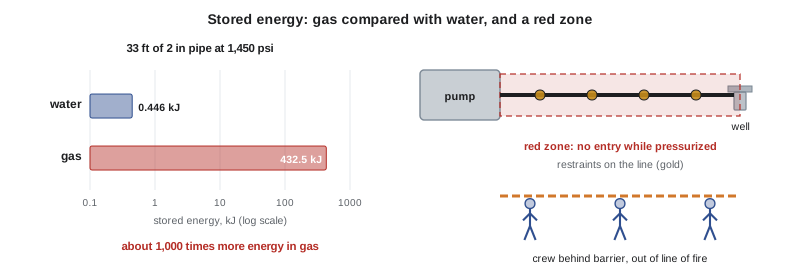
The program below compares the energy stored in a 33 ft (10 m) length of 2 in (50 mm) pipe at a pressure of 1,450 psi (10,000 kPa) when it is filled with gas and when it is filled with water. The gas calculation uses the standard expression for the energy released when a compressed gas expands adiabatically to atmospheric pressure, and the water calculation uses water's bulk modulus. The result is expressed in kilograms of TNT equivalent for comparison. The figures are teaching approximations, not engineering calculations.
import math
# Energy stored in 10 m of 50 mm inside-diameter pipe at 10,000 kPa gauge.
d, L = 0.050, 10.0                    # m
V = math.pi * d ** 2 / 4 * L          # m3
p_atm = 101.325e3                     # Pa
p1 = 10_000e3 + p_atm                 # Pa absolute
k = 1.3                               # ratio of specific heats, natural gas (approx.)
E_gas = p1 * V / (k - 1) * (1 - (p_atm / p1) ** ((k - 1) / k))   # J
K_water = 2.2e9                       # Pa, bulk modulus of water
E_water = 0.5 * V * (p1 - p_atm) ** 2 / K_water                  # J
TNT = 4.184e6                         # J per kg of TNT
print(f"Volume: {V * 1000:.1f} L ({V * 264.17:.2f} US gal)")
print(f"Gas:   {E_gas / 1e3:8.1f} kJ  = {E_gas / TNT * 1000:6.1f} g TNT")
print(f"Water: {E_water / 1e3:8.3f} kJ  = {E_water / TNT * 1000:6.3f} g TNT")
print(f"Gas stores about {E_gas / E_water:,.0f} times more energy")Volume: 19.6 L (5.19 US gal) Gas: 432.5 kJ = 103.4 g TNT Water: 0.446 kJ = 0.107 g TNT Gas stores about 969 times more energy
Filled with gas, this short pipe stores energy equivalent to more than a hundred grams of TNT, enough to throw fittings and pipe with lethal force. Filled with water, it stores a tiny fraction of that. The comparison explains several site rules: hydrotest instead of air testing, bleed gas from lines before working on them, keep away from temporary lines carrying gas or multiphase fluids, and treat any line of unknown content as if it holds gas.
How pressure releases hurt people
Pressure releases injure in predictable ways, and each has its own controls:
- Whipping lines and hoses: when a hose or temporary line parts, the free end thrashes with great force. Whip checks, whip socks, tethers and line restraints limit the movement, but they do not make it safe to stand nearby.
- Projectiles: caps, plugs, bull plugs, gauges, valve stems, pigs and hydrate plugs can be ejected at high speed. Never stand in front of a cap or plug that holds pressure, or in line with a pig launcher or receiver door.
- Fluid jets: a pinhole leak in a hydraulic or high-pressure line can inject fluid through the skin. Injection injuries look small but can destroy tissue and need urgent surgical care. Never feel for a leak with your hand.
- Mismatched connections: hammer unions and other fittings of different pressure ratings can sometimes be screwed together but fail under pressure. Some fittings of different ratings look nearly identical, which has caused fatal failures in the industry.
- Sudden release of gas: blowing down a line or vessel releases gas that may be flammable or toxic, is very loud and can carry debris and liquids.
- Vessel and tank failures: overpressure from blocked outlets, failed regulators or gas blowing back into a tank can rupture equipment that is not designed for it, such as atmospheric tanks.
Ratings and overpressure protection
Every piece of pressure equipment has a rated maximum pressure, called the maximum allowable working pressure or the working pressure rating, marked on its nameplate or body. The weakest component sets the limit for the system, so every hose, fitting, valve and gauge in a line must be rated for the highest pressure it could see. Temporary equipment such as hoses, iron and fittings used in well servicing and testing must be inspected, tested and certified on a schedule and marked with its rating; equipment of unknown rating or condition should not be used.
Pressure safety valves, rupture discs and automatic shutdown systems protect equipment from pressures above its rating. They work only if they are left alone. Never block, isolate, gag or adjust a safety valve or shutdown device unless that is part of an authorized procedure with a permit, and report any that are leaking, corroded or obstructed. Vent and relief lines must point away from where people work, and their outlets must be kept clear.
Red zones and the line of fire
A red zone is an area around pressurized equipment or moving machinery that people must not enter while the hazard is live. Fracturing, coiled tubing, pressure testing, flowback and well testing operations set up red zones around high-pressure iron and connections, marked with barriers, signs and flagging. Only authorized people may enter, and only when the line is depressurized and the supervisor has given permission. Line-of-fire thinking applies everywhere, not only inside marked zones: before you stand near any pressurized line, cap or fitting, ask where things would go if it failed, and position yourself out of that path. Stand to the side of valves when opening them, never over or in front of caps, plugs and hatches, and never straddle a pressurized hose.
Getting to zero energy
Before anyone works on a line or vessel, all pressure must be removed and verified gone. That means isolating the equipment from every source of pressure, bleeding off the pressure to a safe location, verifying zero pressure, and keeping it at zero until the work is done. Gauges can be wrong or plugged, so zero pressure must be confirmed by opening a bleed valve and seeing that nothing comes out, and by watching for pressure that builds back up. Plugs of ice, hydrate, wax, sand or scale can trap pressure behind them while a gauge on the near side reads zero. Double block and bleed arrangements give the strongest isolation for hazardous fluids. HSE-210 covers the general principles and HSE-333 the oil and gas isolation practices in detail.
| Situation | Hidden pressure hazard | Control |
|---|---|---|
| Line between two closed valves in sunshine | Thermal expansion of trapped liquid raises pressure sharply | Provide thermal relief; do not leave liquid-full lines blocked in |
| Gauge reads zero on a line that has frozen | Ice or hydrate plug holds pressure behind it | Treat as pressurized; thaw from the end away from people; follow plug procedures |
| Tank connected to a separator | Gas blowing through a failed dump valve pressurizes an atmospheric tank | Keep tank vents and relief clear; report blow-by; never stand on tank tops during upsets |
| Temporary flowback line | Multiphase flow with gas and sand erodes iron and can part the line | Rated, inspected iron; restraints; red zone; erosion monitoring |
| Hydraulic hose on a service unit | Pinhole leak injects oil through skin | Inspect hoses; never feel for leaks; get urgent care for any injection injury |
| Opening a pig receiver | Trapped pressure ejects the closure or the pig | Verify zero pressure through bleed valves; stand to the side; follow the procedure (HSE-332) |
Worked problem
A hammer union that does not look right
A well servicing crew at Pinecrest is rigging up temporary iron to pump into a well at up to 2,900 psi (20,000 kPa). A helper notices that one hammer union seems to need more turns than usual to tighten and that the markings on the two halves are different. The crew is behind schedule. What should happen?
Show solution
- Stop and report it to the supervisor before the line is pressurized. Different markings on the two halves of a union may mean mismatched pressure ratings, which can hold at low pressure and fail violently at high pressure.
- Remove the union from service and replace it with matched, certified components marked with the correct rating for the job. Check the rest of the line for the same problem.
- Pressure test the assembled line to the specified test pressure from outside the red zone before pumping, with everyone clear.
- Record the near miss so that the source of the mismatched part can be traced and the crew's inspection practices reinforced. Schedule pressure is not a reason to accept an unverified component.
Answer: Stop, report, replace the suspect union with matched rated parts, check the rest of the line, test from outside the red zone and record the near miss.
Common mistakes
MistakeAssuming a line is safe because the gauge reads zero.
InsteadVerify zero pressure through a bleed valve and watch for plugs and pressure build-up.
MistakeStanding in front of a cap, plug or pig receiver door.
InsteadStand to the side, out of the line of fire.
MistakeRunning a pressure test with air because water is inconvenient.
InsteadUse hydrostatic testing; pneumatic tests need special approval and larger exclusion zones.
MistakeFeeling along a hydraulic hose for a leak.
InsteadNever use your hand; use cardboard or a detector and treat any injection injury as an emergency.
MistakeStepping into a red zone briefly to check a connection.
InsteadStay out while the line is pressurized; enter only when depressurized and authorized.
Summary and key terms
- Pressure on a lease comes from reservoirs, pumps, compressors and heat, and also hides in trapped liquid, plugs and gas blowing into connected equipment.
- Compressed gas stores far more energy than liquid at the same pressure, so hydrotesting is preferred and gas lines are treated with extra caution.
- Pressure releases injure through whipping lines, projectiles, fluid injection, mismatched fittings, sudden gas releases and vessel failures.
- The weakest component sets a system's pressure limit; use only rated, inspected and matched equipment.
- Never block, gag or adjust safety valves or shutdown devices outside an authorized procedure.
- Red zones keep people away from live high-pressure lines; line-of-fire thinking applies everywhere.
- Before work, isolate, bleed, verify zero pressure through a bleed valve and keep it at zero.
- Maximum allowable working pressure
- The highest pressure at which a piece of equipment is rated to operate.
- Hydrostatic test
- A pressure test using water, which stores little energy compared with gas.
- Red zone
- An area around live high-pressure equipment or moving machinery that people must not enter.
- Line of fire
- The path that energy, fluids or objects would take if equipment failed or moved.
- Whip check
- A cable restraint across a hose connection that limits whipping if the connection fails.
- Hydrate plug
- An ice-like blockage of gas and water that can trap pressure and release suddenly.
- Injection injury
- Damage caused when high-pressure fluid is forced through the skin.
Practice problems
Work each problem on paper first, then reveal the answer to check.
Why does gas store much more energy than water at the same pressure?
Show answer
Gas compresses readily and releases energy as it expands; water hardly compresses.
In the program, roughly how much more energy did gas store than water?
Show answer
Roughly a thousand times more.
What typical pressures do fracturing treating lines run at?
Show answer
About 7,000 to 15,000 psi (50,000 to 100,000 kPa).
Name four ways a pressure release can injure people.
Show answer
Any four of whipping lines, projectiles, fluid injection, mismatched fitting failures, sudden gas release, vessel failure.
What sets the pressure limit of a line made of several components?
Show answer
The lowest-rated component.
Why is a gauge reading of zero not enough to prove a line is safe?
Show answer
The gauge may be faulty or plugged, or a plug may trap pressure behind it.
What is a red zone?
Show answer
An area around live high-pressure equipment that people must not enter while it is pressurized.
Where should you stand when opening a valve or near a cap?
Show answer
To the side, out of the line of fire.
What should you do about a safety valve that is leaking?
Show answer
Report it; never block, gag or adjust it outside an authorized procedure.
What should happen to a hammer union with mismatched markings?
Show answer
Remove it from service and replace it with matched, rated parts before pressurizing.
Lesson quiz · 5 questions
Score 60% or more to complete this lesson.
Create a free account to save your progress, take quizzes and earn a certificate.