
HSE-330 · Lesson 2 of 12 · 26 min
Law, regulators and industry standards
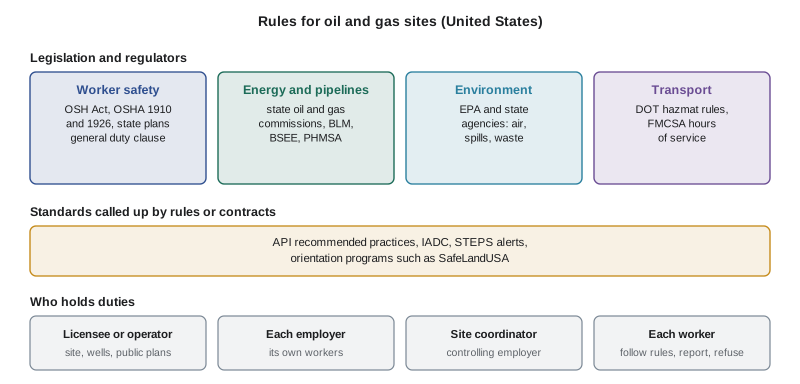
Oil and gas sites answer to more rule-makers than most workplaces. Occupational health and safety law protects workers. Energy regulators license wells, facilities and pipelines and set technical and emergency planning rules. Environmental regulators control releases to air, water and land. Transportation law governs trucks and dangerous goods on public roads. On top of the law sit industry standards and recommended practices, many of them written by the industry itself, which contracts, regulators and courts often treat as the expected standard of care. This lesson maps those rules so that you know where a requirement comes from and who enforces it.
HSE-101 explained workers' rights and employers' general duties, and HSE-244 Lesson 5 covered hydrogen sulfide exposure limits in detail. This lesson does not repeat them. The editions and organizations named are those in place as of 2026. Rules change often in this industry, and the version that applies at a site is the one in force in that jurisdiction, so read the current documents when you need the exact wording. Clause numbers are deliberately not given.
Two kinds of regulator
The most important idea in this lesson is that an oil and gas site usually has two kinds of regulator watching different things. The occupational health and safety regulator protects workers: it enforces rules on training, protective equipment, exposure limits, confined spaces, fall protection, multi-employer sites and incident reporting, and it investigates serious worker injuries. The energy regulator licenses and oversees the wells, facilities and pipelines themselves: it sets rules on well design, flaring and venting, emergency response planning for the public, spacing from homes, pipeline integrity, damage prevention and abandonment. The two overlap, especially for hydrogen sulfide and emergency planning, and they often share information, but they have different powers and different staff.
Worker safety law
In the United States, worker safety on most oil and gas sites falls under the Occupational Safety and Health Act. Federal OSHA enforces it in most oil and gas states, including Texas, North Dakota, Oklahoma, Pennsylvania, Louisiana and Colorado, while approved state plans run their own programs in states such as Wyoming, New Mexico, Utah, Alaska and California. There is no single OSHA standard written specifically for oil and gas well drilling and servicing. Instead, the general industry standards in 29 CFR 1910 apply, including those on hazard communication, respiratory protection, permit-required confined spaces, hazardous energy control, personal protective equipment, walking-working surfaces and flammable liquids, with the construction standards in 29 CFR 1926 applying to some construction work. Where no specific standard covers a recognized hazard, OSHA cites the general duty clause, which requires employers to keep the workplace free of recognized hazards likely to cause death or serious harm. The process safety management standard, which HSE-311 covered, applies to gas plants and other facilities that hold enough of a highly hazardous chemical, but it expressly does not apply to oil or gas well drilling or servicing operations or to normally unoccupied remote facilities, so much upstream work falls outside it.
Energy and pipeline regulators
Energy regulation in the United States is shared between the states and federal agencies. State oil and gas commissions permit and inspect wells and production facilities on state and private land: for example, the Railroad Commission of Texas, the North Dakota Industrial Commission and its Department of Mineral Resources, the New Mexico Oil Conservation Division and the Pennsylvania Department of Environmental Protection. The Bureau of Land Management oversees oil and gas operations on federal onshore land, and the Bureau of Safety and Environmental Enforcement (BSEE) regulates offshore operations, including safety and environmental management systems. The Pipeline and Hazardous Materials Safety Administration (PHMSA) sets federal safety rules for gas and hazardous liquid pipelines, which states with certified programs often enforce for intrastate lines. The Environmental Protection Agency regulates air emissions such as methane and volatile organic compounds, though its oil and gas emission rules have changed repeatedly in recent years, so check the current status before relying on any compliance date.
Environmental and transportation rules
Releases of oil, produced water and gas are regulated in both countries as environmental matters as well as safety ones. Spills must be reported to the energy or environmental regulator within short time limits, and many sites have spill response plans and equipment (HSE-251). Flaring and venting rules limit routine releases and require records. On the road, trucks carrying crude oil, condensate, produced water, chemicals and compressed gas are covered by dangerous goods or hazardous materials transportation law (HSE-250), and commercial drivers by hours-of-service rules (Lesson 3 and HSE-252).
| Topic | Canada | United States |
|---|---|---|
| Worker safety law | Provincial OHS acts and codes; Canada Labor Code Part II for federal undertakings | OSH Act; OSHA 29 CFR 1910 and 1926; state plans; general duty clause |
| Process safety | Provincial requirements, energy regulator directives and CSA standards | OSHA process safety management, with exemptions for drilling, servicing and remote unoccupied facilities |
| Wells and facilities | AER (Alberta), BC Energy Regulator, Saskatchewan Ministry of Energy and Resources | State oil and gas commissions; BLM on federal land; BSEE offshore |
| Pipelines | Provincial regulators; Canada Energy Regulator for interprovincial lines; CSA Z662 | PHMSA (49 CFR Parts 192 and 195) and state pipeline safety programs |
| Public emergency planning | AER Directive 071 and equivalent provincial rules; CSA Z246.2 | State rules, local emergency planning committees, PHMSA and EPA requirements |
| Hazard communication | WHMIS 2015 | OSHA Hazard Communication Standard |
| Transport of products | Transportation of Dangerous Goods Act and Regulations | DOT hazardous materials regulations (49 CFR) |
| Industry practice | Energy Safety Canada programs and Industry Recommended Practices (IRPs) | API recommended practices; NIOSH and OSHA STEPS network alerts |
Industry standards and recommended practices
Much of the detailed technical practice on US sites comes from industry. The American Petroleum Institute (API) publishes recommended practices that are widely used in contracts and cited by regulators and courts, including API RP 54 on occupational safety and health for oil and gas well drilling and servicing operations, API RP 49 on drilling and well servicing operations involving hydrogen sulfide, API RP 76 on contractor safety management, API RP 75 on safety and environmental management systems for offshore operations and API RP 1173 on pipeline safety management systems. The International Association of Drilling Contractors (IADC) publishes guidance and training for drilling crews. The National STEPS Network, a partnership of operators, contractors, OSHA and NIOSH, issues safety alerts on recurring hazards such as tank gauging and vehicle safety. Basic orientation programs such as SafeLandUSA, now offered through Veriforce, give a common base of training. Recommended practices are not automatically law, but OSHA may treat them as evidence of recognized hazards and feasible controls, and contracts often make them mandatory.
Inspections, orders and enforcement
Both kinds of regulator inspect sites, often without notice. An OSHA compliance officer can enter a work site, examine equipment and records, interview workers privately, take samples and photographs, and issue citations with proposed penalties, which are adjusted for inflation each year and are much higher for willful or repeated violations. OSHA cannot itself order a site shut down, but it can seek a court order in cases of imminent danger, and willful violations that cause a death can be referred for criminal prosecution. State oil and gas commissions can issue notices of violation, shut in wells and impose penalties on operators. For workers and supervisors, the practical lessons are the same: keep the records the law requires (orientations, hazard assessments, gas detector bump tests, permits and training), answer inspectors honestly, and never alter or remove evidence after an incident.
Who carries which duty
Duties do not disappear when work is contracted out. The licensee or operator holds the energy regulator's license or permit and remains responsible for the well, facility or pipeline and for public emergency planning. Each employer, including every contractor, has duties to its own workers. On a site with several employers, one party coordinates safety for the whole site: the prime contractor in Alberta and British Columbia, or, under OSHA's multi-employer citation policy, a controlling employer who can be cited for hazards it could reasonably have prevented. Workers have their own duties: to follow safe procedures, use protective equipment, report hazards and refuse work they believe is dangerous. Lesson 10 develops these roles.
The program below is a simple lookup that a site supervisor might keep: for each kind of event, which regulator to notify. The entries are illustrative examples for the invented Pinecrest site; every operator's emergency response plan lists the actual contacts and time limits.
# Illustrative notification lookup for a North Dakota upstream site.
# Real plans list exact contacts, time limits and forms.
notify = {
    "serious worker injury":        ["OSHA (fatality 8 h; hospitalization 24 h)", "employer and controlling employer"],
    "uncontrolled gas release":     ["state oil and gas regulator", "local emergency manager if public may be affected"],
    "spill off the lease":          ["state regulator", "landowner"],
    "pipeline hit while digging":   ["pipeline owner", "811 one-call center", "911 if gas is escaping"],
    "fire or explosion":            ["fire department (911)", "state regulator", "OSHA if workers hurt"],
}
for event, who in notify.items():
    print(f"{event:28} -> {', '.join(who)}")
print("Events listed:", len(notify))serious worker injury -> OSHA (fatality 8 h; hospitalization 24 h), employer and controlling employer uncontrolled gas release -> state oil and gas regulator, local emergency manager if public may be affected spill off the lease -> state regulator, landowner pipeline hit while digging -> pipeline owner, 811 one-call center, 911 if gas is escaping fire or explosion -> fire department (911), state regulator, OSHA if workers hurt Events listed: 5
Worked problem
Two regulators, one incident
A contractor at Pinecrest is overcome by gas while gauging a tank and is taken to the hospital. The tank vented to the atmosphere for several minutes before the hatch was closed. Which regulators are involved and why?
Show solution
- The worker injury is a matter for OSHA. An in-patient hospitalization must be reported within 24 hours, and OSHA may inspect the employer and, under its multi-employer policy, the operator or other contractors who created or controlled the hazard.
- The gas release is a matter for the state oil and gas regulator, which may require a report on the release, and possibly for the EPA or the state environmental agency regarding emissions.
- Industry practice is relevant evidence: the operator's gauging procedures will be compared with the OSHA and NIOSH hazard alert on tank gauging and with API guidance on gauging without opening hatches.
- Both investigations may run at the same time. Cooperating fully, preserving information and fixing the hazard quickly are the same whichever regulator asks.
Answer: The worker safety regulator investigates the injury and the energy or environmental regulator the release; industry standards serve as evidence of what should have been done.
Common mistakes
MistakeAssuming the energy regulator handles worker injuries.
InsteadReport worker injuries to the occupational health and safety regulator; the energy regulator handles the wells, facilities and public safety.
MistakeTreating industry recommended practices as optional advice.
InsteadExpect regulators, contracts and courts to treat them as the standard of competent practice.
MistakeBelieving process safety management rules cover every oil and gas site.
InsteadCheck applicability; drilling, servicing and normally unoccupied remote facilities are exempt from OSHA PSM.
MistakeThinking a contractor takes over the operator's legal responsibilities.
InsteadKnow that the licensee or operator keeps its duties, and each employer keeps duties to its own workers.
MistakeRelying on an old copy of a directive or standard.
InsteadUse the edition currently in force; directives such as emergency planning rules have been revised recently.
Summary and key terms
- Oil and gas sites usually have two kinds of regulator: one for worker safety and one for the wells, facilities and pipelines.
- OSHA general industry and construction standards and the general duty clause cover most US sites; some states run their own plans.
- State oil and gas commissions, BLM, BSEE and PHMSA license and oversee energy activity and pipelines.
- OSHA PSM does not apply to oil or gas well drilling or servicing operations or to normally unoccupied remote facilities.
- Environmental and transportation law cover spills, flaring, venting, dangerous goods and drivers' hours.
- API recommended practices, IADC guidance, STEPS alerts and orientation programs supply much of the detailed practice.
- The licensee or operator, each employer, the site coordinator and each worker all keep their own duties.
- Energy regulator
- An agency that licenses and oversees wells, facilities and pipelines and sets technical and public safety rules for them.
- Licensee
- The company that holds the energy regulator's license or permit for a well, facility or pipeline and remains responsible for it.
- Directive
- A numbered set of requirements issued by an energy regulator such as the AER.
- Recommended practice
- An industry document describing accepted ways of doing work, often cited by contracts and regulators.
- General duty clause
- The OSH Act provision requiring employers to keep workplaces free of recognized serious hazards.
- Prescribed area
- The strip of land 30 m on either side of a federally regulated pipeline in Canada where ground disturbance needs authorization.
- State plan
- A US state occupational safety and health program approved by OSHA to operate in place of federal enforcement.
Practice problems
Work each problem on paper first, then reveal the answer to check.
What are the two kinds of regulator that usually watch an oil and gas site?
Show answer
A worker safety regulator and an energy regulator for the wells, facilities and pipelines.
Name two state oil and gas regulators.
Show answer
Any two of the Railroad Commission of Texas, the North Dakota Industrial Commission and its Department of Mineral Resources, the New Mexico Oil Conservation Division, the Pennsylvania DEP.
Which operations does the OSHA process safety management standard expressly exclude?
Show answer
Oil or gas well drilling or servicing operations and normally unoccupied remote facilities.
Who regulates interprovincial pipelines in Canada and federal pipeline safety in the US?
Show answer
The Canada Energy Regulator in Canada; PHMSA in the United States.
Give two examples of industry organizations that publish oil and gas safety practices.
Show answer
Any two of Energy Safety Canada, CSA Group, the American Petroleum Institute, IADC, the National STEPS Network.
Why do recommended practices matter even when they are not law?
Show answer
Contracts often require them and regulators and courts treat them as evidence of competent practice.
Who keeps responsibility for a well when contractors do the work?
Show answer
The licensee or operator, along with each contractor's own employer duties.
Which law covers trucks carrying condensate on public roads?
Show answer
Dangerous goods or hazardous materials transportation law (TDG in Canada, DOT hazmat rules in the US).
What does the CER prescribed area around a federal pipeline extend to?
Show answer
30 m on either side of the pipeline.
Which regulator would investigate a worker overcome by gas at a tank?
Show answer
The occupational health and safety regulator (with the energy regulator looking at the release).
Lesson quiz · 5 questions
Score 60% or more to complete this lesson.
Create a free account to save your progress, take quizzes and earn a certificate.