
HSE-330 · Lesson 1 of 12 · 27 min
The oil and gas life cycle and its hazards
Oil and gas sites are among the most varied and most dangerous workplaces in either country. On a single day a worker might drive two hours on a gravel lease road, check pressures at a wellhead, gauge a tank of produced fluid, help a crew rig up a service unit and then wait in a truck while a pipeline is blown down. Each of those tasks carries a different mix of hazards: moving vehicles, high pressure, flammable and toxic gas, heavy rotating equipment, falls, cold and isolation. This course is the entry point to the oil and gas sites track. It gives workers, new supervisors, contractors and visitors the orientation they need to recognize those hazards, follow site rules and respond when something goes wrong.
HSE-103 introduced hazard recognition and risk assessment, and HSE-310 and HSE-311 covered industrial plants and process safety. This course applies those ideas to upstream sites (exploration, drilling, completion and production) and midstream sites (gathering, processing, compression and transmission). Three more courses in the track go deeper: HSE-331 covers drilling and well site hazards, HSE-332 covers facilities and pipelines, and HSE-333 covers permits to work and isolation in oil and gas. Where a topic belongs to one of them, this course introduces it and points ahead.
Why orientation matters here
Oil and gas work combines several features that make orientation unusually important. Sites are spread over large areas, often far from towns and medical help. Many workers move between sites and employers every week, so they meet new layouts, new equipment and new rules constantly. Most sites have several employers working side by side: the operator who holds the license or permit, a drilling or service contractor, specialist subcontractors, truck drivers and visitors. And the materials themselves, hydrocarbons under pressure, sometimes containing hydrogen sulfide, can injure many people at once if they escape.
An orientation is how a site closes the gap between general training and the specific hazards of that place on that day. It tells a newcomer where the hazards are, which rules apply, where to muster, who is in charge and how to raise a concern. Industry has standardized much of this. In Canada, Energy Safety Canada's Common Safety Orientation gives workers a common base of safety knowledge across the industry, and in the United States, basic orientation programs such as SafeLandUSA play a similar role. Lesson 3 explains how these industry programs fit with the site-specific orientation every site must still give.
From exploration to reclamation
The oil and gas life cycle runs from finding a resource to restoring the land after production ends. Each phase has its own sites, equipment, workforce and hazards. Knowing where a site sits in the life cycle is the first step in knowing what can hurt you there.
| Phase | Typical work | Main hazards |
|---|---|---|
| Exploration and seismic | Surveying, line cutting, drilling shot holes, recording crews | Remote travel, helicopters and off-road vehicles, explosives handling, wildlife, cold and heat |
| Site and lease construction | Clearing, building roads and pads, installing culverts | Heavy equipment, ground disturbance near existing pipelines, traffic |
| Drilling | Rigging up, making hole, tripping pipe, running casing, cementing | Rotating equipment, pinch points, dropped objects, falls from the derrick, well control, H2S |
| Completion and stimulation | Perforating, hydraulic fracturing, flowback, coiled tubing | Very high pressure lines, red zones, sand and silica, flammable flowback fluids, explosives |
| Production | Operating wells, pump jacks, batteries, tanks, gauging and sampling | Flammable and toxic gas, tank vapors, pressure, rotating equipment, working alone |
| Processing and compression | Gas plants, compressor stations, dehydration and sweetening | Process safety, high pressure, noise, hot surfaces, H2S and sulfur dioxide |
| Transportation and storage | Gathering lines, transmission pipelines, trucking, rail and storage tanks | Ground disturbance, pigging, blowdowns, tank fires, road traffic |
| Abandonment and reclamation | Plugging wells, removing equipment, remediating soil, reclaiming land | Residual pressure and gas, contaminated soil, heavy equipment, NORM in old equipment |
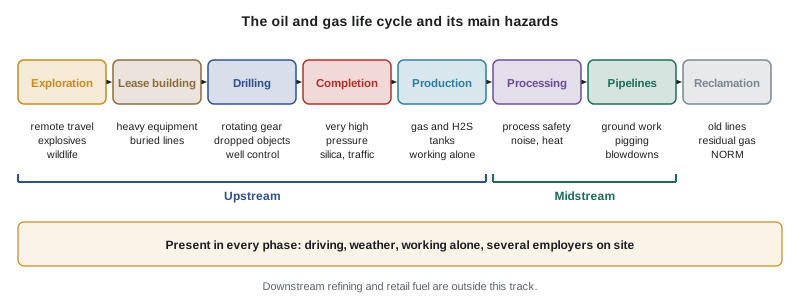
Workers often describe the industry in three parts. Upstream is exploration, drilling, completion and production. Midstream is gathering, processing, compression, transmission by pipeline and storage. Downstream is refining, petrochemicals and retail fuel. This track covers upstream and midstream sites; refineries and chemical plants are closer to the industrial track (HSE-310 to HSE-313), and retail fuel stations have their own course, HSE-350.
Conventional, unconventional and oil sands
The kind of resource changes the work. Conventional reservoirs are porous rock where oil or gas flows to a vertical well with little help. Unconventional resources, such as shale and tight formations, need long horizontal wells and hydraulic fracturing to produce. A typical modern pad in the Montney formation of Alberta and British Columbia or the Bakken of North Dakota holds several horizontal wells drilled from one surface location, with a production facility on or near the pad. Fracturing operations bring large crews, many trucks, high-pressure pumping equipment and huge volumes of sand and water to the site for a few weeks, after which the site settles into a quieter production phase with occasional visits.
Oil sands, found in northeastern Alberta, are produced in two ways. Surface mining digs out bitumen-bearing sand near the surface and processes it in large plants, so the hazards resemble those of large mines and heavy industry. In-situ operations, such as steam-assisted gravity drainage, inject steam through paired horizontal wells and bring heated bitumen to the surface, so they combine well site, high-temperature steam and process plant hazards. Offshore operations, off Newfoundland and Labrador and Nova Scotia and in the US Gulf of Mexico, add helicopter transport, marine hazards and living on an installation. They have separate regulators and specialized training, and this course mentions them only briefly.
Where workers are hurt and killed
Data from the United States show clearly where the serious risk lies. The National Institute for Occupational Safety and Health (NIOSH) maintains a database called Fatalities in Oil and Gas Extraction (FOG) that collects detailed information on worker deaths. Its report covering 2014 to 2019, published in 2023, counted 470 fatalities, of which 401 were traumatic injuries and 69 were cardiac deaths at work. Vehicle incidents were the most common type of fatal event, followed by contact injuries (being struck by, caught in or crushed by objects and equipment) and then explosions and fires. The program below works through the published percentages.
# Shares of 470 oil and gas extraction fatalities, 2014 to 2019,
# from the NIOSH FOG surveillance report (percentages as published).
total = 470
shares = [
    ("Vehicle incidents", 26.8),
    ("Contact injuries", 21.7),
    ("Explosions", 14.5),
    ("Fires", 12.8),
    ("Falls", 4.9),
    ("Harmful substance exposures", 3.4),
]
listed = 0
for name, pct in shares:
    n = round(total * pct / 100)
    listed += n
    bar = "#" * round(pct)
    print(f"{name:28} {pct:5.1f}%  about {n:3d}  {bar}")
print(f"{'Other events (incl. cardiac)':28} {100 - sum(p for _, p in shares):5.1f}%  about {total - listed:3d}")
print(f"Explosions and fires together: {14.5 + 12.8:.1f}% of deaths")Vehicle incidents 26.8% about 126 ########################### Contact injuries 21.7% about 102 ###################### Explosions 14.5% about 68 ############## Fires 12.8% about 60 ############# Falls 4.9% about 23 ##### Harmful substance exposures 3.4% about 16 ### Other events (incl. cardiac) 15.9% about 75 Explosions and fires together: 27.3% of deaths
Several patterns stand out. More than a quarter of deaths happened on the road or in vehicles, far from the wellhead. Contact injuries, mostly involving heavy equipment, pipe and rotating machinery, were the next largest group. Explosions and fires together accounted for roughly as many deaths as vehicles. The same report found that about 60 percent of the deaths were workers of well servicing companies, and fewer than 20 percent were employees of drilling contractors; employees of the operating companies themselves were a small share. In other words, the people most at risk are usually contractors doing hands-on work. The US Bureau of Labor Statistics counted 65 fatal work injuries in oil and gas extraction and its support activities in 2024. Activity remains high: according to the Energy Information Administration, US crude oil production averaged a record of about 13.6 million barrels per day in 2025, with roughly half coming from the Permian Basin of Texas and New Mexico.
Comparable national data for Canada are spread across provincial workers' compensation boards and regulators, but the pattern is similar: motor vehicle incidents, struck-by and caught-between injuries, falls, and fires and explosions dominate serious incidents in the upstream industry. Lesson 2 maps the regulators who collect and publish that information.
Thinking in energy
A useful way to scan any site is to ask what forms of energy could be released and reach a person. Energy Safety Canada's Common Safety Orientation teaches hazard recognition with an energy wheel, and many US companies use similar tools. The energy forms are gravity, motion, mechanical, electrical, pressure, temperature, chemical, biological, radiation and sound. An oil and gas site usually has all ten at once: a tank top (gravity), a haul truck (motion), a pump jack (mechanical), a motor control panel (electrical), a pressurized separator (pressure), a line heater (temperature), crude oil and sour gas (chemical), insects and wildlife (biological), naturally occurring radioactive material in old scale (radiation) and a compressor (sound).
Energy thinking connects directly to the most serious outcomes. Incidents that kill or permanently injure people almost always involve a large, uncontrolled release of energy: a vehicle at highway speed, a pressurized line that parts, a heavy load that falls, a gas cloud that ignites. Many companies and industry associations have adopted short lists of life-saving rules aimed at these high-energy hazards, such as rules on bypassing safety controls, confined space entry, driving, energy isolation, hot work, line of fire, safe mechanical lifting, work authorization and working at height. The updated Common Safety Orientation released in October 2025 teaches the energy wheel alongside ten life-saving rules. Learn the rules your site uses; they mark the places where a single mistake is most likely to be fatal.
The Pinecrest pad: our running example
Throughout this course, examples use an invented site: the Pinecrest pad and battery, operated by an invented company, Larchwood Resources, about 40 miles (64 km) south of Watford City, North Dakota. The pad holds eight horizontal wells producing oil and associated gas from the Bakken formation. The associated gas contains about 0.5 percent hydrogen sulfide (5,000 ppm) in the raw stream. A small tank battery beside the pad has an inlet separator, a heater-treater, a compressor, four 400 bbl (64 m³) production tanks for oil and water, a flare stack and a pipeline riser where the gathering line leaves the site. A gravel lease road joins a state highway 9 miles (14 km) away. Contractors visit for well servicing, trucking, maintenance and pipeline work. All figures, people and incidents at Pinecrest are invented for teaching.
Worked problem
Scanning Pinecrest by phase
Three new workers are assigned to Pinecrest in the same week: a fracturing crew member during completion of two new wells, a lease operator who will check the producing wells and battery daily, and a reclamation equipment operator removing an old flowline at the edge of the lease. For each, name the two hazards most likely to cause serious harm.
Show solution
- Fracturing crew member: the high-pressure treating lines (pressure; Lesson 7) and the many trucks and heavy equipment moving on a crowded pad (motion). Silica dust from sand handling is a serious health hazard as well (HSE-242).
- Lease operator: flammable and toxic gas at the battery and tanks, especially during gauging and sampling (chemical; Lessons 4 to 6), and driving alone on rural roads in all weather (motion; Lesson 3).
- Reclamation operator: buried live pipelines near the old flowline (ground disturbance; Lesson 9) and residual pressure or gas in the old line itself (pressure and chemical).
- All three share the site-wide hazards: weather, wildlife, working far from help and the presence of several employers whose work can affect each other.
Answer: Fracturing: pressure and moving equipment; lease operator: gas exposure and driving; reclamation: buried pipelines and residual pressure. The phase decides the dominant hazards, but some hazards are present in every phase.
Common mistakes
MistakeTreating the wellhead and tanks as the only real hazards on a site.
InsteadRecognize that vehicle incidents kill more oil and gas workers than any other event.
MistakeAssuming a general industry orientation covers an oil and gas site.
InsteadComplete the industry orientation and the site-specific orientation for each site.
MistakeThinking a quiet production site is low risk because no crew is present.
InsteadExpect gas, pressure and working-alone hazards at unattended sites.
MistakeAssuming the operating company carries most of the risk.
InsteadKnow that most deaths are among contractors doing hands-on work, so contractor safety is everyone's concern.
MistakeScanning for hazards one task at a time and forgetting the site around you.
InsteadUse the energy wheel to check all forms of energy that could reach you, including other crews' work.
Summary and key terms
- Oil and gas sites combine remote locations, many employers, mobile workers and hazardous materials, which makes orientation essential.
- The life cycle runs from exploration and construction through drilling, completion, production, processing, transportation and storage to abandonment and reclamation.
- Each phase has dominant hazards, but driving, weather, working alone and multi-employer work appear in all of them.
- Unconventional resources use multi-well pads, horizontal wells and hydraulic fracturing; oil sands combine mining or in-situ steam operations with plant hazards.
- In US data for 2014 to 2019, vehicle incidents were the leading fatal event, followed by contact injuries and then explosions and fires.
- About 60 percent of the deaths were among well servicing workers, so contractors carry much of the risk.
- The energy wheel helps you scan for gravity, motion, mechanical, electrical, pressure, temperature, chemical, biological, radiation and sound hazards.
- Upstream
- Exploration, drilling, completion and production of oil and gas.
- Midstream
- Gathering, processing, compression, pipeline transmission and storage of oil and gas.
- Battery
- A production facility near wells that separates, measures and stores oil, gas and water before transport.
- Pad
- A surface location from which one or more wells are drilled, often with several horizontal wells.
- Hydraulic fracturing
- Pumping fluid and sand into a well at high pressure to crack the rock and let oil or gas flow.
- Energy wheel
- A hazard recognition tool that prompts workers to look for ten forms of energy that can cause harm.
- Life-saving rules
- A short list of rules targeting the activities most likely to cause fatalities.
Practice problems
Work each problem on paper first, then reveal the answer to check.
Name the three broad parts of the oil and gas industry and say which two this track covers.
Show answer
Upstream, midstream and downstream; the track covers upstream and midstream sites.
What was the most common type of fatal event in the NIOSH FOG data for 2014 to 2019?
Show answer
Vehicle incidents (26.8 percent).
Roughly what share of deaths in that report were explosions and fires together?
Show answer
About 27 percent.
Which type of company employed about 60 percent of the workers who died?
Show answer
Well servicing companies.
List the ten energy forms on the energy wheel.
Show answer
Gravity, motion, mechanical, electrical, pressure, temperature, chemical, biological, radiation and sound.
Give two hazards that dominate the completion and stimulation phase.
Show answer
Very high pressure lines and red zones, heavy traffic and equipment, silica, flammable flowback fluids, explosives (any two).
What makes an unconventional pad different from a conventional single well?
Show answer
Several long horizontal wells drilled from one location and stimulated by hydraulic fracturing.
Why do oil and gas workers need site-specific orientations even after industry orientation?
Show answer
Each site has its own layout, hazards, rules, muster points and people in charge.
What hazard might a reclamation crew meet when removing an old flowline?
Show answer
Buried live pipelines nearby and residual pressure or gas in the old line.
What is the raw hydrogen sulfide content at the invented Pinecrest site?
Show answer
About 0.5 percent, or 5,000 ppm.
Lesson quiz · 5 questions
Score 60% or more to complete this lesson.
Create a free account to save your progress, take quizzes and earn a certificate.