
HSE-330 · Lesson 11 of 12 · 27 min
Emergency response plans
Oil and gas emergencies can grow quickly and reach far beyond the lease. A sour gas release can threaten residents kilometers downwind, a well control incident can run for days, a pipeline rupture can start a fire visible for miles, and a serious injury at a remote site can be hours from a hospital by road. The response in the first few minutes, by workers on site, often decides how bad the outcome is. Emergency response plans exist so that those first minutes are spent on the right actions, and so that the company, emergency services, regulators and the public can work together on a larger response. This lesson explains what an emergency response plan for an oil and gas site contains, the public safety planning required for sour and high-vapor-pressure operations, and what every worker must do when the alarm sounds.
HSE-105 covered fire safety and emergency preparedness in general, HSE-222 covered fire wardens and evacuation leaders, HSE-244 Lesson 10 covered the hydrogen sulfide emergency and HSE-251 covered spill response. HSE-331 covers well control. This lesson focuses on emergency planning as it applies to upstream and midstream sites.
Kinds of emergency
An oil and gas emergency response plan must cover the emergencies that could realistically happen at that site:
- Releases of sour gas or hydrogen sulfide, and of other toxic or flammable gas.
- Fires and explosions at wellheads, tanks, compressors, process equipment and flares.
- Loss of well control during drilling, completion or servicing (HSE-331).
- Pipeline leaks and ruptures.
- Spills of oil, condensate, produced water or chemicals, especially into water.
- Serious injuries and medical emergencies, including cardiac events, which were about 15 percent of deaths in the NIOSH FOG data.
- Vehicle collisions on lease and access roads.
- Severe weather, wildfire and flooding.
- Security events such as vandalism or intruders.
What a site emergency response plan contains
An emergency response plan (ERP) sets out who does what, with what resources, when an emergency happens. For workers on site, the most important parts are the alarms and their meanings, the muster points and evacuation routes, how people are counted, who is in charge and how to call for help. For the company, the plan also covers notification of emergency services, regulators and the public, the roles of the response team, equipment and resources, communications, and recovery.
| ERP element | What it covers |
|---|---|
| Hazard and scenario assessment | What could go wrong, how bad it could be and who could be affected, including worst-case and worst-credible scenarios |
| Alarms and signals | What each alarm sounds and looks like and what it means |
| Muster points and evacuation | Primary and secondary muster points chosen for different wind directions, routes and headcount procedures |
| Roles and command | Incident commander and response roles using the incident command system |
| Notification and contacts | Emergency services, regulators, company management, mutual aid partners, landowners and residents, with time limits |
| Public protection | Planning zones, resident contact lists, shelter-in-place and evacuation procedures, road blocks and air monitoring |
| Medical response | First aid, transport to hospital, air ambulance landing areas and travel times |
| Resources and equipment | Breathing apparatus, gas monitors, fire extinguishers, spill kits, communications and mutual aid |
| Training and exercises | Who must be trained and how often the plan is exercised |
| Recovery and review | Making the site safe, investigation, reporting and updating the plan |
The incident command system
Large emergencies involve many organizations: the operator, contractors, fire departments, police, ambulance services, municipalities, regulators and sometimes provincial, state or federal agencies. The incident command system (ICS) gives them a common structure. One incident commander, or a unified command of several agencies, is in charge, supported by sections for operations, planning, logistics and finance, with a manageable span of control at each level. Because everyone uses the same terms and structure, people from different organizations can fit into the response quickly. Workers on site do not need to know ICS in detail, but they should know who the on-scene incident commander is and follow their direction.
Public safety planning for sour and high-vapor-pressure operations
For operations that could harm the public, regulators require specific public safety planning, although the rules are spread across agencies. Texas's Statewide Rule 36 requires operators of wells, facilities and pipelines handling hydrogen sulfide to calculate the radius of exposure (ROE) at which a release would produce 100 ppm and 500 ppm, and to prepare a contingency plan when those radii reach public areas or roads; other producing states have similar H2S rules, and API RP 49 and API RP 55 describe contingency planning for H2S operations. Pipeline operators must have written emergency procedures under PHMSA rules, and some facilities fall under EPA's Risk Management Program and community right-to-know requirements that involve local emergency planning committees. Within a planning area, operators must know who lives and works there, coordinate with local emergency managers, and be ready to notify residents, advise them to shelter in place or evacuate, set up road blocks and monitor air quality. For workers, OSHA requires employers to have an emergency action plan covering alarms, evacuation, headcounts and reporting, and workers who respond to releases beyond the incipient stage need HAZWOPER emergency response training.
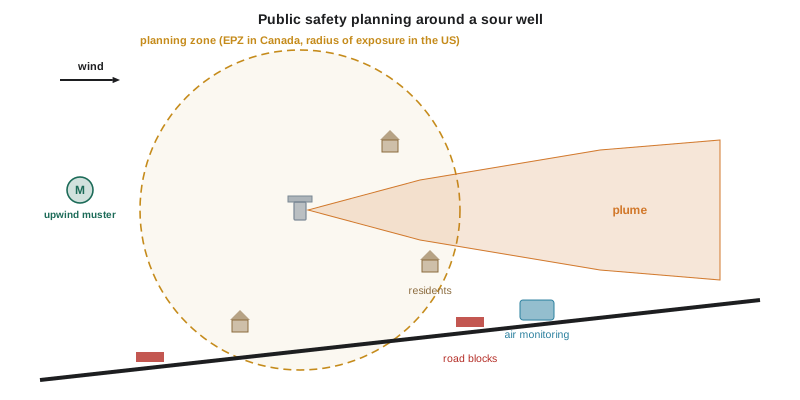
Two protective actions are used for the public. Shelter in place means staying indoors with doors and windows closed and ventilation systems off, which is often safer than going outside into a moving plume, especially for short releases. Evacuation means leaving the area along a route away from the plume, which is better for long releases or when there is enough warning. Operators plan for people who need help, such as residents without vehicles or with mobility limitations, and for schools and workplaces in the zone.
Igniting a sour gas release is a last-resort public protection measure. Burning the gas converts hydrogen sulfide into sulfur dioxide, which is far less toxic, and turns an invisible ground-level hazard into a rising plume. Plans for critical sour wells set criteria for when the incident commander should order ignition, such as air monitoring showing H2S above set levels at the edge of the zone or a release that cannot be controlled. Ignition is done by trained specialists with dedicated equipment, never improvised by workers.
When the alarm sounds
Every worker on site has the same basic duties in an emergency, whatever their employer:
- Stop work and make your own work safe only if you can do so in seconds, for example by closing a valve you are holding.
- Check the wind direction using the wind socks and move upwind and, for heavy gases, uphill, to the designated muster point. If the muster point is downwind, go to the alternate one.
- If gas is involved, keep your monitor on and do not enter areas where it alarms.
- Report to the muster point coordinator so that you are counted. Never leave the site without being accounted for; a missing person triggers a search that can put rescuers at risk.
- Tell the coordinator about anyone you know is missing, injured or still in the hazard area, and what you saw.
- Do not attempt a rescue in a toxic or flammable atmosphere unless you are trained and equipped to do so.
- Follow the instructions of the incident commander and do not return to the site until it is declared safe.
Medical emergencies at remote sites
Distance to care shapes medical emergency planning. Plans must state how an injured worker will reach a hospital, how long that takes by road and air, and where an air ambulance can land; some operators register their sites' coordinates with air medical services in advance. OSHA requires that, in the absence of an infirmary, clinic or hospital in near proximity, a person adequately trained in first aid be available, and that suitable eyewash and drenching facilities be provided where corrosive materials are used. Cardiac arrest is a real risk among oil and gas workers, about 15 percent of deaths in the NIOSH FOG data, so automated external defibrillators and CPR training (HSE-111) are valuable even when not required.
Estimating how far a release travels
Emergency planning zones and radii of exposure are calculated with approved models and professional judgment. The program below uses a much simpler Gaussian plume formula, a standard textbook method, to show how the concentration of hydrogen sulfide from a continuous release falls with distance downwind under one set of weather conditions. It is a teaching illustration only: it must never be used to size a planning zone or make emergency decisions. Real releases depend on release rate and duration, terrain, buildings, weather stability and gas density, which this simple model ignores.
import math
# Teaching illustration only: ground-level concentration on the plume axis from a
# continuous ground-level release (Gaussian plume, neutral stability, rural).
Q_g_s = 500.0       # g/s of H2S released (illustrative)
u = 3.0             # wind speed, m/s
def sigmas(x):      # Briggs rural class D dispersion coefficients, x in m
    sy = 0.08 * x / math.sqrt(1 + 0.0001 * x)
    sz = 0.06 * x / math.sqrt(1 + 0.0015 * x)
    return sy, sz
for x in (100, 250, 500, 1000, 2000, 4000):
    sy, sz = sigmas(x)
    c = Q_g_s / (math.pi * u * sy * sz)          # g/m3 at ground level on the plume axis
    ppm = c * 1e3 * 24.45 / 34.08                # convert mg/m3 to ppm at 25 C
print(f"{x:5d} m ({x * 3.281:6.0f} ft): about {ppm:8.1f} ppm H2S")100 m ( 328 ft): about 854.6 ppm H2S 250 m ( 820 ft): about 150.6 ppm H2S 500 m ( 1640 ft): about 43.0 ppm H2S 1000 m ( 3281 ft): about 13.1 ppm H2S 2000 m ( 6562 ft): about 4.3 ppm H2S 4000 m ( 13124 ft): about 1.6 ppm H2S
Even this simple model shows the key point: a continuous release of about 0.5 kg of hydrogen sulfide per second, far smaller than a large sour well blowout, can produce concentrations above 100 ppm, the IDLH, more than 820 ft (250 m) downwind, and concentrations above the ACGIH threshold limit value of 1 ppm for several kilometers. That is why sour operations need public safety planning, why workers move upwind rather than simply away, and why air monitoring at the edge of a zone matters during a response.
Exercises and readiness
A plan that has never been practiced rarely works as written. Regulators and good practice call for regular exercises: tabletop exercises that walk through a scenario in a meeting room, drills that practice one function such as a muster and headcount, functional exercises that test communications and command, and full-scale exercises that involve emergency services. Exercises reveal outdated phone numbers, muster points that are downwind in the prevailing wind, radios that do not reach, and roles nobody understands. Every exercise should end with a review and actions to improve the plan.
Worked problem
An H2S alarm during a site drill
During a planned drill at Pinecrest, the site supervisor sounds the H2S alarm and announces a simulated release at the battery inlet separator. The wind is from the north-west. Twelve workers from four companies are on site, including two visitors with an escort. What should happen in the first ten minutes, and what should the review look for?
Show solution
- Workers stop work, check the wind socks and move upwind, toward the north-west, to the muster point on that side. Those near the battery leave by routes that do not pass the separator.
- The muster coordinator counts everyone against the sign-in sheet. The escort brings both visitors. Anyone missing is reported immediately to the incident commander, who decides on a search by trained, equipped responders only.
- The incident commander notifies the operator's emergency line and, in a real event, emergency services and the regulator within the required time, and starts air monitoring and road control if the public could be affected.
- The review checks how long the headcount took, whether anyone went to the wrong muster point, whether everyone heard and understood the alarm, whether visitors were accounted for and whether contact numbers in the plan worked.
Answer: Upwind muster, complete headcount including visitors, prompt notification by the incident commander, and a review that tests timing, routes, communication and contacts.
Common mistakes
MistakeRunning to the usual muster point without checking the wind.
InsteadCheck the wind socks and use the upwind muster point.
MistakeLeaving the site during an emergency without reporting to the muster point.
InsteadAlways be counted; a missing person triggers a dangerous search.
MistakeAssuming the public is the operator's problem, not the crew's.
InsteadKnow that sour operations need public safety planning and that crews may be asked to help with road blocks and monitoring under direction.
MistakeTreating drills as a nuisance.
InsteadUse them to find and fix problems before a real emergency.
MistakeUsing a simple plume calculation to decide how far to evacuate.
InsteadUse approved models and the plan's zones; simple formulas are for understanding only.
Summary and key terms
- Oil and gas ERPs must cover toxic and flammable releases, fires, well control, pipelines, spills, medical emergencies, vehicles, weather and security.
- Key elements include scenarios, alarms, muster points, command, notification, public protection, medical response, resources, exercises and review.
- The incident command system lets many organizations work under one structure.
- Rules such as Texas Statewide Rule 36 use radius of exposure calculations to decide when H2S contingency plans are needed; OSHA requires emergency action plans for workers.
- Shelter in place and evacuation protect the public; ignition of a sour release is a last resort carried out by specialists.
- When the alarm sounds: make safe only if quick, move upwind to the muster point, be counted, report what you know and do not attempt untrained rescues.
- Remote sites need planned medical transport, first aid resources and regular exercises.
- Emergency response plan (ERP)
- A documented plan setting out who does what, with what resources, in an emergency.
- Incident command system (ICS)
- A standard structure for managing emergencies with one commander and defined sections.
- Emergency planning zone (EPZ)
- In Canadian regulation, the area around a sour or HVP operation where public safety planning is required.
- Radius of exposure (ROE)
- In US H2S rules, the distance at which a release could produce a set H2S concentration.
- Shelter in place
- Staying indoors with doors, windows and ventilation closed to avoid a passing plume.
- Muster point
- A designated gathering place where people are counted in an emergency.
- Ignition criteria
- Pre-set conditions under which a sour gas release will be deliberately ignited to protect the public.
Practice problems
Work each problem on paper first, then reveal the answer to check.
Name six kinds of emergency an oil and gas ERP should cover.
Show answer
Any six of toxic gas release, fire or explosion, well control, pipeline rupture, spill, medical emergency, vehicle collision, severe weather or wildfire, security.
What is the purpose of the incident command system?
Show answer
To give all responding organizations a common structure under one commander or unified command.
What does Texas Statewide Rule 36 use to decide when an H2S contingency plan is needed?
Show answer
Radius of exposure calculations at 100 ppm and 500 ppm reaching public areas or roads.
What are the two main protective actions for the public?
Show answer
Shelter in place and evacuation.
Why might a sour gas release be deliberately ignited?
Show answer
To convert H2S into far less toxic sulfur dioxide and lift the plume, protecting the public.
What should you check before going to a muster point?
Show answer
The wind direction, so you go to the upwind muster point.
Why must everyone report to the muster point?
Show answer
So that everyone is counted; a missing person triggers a search that can endanger rescuers.
What share of NIOSH FOG deaths were cardiac?
Show answer
About 15 percent (69 of 470).
Name three kinds of exercise.
Show answer
Any three of tabletop exercises, drills, functional exercises, full-scale exercises.
Can the plume program be used to size a planning zone?
Show answer
No; it is a teaching illustration only. Approved models and professional judgment are required.
Lesson quiz · 5 questions
Score 60% or more to complete this lesson.
Create a free account to save your progress, take quizzes and earn a certificate.