
HSE-330 · Lesson 12 of 12 · 27 min
Capstone: an orientation and hazard review for a well pad and battery
This capstone brings the course together at the invented Pinecrest pad and battery. A well servicing crew is about to arrive to work over one of the eight producing wells while the rest of the pad and the battery keep producing. You have been asked, as a new field safety coordinator for Larchwood Resources, to do three things: review the site before the crew arrives and rank what you find, prepare the site-specific orientation the crew will receive, and check the emergency arrangements for the job. Each part uses the lessons of this course, and each points ahead to the deeper courses in the oil and gas sites track.
The site, people and findings in this lesson are invented for teaching. They are typical of real sites, and the way of working, walking the site with the energy wheel in mind, ranking findings by risk and turning them into specific actions, applies anywhere.
The job and the site
The job is a five-day workover of well 4 on the Pinecrest pad, about 40 miles (64 km) south of Watford City, North Dakota, to replace production tubing. A well servicing contractor will bring a workover rig, a pump truck, a tank truck and a crew of seven; a wireline company will attend for one day; and trucking contractors will haul fluids. The operator's company man will be on site daily. The other seven wells will keep producing to the tank battery, which has an inlet separator, a heater-treater, a compressor, four tanks, a flare and a pipeline riser. Associated gas contains about 0.5 percent hydrogen sulfide (5,000 ppm). The lease road is 9 miles (14 km) of gravel. It is late October, with daytime temperatures near 32 °F (0 °C), frequent wind and early darkness. Larchwood's company man will act as the controlling employer's representative on site.
Part 1: the pre-job site review
You walk the site two days before the job with the lease operator, using the energy wheel to prompt each form of energy and checking against the lessons of this course. The figure shows the site and the numbered findings, and the table lists them.
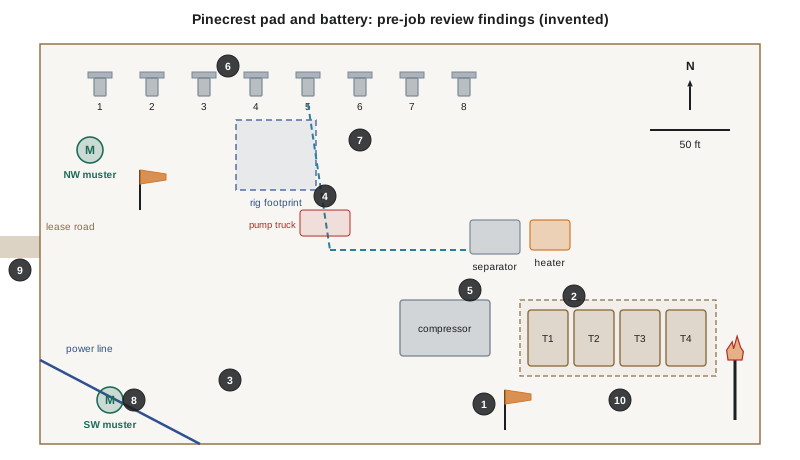
| No. | Finding | Energy and lesson |
|---|---|---|
| 1 | Only one wind sock is visible from the rig location; the second is hidden behind the compressor building | Chemical; Lessons 3 and 11 |
| 2 | Tank 2 thief hatch gasket is damaged and the hatch does not seal; manual gauging is still the routine method | Chemical; Lessons 4 and 6 |
| 3 | The planned rig position puts the mast within reach of the overhead power line when raised | Electrical; Lesson 8 |
| 4 | Flowline from well 5 runs under the planned pump truck location; it is not on the locate ticket because it is a private line | Pressure and chemical; Lesson 9 |
| 5 | Two of the four battery gas monitors in the site shack are past their calibration date | Chemical; Lesson 5 |
| 6 | Pump jack on well 3 has a missing section of fence on the side facing the rig area | Mechanical; Lesson 8 |
| 7 | A hammer union of a different pressure rating is mixed in with the site's temporary iron | Pressure; Lesson 7 |
| 8 | The muster point on the south-west is downwind of the battery in the prevailing north-west wind | Chemical; Lesson 11 |
| 9 | Journey management for night trips on the lease road is informal, and cell coverage drops 5 km (3 miles) from the pad | Motion; Lesson 3 |
| 10 | The SIMOPS plan does not mention the scheduled condensate truck loading during the workover | Chemical and motion; Lesson 10 |
Ranking the findings
Not every finding is equally urgent. A simple risk matrix scores each finding for likelihood and severity from 1 to 5 and multiplies the two, as HSE-103 explained. The program below ranks the findings and assigns a response: findings scoring 15 or more must be fixed before the crew arrives, those from 8 to 14 need controls in place before the related task starts, and the rest go on the action list. The scores reflect the judgment of the review team; another team might score some differently, which is why scoring should be done together and the reasoning recorded.
findings = [  # (number, short description, likelihood 1-5, severity 1-5)
    (1, "second wind sock hidden", 4, 4),
    (2, "tank 2 hatch does not seal; manual gauging", 4, 5),
    (3, "rig mast within reach of power line", 3, 5),
    (4, "private flowline under pump truck spot", 3, 5),
    (5, "two monitors past calibration", 3, 5),
    (6, "pump jack fence missing", 3, 4),
    (7, "mismatched hammer union in iron", 3, 5),
    (8, "muster point downwind in prevailing wind", 4, 4),
    (9, "informal night journey management", 3, 4),
    (10, "SIMOPS plan misses truck loading", 3, 4),
]
def action(score):
    if score >= 15:
        return "fix before crew arrives"
    if score >= 8:
        return "control before related task"
    return "action list"
ranked = sorted(findings, key=lambda f: (-f[2] * f[3], f[0]))
for n, text, like, sev in ranked:
    s = like * sev
    print(f"#{n:<2} score {s:2d}  {action(s):28}  {text}")
print("Fix before arrival:", sum(1 for f in findings if f[2] * f[3] >= 15), "of", len(findings))#2 score 20 fix before crew arrives tank 2 hatch does not seal; manual gauging #1 score 16 fix before crew arrives second wind sock hidden #8 score 16 fix before crew arrives muster point downwind in prevailing wind #3 score 15 fix before crew arrives rig mast within reach of power line #4 score 15 fix before crew arrives private flowline under pump truck spot #5 score 15 fix before crew arrives two monitors past calibration #7 score 15 fix before crew arrives mismatched hammer union in iron #6 score 12 control before related task pump jack fence missing #9 score 12 control before related task informal night journey management #10 score 12 control before related task SIMOPS plan misses truck loading Fix before arrival: 7 of 10
Seven findings must be fixed before the crew arrives. The damaged tank hatch, combined with manual gauging on a sour site, scores highest, because the NIOSH and OSHA alert on tank gauging deaths shows how likely and how severe that exposure can be. The power line, the unlocated flowline, the out-of-date monitors and the mismatched union could each kill someone outright. The muster point downwind in the prevailing wind and the hidden wind sock would send people the wrong way in an H2S release. The other three findings still need controls before the related work starts.
Turning findings into actions
Each finding needs a specific action with an owner and a date, not a general reminder. For the highest-ranked findings, the actions agreed were:
- Tank 2: replace the hatch gasket before the job, stop manual gauging of tank 2 until it seals, and bring forward the planned installation of remote tank gauging (Lesson 6).
- Power line: move the rig position 50 ft (15 m) east so that the raised mast stays outside the limit of approach, mark the line with goal posts and require a spotter for all mast and boom movements (Lesson 8).
- Private flowline: arrange a private locate, mark the line, move the pump truck location off it and add a ground protection mat where vehicles must cross (Lesson 9).
- Gas monitors: remove the two overdue monitors from the shack, calibrate them, and check that every worker's personal monitor is bumped daily (Lesson 5).
- Hammer union: remove it from the site and check the remaining iron for matched, certified ratings before rig-up (Lesson 7).
- Muster point and wind sock: relocate the second muster point to the north-east, install an extra wind sock visible from the rig, and update the site plan and ERP (Lessons 3 and 11).
Part 2: the site-specific orientation
The service crew, the wireline crew and the truck drivers have all completed industry orientation and H2S training, but none has been to Pinecrest. The orientation you prepare should take about twenty minutes, be given at the start of the first shift and whenever a new person arrives, and cover the topics in the table from Lesson 3, made specific to this job. Its key messages for Pinecrest are:
- Who is in charge: Larchwood's company man, acting for the controlling employer, and the well servicing contractor's rig supervisor, with their radio channel and phone numbers.
- The hazards that make Pinecrest different: sour gas at 5,000 ppm in the producing wells and battery, simultaneous production during the workover, the overhead line, the private flowlines, and the pump jacks that start on timers.
- Site rules: four-gas monitors bumped and worn at all times; no entry to the battery or tank tops without the lease operator's permission; no manual gauging of tank 2; permits for hot work and line opening; phones only in the site trailer and vehicles; parking in the marked area facing out.
- Alarms and emergencies: what the site H2S alarm sounds like, the two muster points and how to choose between them by the wind socks, headcount at the muster point, never attempting an unprotected rescue, and the air ambulance landing area and road travel time to hospital.
- Coordination: daily 07:00 meeting for all companies on site, SIMOPS controls for truck loading during the workover, and stop work authority for everyone.
- Reporting: report hazards, near misses and injuries to the company man and your own supervisor; you can stop or refuse work you believe is unsafe.
A good orientation is a conversation, not a lecture. Walk the crew to the muster points, show them the wind socks and the overhead line, and ask each person to say which muster point they would use if the wind were from the south-east. Check understanding rather than collecting signatures alone.
Part 3: checking the emergency arrangements
The workover changes the site's emergency picture. More people are on site, a rig is working on a sour well, fluids are being trucked, and darkness falls early. The checks you make with the wellsite supervisor and rig manager are:
| Check | Question | Result at Pinecrest |
|---|---|---|
| Scenarios | Does the ERP cover a well control incident or H2S release on well 4 during the workover? | Yes; the rig contractor's well control plan is bridged to Larchwood's ERP |
| Planning zone | Do the release rate and H2S content of well 4 change the planning zone or resident contacts? | No change, but the resident contact list is refreshed for the job |
| Muster and headcount | Can the headcount account for rig, wireline and truck crews arriving at different times? | A sign-in board at the trailer and a radio check at shift change were added |
| Breathing apparatus | Is enough supplied-air equipment on site, inspected and with trained users? | The rig crew brings SCBA and a cascade system; two lease staff are trained |
| Medical | How long to hospital by road, and where can an air ambulance land? | About 75 minutes by road; landing area marked 660 ft (200 m) west of the pad |
| Communication | Do radios work at both muster points, and is there a satellite backup? | Radios work; a satellite phone is kept in the trailer |
| Exercise | Has the crew practiced the H2S muster at this site? | A muster drill is scheduled for the first morning |
What the track covers next
This course has given an orientation-level view of oil and gas sites. The next three courses go deeper into the work that most often goes wrong:
- HSE-331, Drilling and Well Site Hazards: rig floor and pipe handling, well control basics, well servicing and completions, and working with drilling contractors.
- HSE-332, Facility and Pipeline Safety: batteries, compressor stations and gas plants, pressurized equipment, isolation and blinding, pipeline right-of-way hazards, pigging and maintenance.
- HSE-333, Permit to Work and Isolation in Oil and Gas: safe work permits, energy isolation planning, simultaneous operations and permit handover.
Worked problem
One more check before rig-up
On the first morning, as the rig arrives, the rig manager tells you the crew wants to move the pump truck back onto its original position because the ground protection mat over the flowline is in the way of their hose layout. What do you do?
Show solution
- Stop the move and talk it through with the rig manager and the wellsite supervisor before anything changes. The original position puts the heavy pump truck over a sour flowline that the review identified as a serious hazard.
- Look for another layout that meets the crew's needs without loading the flowline, such as rearranging the hoses or moving the tank truck.
- If a change to the plan is needed, treat it as a change: reassess the hazard, update the site plan and tell everyone at the coordination meeting.
- Record the discussion. The fact that the crew raised the issue openly is a good sign; the aim is to solve the problem together, not to win an argument.
Answer: Pause the move, find a layout that keeps the pump truck off the flowline, manage any change formally and communicate it to everyone.
Common mistakes
MistakeWriting findings as general reminders such as be careful near tanks.
InsteadWrite specific actions with an owner and a date.
MistakeGiving a generic orientation that could apply to any site.
InsteadMake the orientation specific to the site, the job and the day's hazards.
MistakeAssuming the existing ERP covers a workover without checking.
InsteadCheck scenarios, headcount, equipment, medical response and communication for the job.
MistakeLetting a crew change the agreed layout because it is inconvenient.
InsteadManage changes formally and reassess the hazard.
MistakeCollecting signatures as proof that people understood.
InsteadCheck understanding by asking questions and walking the site.
Summary and key terms
- A pre-job review uses the energy wheel and the course lessons to find hazards across the whole site, not only at the work location.
- Ranking findings by likelihood and severity sorts what must be fixed before work from what needs controls before a task.
- Each finding needs a specific action with an owner and a date.
- A site-specific orientation covers who is in charge, the site's particular hazards, rules, alarms and muster points, coordination and reporting, and checks understanding.
- Jobs such as workovers change the emergency picture; check scenarios, planning zones, headcount, breathing apparatus, medical response, communication and drills.
- Changes on the day must be managed formally, not accepted for convenience.
- HSE-331, HSE-332 and HSE-333 build on this orientation for drilling, facilities and pipelines, and permits and isolation.
- Pre-job site review
- A walk-through of a site before a job to identify and control hazards.
- Risk matrix
- A table that scores hazards by likelihood and severity to rank them.
- Workover
- Work on an existing well to repair or improve it, often with a service rig.
- Action list
- A list of findings with specific actions, owners and dates.
- Management of change
- A process for reviewing and approving changes to plans, equipment or procedures before they are made.
- Muster drill
- A practice evacuation to muster points with a headcount.
- Field safety coordinator
- A person who supports supervisors and crews with hazard reviews, orientations and safety planning on site.
Practice problems
Work each problem on paper first, then reveal the answer to check.
Which finding scored highest in the Pinecrest review, and why?
Show answer
The tank 2 hatch that does not seal with manual gauging, because tank gauging exposures are both likely and potentially fatal.
What score threshold required a fix before the crew arrived?
Show answer
15 or more.
How was the power line finding resolved?
Show answer
Moving the rig position east, marking the line with goal posts and requiring a spotter for mast and boom movements.
Why was the private flowline not on the locate ticket?
Show answer
It is a private line owned by the operator and not registered with the one-call system.
What was wrong with the south-west muster point?
Show answer
It was downwind of the battery in the prevailing north-west wind.
Name four key messages of the Pinecrest orientation.
Show answer
Any four of who is in charge, sour gas and site hazards, site rules, alarms and muster points, coordination and SIMOPS, reporting and the right to refuse.
How should understanding of an orientation be checked?
Show answer
By asking questions and walking the site, not only by collecting signatures.
Name three emergency arrangements checked for the workover.
Show answer
Any three of scenarios, planning zone, muster and headcount, breathing apparatus, medical response, communication, exercises.
What should happen if a crew wants to change the agreed layout?
Show answer
Pause, reassess, find a safe alternative and manage the change formally with communication.
Which course covers permits and isolation in oil and gas?
Show answer
HSE-333.
Lesson quiz · 5 questions
Score 60% or more to complete this lesson.
Create a free account to save your progress, take quizzes and earn a certificate.