
HSE-330 · Lesson 3 of 12 · 28 min
Site access, orientation and journey management
For many oil and gas workers the most dangerous part of the day is not the work at the wellhead but the drive to get there and the first few minutes after arriving. Lesson 1 showed that vehicle incidents are the leading cause of death in the industry. Newcomers who arrive without the right training, equipment or information, who park in the wrong place or who do not know where to go if an alarm sounds, add risk for everyone on site. This lesson covers what to do before you leave, how journey management controls driving risk, how to arrive and sign in, what a good site orientation contains and how sites keep track of people who work alone.
HSE-252, Defensive Driving and Fleet Safety, covers driving skills, fatigue, hours of service and fleet programs in depth, and its capstone builds a full journey management plan. This lesson applies those ideas to oil and gas travel and adds the site-arrival rules that are specific to the industry. HSE-104 covers protective equipment in general, and HSE-243 covers heat and cold stress.
Before you go
Arriving ready starts days before the trip. Most operators require proof of industry training before a worker can be oriented to a site. In US oil and gas a common minimum is a basic orientation such as SafeLandUSA, hydrogen sulfide awareness training, first aid and CPR, hazard communication and, for drivers, hazardous materials training and the required commercial license, plus task training such as confined space, fall protection or excavation competent person. Contractors are often checked through prequalification systems before they are allowed on site. Workers should carry their cards or have them available in the company's training records, because a gate check that finds expired H2S training will turn the worker away.
The second part of being ready is the right equipment. Oil and gas sites almost always require flame-resistant clothing, commonly meeting NFPA 2112, together with a hard hat, safety boots, safety glasses and gloves suited to the task, and hearing protection where noise is high. On sites where hydrogen sulfide may be present, a personal gas monitor is required, often a four-gas monitor; Lesson 5 explains how to check it. Pack for the weather and for the possibility of being stuck: in a northern plains winter, that means a vehicle survival kit with warm clothing, food, water, a shovel, a way to call for help and enough fuel. Finally, be fit for duty. Arriving tired, ill or impaired by alcohol, drugs or medication puts others at risk as well as you, and most operators run fitness-for-duty and drug and alcohol testing programs, which are mandatory for commercial drivers under federal rules.
Why driving dominates the risk
Oilfield driving combines many risk factors at once. Workers drive long distances, often before dawn or after dark, at the start or end of long shifts. Many roads are gravel lease roads that are narrow, dusty in summer and icy or rutted in winter, shared with loaded tankers, rig moves and wide loads. Wildlife crossings are common. Cell coverage is patchy. A NIOSH study of US oil and gas extraction workers from 2003 to 2009 found a motor vehicle fatality rate 8.5 times that of all private-sector workers (7.6 compared with 0.9 per 100,000 workers). Pickup trucks were the most common vehicle involved, and seat belts were not being used in at least 38 percent of the deaths. Wearing a seat belt on every trip, including short trips across a lease, is the single most effective thing a driver can do.
Journey management
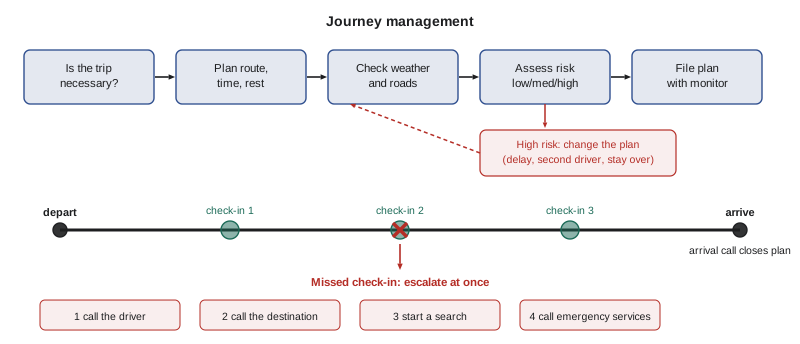
Journey management is a planned, tracked system for work travel. It asks four questions before each trip: is the trip necessary, can it be combined with others or done at a safer time, what are the risks of the route and conditions, and how will the traveler be tracked until arrival? A journey plan records the route, departure time, expected arrival, rest stops, check-in times and the person responsible for monitoring the trip. If a traveler misses a check-in, the monitor follows a set escalation: try to contact the driver, then contact the destination, then start a search and notify emergency services. Many operators use GPS tracking and satellite devices, but the core is the same: someone knows where you are and will act if you do not arrive.
Lease and county roads have their own hazards. Many oilfield roads are narrow gravel roads used by loaded water haulers, crude tankers, rig moves and wide loads, often with no shoulders and steep ditches. Drive with headlights on, keep to the right, yield to loaded trucks, slow down for dust, never pass in dust, and watch for livestock and wildlife at dawn and dusk. Some operators require drivers to call their position on a radio channel on busy lease roads. In the spring, road restrictions and soft ground limit heavy traffic, and some lease roads become impassable; in winter, blowing snow and ice on the northern plains demand lower speeds and more following distance.
Professional drivers are also bound by federal hours-of-service rules from the Federal Motor Carrier Safety Administration, which limit property-carrying drivers to 11 hours of driving within a 14-hour window after 10 hours off duty. The rules contain oilfield provisions, including a shorter restart period for drivers of vehicles used exclusively in oilfield operations and an exclusion for waiting time at oil and gas sites. Light-vehicle drivers are not covered by those rules, but employers must still manage fatigue as a hazard, and many limit total work plus driving time in a day, ban driving after very long shifts and require rest breaks on long trips.
The program below checks a simple journey plan for a day trip to Pinecrest: it adds up driving time, inserts a rest stop at least every two hours, sets check-in times and tests the plan against an invented company rule limiting the combined work and driving day to 14 hours. Speeds and times are illustrative.
# Journey plan check for an invented day trip (all values illustrative).
legs = [  # (description, distance mi, planned speed mph)
    ("Williston yard to highway junction", 30, 55),
    ("Highway to lease road turnoff", 11, 50),
    ("Lease road to Pinecrest pad", 9, 25),
]
depart = 6.0            # 06:00
work_hours = 8.5        # planned time on site
rule_day = 14.0         # company limit on work plus driving
t, since_break, total_drive = depart, 0.0, 0.0
def hm(x):
    return f"{int(x):02d}:{int(round((x % 1) * 60)) % 60:02d}"
print("Outbound:")
for name, mi, v in legs:
    d = mi / v
    if since_break + d > 2.0:
        t += 0.25; since_break = 0.0
        print(f"  {hm(t)} rest stop 15 min")
    t += d; since_break += d; total_drive += d
    print(f"  {hm(t)} reached end of: {name} ({mi} mi) - check in")
arrive = t
leave = arrive + work_hours
back = leave + total_drive
day = back - depart
print(f"On site {hm(arrive)} to {hm(leave)}, home about {hm(back)}")
print(f"Driving {2 * total_drive:.1f} h, total day {day:.1f} h")
print("Within company limit" if day <= rule_day else "Exceeds limit: change the plan")Outbound: 06:33 reached end of: Williston yard to highway junction (30 mi) - check in 06:46 reached end of: Highway to lease road turnoff (11 mi) - check in 07:08 reached end of: Lease road to Pinecrest pad (9 mi) - check in On site 07:08 to 15:38, home about 16:45 Driving 2.3 h, total day 10.8 h Within company limit
The plan fits the invented company rule, but only just, and only if the work finishes on time. A real journey plan would also check the weather and road reports, daylight hours and whether the worker had enough rest the night before, and would decide in advance what happens if the job overruns: an overnight stay, a second driver or a pickup.
Arriving and signing in
Arrival is a short but critical step. Before entering the lease, stop at the entrance and read the signs. They usually give the site name and legal location or address, the operator's emergency number, hazard warnings such as hydrogen sulfide or sour gas, PPE requirements and directions to the sign-in point. Look at the wind socks: most sites have at least two so that the wind direction can be seen from any approach. Note where the muster points are. If an alarm or flare is sounding or the site is obviously in an upset condition, do not enter; stay upwind, call the site contact and wait for direction.
Every person on a site must be accounted for, so sign in at the gate shack, office trailer or electronic sign-in point, and sign out when you leave. Park where you are told, usually in a designated area away from wellheads, tanks and process equipment and outside the hazard zone, and back in so that you can drive straight out in an emergency. Do not leave engines idling near wellheads or tanks, because a vehicle is an ignition source. Phones and other non-intrinsically safe electronics are usually banned from hazardous areas around wellheads, tanks and process equipment; follow the site rules on where they may be used.
What a site orientation should cover
A good site-specific orientation is short and practical and is given before any work starts. It should tell a newcomer the things in the table below, and it should give them a chance to ask questions. Many sites record each orientation with the worker's signature, and require a fresh orientation when site conditions change significantly, such as at the start of fracturing or when a sour well is brought on.
| Topic | What the newcomer should learn |
|---|---|
| Who is in charge | The site supervisor, prime contractor or controlling employer representative, and how to reach them |
| Site layout | Wellheads, tanks, process equipment, flare, hazardous areas, parking, offices and washrooms |
| Specific hazards | Sour gas or H2S concentrations, high-pressure work, overhead lines, buried pipelines, current simultaneous operations |
| Site rules | PPE, smoking and ignition sources, phones, speed limits, permits needed, restricted zones |
| Alarms and emergencies | Alarm sounds and lights, muster points, wind direction, evacuation routes, emergency contacts |
| Gas monitoring | Required monitors, alarm set points, what to do on an alarm |
| Reporting | How to report hazards, near misses and injuries, and the right to refuse unsafe work |
| First aid | Where first aid kits, eyewash and trained first aiders are, and how evacuation by road or air works |
Working alone and check-ins
Lease operators, truck drivers and maintenance staff often work alone at remote sites. OSHA has no general standard for working alone, but employers must still protect workers from recognized hazards under the general duty clause, and specific standards prohibit some tasks without a second person, such as permit-required confined space entry without an attendant. Good practice is to assess the hazards of working alone and control them with check-in calls at set intervals, automated man-down and lone-worker devices, satellite communicators where there is no cell coverage, rules that prohibit certain tasks alone (such as entering a confined space or working where H2S may exceed set limits) and a clear response if a check-in is missed.
Check-in intervals should match the hazard. A worker doing routine inspections at a sweet gas site might check in every two to four hours; a worker gauging tanks at a sour site might be required to check in before and after each task, or not do that task alone at all. The response to a missed check-in must be planned in advance: who will call, how long they will wait, who will drive out and what that person must not do, such as enter a building or tank area without a gas monitor. Rescuers are themselves killed when they rush in to help a collapsed worker without checking for gas; Lesson 6 returns to this.
Worked problem
Planning a winter visit to Pinecrest
A contractor technician is booked to calibrate meters at Pinecrest on a January day with a forecast low of −30 °F (−34 °C) and blowing snow. She will drive alone from Williston. What should the journey plan and arrival include?
Show solution
- Check whether the trip is necessary today. If the work can wait for better weather without creating a hazard, reschedule. If not, plan to travel in daylight.
- File a journey plan with her supervisor: route, departure, expected arrival, check-in times and the escalation if she misses one. Confirm road reports and that her vehicle has a full tank, winter tires and a survival kit.
- Confirm her tickets and equipment: flame-resistant winter clothing, a bumped four-gas monitor, and a satellite communicator because coverage on the lease road is poor.
- At the lease entrance, read the signs, check the wind socks and call the site contact before entering. Sign in, park in the designated area facing out, and receive the site orientation if she has not had one for this site.
- Agree check-in times while on site that suit the work and the cold, and plan to leave with enough daylight and fuel for the return trip.
Answer: Question the trip and its timing, file a journey plan with check-ins and escalation, carry winter gear and a working gas monitor and communicator, follow the arrival routine, and set on-site check-ins.
Common mistakes
MistakeSkipping the seat belt on short drives across the lease.
InsteadWear a seat belt on every trip; many fatal crashes involve unbelted occupants.
MistakeDriving to a remote site without telling anyone the route or arrival time.
InsteadFile a journey plan with check-in times and an escalation for missed calls.
MistakeParking beside the wellhead with the engine running.
InsteadPark in the designated area, outside hazard zones, facing out, with the engine off.
MistakeDriving onto a site where an alarm is sounding to find out what is wrong.
InsteadStop outside, stay upwind and call the site contact for direction.
MistakeTreating a missed check-in as probably nothing.
InsteadFollow the planned escalation at once; a missed check-in may be a collapsed worker.
Summary and key terms
- Arrive ready: current industry training, the right PPE including flame-resistant clothing and a gas monitor, a winter or emergency kit and fitness for duty.
- Driving is the leading cause of death in the industry; wearing a seat belt on every trip is the most effective personal control.
- Journey management asks whether a trip is needed, plans the route and timing, tracks the traveler with check-ins and escalates missed calls.
- Lease and resource roads need lower speeds, headlights, care in dust and radio or call-in procedures where used.
- Hours-of-service rules limit professional drivers; employers must manage fatigue for all drivers.
- On arrival, read the signs, check wind socks and muster points, sign in, park in the designated place facing out and stay off a site in upset.
- Working alone must be assessed and controlled with check-ins, devices, task restrictions and a planned response to missed calls.
- Journey management
- A planned and tracked system for work travel with route, timing, check-ins and escalation.
- Check-in
- A scheduled call or signal confirming that a traveler or lone worker is safe.
- Wind sock
- A fabric cone on a pole that shows wind direction so that people can move upwind of a gas release.
- Muster point
- A designated place where people gather and are counted during an emergency.
- Site-specific orientation
- A briefing on the layout, hazards, rules and emergency arrangements of a particular site.
- Working alone
- Working where help is not readily available if the worker is injured or ill.
- Flame-resistant clothing
- Clothing made to resist ignition and self-extinguish, worn to reduce burns from flash fires.
Practice problems
Work each problem on paper first, then reveal the answer to check.
What four questions does journey management ask before a trip?
Show answer
Is the trip necessary, can it be combined or done at a safer time, what are the risks of route and conditions, and how will the traveler be tracked?
How much higher was the oil and gas motor vehicle fatality rate than for all private workers in the NIOSH study?
Show answer
About 8.5 times (7.6 compared with 0.9 per 100,000 workers).
What is the first escalation step when a driver misses a check-in?
Show answer
Try to contact the driver, then the destination, then start a search and call emergency services.
Why do sites have more than one wind sock?
Show answer
So that the wind direction can be seen from any approach and people can move upwind of a release.
Where and how should you park on a lease?
Show answer
In the designated area away from wellheads, tanks and process equipment, backed in to drive straight out, engine off.
What should you do if you arrive and an alarm is sounding?
Show answer
Stay outside the site, upwind, and call the site contact for direction.
Name four topics a site orientation should cover.
Show answer
Any four of: who is in charge, layout, specific hazards, site rules, alarms and emergencies, gas monitoring, reporting, first aid.
Give three controls for working alone.
Show answer
Any three of: check-ins at set intervals, lone-worker devices, satellite communicators, task restrictions, a planned response to missed check-ins.
Why might a phone be banned near a wellhead?
Show answer
It is not intrinsically safe and could ignite a flammable atmosphere.
In the journey plan example, what did the program check the total day against?
Show answer
An invented company limit of 14 hours of work plus driving.
Lesson quiz · 5 questions
Score 60% or more to complete this lesson.
Create a free account to save your progress, take quizzes and earn a certificate.