
HSE-323 · Lesson 7 of 12 · 28 min
Water-based systems: pre-action, water mist and impairments
Sprinklers are the most reliable fire protection technology ever developed, and most data halls are protected by them even when clean agents protect smaller rooms. Water has obvious drawbacks around electrical equipment, so data centers use particular kinds of sprinkler system designed to keep water out of the pipes until it is really needed. This lesson explains how wet, dry and pre-action systems and water mist work, what hazards they present to people who work around them, and why the most dangerous sprinkler system is one that has been shut off and forgotten. Impairment procedures, the rules for taking a system out of service safely, are a central part of the lesson.
Sprinkler hydraulics, water supplies and fire pumps are covered in DCE-440 Lesson 5, and the installation rules in NFPA 13. HSE-221, Permit-to-Work Systems, covers permits in general. This lesson focuses on the parts that people on site meet every day.
How sprinklers work
A sprinkler head is a heat-activated valve. The common type has a small glass bulb filled with a liquid that expands when heated; at the rated temperature, often 155 °F (about 68 °C) for ordinary heads, the bulb shatters, releasing a cap and letting water flow onto a deflector that spreads it over the area below. Each head operates individually. Only the heads heated by the fire open, which in most fires means one to a few heads. The film image of every sprinkler in a building discharging at once is wrong for ordinary systems, and understanding that helps people react calmly to a sprinkler operating.
Sprinklers are designed to control a fire, keeping it from growing and spreading, and often extinguish it. They are effective: in reported fires in buildings with sprinklers, deaths and property losses are far lower than in buildings without them. When sprinklers fail, the most common reason found in fire statistics is that the system had been shut off, usually for maintenance, construction or because of a leak, and had not been restored. That finding is why impairment management takes up much of this lesson.
Types of system
There are four main types of sprinkler system, distinguished by what is in the pipes before a fire and what lets water in.
| Type | Pipes contain | Water enters the pipes when | Typical data center use |
|---|---|---|---|
| Wet pipe | Water under pressure | Always present | Offices, corridors, loading docks, mechanical rooms |
| Dry pipe | Compressed air or nitrogen | A head opens and pipe pressure drops | Unheated areas at risk of freezing, such as docks and canopies |
| Pre-action, single interlock | Air or nitrogen, often supervised at low pressure | The detection system operates | Data halls, UPS and battery rooms |
| Pre-action, double interlock | Air or nitrogen | Detection operates and a head opens (pressure drops) | Data halls where accidental water release is most costly |
| Deluge | Air at atmospheric pressure; heads are open | Detection operates; all heads discharge | Rare in data centers; special hazards |
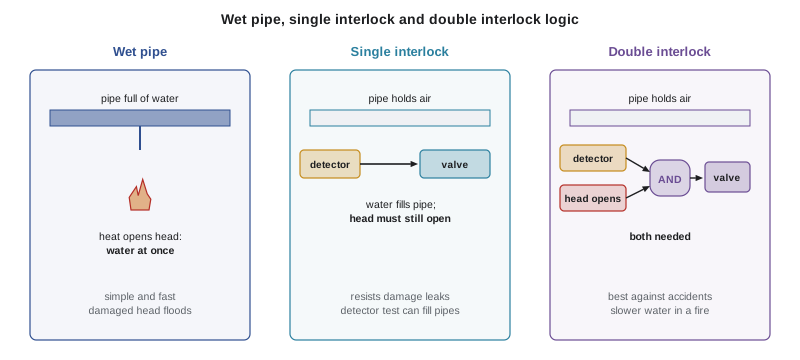
In a single interlock pre-action system, a signal from the detection system opens the pre-action valve and water fills the pipes, but no water discharges until a head opens from heat. If a pipe is damaged, the supervisory air pressure drops and an alarm sounds, but water does not enter the pipes. This protects against accidental discharge from mechanical damage to pipe or heads, which is a real risk in busy data halls where people move tall racks and ladders.
In a double interlock system, both events are needed before water enters the pipes: detection and the loss of air pressure caused by a head opening. Double interlock gives the strongest protection against accidental water release, but it delays water delivery in a real fire, because the pipes are still full of air when the first head opens and water must travel through the piping before it reaches the head. NFPA 13 limits that delay, and double interlock systems often need quick-opening devices or nitrogen to meet the limit. At Cedar Ridge, Hall 1 has double interlock and Hall 2 has single interlock, a mixed arrangement that people working in both halls should understand.
Hazards around sprinkler systems
Sprinkler systems are usually quiet and invisible, which makes it easy to forget their hazards. The main ones for people on site are these.
- Water near energized equipment. When a sprinkler discharges onto electrical equipment, water can conduct current to people, especially those standing in water on the floor. Equipment in the discharge area may short-circuit and arc. After any discharge, treat the area as an electrical hazard: do not wade through water near energized equipment, and let the electrical team and fire service decide on isolation.
- Stored pressure. Wet pipes hold water at system pressure, and dry and pre-action pipes hold compressed air or nitrogen, commonly at 10 to 40 psi (roughly 0.7 to 3 bar) in pre-action systems and higher in dry pipe systems. Loosening a fitting or removing a head on a pressurized pipe can cause a sudden release, a whipping pipe, a projectile cap or a flood.
- Accidental damage. Heads can be knocked off by ladders, lifts, tall racks and carts. A wet pipe head that is broken discharges at once; a pre-action head that is broken causes a supervisory alarm and, if detection then operates, water.
- Residual water. After a trip test or a discharge, water remains in pre-action and dry piping unless it is drained properly at the low points. Residual water causes corrosion and leaks, and in double interlock systems it can drip from loose fittings.
- Nitrogen generators. Many pre-action and dry systems use nitrogen to reduce internal corrosion. Nitrogen generators and their vents can lower the oxygen in small, poorly ventilated rooms. The equipment room should be ventilated as designed, and the manufacturer's warnings followed.
- Working at height near piping. Work on sprinkler piping often involves ladders or lifts; HSE-212, HSE-213 and HSE-220 apply.
Keeping sprinklers able to work
Sprinklers can only work if water can reach and leave the heads. People on site affect that every day.
- Keep the clearance below sprinkler deflectors free of storage and obstructions. NFPA 13 requires a minimum clearance, commonly 18 in (450 mm) below deflectors for storage, and larger for some hazards; cable trays, ductwork and containment panels installed after the sprinklers can create obstructions that need new heads.
- Never hang anything from sprinkler pipe, hangers or heads, including cables, signs, lights or decorations.
- Never paint, tape or cover sprinkler heads. Paint on the bulb or deflector changes how the head responds. Heads covered with bags during dusty work must be uncovered as soon as the work ends.
- Report damaged, corroded, leaking or loaded heads. Dust, lint or overspray on heads affects their operation.
- Keep sprinkler control valves accessible and do not close them, even to stop a leak, unless authorized; an authorized person must follow the impairment procedure.
Water mist
Water mist systems discharge water as very fine droplets, using high pressure, special nozzles or both. NFPA 750 classifies systems by pressure, with high-pressure systems at or above 500 psi (34.5 bar). The small droplets have a very large surface area, so they absorb heat quickly and turn to steam, which also displaces oxygen locally near the fire. Water mist uses far less water than sprinklers, which reduces water damage, and some systems are listed for data center and electrical hazards. They are found in some data halls, generator rooms and turbine enclosures.
Water mist brings its own hazards. High-pressure systems have pump skids or cylinder banks pressurized with nitrogen to drive the water, and their piping and fittings operate at pressures where a leak can cut skin or inject fluid under it. Only trained technicians should work on high-pressure mist systems, using the manufacturer's procedures. Mist systems also depend on small nozzle orifices that can be blocked by debris or corrosion, and on tight installation tolerances, so unauthorized changes are especially harmful. The steam produced can reduce visibility and, in small spaces, briefly reduce oxygen.
How much water?
When a pre-action head opens in a data hall, the amount of water released depends on how many heads operate, the flow from each head and how long it takes for someone to shut the system down once the fire is out. Flow from a sprinkler head follows Q = K × √P, where K is the head's discharge coefficient and P the pressure at the head. The program below estimates water released in an illustrative case. The values are invented for teaching; actual flows depend on the system design.
import math
# Teaching estimate of water released by operating sprinklers.
K = 80.0          # L/min per sqrt(bar), a common standard-response head (K5.6 in US units)
P = 1.0           # bar at the head (illustrative)
q = K * math.sqrt(P)   # L/min per head
for heads in (1, 2, 4):
    for minutes in (5, 15, 30):
        vol_L = heads * q * minutes
        print(f"{heads} head(s) for {minutes:2} min: {vol_L:6.0f} L "
              f"({vol_L/3.785:5.0f} US gal), {vol_L/1000:4.1f} m3")
print(f"One head flows about {q:.0f} L/min ({q/3.785:.0f} US gal/min)")1 head(s) for 5 min: 400 L ( 106 US gal), 0.4 m3 1 head(s) for 15 min: 1200 L ( 317 US gal), 1.2 m3 1 head(s) for 30 min: 2400 L ( 634 US gal), 2.4 m3 2 head(s) for 5 min: 800 L ( 211 US gal), 0.8 m3 2 head(s) for 15 min: 2400 L ( 634 US gal), 2.4 m3 2 head(s) for 30 min: 4800 L ( 1268 US gal), 4.8 m3 4 head(s) for 5 min: 1600 L ( 423 US gal), 1.6 m3 4 head(s) for 15 min: 4800 L ( 1268 US gal), 4.8 m3 4 head(s) for 30 min: 9600 L ( 2536 US gal), 9.6 m3 One head flows about 80 L/min (21 US gal/min)
Even one head running for 30 minutes releases about 2,400 liters (630 gal) of water, enough to flood a large area of floor and run into cable trenches, raised floors and rooms below. The water itself is usually less damaging than an uncontrolled fire, and sprinklers must never be shut off while a fire may still be burning. Once the fire service confirms that the fire is out, however, shutting the system down quickly and controlling run-off matter for the business. Sites usually train designated staff in how to close the correct control valve under the fire service's direction and how to restore protection afterwards.
Impairments
An impairment is any shutdown or condition that prevents a fire protection system from working as intended. NFPA 25 divides impairments into planned impairments, such as maintenance, modifications or construction, and emergency impairments, such as a broken pipe or a failed valve. It requires an impairment program run by an impairment coordinator, usually the building owner or someone the owner designates, and sets out what must happen before, during and after an impairment. Fire codes in both countries have similar requirements for fire alarm and other systems. The essentials are the same whatever the system.
- Before: assess the risk of the impairment and decide on precautions; obtain authorization; notify the fire department where required, the monitoring station, the insurer and the people in the affected area; tag the impaired system and its controls; and limit the area and time of the impairment.
- During: provide alternative protection as needed, such as a fire watch patrolling the area, extra portable extinguishers, temporary detection or a temporary water supply; stop hot work and other hazardous activities in the impaired area where possible; and keep work moving to finish quickly.
- After: restore the system fully, test it as required (for sprinklers, for example, a main drain test after a valve is reopened to prove water is available), remove tags, close the permit and notify everyone who was told of the impairment.
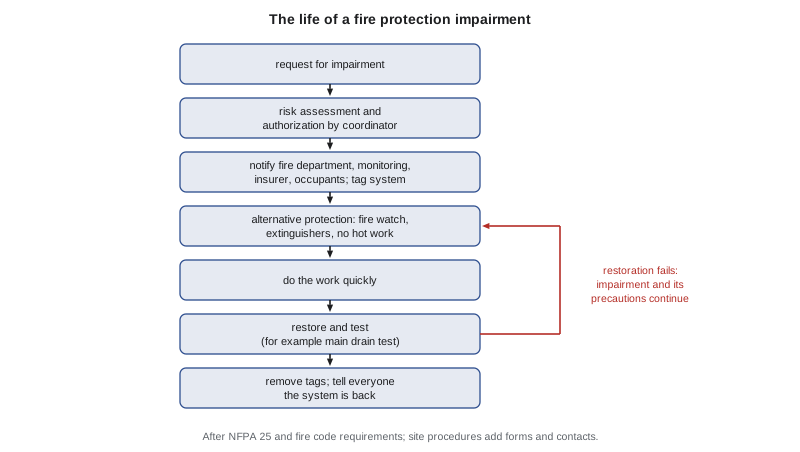
Impairments go wrong in predictable ways. A valve is closed to stop a leak and nobody records it. A contractor finishes late on a Friday and leaves the system in test. A fire watch is assigned but leaves to do other work. A detection zone isolated for dusty work is never restored because the person who isolated it went home. Sites guard against these failures with permits, valve locks and supervisory switches that alarm when a valve moves, a shift handover that reviews open impairments, and a rule that no impairment is closed until the system has been seen and tested in its normal state.
Worked problem
A leak in Hall 1
At 22:00 a technician at Cedar Ridge notices water dripping from a pre-action pipe joint above a row of customer racks in Hall 1. The pipe should contain only air. The panel shows no alarm. What should happen?
Show solution
- Protect the equipment and people: cover the racks below with plastic sheeting if it is safe to do so, keep people out of the drip area, and watch for water near power cables and power distribution units.
- Report it at once to the site operations lead, who contacts the fire protection contractor's emergency line. The water is probably residual water from the last trip test, but it shows the piping was not fully drained and that a joint is leaking.
- Do not close any valve or open any drain without authorization. If the fire protection contractor decides the system must be drained or valved off to repair the joint, that is an emergency impairment.
- If an impairment is needed, the coordinator authorizes it, notifies the monitoring station, insurer and, as required, the fire department, tags the valve and arranges a fire watch for the affected area of Hall 1.
- After repair, the contractor drains the piping fully, restores air pressure, returns the valve to normal, checks for a normal panel display and closes the impairment with notifications.
Answer: Protect equipment and people, report immediately, let the fire protection contractor diagnose and repair it under an emergency impairment with notifications and a fire watch, and confirm full restoration before closing the impairment.
Common mistakes
MistakeBelieving that every sprinkler head discharges when one operates.
InsteadKnow that ordinary heads operate individually, so usually only a few open in a fire.
MistakeClosing a sprinkler valve to stop a leak without telling anyone.
InsteadReport the leak; only an authorized person closes a valve, under an impairment procedure.
MistakeHanging cables or signs from sprinkler pipe.
InsteadSupport everything independently of the sprinkler system.
MistakeLeaving bags over sprinkler heads after dusty work.
InsteadRemove head covers as soon as the work ends and check them on handover.
MistakeWading through water to reach equipment after a discharge.
InsteadTreat the area as an electrical hazard and wait for isolation decisions.
Summary and key terms
- Sprinkler heads are individual heat-activated valves; usually only a few operate in a fire.
- The most common reason sprinklers fail in fires is that the system had been shut off.
- Data halls usually use pre-action systems: single interlock admits water on detection; double interlock needs detection and a head opening.
- Hazards include water near energized equipment, stored pressure, accidental damage, residual water and nitrogen generators.
- Keep clearance below heads, do not hang or paint anything on the system, and report damaged or leaking heads.
- Water mist uses fine droplets and often high pressure, with its own injection and pressure hazards.
- Impairments need authorization, notifications, tags, alternative protection such as a fire watch, and full restoration with testing.
- Double interlock
- A pre-action system that admits water only when both detection and loss of pipe pressure occur.
- Dry pipe system
- A sprinkler system with pressurized air or nitrogen in the pipes, admitting water when a head opens.
- Fire watch
- A trained person who patrols an area to detect and report fire while protection is impaired.
- Impairment coordinator
- The person responsible for authorizing and managing fire protection impairments.
- Main drain test
- A test that confirms water supply to a sprinkler system, often after a valve has been reopened.
- Single interlock
- A pre-action system that admits water to the pipes when the detection system operates.
- Water mist
- A system that discharges very fine water droplets to control or extinguish fire with little water.
Practice problems
Work each problem on paper first, then reveal the answer to check.
What makes an ordinary sprinkler head open?
Show answer
Heat breaks a glass bulb or melts a link at its rated temperature, often 155 °F (about 68 °C).
What is the most common reason sprinklers fail to operate in fires?
Show answer
The system had been shut off.
What lets water into the pipes of a single interlock pre-action system?
Show answer
Operation of the detection system.
What is the drawback of double interlock?
Show answer
Slower water delivery in a real fire because the pipes are still full of air when the first head opens.
Give three hazards of sprinkler systems to people on site.
Show answer
Any three of: water near energized equipment, stored pressure, accidental damage, residual water, nitrogen generators, work at height.
What clearance below deflectors is commonly required for storage?
Show answer
18 in (450 mm).
At what pressure does NFPA 750 classify water mist as high pressure?
Show answer
500 psi (34.5 bar) or more.
Roughly how much water does one head release in 30 minutes in the lesson example?
Show answer
About 2,400 liters (630 gal).
Name three steps before a planned impairment.
Show answer
Any three of: risk assessment, authorization, notifications, tagging, limiting the area and time.
What test is often done after reopening a sprinkler control valve?
Show answer
A main drain test.
Lesson quiz · 5 questions
Score 60% or more to complete this lesson.
Create a free account to save your progress, take quizzes and earn a certificate.