
HSE-323 · Lesson 2 of 12 · 28 min
Codes, standards and responsibilities
Fire suppression and liquid cooling systems sit where several bodies of rules meet. Occupational health and safety law protects the workers who maintain and work near these systems. Building and fire codes require fire protection, set how it is designed and decide how it must be inspected, tested and maintained. Installation standards for sprinklers, clean agents, carbon dioxide and fire alarms fill in the detail. Environmental law governs the agents and refrigerants that can harm the ozone layer or the climate. Hazard communication law covers the chemicals in coolants and agents. Mechanical and refrigeration codes cover cooling plant. This lesson maps these rules so that you know where a given requirement comes from and who is responsible for meeting it.
HSE-320 Lesson 2 introduced the safety framework for data centers, HSE-321 Lesson 2 mapped the electrical rules and HSE-322 Lesson 2 mapped the rules for battery systems. This lesson does not repeat those maps. As in those lessons, the editions named here are those current or newly published as of 2026, and the edition that applies at a particular site is the one adopted by the authority having jurisdiction. Clause numbers are deliberately not given; read the adopted documents themselves when you need the exact wording.
Layers of rules
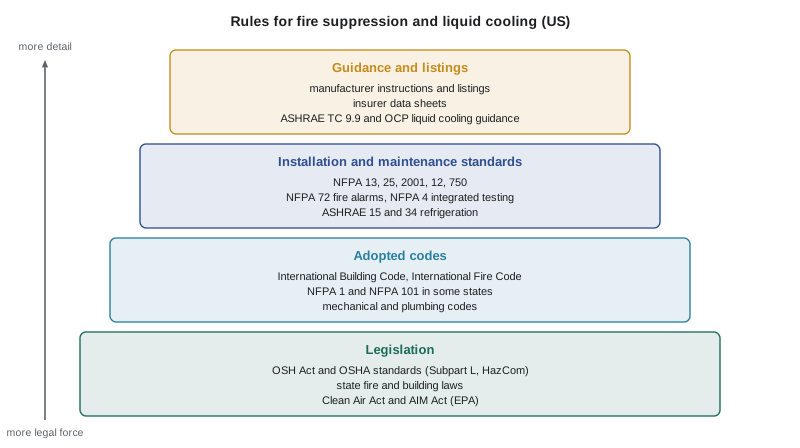
The rules come in layers. At the base is legislation: occupational health and safety statutes and regulations, and the fire and building legislation that adopts codes. Above that are the adopted codes, which require fire protection systems and their maintenance. The codes reference installation and maintenance standards, which become mandatory when called up. At the top are manufacturer instructions, insurer requirements and good practice guidance, which are not law in themselves but are often made binding by contracts, listings or the codes.
Occupational health and safety law
In the United States, the Occupational Safety and Health Act and the standards issued under it apply to most private-sector data centers, with approved state plans covering some states. Subpart L of the general industry standards (29 CFR 1910) covers fire protection, including portable fire extinguishers, fixed extinguishing systems in general, gaseous agent systems, fire detection systems and employee alarm systems. Among other things, these standards require that employees be warned before a fixed system discharges an agent at hazardous concentrations and be able to leave safely, and that systems be inspected and maintained. Other standards that apply here include the hazard communication standard for coolants, inhibitors, biocides and some agents, the respiratory protection and permit-required confined space standards, emergency action and fire prevention plans, personal protective equipment, and the requirement for eyewash and emergency showers where corrosive materials are used. The general duty clause covers recognized hazards not addressed by a specific standard.
Building and fire codes
Building codes decide which spaces need fire protection and what kind; fire codes govern how buildings are used and maintained, including how fire protection systems are inspected, tested and maintained over the life of the building. In the United States, the International Building Code and International Fire Code are the most widely adopted model codes, with NFPA 1, Fire Code, and NFPA 101, Life Safety Code, adopted in some states and used by many federal and health care facilities. States and cities adopt different editions, often years apart, so the edition at a site depends on its location. The fire code requires owners to keep fire protection systems in operating condition, to inspect, test and maintain them to referenced standards, to keep records, and to take specific measures, such as notifying the fire department and providing a fire watch, when a system is impaired. Integrated testing of fire protection and life safety systems, using NFPA 4, Standard for Integrated Fire Protection and Life Safety System Testing, is increasingly required for new buildings and after significant changes.
Installation and maintenance standards
Most of the technical rules for fire protection systems are in NFPA standards, which the codes in both countries reference or which authorities accept, sometimes alongside national standards. The ones most relevant to this course are shown in the table. The design detail belongs to DCE-440; what matters here is knowing which document governs which system, and that maintenance standards set duties for people on site, not only for designers.
| Standard | Covers | Relevance to people on site |
|---|---|---|
| NFPA 75 and NFPA 76 (2024) | Protection of IT equipment; fire protection of telecommunications facilities | Housekeeping, combustible materials, emergency power off and protection choices in IT and telecom spaces |
| NFPA 13 | Installation of sprinkler systems, including pre-action | Clearance below heads, no hanging items from pipe, system types |
| NFPA 25 | Inspection, testing and maintenance of water-based systems | Impairment procedures, valve supervision, trip tests |
| NFPA 2001 (2025) | Clean agent systems | Safe exposure limits, pre-discharge alarms, lockout during maintenance, enclosure integrity |
| NFPA 12 | Carbon dioxide systems | Lockout valves, pneumatic time delays, warning odorants, signage |
| NFPA 750 | Water mist systems | High-pressure equipment, nozzle care |
| NFPA 72 | National Fire Alarm and Signaling Code | Who may test the alarm; impairment of detection |
| NFPA 4 | Integrated system testing | Testing how alarm, release, fans and doors work together |
| ASHRAE 15 and ASHRAE 34 | Refrigeration system safety; refrigerant designations and safety classes | Machinery rooms, detection, ventilation and relief; flammability classes |
NFPA 2001 deserves particular attention because it governs the agents most often found in data center rooms. It sets limits on the concentrations to which people may be exposed for each agent, requires alarms and time delays before discharge in normally occupied spaces where exposure limits could be exceeded, requires means to prevent discharge while people work in a protected space or on the system, and requires enclosure integrity checks so that the agent stays at its design concentration for long enough. The 2025 edition is the current edition as of 2026. Lessons 4 to 6 explain these requirements from the worker's point of view.
Environmental rules for agents and refrigerants
Many fire suppression agents and refrigerants are halocarbons, compounds containing fluorine, chlorine or bromine. Some destroy stratospheric ozone, and many are powerful greenhouse gases. Under the Montreal Protocol, production of halons, including Halon 1301 that was once the standard data center agent, ended in developed countries in 1994, and the 2016 Kigali Amendment added a phase-down of hydrofluorocarbons (HFCs), including the agent HFC-227ea and many refrigerants. Both countries have national rules implementing these agreements.
In the United States, the Environmental Protection Agency regulates ozone-depleting substances under Title VI of the Clean Air Act and phases down HFCs under the American Innovation and Manufacturing (AIM) Act of 2020. The Significant New Alternatives Policy (SNAP) program lists acceptable substitutes for halon in fire suppression, sometimes with conditions such as use only in normally unoccupied spaces. The AIM Act technology transitions rule limits the global warming potential of refrigerants in new equipment by sector; for cooling of information technology equipment, EPA's fact sheet shows a limit of 700 for new products and systems from January 1, 2027, and a May 2026 rule adjusted other parts of the program, so the current requirements should be checked with EPA. Refrigerant handling and leak repair are governed by Section 608 rules.
For people on site, the environmental rules mean three practical things. First, an accidental discharge of a halocarbon agent or a refrigerant leak is an environmental event as well as a safety event, and it may have to be recorded and reported. Second, only qualified and, where required, certified technicians may service, recover or refill halocarbon systems. Third, agents and refrigerants are changing. Some existing systems use agents that are no longer made by their original manufacturer, as Lesson 4 explains, and new cooling equipment increasingly uses refrigerants with lower global warming potential that are mildly flammable, which brings new safety rules.
Liquid cooling: rules still catching up
Liquid cooling inside the data hall is newer than most of the codes. There is no single code or standard that covers all of it. The building services side, such as facility water piping, pumps, chillers and refrigeration machinery, is covered by mechanical and plumbing codes and refrigeration safety standards. The IT side is covered by product safety standards for the equipment and by manufacturer requirements. Industry guidance fills the gap: ASHRAE Technical Committee 9.9 publishes guidance on liquid cooling, including water quality and wetted materials for technology cooling systems, and the Open Compute Project publishes specifications and guidelines for cold plates, coolant distribution units and immersion. These documents are not law but are often referenced in specifications and contracts.
The occupational health and safety rules apply to liquid cooling as they do to anything else. Coolants with hazardous ingredients must have safety data sheets and labels, workers must be trained on them, and the employer must assess and control the hazards of working with pressurized liquid near energized equipment. Lessons 9 to 11 apply these general duties to specific tasks.
Who is responsible for what
Many parties share responsibility for fire protection and cooling systems in a data center. Confusion about who does what is a common cause of incidents, especially during impairments, when one party shuts a system down and another does not know.
| Party | Typical responsibilities |
|---|---|
| Building owner | Keeping fire protection systems in service and maintained to the fire code; records; notifying the fire department of impairments as required |
| Operator (if not the owner) | Day-to-day operation, impairment management, emergency plan, training of site staff |
| Employers on site (operator, contractors, customers) | OSHA duties to their own employees: hazard assessment, training, supervision, PPE |
| Fire protection contractor | Qualified inspection, testing, maintenance and repair; documenting deficiencies; following impairment procedures |
| Mechanical and cooling contractors | Safe work on cooling systems; coordination with operations and fire protection |
| Customers and their technicians | Following site rules, reporting leaks and alarms, not interfering with protection |
| Authority having jurisdiction (fire marshal or fire code official) | Enforcing the fire code, approving systems and changes, receiving impairment notices |
| Insurer | Setting conditions of coverage, inspecting, receiving impairment notices |
Insurers deserve a note. Many data centers are insured by companies that publish their own loss prevention standards for data centers and for fire protection systems, and those standards can be stricter than the code. They often require notice before any fire protection system is taken out of service, so impairment procedures at most sites include the insurer as well as the fire department.
Qualified people
Codes and standards require that inspection, testing and maintenance of fire protection systems be done by qualified people, and many states and cities require licenses. Certification through the National Institute for Certification in Engineering Technologies (NICET) is widely used for fire alarm and sprinkler inspection and testing technicians, and some states require it. For a site, the practical rule is that only the designated fire protection contractor, or trained site staff acting within a written procedure, should operate valves, release controls and fire alarm functions.
The program below checks a list of planned tasks against a simple site rule: each task on a fire protection or cooling system must be done by someone with the required qualification, and tasks that impair a system must have an impairment permit. The rules and names are invented for teaching.
# Teaching check of planned tasks against invented Cedar Ridge site rules.
REQUIRED = {  # task type -> (qualification needed, impairs a system?)
    "clean agent cylinder weighing": ("fire protection technician", True),
    "pre-action trip test": ("fire protection technician", True),
    "fire alarm device test": ("fire alarm technician", True),
    "CDU filter change": ("cooling technician", False),
    "coolant top-up": ("cooling technician", False),
    "cross-connect in meet-me room": ("network technician", False),
}
planned = [
    ("Ana", "fire protection technician", "clean agent cylinder weighing", "IMP-114"),
    ("Ben", "cooling technician", "pre-action trip test", "IMP-115"),
    ("Chloe", "cooling technician", "coolant top-up", None),
    ("Dev", "fire alarm technician", "fire alarm device test", None),
    ("Eli", "network technician", "cross-connect in meet-me room", None),
]
for who, qual, task, permit in planned:
    need, impairs = REQUIRED[task]
    problems = []
    if qual != need:
        problems.append(f"needs a {need}")
    if impairs and not permit:
        problems.append("impairment permit missing")
    status = "OK" if not problems else "STOP: " + "; ".join(problems)
print(f"{who:6} {task:31} {status}")Ana clean agent cylinder weighing OK Ben pre-action trip test STOP: needs a fire protection technician Chloe coolant top-up OK Dev fire alarm device test STOP: impairment permit missing Eli cross-connect in meet-me room OK
Two tasks are stopped: a cooling technician has been assigned a sprinkler trip test, and a fire alarm test has been planned without an impairment permit. Both are real patterns. Busy sites sometimes assign work to whoever is available, and fire alarm testing is sometimes treated as harmless even though testing devices can start release sequences or send signals to the fire department if the system is not properly placed in test.
Worked problem
Tracing a requirement to its source
During a contractor briefing at Cedar Ridge, a technician asks why he must wait for the meet-me room clean agent system to be placed in manual and locked out before he can work on cable trays above the ceiling in that room. Where does the requirement come from?
Show solution
- OSHA's fixed extinguishing system standards and the general duty clause require the employer to protect employees from accidental discharge and its effects.
- NFPA 2001, which the fire code references for clean agent systems, requires a means to prevent discharge while people work in the protected space or on the system.
- The fire code requires the owner to manage the impairment of a fire protection system, including taking alternative measures and, where required, notifying the fire department.
- The site's impairment procedure and permit-to-work system (HSE-221) turn these requirements into specific steps, including who may lock out the system and how it is restored.
Answer: The requirement comes from several layers at once: occupational health and safety law, the clean agent standard referenced by the codes, the fire code's rules for shutting down fire protection, and the site procedure that puts them into practice.
Common mistakes
MistakeAssuming the newest edition of a code or standard applies everywhere.
InsteadCheck the edition adopted by the authority having jurisdiction for the site.
MistakeTreating an agent discharge or refrigerant leak only as a safety event.
InsteadRecognize that it may also be an environmental release that must be recorded and reported.
MistakeLetting any available technician operate fire protection valves or release controls.
InsteadLimit these tasks to qualified people working under written procedures and impairment permits.
MistakeBelieving a lease or contract moves all fire protection duties to the tenant or contractor.
InsteadRemember that the owner and every employer keep their legal duties regardless of contracts.
MistakeAssuming liquid cooling is covered by a single complete code.
InsteadCombine mechanical codes, product standards, OHS law, manufacturer requirements and industry guidance.
Summary and key terms
- Rules come in layers: legislation, adopted codes, referenced standards, and manufacturer, insurer and industry guidance.
- Occupational health and safety law covers workers near suppression and cooling systems, including hazardous atmospheres, chemicals and emergencies.
- Fire codes require owners to keep fire protection in service, maintain it to referenced standards and manage shutdowns.
- NFPA 13, 25, 2001, 12, 750 and the fire alarm standards govern the systems in this course; NFPA 2001 sets exposure limits and lockout requirements for clean agents.
- Environmental rules control halocarbon agents and refrigerants under the Montreal Protocol and Kigali Amendment and national laws.
- Liquid cooling is covered by a combination of mechanical codes, product standards, OHS law and industry guidance.
- Owners, operators, employers, contractors, customers, the authority having jurisdiction and insurers share responsibilities.
- Authority having jurisdiction
- The organization or official responsible for enforcing a code or approving equipment and procedures.
- Halocarbon
- A compound containing carbon and one or more halogens such as fluorine, chlorine or bromine.
- HFC
- Hydrofluorocarbon, a halocarbon without chlorine or bromine; not ozone-depleting but often a strong greenhouse gas.
- Impairment
- A shutdown or condition of a fire protection system that prevents it from working as intended.
- Integrated systems testing
- Testing that confirms fire protection and life safety systems work together as designed.
- Kigali Amendment
- The 2016 amendment to the Montreal Protocol that phases down hydrofluorocarbons.
- Montreal Protocol
- The international treaty that phased out production of ozone-depleting substances such as halons.
Practice problems
Work each problem on paper first, then reveal the answer to check.
Name the four layers of rules described in this lesson.
Show answer
Legislation; adopted codes; referenced installation and maintenance standards; manufacturer, insurer and industry guidance.
Which standard governs clean agent systems?
Show answer
NFPA 2001, Standard on Clean Agent Fire Extinguishing Systems.
Which standard covers inspection, testing and maintenance of sprinklers?
Show answer
NFPA 25.
What does integrated systems testing check?
Show answer
That fire protection and life safety systems such as alarms, releases, fans, doors and elevators work together as intended.
When did production of halons end in developed countries?
Show answer
In 1994, under the Montreal Protocol.
What did the Kigali Amendment add?
Show answer
A phase-down of hydrofluorocarbons.
Give two practical consequences of environmental rules for people on site.
Show answer
Discharges and leaks may need to be recorded and reported; only qualified, certified technicians may service halocarbon systems; agents and refrigerants are changing.
Why are insurers often notified of impairments?
Show answer
Because their conditions of coverage and loss prevention standards usually require notice before fire protection is taken out of service.
Who keeps the legal duty to maintain fire protection systems even if a contractor does the work?
Show answer
The building owner, under the fire code.
Name one source of guidance for liquid cooling in data centers.
Show answer
ASHRAE Technical Committee 9.9 guidance or Open Compute Project specifications.
Lesson quiz · 5 questions
Score 60% or more to complete this lesson.
Create a free account to save your progress, take quizzes and earn a certificate.