
HSE-323 · Lesson 3 of 12 · 29 min
Detection, alarms and release sequences
Automatic suppression systems are only as good as the signals that start them, and only as safe as the warnings that come before them. A clean agent system that discharges into a room with people in it, or a sprinkler system that fills its pipes because someone bumped a detector, is a failure of the detection and release sequence rather than of the agent or the water. This lesson explains how detectors, control panels, alarms, time delays, abort switches and manual release stations work together, what each signal means to the people in the space, and how routine work such as testing, dust-making and maintenance interacts with them.
The design of detection and alarm systems is covered in DCE-440, Lessons 2 and 3. HSE-105 and HSE-222 cover general fire alarm response and evacuation. This lesson focuses on the sequences that lead to automatic discharge in data center spaces and on what people need to know to stay safe within them.
Kinds of detection
Data centers use several kinds of fire detection, often in the same room.
- Spot smoke detectors, mounted on ceilings and sometimes below raised floors or above ceilings, sense smoke reaching the detector chamber. Photoelectric detectors respond well to the smoldering, smoky fires typical of overheated electrical equipment.
- Aspirating smoke detection draws air continuously through a network of sampling pipes with small holes to a central detector that measures smoke very sensitively. It usually has several thresholds, often called alert, action, fire 1 and fire 2, which can be used for different purposes: early warning to staff at the lowest levels and alarm or release at higher levels.
- Heat detectors respond to a fixed temperature or a rapid rate of rise. They are used in spaces where smoke detectors would give false alarms, such as some generator rooms and kitchens. Sprinkler heads are themselves heat-activated devices.
- Linear heat detection cable and flame detectors appear in special areas such as cable tunnels, generator enclosures and fuel areas.
- Gas detection, such as the off-gas and hydrogen detection covered in HSE-322, and refrigerant leak detection are not fire detection, but they may share the same panel or trigger related actions.
Alarm, supervisory and trouble signals
A fire alarm control panel distinguishes three kinds of signal, and people on site should know the difference because each needs a different response.
| Signal | What it means | Examples | Expected response |
|---|---|---|---|
| Alarm | A condition that indicates fire | Smoke detector in alarm, water flow, manual pull station | Follow the fire plan: evacuate or respond as trained |
| Supervisory | A fire protection system is not in its normal state | Closed sprinkler valve, low air pressure in pre-action pipe, clean agent system in manual or locked out | Investigate promptly; may indicate an impairment |
| Trouble | A fault in the alarm system itself | Broken wiring, power failure to panel, detector fault | Report to the fire alarm contractor; detection may be impaired |
| Pre-alarm or alert | An early warning below alarm level (on some systems) | Aspirating detector alert threshold | Investigate the area for a developing fault |
Supervisory signals deserve more respect than they often get. A supervisory signal from a sprinkler valve means that water may not reach the heads if there is a fire; a supervisory signal from a clean agent system in manual means that it will not discharge automatically. At a busy site, supervisory signals can become routine noise during maintenance. Each one should be matched to a known, permitted impairment, and an unexplained supervisory signal should be investigated immediately.
Cross-zoning and confirmation
A clean agent discharge or the opening of a pre-action valve is costly and disruptive, and a clean agent discharge into an occupied room can be dangerous. To avoid releases on a single false signal, systems are usually arranged so that two independent detections are needed before discharge. This is called cross-zoning or confirmation. The detectors in a room are divided into two zones, often by alternating them, or an aspirating system's higher threshold is combined with a spot detector. The first detection gives an alarm and starts some actions; the second confirms the fire and starts the release sequence.
Cross-zoning reduces false releases from dust, a failed detector or a single puff of smoke from a burnt-out component. It has a cost: a real fire must grow enough to reach a second detector before release, which slightly delays suppression. Designers balance these effects, and DCE-440 explains the choices. For people on site, the practical point is that a first-stage alarm in a clean agent room is a signal to leave immediately, because a second detection could follow quickly.
The clean agent release sequence
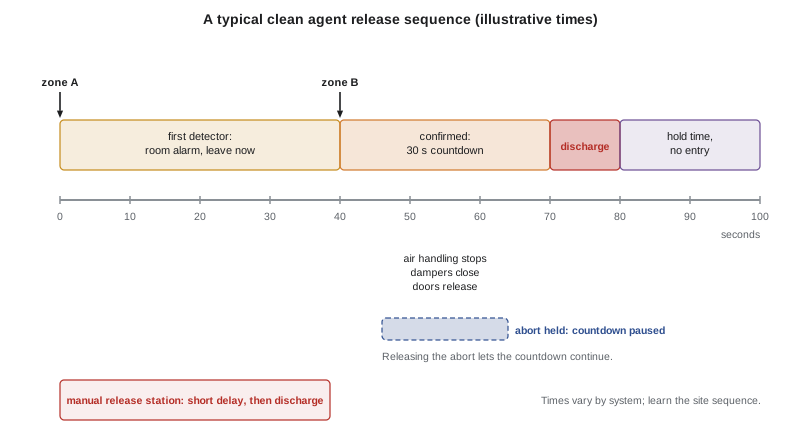
A typical clean agent release sequence in a normally occupied room runs through several stages. The details depend on the design and must be learned for each site, but the pattern is common.
- First detection: the panel goes into alarm for the zone. Horns and strobes sound and flash in and around the room, often with a distinct tone or a voice message for the clean agent room. The monitoring station is notified.
- Second detection (confirmation): the panel starts the pre-discharge sequence. A different alarm tone or message sounds, strobes may change, and a countdown time delay begins, commonly in the range of 30 to 60 seconds, set by design to allow people to leave.
- Pre-discharge actions: during the delay the panel shuts down air handling units that would dilute or remove the agent, closes motorized dampers, releases door hold-open devices, and may shut down power to equipment if the design calls for it.
- Discharge: at the end of the delay, the panel fires the release devices on the agent cylinders. The agent flows through the pipes and out of the nozzles, typically within 10 seconds for halocarbon agents and within about 60 to 120 seconds for inert gases.
- After discharge: a discharge indicator may light outside the door, signs warn against entry, and the agent is held in the room for a design hold time before ventilation, as Lesson 6 explains.
Abort switches
An abort switch, usually a yellow or blue station near the exit, interrupts the countdown. It exists for a situation where staff can see that there is no fire, or that a small fire has already been dealt with, and want to prevent an unnecessary discharge. Abort switches are designed to work only while someone holds them, so that the countdown resumes or restarts if the person lets go or is overcome. The exact behavior, such as whether the countdown resumes from where it paused or restarts from the beginning, depends on the system and how it is programmed, and must be learned for each site.
Abort switches create human factors problems. A person who holds the abort is staying in a room where a fire may be developing and where an agent may still discharge if they let go. Sites usually restrict use of the abort to trained staff who can see the situation clearly, and many train everyone else simply to leave. An abort does not reset the alarm, does not stop the fire, and does not remove the need to call the fire service. It also does not work against a manual release on many systems.
Manual release stations
A manual release station, usually a distinctive station with a cover, allows a person to start the discharge without waiting for automatic detection, for example when a fire is visible but has not yet set off two detectors. Pulling a manual release on most systems starts the pre-discharge alarm and a short or no delay, then discharges the agent, and it often overrides the abort switch. Manual release stations are among the most dangerous controls in a data center for an untrained person, because they look similar to fire alarm pull stations and door release buttons. Accidental discharges have happened when people pressed a manual release thinking it would open a door or call for help.
Good practice includes distinct colors and labels, protective covers, placement where they cannot be mistaken for door controls, and training that shows every person on site what the stations look like. In the HSE-320 site orientation, clean agent controls were one of the items pointed out to every new contractor for this reason.
Pre-action sprinkler sequences
Pre-action sprinkler systems also rely on detection, but in a different way. In a single interlock system, a detection signal opens the pre-action valve and fills the pipes with water; water discharges only when a sprinkler head is heated enough to open. In a double interlock system, two events are needed before water enters the pipes: a detection signal and a drop in pipe air pressure caused by a sprinkler head opening or a pipe breaking. Non-interlock systems admit water on either event. Lesson 7 explains the trade-offs. In both cases, the detection signal that opens or arms the valve usually comes from the same fire alarm system that runs the rest of the building, so detector testing and bypassing can affect the sprinklers too.
What sets off false alarms and releases
Many alarms in data centers are not fires. The most common causes are dust from construction or cleaning, smoke or fumes from hot work, aerosol sprays, vapor from cleaning products, steam or humidification problems, insects, and failed detectors. Very sensitive aspirating systems detect particles that people cannot see. Contractors who cut, grind, drill concrete or remove ceiling tiles can easily set off detectors, and in a cross-zoned clean agent room enough dust can trigger both zones.
Unwanted alarms are not harmless. They cause unnecessary evacuations and fire service responses, they can lead to unwanted discharges, and repeated false alarms teach people to ignore alarms. The control is not to switch detection off casually but to plan dusty work: use dust extraction, cover or isolate specific detectors only under an impairment permit, provide a fire watch where detection is impaired, and restore detection as soon as the work ends.
Testing and putting systems in test
Fire alarm and release systems must be tested regularly, and testing is one of the most common sources of accidental discharge and false alarm. Before testing detectors in a clean agent room, the technician must isolate the release circuit so that an alarm cannot fire the cylinders, notify the monitoring station so that signals are not dispatched to the fire department, and warn people in the area. After testing, every isolation must be removed and the system confirmed back in normal operation. Lesson 8 covers this as part of working safely around suppression systems.
The program below simulates a simplified clean agent release sequence. It processes a list of timed events, including detections and abort switch presses, and prints what the panel would do. The timing values are invented for teaching; real panels have many more states and settings.
# Teaching simulation of a cross-zoned clean agent release sequence.
DELAY = 30     # pre-discharge countdown in seconds (illustrative)

def run(events, title):
    print(title)
    zones, count_start, remaining, abort_held = set(), None, DELAY, False
    for t in range(0, 241):
        for et, kind, arg in events:
            if et != t:
                continue
            if kind == "detect":
                zones.add(arg)
                print(f"  t={t:3}s detector in zone {arg}: " +
                      ("room alarm" if len(zones) == 1 else "CONFIRMED, countdown starts"))
                if len(zones) == 2 and count_start is None:
                    count_start = t
            elif kind == "abort":
                abort_held = arg
                print(f"  t={t:3}s abort {'pressed and held' if arg else 'released'}")
            elif kind == "manual":
                print(f"  t={t:3}s MANUAL RELEASE pulled: abort overridden, short delay")
                count_start, remaining, abort_held = t, 10, False
        if count_start is not None and t > count_start and not abort_held:
            remaining -= 1
            if remaining == 0:
                print(f"  t={t:3}s DISCHARGE")
                return
    print("  no discharge in 240 s")

run([(0, "detect", "A"), (40, "detect", "B")], "Case 1: fire confirmed, room cleared")
run([(0, "detect", "A"), (40, "detect", "B"), (55, "abort", True), (120, "abort", False)],
    "Case 2: abort held while staff check, then released")
run([(0, "detect", "A"), (60, "manual", None)], "Case 3: visible fire, manual release")Case 1: fire confirmed, room cleared t= 0s detector in zone A: room alarm t= 40s detector in zone B: CONFIRMED, countdown starts t= 70s DISCHARGE Case 2: abort held while staff check, then released t= 0s detector in zone A: room alarm t= 40s detector in zone B: CONFIRMED, countdown starts t= 55s abort pressed and held t=120s abort released t=135s DISCHARGE Case 3: visible fire, manual release t= 0s detector in zone A: room alarm t= 60s MANUAL RELEASE pulled: abort overridden, short delay t= 70s DISCHARGE
The second case shows why an abort is not an off switch. The countdown is paused while the switch is held, but it continues as soon as the switch is released, unless the system is reset by a qualified person after the cause has been found. The third case shows how a manual release short-cuts the whole process.
Worked problem
Planning dusty work in a clean agent room
A contractor needs to core-drill two holes through the concrete wall of the Cedar Ridge meet-me room for new conduit. The room has a cross-zoned halocarbon clean agent system and spot smoke detectors. What should happen before, during and after the work?
Show solution
- Before: obtain a hot work or dust-producing work permit and a fire protection impairment permit; have the fire protection contractor place the clean agent release in manual or lockout and isolate only the detectors near the work; notify the monitoring station, the insurer and, if required, the fire department.
- Before: use wet coring or dust extraction, cover nearby equipment, and confirm that the remaining detectors and the manual alarm functions are still active.
- During: post a trained fire watch in the room with a suitable portable extinguisher, and keep the impairment as short as possible.
- After: clean up dust, remove the detector covers or isolations, return the release to automatic, confirm a normal panel display with no supervisory or trouble signals, close the permits and notify everyone who was told of the impairment.
Answer: Dust-producing work in a clean agent room needs a planned impairment with the release locked out and only the necessary detectors isolated, dust control, a fire watch, notifications, and a careful restoration check afterwards.
Common mistakes
MistakeStaying in a clean agent room after the first alarm to see whether a second one follows.
InsteadLeave immediately on any alarm in a clean agent protected room.
MistakeTreating the abort switch as a way to switch the system off.
InsteadUnderstand that an abort only pauses the countdown while held and that a qualified person must reset the system.
MistakePressing an unfamiliar button near a door to open it.
InsteadLearn the appearance and location of manual release stations and door controls at each site.
MistakeIgnoring supervisory signals during busy maintenance periods.
InsteadMatch each supervisory signal to a known impairment and investigate any that are unexplained.
MistakeTesting detectors in a clean agent room without isolating the release circuit.
InsteadIsolate the release, notify the monitoring station and warn occupants before testing.
Summary and key terms
- Data centers combine spot smoke, aspirating, heat, flame and gas detection, often with several thresholds.
- Alarm, supervisory and trouble signals need different responses; supervisory signals often mean a system is impaired.
- Cross-zoning requires two detections before release to reduce false discharges.
- A clean agent sequence runs from first alarm through confirmation, a time delay with shutdowns, discharge and a hold period.
- Abort switches pause the countdown only while held; manual release stations start discharge and often override the abort.
- Pre-action sprinklers use detection to open or arm the valve; double interlock also needs loss of pipe pressure.
- Dust, hot work, aerosols and testing cause many false alarms and accidental releases and must be planned.
- Abort switch
- A control that pauses a clean agent countdown while it is held.
- Aspirating smoke detection
- Detection that draws air through sampling pipes to a sensitive central detector.
- Cross-zoning
- An arrangement requiring detection in two zones before a suppression release.
- Manual release station
- A control that starts a suppression discharge without waiting for automatic detection.
- Pre-discharge alarm
- The distinct alarm and countdown that warn occupants before an agent discharges.
- Supervisory signal
- A signal that a fire protection system is not in its normal operating state.
- Trouble signal
- A signal indicating a fault in the fire alarm system itself.
Practice problems
Work each problem on paper first, then reveal the answer to check.
What is the difference between an alarm signal and a supervisory signal?
Show answer
An alarm indicates fire; a supervisory signal indicates a fire protection system is not in its normal state.
Why are clean agent systems usually cross-zoned?
Show answer
To avoid releases on a single false signal by requiring two independent detections.
What happens during the pre-discharge time delay?
Show answer
Occupants are warned and leave; air handling stops, dampers close, doors release and power may be shut down.
How long does a halocarbon agent typically take to discharge?
Show answer
Within about 10 seconds.
What does an abort switch do, and what does it not do?
Show answer
It pauses the countdown while held; it does not reset the alarm, stop the fire or remove the need to call the fire service.
Why are manual release stations dangerous for untrained people?
Show answer
They can be mistaken for door or alarm controls and start a discharge, often overriding the abort.
In a double interlock pre-action system, what two events are needed before water enters the pipes?
Show answer
A detection signal and a loss of pipe air pressure.
Name three common causes of false alarms in data centers.
Show answer
Any three of: construction dust, hot work smoke, aerosols, cleaning vapors, steam, insects or failed detectors.
What must be done before testing detectors in a clean agent room?
Show answer
Isolate the release circuit, notify the monitoring station and warn occupants.
What should happen to an unexplained supervisory signal?
Show answer
It should be investigated immediately.
Lesson quiz · 5 questions
Score 60% or more to complete this lesson.
Create a free account to save your progress, take quizzes and earn a certificate.