
HSE-323 · Lesson 5 of 12 · 31 min
Clean agent and carbon dioxide discharge hazards
A gaseous suppression system is designed to make a room unable to support fire. Some of the conditions that stop a fire also stop a person from functioning, and a few of them kill. This lesson examines what happens to a person caught in a discharge: the effects of reduced oxygen, the toxic and cardiac effects of halocarbon agents and their decomposition products, the cold, fog and turbulence of the discharge itself, and the very different danger of carbon dioxide. It then covers how to escape, how not to become a second victim, and what first aid involves.
HSE-211, Confined Space Awareness, explains oxygen-deficient atmospheres in general, and HSE-240, Respiratory Protection, explains why air-purifying respirators do not protect against oxygen deficiency. This lesson applies those ideas to suppression discharges. Pressure and noise effects on rooms and equipment are covered in Lesson 6.
Reduced oxygen
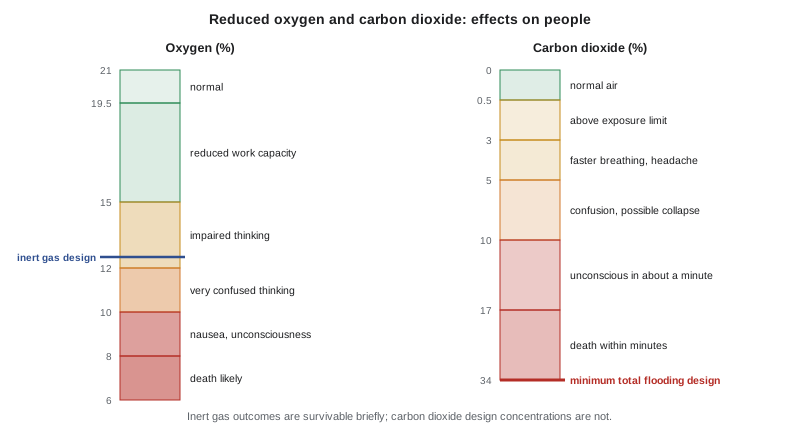
Normal air contains about 20.9 percent oxygen. Many occupational health and safety rules treat an atmosphere below 19.5 percent oxygen as oxygen-deficient, requiring special precautions before entry. The body responds to falling oxygen in stages, and the effects depend on the person's health, their level of exertion, the rate of fall and how long they are exposed. A person exerting themselves, such as someone hurrying to leave a room, uses oxygen faster and is affected sooner.
| Oxygen (percent by volume) | Typical effects on a healthy adult at rest |
|---|---|
| 19.5 to 20.9 | Normal; no effects |
| 15 to 19 | Reduced ability to work hard; early impairment of coordination in some people |
| 12 to 15 | Faster breathing and pulse; impaired attention, judgment and coordination |
| 10 to 12 | Very poor judgment; lips may turn blue; fatigue; possible fainting with exertion |
| 8 to 10 | Nausea and vomiting; unconsciousness possible within minutes |
| Below 8 | Unconsciousness in a short time; death possible within minutes |
| Below about 6 | Collapse within a few breaths; death likely without rescue |
The most dangerous feature of oxygen deficiency is that people do not feel it coming. The body's urge to breathe is driven mainly by carbon dioxide in the blood, not by low oxygen, so a person in a low-oxygen atmosphere may feel normal while their judgment fails. They may continue a task, walk the wrong way or sit down to rest, and then lose consciousness without warning.
Inert gas systems are designed so that, in normally occupied rooms, the oxygen concentration after discharge stays within the range that NFPA 2001 permits for short exposure, typically around 12 to 13 percent for a design concentration of about 38 to 42 percent. At those levels a healthy person should be able to walk out of the room within the permitted time, and the carbon dioxide in IG-541 helps by stimulating breathing. That margin depends on everything going to plan: the correct agent quantity, the correct room volume, a working pressure relief vent and people who leave promptly. A person who stays to finish a task, who is trapped behind equipment, or who is unwell can be at risk even within the design limits.
Halocarbon toxicity and cardiac sensitization
Halocarbon agents do not lower oxygen much at their design concentrations, which are below about 10 percent. Their main toxic effect at high concentration is cardiac sensitization: the agent makes the heart more sensitive to adrenaline, so that a sudden surge of adrenaline, such as in a frightened person running from an alarm, can trigger a dangerous irregular heartbeat. NFPA 2001 limits exposure according to the agent's NOAEL and LOAEL, as Lesson 4 described, and permits use in normally occupied spaces only where the design concentration and expected exposure time are within safe limits.
At design concentrations below the NOAEL, healthy people briefly exposed while leaving the room are not expected to suffer harm. Exposure becomes more serious if the concentration is higher than designed, if a person stays in the room for a long time, or if the person has heart disease. For this reason, NFPA 2001 and good practice require people to leave on the pre-discharge alarm and not to stay in the room after discharge, even where the agent is considered safe for occupied spaces.
Decomposition products
When a halocarbon agent meets flames or very hot surfaces, part of it breaks down. The main decomposition product of the common fluorinated agents is hydrogen fluoride, a highly irritating and toxic gas that forms hydrofluoric acid in contact with moisture. Carbonyl fluoride and other fluorine compounds can also form. The amount depends mainly on the size of the fire when the agent arrives and how long the fire continues in contact with the agent; this is one reason halocarbon systems are designed to detect fires early and discharge within about 10 seconds. A small fire extinguished quickly produces little hydrogen fluoride; a large fire, or a fire that keeps burning because the agent concentration was too low, can produce dangerous amounts.
In any fire, the room atmosphere also contains the products of combustion: carbon monoxide, hydrogen chloride from burning PVC cable, soot and other irritants. Inert gases do not decompose, but the room still contains whatever the fire produced. After any discharge into a real fire, the room must be treated as containing toxic gases, and entry should wait until the fire service or trained staff with appropriate respiratory protection have assessed it, and until the room has been ventilated and tested. Lesson 11 covers re-entry.
Cold, fog and turbulence
The discharge itself is violent. Halocarbon agents are stored as liquids and flash to vapor as they leave the nozzle, absorbing heat; inert gases expand from high pressure and cool as they do. The nozzles and the air near them become very cold, and frost can form on nozzles and pipes. A person close to a nozzle could suffer cold injury to exposed skin or eyes, and touching discharge piping just after a release can cause cold burns.
Halocarbon discharges often produce a dense fog as the cold vapor condenses moisture from the air, reducing visibility to near zero for a short time. A person who has not left before the discharge may be unable to see the exit. The high-velocity gas can blow loose ceiling tiles, paper, labels and light objects around the room; this is why ceiling tiles in protected rooms are clipped down and loose materials are not stored there. The noise of the discharge is very loud, as Lesson 6 explains.
Carbon dioxide: a different order of danger
Carbon dioxide extinguishes fire by reducing oxygen, like the inert gases, but it is not inert in the body. At low concentrations it stimulates breathing; at higher concentrations it is directly toxic, causing headache, dizziness, confusion, loss of consciousness, convulsions and death, quite apart from the reduction in oxygen. The design concentration of a carbon dioxide total flooding system is at least 34 percent for surface fires and much higher for deep-seated fires. These concentrations are lethal within a very short time. A person caught in a carbon dioxide discharge can lose consciousness within a few breaths.
| Carbon dioxide (percent by volume) | Typical effects |
|---|---|
| 0.04 | Normal outdoor air |
| 0.5 | Typical 8-hour occupational exposure limit in many jurisdictions |
| 3 to 4 | Faster, deeper breathing; headache; immediately dangerous to life or health level is 4 percent in US guidance |
| 5 to 7 | Difficult breathing, dizziness, confusion, possible unconsciousness with longer exposure |
| 10 to 15 | Unconsciousness within about a minute or less; convulsions |
| Above about 17 | Rapid loss of consciousness, convulsions and death within minutes |
| 34 and above | Typical total flooding design concentrations: lethal within a very short time |
Carbon dioxide has other dangerous properties. It is about 1.5 times as dense as air, so it flows downward and collects in low places: under raised floors, in pits, trenches, basements, stairwells and cable vaults. It can migrate through openings, ducts and cable penetrations into rooms that are not protected and have no alarms. It is colorless and odorless at the concentrations that kill, so NFPA 12 calls for an odorant in many systems to give a warning, and for signs at entrances to protected and adjacent spaces.
The United States Environmental Protection Agency examined the record of carbon dioxide systems in a 2000 report, Carbon Dioxide as a Fire Suppressant: Examining the Risks. It found records of 51 incidents from 1975 onward involving 72 deaths and 145 injuries, and 11 earlier incidents with 47 deaths, while noting that the records were probably incomplete. Many of the incidents happened during maintenance, testing or work near the systems rather than during fires, often through accidental discharge or through people entering a space before the gas had cleared. Several involved would-be rescuers.
These findings shaped the safety features now required by NFPA 12 for total flooding systems in spaces people can enter: supervised lockout valves that physically prevent discharge into a space while people work in it, pneumatic time delays that hold the discharge for a period after the alarm even if electrical power fails, pre-discharge alarms, odorants and standardized signs. Many older systems were installed before some of these requirements and may lack them, which is one reason inspections of legacy carbon dioxide systems often find serious deficiencies. Cedar Ridge does not allow carbon dioxide total flooding systems in any space a person can enter.
Portable carbon dioxide extinguishers in small rooms
Carbon dioxide extinguishers are common in data centers because they leave no residue on electrical equipment. In a large room, the gas from one extinguisher is quickly diluted. In a small, closed room, such as an electrical closet, a small UPS room or a cylinder room, the concentration can rise to harmful levels. The program below estimates the carbon dioxide and oxygen concentrations after discharging extinguishers of different sizes into closed rooms of different volumes, assuming the gas mixes evenly and none escapes. The assumptions are simple and conservative in one way (no leakage) and optimistic in another (carbon dioxide actually collects near the floor at higher concentration).
# Teaching estimate: CO2 concentration after portable extinguisher discharge
# into a closed room, assuming even mixing and no leakage.
R = 8.314; T = 293.15; P = 101325.0; M = 0.04401   # SI units, 20 degC
def co2_volume_m3(kg):
    return kg / M * R * T / P            # ideal gas volume at room conditions

for room_m3 in (15, 30, 60, 500):
    for kg in (2.3, 4.5, 9.0):           # about 5, 10 and 20 lb extinguishers
        v = co2_volume_m3(kg)
        c = 100 * v / (room_m3 + v)      # percent CO2 after displacing nothing
        o2 = 20.9 * (1 - c / 100)
        flag = "DANGER" if c >= 5 else ("caution" if c >= 3 else "")
print(f"room {room_m3:4} m3, {kg:3.1f} kg CO2: {c:5.1f}% CO2, O2 {o2:4.1f}% {flag}")room 15 m3, 2.3 kg CO2: 7.7% CO2, O2 19.3% DANGER room 15 m3, 4.5 kg CO2: 14.1% CO2, O2 18.0% DANGER room 15 m3, 9.0 kg CO2: 24.7% CO2, O2 15.7% DANGER room 30 m3, 2.3 kg CO2: 4.0% CO2, O2 20.1% caution room 30 m3, 4.5 kg CO2: 7.6% CO2, O2 19.3% DANGER room 30 m3, 9.0 kg CO2: 14.1% CO2, O2 18.0% DANGER room 60 m3, 2.3 kg CO2: 2.1% CO2, O2 20.5% room 60 m3, 4.5 kg CO2: 3.9% CO2, O2 20.1% caution room 60 m3, 9.0 kg CO2: 7.6% CO2, O2 19.3% DANGER room 500 m3, 2.3 kg CO2: 0.3% CO2, O2 20.8% room 500 m3, 4.5 kg CO2: 0.5% CO2, O2 20.8% room 500 m3, 9.0 kg CO2: 1.0% CO2, O2 20.7%
A single 20 lb (9 kg) extinguisher discharged into a closed 530 ft³ (15 m³) room could produce a carbon dioxide concentration well above the level at which people become confused and lose consciousness, and even a 10 lb (4.5 kg) unit produces a dangerous concentration in a small room. The practical rules are to use a carbon dioxide extinguisher from the doorway of a small room where possible, to leave and close the door after use, to ventilate before re-entering, and to prefer clean agent extinguishers for small enclosed spaces. HSE-105 covers extinguisher use in general.
Escaping a discharge
The pre-discharge alarm and time delay are designed to give people time to leave. Whether that time is enough depends on how quickly people react and how far they must travel. Studies of evacuation consistently find that the time before people start to move, called pre-movement time, is often longer than the time they take to walk out, especially if they are absorbed in a task, wearing hearing protection, unfamiliar with the alarm or unsure whether it is real. The program below compares estimated egress time from points in the Cedar Ridge meet-me room with the 30-second pre-discharge delay. The distances and walking speed are invented for teaching.
# Teaching check: egress time vs pre-discharge delay in a protected room.
DELAY_S = 30
WALK_M_S = 1.0           # cautious walking speed in a cluttered room (illustrative)
locations = {  # location: (travel distance to exit in m, pre-movement time in s)
    "cross-connect frame near door": (6, 5),
    "back row, working with hearing protection": (18, 15),
    "inside customer cage (gate must be unlocked)": (16, 25),
    "on a ladder above cable tray": (14, 20),
}
for where, (dist, pre) in locations.items():
    total = pre + dist / WALK_M_S
    margin = DELAY_S - total
    verdict = "out before discharge" if margin > 0 else "STILL INSIDE AT DISCHARGE"
print(f"{where:45} {total:4.0f} s margin {margin:+4.0f} s {verdict}")cross-connect frame near door 11 s margin +19 s out before discharge back row, working with hearing protection 33 s margin -3 s STILL INSIDE AT DISCHARGE inside customer cage (gate must be unlocked) 41 s margin -11 s STILL INSIDE AT DISCHARGE on a ladder above cable tray 34 s margin -4 s STILL INSIDE AT DISCHARGE
The results show that a person wearing hearing protection at the back of the room, working in a locked customer cage or standing on a ladder could still be inside when the agent discharges, even with a 30-second delay. The controls are practical ones: keep egress routes clear, avoid working alone in protected rooms, make sure cage gates can be opened quickly from inside, place the system in manual or lockout when people work in hard-to-leave positions, remove hearing protection when it is not needed so that alarms are heard, and train everyone to move at the first alarm rather than waiting for the second.
Do not become a second victim
In oxygen-deficient atmospheres, would-be rescuers are a large share of the fatalities, and the carbon dioxide incident record includes several. A person who sees a colleague collapse in a room after a discharge will instinctively rush in, and the same atmosphere will overcome them in seconds. The rules are simple and hard to follow under stress: do not enter a room after a discharge to rescue someone unless you are trained and equipped with self-contained breathing apparatus; call the fire service and the site emergency number immediately; tell them the agent involved and that someone is inside; if it can be done from outside, open doors and start any designated post-discharge exhaust; and meet the fire service to guide them.
First aid
Once a person exposed to a discharge has been brought out into fresh air by trained rescuers, first aid follows the general principles taught in HSE-110 and HSE-111: call for emergency medical help, check breathing and circulation, start CPR if the person is not breathing normally, and give oxygen if trained and equipped. Tell the paramedics which agent was involved, the approximate exposure time and whether there was a fire. People exposed to halocarbon decomposition products or fire gases may have delayed lung effects and should be assessed medically even if they feel well. Anyone exposed to a halocarbon agent should avoid adrenaline-type medications unless a physician decides otherwise, because of cardiac sensitization; this is a matter for medical professionals, and the safety data sheet for the agent gives guidance for them.
Worked problem
Responding to a collapse after a discharge
During a night shift at an older site you are visiting, a carbon dioxide system protecting a generator enclosure discharges. A colleague who was inside the enclosure doing a check has not come out, and you can see him lying near the door through the window. What should you do?
Show solution
- Do not enter. The enclosure contains carbon dioxide at a lethal concentration, and you would collapse within a few breaths.
- Call the fire service and the site emergency contact immediately; say that a carbon dioxide system has discharged and a person is down inside.
- Raise the alarm on site and keep others from entering the enclosure and any low areas nearby where gas may flow.
- If the site procedure allows it and it can be done from outside, open the enclosure doors or start the designated exhaust, without leaning into the doorway.
- Meet the firefighters, tell them the agent, the time of discharge and where the person is, and give them drawings or keys as needed. They will enter with breathing apparatus.
Answer: Call for help and keep everyone out; only rescuers with self-contained breathing apparatus should enter. Ventilating from outside, if it can be done safely, and guiding the fire service are the most useful actions.
Common mistakes
MistakeAssuming you would feel short of breath before low oxygen became dangerous.
InsteadKnow that low oxygen impairs judgment without warning and that people may collapse suddenly.
MistakeStaying in a halocarbon-protected room after discharge because the agent is rated for occupied spaces.
InsteadLeave on the pre-discharge alarm and stay out after discharge; decomposition and fire products may be present.
MistakeRushing into a room after a discharge to help someone who has collapsed.
InsteadCall for help and keep out unless trained and equipped with self-contained breathing apparatus.
MistakeDischarging a carbon dioxide extinguisher inside a small closed room and staying there.
InsteadUse it from the doorway where possible, leave, close the door and ventilate before re-entry.
MistakeWorking in a locked cage or on a ladder in a protected room with the system in automatic.
InsteadPlan for slow egress: clear routes, quick-release gates, and manual or lockout mode when egress is difficult.
Summary and key terms
- Below 19.5 percent oxygen is oxygen-deficient; effects worsen through impaired judgment to unconsciousness and death, often without warning.
- Inert gas designs leave about 12 to 13 percent oxygen, survivable for a short exposure if people leave promptly.
- Halocarbons can cause cardiac sensitization at high concentrations and decompose to hydrogen fluoride in fires.
- Discharges are cold, foggy, turbulent and loud; loose tiles and objects can be blown around.
- Carbon dioxide is toxic as well as asphyxiating; design concentrations of 34 percent or more are lethal within a short time.
- The EPA documented 72 deaths and 145 injuries from carbon dioxide systems from 1975 onward, many during maintenance and rescue attempts.
- Leave at the first alarm, never enter to rescue without breathing apparatus, and tell responders which agent was involved.
- Cardiac sensitization
- Increased sensitivity of the heart to adrenaline, which can cause dangerous arrhythmias.
- Decomposition products
- Substances such as hydrogen fluoride formed when a halocarbon agent is exposed to flame or hot surfaces.
- Hypoxia
- A shortage of oxygen reaching the body tissues.
- Lockout valve
- A supervised valve that physically prevents agent from discharging into a protected space.
- Oxygen-deficient atmosphere
- An atmosphere with less than 19.5 percent oxygen under many OHS rules.
- Pneumatic time delay
- A device that holds a carbon dioxide discharge for a set time using gas pressure, independent of electrical power.
- Pre-movement time
- The time between an alarm and the moment a person starts to move toward an exit.
Practice problems
Work each problem on paper first, then reveal the answer to check.
Why do people often fail to notice oxygen deficiency?
Show answer
The urge to breathe is driven mainly by carbon dioxide, not low oxygen, so judgment fails without a warning sensation.
Roughly what oxygen level remains after a typical inert gas discharge in an occupied room?
Show answer
About 12 to 13 percent.
What is the main decomposition product of fluorinated halocarbon agents?
Show answer
Hydrogen fluoride.
What factor most affects the amount of decomposition products?
Show answer
The size of the fire when the agent arrives and how long it burns in contact with the agent.
Why are ceiling tiles clipped in clean agent rooms?
Show answer
Because the discharge turbulence can blow loose tiles and objects around the room.
What is the minimum carbon dioxide design concentration for surface fires?
Show answer
34 percent.
Why does carbon dioxide collect under raised floors and in pits?
Show answer
It is about 1.5 times as dense as air.
What did the EPA 2000 report find for incidents from 1975 onward?
Show answer
51 incidents with 72 deaths and 145 injuries.
Name three NFPA 12 safety features for carbon dioxide systems in enterable spaces.
Show answer
Supervised lockout valves, pneumatic time delays, pre-discharge alarms, odorants and signs (any three).
What should you do if a colleague collapses in a room after a discharge?
Show answer
Do not enter; call the fire service and emergency contact, keep others out, ventilate from outside if safe and guide responders.
Lesson quiz · 5 questions
Score 60% or more to complete this lesson.
Create a free account to save your progress, take quizzes and earn a certificate.